

You are here

publications

Together We Can Cool the Planet

By Eugenia Izquierdo and IvanZigarán - La Via Campesina and GRAIN - December 2016

Based on the video Together we can cool the planet! co-produced by La Vía Campesina and GRAIN in 2015, we have created a comic book to support training activities of social movements and civil society organisations around climate change. This comic book looks at how the industrial food system impacts our climate and also explains what we can do to change course and start cooling the planet.
La Via Campesina and GRAIN have pointed out that the industrial food system is responsible for half of all greenhouse gas emissions. In the Americas, Asia, Europe and Africa, we have been denouncing the false solutions to climate change such as GMOs, the “green economy” and "climate-smart agriculture".

We say loud and clear: it is peasants and small farmers, along with consumers who choose agroecological products from local markets, who hold the solution to the climate crisis.

We must all rise to the challenge!

Read the report (PDF).

Watch the video, too:

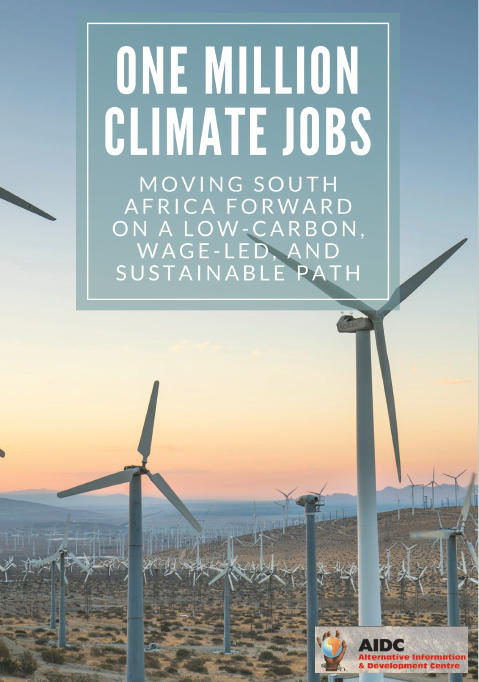
One Million Climate Jobs: Moving South Africa Forward on a Low-Carbon, Wage-Led, and Sustainable Path

By Brian Ashley, et. al. - One Million Climate Jobs - December 2016

The One Million Climate Jobs Campaign is an alliance of labour, social movements and popular organisations in South Africa that is campaigning for the creation of a million climate jobs as part of a collective approach to the crisis of unemployment and climate change. The Campaign was launched in 2011 and since then has been mobilising thousands of South Africans around real solutions to slowing down climate change, protecting the natural environment, improving the quality of life for all and moving towards a sustainable development path. Climate change will exacerbate inequality and poverty because it reduces access to food, water, energy and housing. Thus it is vital that social justice struggles around these issues incorporate struggles around climate change.

This booklet is a follow-up, six years later, to the first booklet that was produced in 2011. It is based on well- researched solutions for how South Africa can immediately begin a just transition, away from the Minerals-Energy Complex that continues to dominate the South African capitalist economy, to a low carbon economy in which the basic needs of communities are met in an equitable, sustainable and affordable way.

It recognizes that in these six years there have been many developments – for instance, renewable energy is now firmly established as part of the energy mix (although still a minor part); retrofitting buildings, and the development of environmentally friendly construction methods, is being developed, and the Rapid Bus Transit system is being slowly implemented in some municipalities.

But most of these solutions are being pursued within the logic of the market. It is not possible, we would argue, within these market parameters, to respond adequately to the enormous challenges facing us – what is needed is a publicly-driven solution for the shift to a sustainable, low-carbon future. The research that this booklet is based on begins to set out what such a transition could look like. We hope that it will be an important contribution to the ongoing work of building a political movement to struggle around these issues.

Download (PDF).

Transformative Climate Communities: Community Vision And Principles For A Successful Program

By staff - California Environmental Justice Alliance, December 2016

Transformative Climate Communities (TCC) is a groundbreaking new program that will develop comprehensive, cross-cutting, and transformative climate investments at a neighborhood scale to achieve multiple greenhouse gas, public health and economic benefits in our state’s most vulnerable communities. CEJA is deeply engaged in the implementation and working with our members to ensure the program truly meets community needs through a strong, transparent, and community-led process.

In our new report, Transformative Climate Communities: Community Vision And Principles For A Successful Program, we draw from CEJA’s members, partners, and allies to provide a snapshot of what TCC could look like in both urban and rural environmental justice neighborhoods across California. From transforming the goods movement in San Bernardino to comprehensive land use planning in Fresno, the wide range of community-led plans for place-based transformation are all grounded in an integrated, collaborative approach to reducing climate change while comprehensively addressing a legacy of environmental pollution and disinvestment in the most highly impacted communities.

The TCC program can help community-based organizations in crafting sustainability plans and leverage existing ones that address long-standing environmental health and justice challenges, while catalyzing equitable economic development at the neighborhood level. The program will achieve this by awarding large grants to develop and implement neighborhood-level climate sustainability plans drawing from deep resident engagement and in partnership with other important stakeholders.

In order to ensure the long-term successful implementation of the program, we lay out the key principles of the Transformative Climate Communities program in our report:

  1. Direct and extensive community engagement
  2. Equity for most impacted residents
  3. Multiple, integrated benefits
  4. Showcase equitable, sustainable land use planning
  5. Catalytic, leveraged investments
  6. Investment without displacement
  7. Creating a pipeline of communities

In addition, we provide some of the indicators for environmental, health, socioeconomic, community and political transformation that can be achieved though comprehensive, cross-cutting climate investments from the TCC.

CEJA’s work on the TCC program grows out of our Green Zones Initiative, where we recognized early on that in order for place-based models to be successful, communities need to have the power to guide development and investments. Green Zones require closely coordinated and leveraged public spending targeted to our most overburdened communities, with deep resident engagement to direct investment. The Transformative Climate Communities program is this vision come to life.

Through its community-level planning and investments, the TCC program can help to achieve a just transition away from inequitable and polluting development patterns that have plagued so many communities. It can help us maintain California’s global climate leadership and move us toward a new future that weaves together environmental and climate sustainability, economic opportunities, and strengthened local democracies.

Download PDF Here.

Reclaiming Alberta’s Future Today

By Regan Boychuk and Brent O’Neil - Reclaiming Alberta’s Future Today, November 3, 2016

As the first step towards reducing Alberta’s dependence on fossil fuels as our primary source of income we must embrace our current environmental deficit. We must admit that climate change is real and that man-made contributions to global warming can be reduced.

After 100 years of exploration we must acknowledge that our provinces conventional oil and gas resources have been depleted. Technically speaking our low hanging fruit has been plucked and what is left is 444,000 oil and gas wells, 430,000 km of pipe lines (the distance to the moon is 384,000 km), 30,000 oil and gas facilities, 900 km of oil sands development, 220 km of tailing ponds, and a 11.2 million ton sulfur pile that dwarfs the great pyramids of Egypt.

Tackling this shameful legacy will be the biggest environmental cleanup project undertaken to date. It will take 1000 rigs 50 years and every willing Canadian to clean up our mess. This change in industry requires a paradigm shift in thinking. Our province no longer see the economic benefit from drilling new conventional oil wells as it once did. The real opportunity for Albertans will come from cleaning up our mess.

No longer can we tackle climate change with taxes and levy’s. We need to start making a real reduction in man-made emissions so our future generations have the same opportunities we once did.

Read the report (PDF).

The Role of Labour in the Fight Against Climate Change

By Asbjørn Wahl - International Transport Workers Federation (ITF), (hosted by Trade Unions for Energy Democracy) November 2016

The climate crisis is steadily coming closer. At the same time, we face a deepening economic crisis, as well as social and political crises. This creates an increasingly serious situation for the future of humanity.

However, given that the various crises have many of the same root causes, going to the core of our economic system, this can contribute to strengthening the mobilisation of social forces needed to break the current trend-–in favour of a democratic and planned development of society.

Action to combat dramatic climate change will require major societal transformation. In other words, we have an all-out battle on our hands over how to organise society. Solutions to the climate crisis do exist. We have most of what is required in terms of technology, knowledge, and competence to avert a climate disaster. It is the power to translate words into action that will pose the greatest challenge.

Since economic growth and ruthless exploitation of natural resources are embedded parts of a capitalist economy–indeed, any capitalism without growth is a capitalism in crisis-–a narrow focus on individual issues of environmental policy will not suffice. Nor will we be able to combat the climate crisis by making individual choices. A system critical approach is needed. We need democratic control of the economy. This means that we are not only faced with a threat, but also an opportunity-–an opportunity, not just to prevent a climate catastrophe, but also to fight the economic and social crises which are currently eroding and threatening the living conditions of millions upon millions of people. In particular, this also provides us with a foundation upon which to build extensive social alliances in search of a different kind of society.

Read the report (PDF).

Job Growth in Clean Energy: Employment in Alberta’s emerging renewables and energy efficiency sectors

By Binnu Jeyakumar - Pembina Institute, November 2016

Alberta has a meaningful plan to enable the growth of a clean energy industry, with commitment to 30% of electricity generated by renewable sources by 2030, and phasing out pollution from coal-fired generation. A portion of the anticipated revenues from the province’s economy-wide carbon levy will be used to enable these efforts. This provides a great opportunity for sustainable employment growth in the clean energy sector. This is in line with the global trends of declining investment and employment in the coal industry, while investment and employment in the renewable sector expands.

The Pembina Institute has conducted an analysis of the employment potential in the renewable energy and energy efficiency sectors in Alberta. Data was collected through literature reviews and from organizations involved in development of projects. The analysis used conservative estimates where there was uncertainty. The results are nevertheless encouraging and paint a positive picture for Albertans.

  • In Alberta, investing in renewable sources of electricity and energy efficiencyalone would generate more jobs than those lost through the retirement of coalpower ( Figure 1).
  • With a high and sustained pace of renewables growth, there are sustained levelsof employment for those engaged in related equipment installations.
  • Additional investment in community energy can increase the employmentpotential by 30-50%.
  • Long-term investments in modernizing infrastructure, the grid and ourelectricity system will result in further job creation with a wide diversity of skills,and in fields that are likely to see sustained growth.

Read the report (Link).

The Chevron Way: Polluting California and Degrading California

By various - International Transport Federation, et. al., November 2016

In the recent election, Chevron-backed campaigns lost bigtime, despite the $61 million the company has spent to influence California elections since 2009. That’s far more than any other oil company spend in state elections. The report, by the International Transport Workers Federation, was released Nov. 17 at the Chevron gates by a coalition including the Richmond Progressive Alliance (RPA), Alliance of Californians for Community Empowerment (ACCE), Communities for a Better Environment (CBE), and more.

Members of the coalition said the report, The Chevron Way: Polluting California and Degrading Democracy, will educate the public about the corrupting influence of corporate money and alert politicians that they will be judged on whether they act in the public interest or in Chevron’s interest.

In this election, in State Assembly and State Senate races, candidates heavily backed by Chevron lost. In Monterey County, Chevron spent $1.5 to oppose a ballot measure to ban fracking and expanded oil drilling. Despite being outspent 33 to 1, the measure passed.

In Richmond, Chevron sat out this election, having spent $3 million in the last election, when its candidates lost anyway. This year, two additional progressive candidates won seats on the city council and a longstanding Chevron candidate was voted out.

Chevron makes billions in profits from its huge retail and refining business in California, but has aggressively cut tax payments to federal, state and local governments. In 2015, the company paid no net income tax in the US, but instead banked nearly $1.7 billion in tax credits.

In 2015, Chevron had over $45 billion stashed in offshore accounts, including the company’s 211 active Bermuda subsidiaries, and the company’s global effective tax rate fell to below 3%.

Read the report (PDF).

Sharing the challenges and opportunities of a clean energy economy: Policy discussion paper A Just Transition for coal-fired electricity sector workers and communities

By staff - Australian Council of Trade Unions - November 2016

The ACTU is primarily concerned with workers, their rights, their welfare and their future. A just and civil society is one where everyone shares in the wealth of the nation but it is also one where economic costs are equally shared.

Transitioning an industry is a massive economic and social disruption. History shows that this has often been done poorly in Australia, with workers and communities bearing the brunt of such transitions - suffering hardship, unemployment and generations of economic and social depression.

Research in the textiles, clothing and footwear (TCF) and car manufacturing industries shows, for example, that only one third of workers find equivalent full time work following their retrenchment, while one third move into lower quality jobs (lower wage, lower job status or into part-time and casual work) and one third are locked out of the labour force altogether.

International experience however shows that a transition can be done equitably, achieve positive outcomes for workers, save communities and forge new areas of industrial growth and prosperity.

Australia is currently facing one such transition in the coal-fired electricity sector. If Australia manages this transition well, the nation would have a structured and equitable approach that could apply to any industry undergoing similar change in the future.

At last year’s Paris climate conference, Australia alongside 194 countries, committed to limit global warming to less than 2°C above pre-industrial levels. As part of this historic agreement, unions successfully achieved recognition of the need for a ‘Just Transition’ that supports the most affected workers obtain new decent and secure jobs in a clean energy economy.

While Australia’s international obligations will require a range of complementary policies that focus on emission reduction across a number of sectors of the economy, as the largest contributor to Australia’s emissions, effective reform of the electricity sector has been identified as a key step in tackling climate change.

Download (PDF).

Just transition of the workforce, and the creation of decent work and quality jobs

By secretariat - United Nations, October 26, 2016

This technical paper provides an overview of the work undertaken under the Convention on a just transition of the workforce, and the creation of decent work and quality jobs (hereinafter referred to as just transition) in the context of the impact of the implementation of response measures. The paper also presents the general concept of just transition, including the drivers and objectives of such transitions, andthen discusses the linkages between just transition and the impacts of the implementation of climate change mitigation policies. It also provides guidance on how to approach just transition at the national level. This technical paper draws upon relevant information contained in:

  • (1) reports on the work of the forum on the impact of the implementation of response measures, as well as submissions, presentations and statements made by Parties and observer organizations during previous sessions of the Conference of the Parties and the subsidiary bodies from 2008 to 2015;
  • (2) national inventory reports, national communications, biennial reports and biennial update reports submitted by Parties;
  • (3) publications by experts, international organizations and research institutes; and
  • (4) inputs from the International Labour Organization

Read the report (PDF).

Climate Emergency: Global Insurgency

By Jeremy Brecher - Common Dreams, October 14, 2016

Note: The new, updated 2016 edition of Jeremy Brecher’s Climate Insurgency: A Strategy for Survival, from which the following is drawn, can be now be downloaded for free at the author's website here.)

The Lilliputian defenders of the earth’s climate have been winning some unlikely battles lately. The Standing Rock Sioux, supported by nearly two hundred Native American tribes and a lot of other people around the globe, have put a halt, at least for now, to completion of the Dakota Access Pipeline, a project that threatens their sacred burial sites and the water supply for 17 million people—not to mention the world’s climate. Before that a seven-year struggle terminated the Keystone XL pipeline. Other fossil fuel extraction, transport, and burning facilities have been halted by actions around the world.

But as Bill McKibben has said, "Fighting one pipeline at a time, the industry will eventually prevail."[1] Is there a plausible strategy for escalating today’s campaigns against fossil fuel infrastructure to create an effective challenge to the escalating climate threat? How can we get the power we need to counter climate catastrophe? My book Climate Insurgency: A Strategy for Survival (download) grapples with that question and proposes a possible strategy: a global nonviolent constitutional insurgency. Now that strategy is being tried – and may even be overcoming some of the obstacles that have foiled climate protection heretofore.

Pages

The Fine Print I:

Disclaimer: The views expressed on this site are not the official position of the IWW (or even the IWW’s EUC) unless otherwise indicated and do not necessarily represent the views of anyone but the author’s, nor should it be assumed that any of these authors automatically support the IWW or endorse any of its positions.

Further: the inclusion of a link on our site (other than the link to the main IWW site) does not imply endorsement by or an alliance with the IWW. These sites have been chosen by our members due to their perceived relevance to the IWW EUC and are included here for informational purposes only. If you have any suggestions or comments on any of the links included (or not included) above, please contact us.

The Fine Print II:

Fair Use Notice: The material on this site is provided for educational and informational purposes. It may contain copyrighted material the use of which has not always been specifically authorized by the copyright owner. It is being made available in an effort to advance the understanding of scientific, environmental, economic, social justice and human rights issues etc.

It is believed that this constitutes a 'fair use' of any such copyrighted material as provided for in section 107 of the US Copyright Law. In accordance with Title 17 U.S.C. Section 107, the material on this site is distributed without profit to those who have an interest in using the included information for research and educational purposes. If you wish to use copyrighted material from this site for purposes of your own that go beyond 'fair use', you must obtain permission from the copyright owner. The information on this site does not constitute legal or technical advice.
