You are here

capital blight

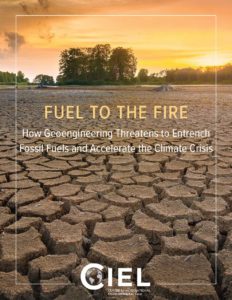
Fuel to the Fire: How Geoengineering Threatens to Enrich Fossil Fuels and Accelerate the Climate Crisis

By Carroll Muffett and Steven Felt - Center for International Environmental Law, February 2019

The present report investigates the early, ongoing, and often surprising role of the fossil fuel industry in developing, patenting, and promoting key geoengineering technologies. It examines how the most heavily promoted strategies for carbon dioxide removal and solar radiation modification depend on the continued production and combustion of carbon-intensive fuels for their viability.

It analyzes how the hypothetical promise of future geoengineering is already being used by major fossil fuel producers to justify the continued production and use of oil, gas, and coal for decades to come. It exposes the stark contrast between the emerging narrative that geoengineering is a morally necessary adjunct to dramatic climate action, and the commercial arguments of key proponents that geoengineering is simply a way of avoiding or reducing the need for true systemic change, even as converging science and technologies demonstrate that shift is both urgently needed and increasingly feasible. Finally, it highlights the growing incoherence of advocating for reliance on speculative and risky geoengineering technologies in the face of mounting evidence that addressing the climate crisis is less about technology than about political will.

Read the report (Link).

Beyond the Nation State: A Critical Look at Venezuela’s Current Crisis

By Brooke Anderson and Mateo Nube - Movement Generation, February 2019

Venezuela has made headlines in the last few weeks, as Venezuelan opposition leader and National Assembly head Juan Guaidó has declared himself interim President, throwing the country into turmoil. Current President, Nicolás Maduro has called the effort a coup. Meanwhile, thousands of people have taken to the streets on both sides, with a death toll of 26 and rising. The Trump administration, many Western European countries, and the right-leaning bloc of Latin American governments have recognized Guaidó as the legitimate president of Venezuela.  Meanwhile Russia, China and others are backing Maduro. A third bloc, most notably Mexico and Uruguay, are calling for a peaceful transition through new elections.

I recently sat down with my co-worker Mateo Nube, collective member of the Movement Generation Justice & Ecology Project, for more political and economic context to the current crisis. In the interview, Nube unpacks the history and promise of the Bolivarian Revolution in Venezuela and beyond; the roots and early warning signs of the authoritarianism we’re now seeing play out in Venezuela; the lost opportunity for Venezuela to leverage its oil money wealth toward a just transition away from extractivism and toward a regenerative economy; and the dangers of U.S. interventionism in the conflict.

Brooke Anderson: Your family came up under dictatorships in both Venezuela and Bolivia, so this is personal for you. Give us some context to how you come to the question of Venezuela.

Mateo Nube: My family has roots in Venezuela. We originally  fled the Holocaust in the 30’s and 40’s and settled in Caracas [Venezuela] from Berlin. My mom grew up under Marcos Pérez Jiménez, the military dictatorship that really marked and traumatized Venezuelans. In turn, I was born in Bolivia in 1971 and spent the first 10 years of my life under military dictatorship there. So I’m politically steeped in resisting military authoritarianism and building social movements to not only overthrow the military but to redistribute wealth and power. So the Venezuelan context really marked my family and informed my political orientation.

So the Venezuelan context really marked my family and informed my political orientation.

Brooke Anderson: What’s actually happening on the ground in Venezuela right now?

Mateo Nube: The situation in Venezuela right now is dire and painful to witness. It is a mixture of a political, economic, and humanitarian crisis. The man who is controlling the state of Venezuela is Nicolás Maduro. He is the successor of Hugo Chávez, who led the Bolivarian Revolution for the last two decades, prior to his death in 2013. Maduro is currently facing a challenge from Juan Guaidó, the current head of the National Assembly. Guaidó is arguing that Maduro is not a legitimate President and that the constitution dictates that he, Guaidó, is the next in line. This contestation coming from the opposition is largely the right wing.

Neither of these leaders has tremendous legitimacy. There are two men (representing two political factions) who are calling themselves President of Venezuela. They are both claiming power in a way that disrespects the constitutional process of Venezuela. We can definitely call Guaidó’s move an attempted coup and unconstitutional. If we do, we also have to recognize that Maduro won the 2018 elections after banning the main opposition leader, Henrique Capriles, and multiple opposition parties from running and dissolved the opposition-controlled National Assembly in March 2017 through a stacked Supreme Court. If a right-wing political party had made these moves, we would have loudly denounced them.

Banking on Climate Change: Fossil Fuel Finance Report 2020

By Alison Kirsch, et. al. - Rainforest Action Network, et. al., January 2019

Financial companies are increasingly being recognized — by their clients, shareholders, regulators, and the general public — as climate actors, with a responsibility to mitigate their climate impact. For the banks highlighted in this report, the last year has brought a groundswell of activism demanding banks cut their fossil fuel financing, at the same time that increasingly extreme weather events have further underscored the urgency of the climate crisis.

This report maps out case studies where bank financing for fossil fuels has real impact on communities — from a planned coal mine expansion in Poland, to fracking in Argentina, to LNG terminals proposed for South Texas. Short essays throughout highlight additional key topics, such as the need for banks to measure and phase out their climate impact (not just risk) and what Paris alignment means for banks. Traditional Indigenous knowledge is presented as an alternative paradigm for a world increasingly beset with climate chaos. November’s U.N. climate conference in Glasgow, on the fifth anniversary of the adoption of the landmark Paris climate agreement, will be a crucial deadline for banks to align their policies and practices with a 1.5° Celsius world in which human rights are fully respected. The urgency of that task is underlined by this report’s findings that major global banks’ fossil financing has increased each year since Paris, and that even the best future-facing policies leave huge gaps.

Read the report (PDF).

Drilling Towards Disaster: Why US Oil and Gas Expansion is Incompatible With Climate Limits

By Kelly Trout and Lorne Stockman - Oil Change International, et. al., January 2019

World governments, including the United States, committed in 2015 in the Paris Agreement to pursue efforts to limit global average temperature rise to 1.5 degrees Celsius above pre-industrial levels and, at a maximum, to keep warming well below 2 degrees Celsius (°C). This report is part of The Sky’s Limit series by Oil Change International examining why governments must stop the expansion of fossil fuel production and manage its decline – in tandem with addressing fossil fuel consumption – to fulfill this commitment.

The global Sky’s Limit report, released in 2016, found that the world’s existing oil and gas fields and coal mines contain more than enough carbon to push the world beyond the Paris Agreement’s temperature limits. This finding indicates that exploring for and developing new fossil fuel reserves is incompatible with the Paris goals. In fact, some already-operating fields and mines will need to be phased out ahead of schedule.

Since the global Sky’s Limit report in 2016, new scientific evidence has added urgency to this call for a managed decline of fossil fuel production. The latest report from the Intergovernmental Panel on Climate Change warns that reaching 2°C of warming would significantly increase the odds of severe, potentially irreversible impacts to human and natural systems, compared to limiting warming to 1.5°C. The difference could be the wipeout or resilience of whole communities and ecosystems. The report underscores that a 1.5°C path is possible but will require “rapid and far- reaching” transitions and “deep emissions reductions in all sectors” so that carbon pollution nears zero by 2050.

Unfortunately, existing climate measures aren’t cutting it – literally. Current national policy pledges under the Paris Agreement would put the world on course for 2.4 to 3.8°C of warming, a catastrophic outcome.

This glaring gap in ambition has been driven in part by a systemic policy omission. Over the past three decades, climate policies have primarily focused on addressing emissions where they exit the smokestack or tailpipe. Meanwhile, they have largely left the source of those emissions – the oil, gas, and coal extracted by fossil fuel companies – to the vagaries of the market.

Basic economics tells us that the consumption of any product is shaped by both supply and demand. It follows that reducing supply and demand together, or ‘cutting with both arms of the scissors,’ais the most efficient and effective way to reduce a harmful output. Putting limits on fossil fuel extraction – or ‘keeping it in the ground’ – is a core yet underutilized lever for accelerating climate action.

Curbing the supply of fossil fuels does not mean turning off the taps overnight. Rather, it means stopping new projects that would lock in new pollution for the coming decades. It means managing an orderly and equitable wind-down of existing fossil fuel infrastructure and extraction projects within climate limits. It makes it possible to plan for a just transition for workers and communities.

If the world is to succeed in meeting the Paris goals, this type of comprehensive and clear-eyed approach is urgently needed everywhere, and particularly in the United States – one of the world’s top producers and users of fossil fuels.

Read the report (PDF).

Responsible Minerals Sourcing for Renewable Energy

By Elsa Dominish, Sven Teske, and Nick Florin - Institute for Sustainable Futures, 2019

The transition to a 100% renewable energy system is urgently needed to meet the goals of the Paris Climate Agreement and increase the chance of keeping global temperature rise below 1.5 degrees. Renewable energy technologies are now the most cost competitive technologies for new installations – and recent investment in new renewable energy infrastructure globally has been double that of new energy investment in fossil fuels and nuclear.

Renewable energy technologies, electric vehicles and battery storage require high volumes of environmentally sensitive materials. The supply chains for these materials and technologies need to be appropriately managed, to avoid creating new adverse social and environmental impacts along the supply chain.

This report presents the findings of an assessment of the projected mineral demand for fourteen metals used in renewable energy and storage technologies, the potential to reduce demand through efficiency and recycling, and the associated supply risks and impacts. Solar photovoltaic (PV) and wind power have been chosen for this assessment because these two technologies make up the majority of new global renewable electricity installations. Batteries have been assessed because of their importance for use in electric vehicles (EVs) and energy storage systems.

This research aims to identify the main ‘hotspots’ or areas of concern in the supply chain, including technologies, metals and locations, where opportunities to reduce demand and influence responsible sourcing initiatives will be most needed.

Read the report (PDF).

Protect the Sperrins From Pollution and Profit

By Derry IWW - (via facebook post), November 17, 2018

Earlier today members of the Industrial Workers of the World have taken a delegation of local activists to visit the Greencastle Peoples Office (GPO) in the heart of the Sperrin Mountains where the community continues to oppose the destruction of their environment by multinational Dalradian Gold Ltd.

Last week, several hundred people rallied at the site in solidarity and support with the ongoing campaign. The size of the demonstration clearly showed the extent of anger felt within the community and beyond at the activities of Dalradian Gold in the area. For the past number of years residents in the village of Greencastle, county Tyrone have continuously objected to any development of a gold-mining processing plant in the Sperrin Mountains due to the huge catastrophic impact which it will have on the environment and the health of people throughout the North West.

Following today’s visit, a spokesperson for the IWW said, “Today was a chance for activists to learn first-hand of what the Greencastle community are facing and have faced over the past number of years and the impact gold-mining will have on all of us. We wanted to show our solidarity with residents who have set up the GPO protest camp at the site of the proposed Dalradian Gold mine.

“Following on from today’s visit we would urge the wider trade union movement to acknowledge the destructive consequences of gold mining within a location such as the Sperrins, an area of outstanding natural beauty, as well as the impact it will have upon the lives and health of our communities throughout the entire North West for future generations.

Confronting the Carbon Capitalists

By Seattle IWW - It's Going Down, November 14, 2018

Last summer brought another record wildfire season to the Pacific Northwest. Smoky air from fires in the region caused hellish air quality around the entire Northern Hemisphere. The causes of the forest fires and the destruction of our forest ecosystem generally are incontrovertible. Over one hundred years of fossil-fueled capitalist development and hundreds of years of violent colonial oppression–of people and the biological world–have driven the Earth to the brink.

Northwest forests, once some of the most biodiverse regions on Earth, have been clear-cut and laden with biocides. Complex interrelationships have been smashed with saws and machinery to make way for monoculture “working forests” devoid of biodiversity. Decades of fire suppression by the Forest Service on behalf of timber companies have left trees to grow on each other like matchsticks waiting to be lit.

In the face of all of this, liberals, true to form, have resorted to self-flagellation and hand-wringing. The New York Times Magazine’s recent piece, “Losing Earth: The Decade We Almost Stopped Climate Change” by Nathaniel Rich, places the blame of climate change and ecocide squarely at the foot of an undefined human nature. The author mostly chronicles failed climate negotiations between nation-states at the United Nations.

In his telling, we were so close to breakthroughs, but then greedy human nature stopped everything. Our collective desire for more stuff led to the failure of negotiations being made in good faith between nations. There is no other possible direction for history to have unfolded. Or so the story goes.

International diplomacy’s climate failures are a failure of all humans in the eyes of the liberal elite like Rich. That a nation-state would act counter to the will of its subjects is unthinkable to the privileged classes.

The victims of colonialism and capitalism have always known otherwise. At the same time “human nature” was failing to protect the earth in UN meeting halls, working-class people were mobilizing against extractive industry in Northern California and being targeted for assassination. Indigenous peoples around the world were suffering from state violence for fighting against the very oil drilling that state officials said they were trying to curb. Everywhere the triplet monsters–capitalism, colonialism, and patriarchy–tread, organized resistance by the oppressed fought back. Contrary to the pearl-clutching lament that “human nature led to this,” water protectors, land defenders, and workers have laid their bodies in front of the machinery of extractive capitalism countless times. And this is nothing new.

Death on the Dakota Access: Oil & Gas Boom Generates Dangerous Pipeline Jobs Amid Lax Regulations

Antonia Juhasz interviewed by Amy Goodman - Democracy Now!, September 12, 2018

AMY GOODMAN: We are broadcasting from San Francisco, the site of this week’s Global Climate Action Summit. I’m Amy Goodman. Thousands, tens of thousands of people marched here in San Francisco Saturday to demand action on climate, jobs and justice, as they kicked off the Rise Against Climate Capitalism conference, a counter-conference to California Governor Jerry Brown’s Global Climate Action Summit.

Today the conference will highlight the common goals of climate activists and labor. That’s also the focus of an explosive new report headlined “Death on the Dakota Access: An investigation into the deadly business of building oil and gas pipelines,” published today in the Pacific Standard magazine. It looks at the deaths of two men who worked on DAPL—that’s the Dakota Access pipeline—and the massive oil and natural gas boom that’s generated some of the deadliest jobs in the country.

For more, we’re joined by the report’s author, Antonia Juhasz, longtime oil and energy journalist. Her books include Black Tide: The Devastating Impact of the Gulf Oil Spill and The Tyranny of Oil: The World’s Most Powerful Industry—and What We Must Do to Stop It.

Welcome back to Democracy Now! It’s great to have you with us, Antonia.

ANTONIA JUHASZ: Thanks for having me, Amy.

AMY GOODMAN: So talk about why you began this piece, why you started this investigation, “Death on the Dakota Access.”

ANTONIA JUHASZ: Yeah, I’d been covering Standing Rock for some time, and I was actually doing an interview with LaDonna Brave Bull Allard in Standing Rock, and she told me that back in 2014 when she first learned of Dakota Access pipeline, she knew she was going to oppose it. And the reason why, she told me, was, “No one is going to build an oil pipeline over my son’s grave,” because of how close it would pass to where her son was buried.

That death got me to thinking about the pipeline itself as a source of injury and harm and death, not just spills that might come from it, and have, or leaks, or where it was being built, but then the people involved in building it. And I started looking at construction and learned of the death of a young man who was building the Dakota Access pipeline, Nicholas Janesich, 27 years old, and his death was reported by the AP.

I started to dig into what had happened to him, and as I started doing that investigating, I learned that just three days later, at the opposite end of the pipeline, another worker building the Dakota Access pipeline had died during construction. So then I said, “I need to learn more about oil and gas pipeline construction,” and went to the Bureau of Labor Statistics to look at fatality rate data, because I had already learned that the drilling of oil and natural gas, so the extraction workers, has been found to be one of the deadliest jobs in America, with fatality rates as high as seven times the national average. So I went to see what were the fatality rates for oil and gas pipeline construction workers, only to learn that they had never been run. The Bureau of Labor Statistics had never run that data. They didn’t even start counting deaths in this sector until 2003.

Climate Change Is the Inevitable Consequence of Capitalist Privatization

By Nathaniel Matthews-Trigg - Common Dreams, August 12, 2018

The notion of the commons refers to shared land, publicly available for all people to access for leisure and when times get tough, for survival. Publicly shared lands have existed since humans first walked the earth but have progressively been enclosed for individual sustenance or for profit. The most profound period of enclosures came with the introduction of European capitalism, and mass displacement of agricultural people to toil in industrial factories.

Throughout European and U.S. colonialism, the genocide, enslavement, and displacement of indigenous people from their lands was “justified” via the pseudo-science concept of Social Darwinism—the notion that humans inherently compete for resources and the most violent and coercive are rightfully in charge. Similarly, the pseudo-science tragedy of the commons was created to justify the privatization of public lands. This “tragedy” was based on the premise that shared resources will inherently be exploited and destroyed by the unruly public. That if left to their own volition people are inherently greedy, they don’t think in the long-term, they don’t communicate, and just like Social Darwinism, they must compete. Economist Elinor Ostrom debunked the tragedy of the commons and in doing so became the first woman to win a Nobel Peace Prize for Economics. 

Our atmosphere, a publicly needed space containing many vital resources such as nitrogen, oxygen, and carbon dioxide—may seem to the untrained eye to be the tragedy of the commons playing out above our heads. But this is hardly the case, and one must only take their head out of the clouds and refocus on the social developments on-the-ground to see that climate change is really the tragedy of the enclosures, the inevitable consequence of capitalist privatization.

"Capitalism's grow-or-die imperative stands radically at odds with ecology's imperative of interdependence and limit. The two imperatives can no longer coexist with each other; nor can any society founded on the myth that they can be reconciled hope to survive. Either we will establish an ecological society or society will go under for everyone, irrespective of his or her status." —Murray Bookchin

Capitalism is an economic system based on competition, and competition is a state of constant warfare. The competing corporation must always be in the process of growing, strengthening, improving in combat, and always ready to strike—or risk losing everything to someone or something that’s biggest, stronger, or more strategic. For corporations, success is based on profit, and profits are used to continue the cycle of growth, exploitation, and political influence. 

The long-term consequences of a corporation’s actions are ignored by the corporation because short-term threats and successes are paramount. The moral implications of a corporation’s actions are ignored by the corporation because short-term threats and successes are everything. It’s a toxic environment of immediacy, anxiety, and violence—that leaves an epoch of garbage, pollutants, and suffering in its wake. 

Pages

The Fine Print I:

Disclaimer: The views expressed on this site are not the official position of the IWW (or even the IWW’s EUC) unless otherwise indicated and do not necessarily represent the views of anyone but the author’s, nor should it be assumed that any of these authors automatically support the IWW or endorse any of its positions.

Further: the inclusion of a link on our site (other than the link to the main IWW site) does not imply endorsement by or an alliance with the IWW. These sites have been chosen by our members due to their perceived relevance to the IWW EUC and are included here for informational purposes only. If you have any suggestions or comments on any of the links included (or not included) above, please contact us.

The Fine Print II:

Fair Use Notice: The material on this site is provided for educational and informational purposes. It may contain copyrighted material the use of which has not always been specifically authorized by the copyright owner. It is being made available in an effort to advance the understanding of scientific, environmental, economic, social justice and human rights issues etc.

It is believed that this constitutes a 'fair use' of any such copyrighted material as provided for in section 107 of the US Copyright Law. In accordance with Title 17 U.S.C. Section 107, the material on this site is distributed without profit to those who have an interest in using the included information for research and educational purposes. If you wish to use copyrighted material from this site for purposes of your own that go beyond 'fair use', you must obtain permission from the copyright owner. The information on this site does not constitute legal or technical advice.