You are here

climate justice

International Trade Union Confederation unveils a Just Transition Centre at COP22

By Elizabeth Perry - Work and Climate Change Report, November 16, 2016

The 22nd meeting of the United Nations Conference of the Parties (COP22) in Marrakesh Morrocco concluded on November 18, having made dogged progress despite the looming spectre of President Donald Trump . (see “7 things you missed at COP22 while Trump hogged the headlines“). 150 trade union members from 50 countries comprised a delegation led by the International Trade Union Confederation (ITUC). On November 18, the ITUC released their assessment of COP22: “ Marrakech Climate Conference: Real Progress on economic diversification, transformation and just transition, but more ambition and more finance needed”.

The three “top line” ITUC demands going in to the meetings can be summed up as: greater ambition and urgency for action; commitments on climate finance, especially for vulnerable countries, and commitment to just transition for workers and communities. The summary of demands is reproduced at the Trade Unions for Energy Democracy website and described in detail in the ITUC Frontlines Briefing: Climate Justice COP 22 Special Edition. (Note that one of the case studies in the Special Edition highlights the president of Unifor Local 707A in Fort McMurray, Alberta, who describes the union’s efforts to lobby government, to bargain for just transition provisions, and to sponsor job fairs for displaced workers.) The union demands are consistent with the issues raised in Setting the Path Toward 1.5 C – A Civil Society Equity Review of Pre-2020 Ambition. The ITUC is a signatory to the Setting the Path document – along with dozens of other civil society groups, including Canada Action Network, David Suzuki Foundation, and Friends of the Earth Canada.

The ITUC Special Edition statement announced “…the ITUC and its partners are establishing a Just Transition Centre . The Centre will facilitate government, business, trade unions, communities, investors and civil society groups to collaborate in the national, industrial, workplace and community planning, agreements, technologies, investments and the necessary public policies.” The “partners” mentioned include the United Nations Environment Programme (UNEP), the B Team , an international network of business executives who believe that “the purpose of business is to become a driving force for social, environmental and economic benefit” and We Mean Business, a coalition of business, NGO and government policy organizations promoting the transition to a low-carbon economy.

As an aside: The CEO of We Mean Business wrote A Just Transition to defeat the populist politicians (Nov. 5), summing up the business point of view about Just Transition. See excerpts here.

The European Trade Union Congress, a member of ITUC, promoted five demands in its own Position Statement , adopted by the Executive Committee on the 26-27 October. The ETUC demands largely mirror those of ITUC but also call for concrete action to move the issue of Just Transition from the Preamble of the Paris Agreement, ( where it landed by compromise ) . “The COP 22 must now urge Parties to integrate just transition elements into their national contributions, notably by mandating the Subsidiary Bodies Implementation (SBI) and for Scientific and Technological Advice (SBSTA), for they define the terms of this integration.” The ETUC urges that the ILO Principles for a just transition to environmentally sustainable economies and societies for all provide an internationally recognized reference for governments and social partners concerning just transition.

The Canadian Labour Congress, Confederation des Syndicats Nationaux and Centrale des Syndicats Democratiques in Canada, and the American Federation of Labor (AFL-CIO) are ITUC affiliates. Details, pictures, videos are posted on Twitter at #unions4climate.

Progress at COP23 as Canada’s Minister pledges to include the CLC in a new Just Transition Task Force

By Elizabeth Perry - Work and Climate Change Report, November 21, 2017

An article in the Energy Mix reflects a widely-stated assessment of the recently concluded Conference of the Parties in Bonn: “COP23 Ends with solid progress on Paris Rules, Process to Push for Faster Climate Action” :  “It was an incremental, largely administrative conclusion for a conference that was never expected to deliver transformative results, but was still an essential step on the road to a more decisive “moment” at next year’s conference in Katowice, Poland.”  A concise summary of outcomes  was compiled by  the  International Institute for Environment and Development, including a link to the main outcome document of the COP23 meetings – the Fiji Momentum for Implementation .  The UNFCCC provides a comprehensive list of initiatives and documents in its closing press release on November 17. And from the only Canadian press outlet which attended COP23 in person, the National Observer: “Trump didn’t blow up the climate summit: what did happend in Bonn?” .

What was the union assessment of COP23? The International Trade Union Confederation expressed concern for the slow progress in Bonn, but stated: “The support for Just Transition policies is now visible and robust among all climate stakeholders: from environmental groups to businesses, from regional governments to national ones. The importance of a social pact as a driver to low-carbon economics means we can grow ambition faster, in line with what science tells us. ”  The European Trade Union Confederation (ETUC) also expressed disappointment, reiterating the demands in its October  ETUC Resolution and views on COP 23  , and calling for a “Katowice plan of action for Just Transition”  in advance of the COP24 meetings next year in Katowice, Poland.

The biggest winner on Just Transition was the Canadian Labour Congress, who pressed the Canadian Minister of Environment and Climate Change outside of formal negotiations at Bonn and received her pledge for federal support for the newly-announced Just Transition Plan for Alberta’s Coal Workers –  including flexibility on federal  Employment Insurance benefits,  and a pledge that  Western Economic Diversification Canada will  support coal communities.   Importantly, “Minister McKenna also announced her government’s intention to work directly with the Canadian Labour Congress to launch a task force that will develop a national framework on Just Transition for workers affected by the coal phase-out. The work of this task force is slated to begin early in the new year”, according to the CLC press release “  Unions applaud Canada’s commitment to a just transition for coal workers” .  The background story to this under-reported breakthrough  is in the National Observer coverage of the Canada-UK Powering Past Coal initiative, on November 15 and November 16.  Unifor’s take on the Task Force is here .

U.S. Labour Resolutions to fight climate change

By Elizabeth Perry - Work and Climate Change Report, October 11, 2016

The most recent e-bulletin from the  Labor Network for Sustainability in the U.S. highlights the Labor Convergence Conference which they convened in January 2016.  The Convergence website  includes a draft version of Principles , with a strong statement on environmental justice. It concludes:  “As workers and trade unionists we will either initiate change or be the victims of it. We hereby resolve to use our power to reshape the economic, political, and social system in the interests of all the world’s people who are threatened by climate change.”  Also from the Convergence conference, a statement of Goals and Strategies , with one of the first year goals to “Create a Labor Resolution on Climate Justice”. Some Convergence members have passed resolutions within their own unions: see the American Postal Workers Union resolution, “Climate Change, Jobs and Justice” , passed August 21, 2016 and the International Association of Machinists Local 1746  Climate Change Resolution  passed in September 2016.

AFL-CIO Convention adopts Climate Change resolution

By Elizabeth Perry - Work and Climate Change Report, October 27, 2017

The 2017 Convention of the AFL-CIO   took place in St. Louis from October 22 to 25.  In a breakthrough, Resolution 55 on Climate Change, Energy and Union Jobs  was adopted, putting the AFL-CIO “on the  record” as  recognizing the threat of  climate change and acknowledging the need to move to a sustainable alternative energy system.  The resolution also calls for workers impacted by the energy transition to be protected.  The floor debate is available on YouTube , showing supportive speeches by members of  the Utility Workers, IBEW, LIUNA, USW, the Boilermakers, CWA,  AFA, the Montana AFL-CIO and the Southeast Minnesota Area Labor Council.  Speaking strongly against the resolution was the General President of the UA, which represents workers in the plumbing and pipefitting trades, including pipeline and energy industry workers. He objected to the exclusion of the UA in the process of drafting the resolution. Resolution 55 was, in fact, a compromise version arrived at by the Executive Council from several resolutions submitted.

From the text of Resolution 55 :  “ THEREFORE, BE IT RESOLVED, that the AFL-CIO will fight politically and legislatively to secure and maintain employment, pensions and health care for workers affected by changes in the energy market; and BE IT FURTHER RESOLVED, that the AFL-CIO supports incentives and robust funding for research programs to bring new energy technologies to market, including renewables, carbon capture and advanced nuclear technologies; and BE IT FURTHER RESOLVED, that the AFL-CIO will support the passage of key energy and environmental policies with a focus on ensuring high labor standards, the creation of union jobs and environmental sustainability; and BE IT FURTHER RESOLVED,  that the AFL-CIO will continue to urge the United States to remain in the Paris Agreement and to work to ensure that all nations make progress on emissions reductions; and BE IT FINALLY RESOLVED, that the AFL-CIO believes that the United States Congress should enact comprehensive energy and climate legislation that creates good jobs and addresses the threat of climate change.”

The full list of Adopted Resolutions from the 2017 AFL CIO Convention is here. The Labor Network for Sustainability has archived past resolutions by U.S. labour unions to their own conventions here.

A Green New Deal for American Labor?

By Saurav Sarkar - Labor Notes, February 15, 2019

The simple yellow protest signs were stenciled “Green Jobs for All.” Speaker after speaker stepped into the middle of the office floor, marked with a U.S. House of Representatives seal. Representative-Elect Alexandria Ocasio-Cortez, fresh off her election win, gave the protesters high fives.

That was the scene in November when the youth climate justice organization Sunrise Movement held a sit-in at the office of Rep. Nancy Pelosi, who was soon to be the Speaker of the House.

Most Americans had never heard of the “Green New Deal” at the time.

Now, it’s on the mainstream radar. The New York Times and the Washington Post ran multiple stories when Ocasio-Cortez introduced a resolution on February 7 to reduce carbon emissions through a massive good jobs program. The resolution has 67 House co-sponsors, while the Senate version has 12.

Even stronger than the original New Deal in the ’30s, her version of a Green New Deal would include a federal guarantee of living-wage employment—that is, anyone who wanted a job could get one at a salary that could support a family, with an emphasis on union jobs and protecting the right to organize.

The plan would also include public investments in clean energy infrastructure. But “there are millions of good, high-wage jobs that will be available through the Green New Deal, and they’re not just jobs that are in the manufacture of clean energy,” said security officer Judith Howell, a Service Employees 32BJ shop steward. For instance, she said, it will take work to clean up the environment where it’s already been damaged.

Howell has been an environmental activist since hearing Ray Charles sing “America the Beautiful” on Earth Day. Last year she helped push through a carbon tax in her hometown of Washington, D.C.

Activists like her are responding to the acute necessity to deal with climate change before the earth is drastically damaged.

It’s not too soon. Scientists now estimate that humanity has 12 years to cut carbon pollution by 45 percent to avert dramatic increases in droughts, flooding, heat, and poverty. Among the costs will be exposure to deadly heat illnesses for 350 million more people around the world by 2050 and $500 billion lost annually to the U.S. economy by 2100.

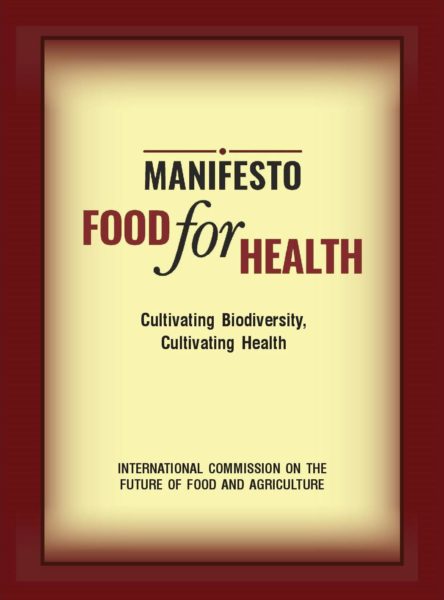
Food for Health Manifesto

By Renata Alleva, et. al. - Navdanya International, 2019

The Food for Health Manifesto aims to give voice, hope and future to all those who wish to commit themselves to act and consume in keeping with a new sustainable food for health paradigm. Additionally, this Manifesto is intended to be used as a tool to help mobilize the urgent transition to local, ecological and diversified food systems. The Manifesto asserts that health, starting with the soil, to plants, animals and humans must be the organizing principle and the aim of agriculture, commerce, science, of our lives and of international trade and aims to create convergence between consumers, producers and stakeholders for a common vision of sustainable development in line with the Millenium Development Goals.

Read the report (Link).

Towards a just transition: coal, cars and the world of work

By Béla Galgóczi - European Trade Union Institute, 2019

The role of trade unions and social dialogue is key in demonstrating the major differences between coal-based energy generation and the automobile industry. This book presents two faces of a just transition towards a net-zero carbon economy by drawing lessons from these two carbon-intensive sectors. The authors regard just transition not as an abstract concept, but as a real practice in real workplaces. While decarbonisation itself is a common objective, particular transitions take place in work environments that are themselves determined by the state of the capital-labour relationship, with inherent conflicts of interest, during the transition process.

The case studies presented in this book highlight the major differences between these two sectors in the nature and magnitude of the challenge, how transition practices are applied and what role the actors play.

Read the report (Link).

Why Sustainable Agriculture Should Support a Green New Deal

By Elizabeth Henderson - The Preying Mantis, January 1, 2019

“For Sale” signs have replaced “Dairy of Distinction” on the last two dairy farms on the road I drive to town. The farm crisis of the 1980’s that never really went away has resurfaced with a vengeance. In 2013, aggregate farm earnings were half of what they were in 2012. Farm income has continued to decline ever since. The moment is ripe for the movement for a sustainable agriculture to address the root causes.

Just as in the 80’s, a brief period of high commodity prices and cheap credit in the 2010’s resulted in a debt and asset bubble. Then prices collapsed. Meanwhile, ever larger corporations have consolidated their dominance in the food sector resulting in shoppers paying more, and a shrinking portion of what they pay going to farmers. At first this mainly hit conventional farms, but in 2017, processors started limiting the amount of milk they purchased from organic dairies and cut the price paid below the cost of production. As a result, family-scale farms of all kinds are going out of business. Reports of farmer suicides are increasing dramatically.  Despite the shortage of farm workers, their wages remain below the poverty line.  People of color and women are often trapped in the lowest paying food system jobs and many are forced to survive on SNAP payments. The tariff game of #45 is only making things worse. The farm consolidation that has taken place has grave consequences for the environment and for climate change as well. The newly passed Farm Bill barely touches the structural and fairness issues that led to this on-going disaster for family-scale farms and the food security of this country.

An alliance of social movements and members of Congress led by newly elected Alexandria Ocasio Cortez (D-NY) are proposing a Green New Deal that would initiate an emergency mobilization to address economic inequities and reverse our blind march toward catastrophic climate change, attracting much more attention than the Green Party version. In a draft resolution, Ocasio Cortez proposes the formation of a Select Committee to develop a plan to transition the US to a carbon neutral economy within ten years, together with a comprehensive package including guaranteed living wage jobs, public banks, and a “Just Transition” for all workers. As of this writing, 43 members of the House have signed on to the concept.

The sustainable agriculture movement with our many organizations and individuals – farmers, foodies, ngos, faith groups and enviros together with farmworkers, food chain workers and their advocates – should become active shapers of the food and agriculture aspects of the Green New Deal. Frontline communities that bear the brunt of the negative impacts of climate chaos and food and economic system breakdown often have the most penetrating insights into pathways forward and real solutions.  For this reason, in addition to the ethical imperatives, fair representation of frontline communities at decision-making tables (of the Select Committee and beyond) is essential.  As a white woman wanting to be the best ally I can, I hope to warmly encourage white people in the food movement to un-learn racism and use privilege to acknowledge and overcome our history of oppression.

Pages

The Fine Print I:

Disclaimer: The views expressed on this site are not the official position of the IWW (or even the IWW’s EUC) unless otherwise indicated and do not necessarily represent the views of anyone but the author’s, nor should it be assumed that any of these authors automatically support the IWW or endorse any of its positions.

Further: the inclusion of a link on our site (other than the link to the main IWW site) does not imply endorsement by or an alliance with the IWW. These sites have been chosen by our members due to their perceived relevance to the IWW EUC and are included here for informational purposes only. If you have any suggestions or comments on any of the links included (or not included) above, please contact us.

The Fine Print II:

Fair Use Notice: The material on this site is provided for educational and informational purposes. It may contain copyrighted material the use of which has not always been specifically authorized by the copyright owner. It is being made available in an effort to advance the understanding of scientific, environmental, economic, social justice and human rights issues etc.

It is believed that this constitutes a 'fair use' of any such copyrighted material as provided for in section 107 of the US Copyright Law. In accordance with Title 17 U.S.C. Section 107, the material on this site is distributed without profit to those who have an interest in using the included information for research and educational purposes. If you wish to use copyrighted material from this site for purposes of your own that go beyond 'fair use', you must obtain permission from the copyright owner. The information on this site does not constitute legal or technical advice.