By staff - International Union of Food, Agricultural, Hotel, Restaurant, Catering, Tobacco and Allied Workers’ Associations, June 2014
 At its 2002 World Congress, the IUF adopted a wide-ranging resolution on trade and investment committing our organization to vigorously oppose the expanded WTO “Doha Round” agenda and to combat the growing number of bilateral trade and investment agreements as instruments for entrenching and expanding corporate power at the expense of democratic rights and the rights of workers and their trade unions.
The resolution highlighted the function of the expanding web of regional and bilateral agreements in building on the WTO rules to construct, layer upon layer, “investment regimes which enforce the right of corporations to pursue maximum profit while removing and undermining restrictions which seek to regulate corporate activities in the interest of public health, worker and consumer health and safety, public services and the environment.”
The Resolution recalled the IUF’s historical and statutory commitment to promote and defend a broad spectrum of basic rights: the right to adequate, nutritious and safe food; the right to food security and food sovereignty; the right to a safe working and living environment; and the right to livelihood protection. Congress further called on the IUF and its affiliates to “actively support and campaign for governments at every level (local, national, regional) to review all existing trade and investment rules and treaties using these fundamental rights as a benchmark and to reject all trade and investment agreements which conflict with those rights.”
Organized opposition killed the proposed Multilateral Agreement on Investment (MAI), an attempt to establish far- reaching powers for transnational investors only partially realized in the WTO’s TRIMS agreement. Popular resistance also halted the proposed Free Trade Area of the Americas, an attempt to extend the reach of the North American Free Trade Agreement (NAFTA) to all of Central and South America and the Caribbean. Since 2002, growing popular resistance has blocked the advance of the WTO Doha Round. This has arrested the insertion of more far-reaching investment rules into the WTO, but has also frozen into place a global food system whose destructive features were dramatically highlighted in the 2008 and subsequent food crises which are essentially permanent. And while attention has largely focused on these ambitious mega-treaties, an intricate web of bilateral and regional investment agreements, some of them deliberately and misleadingly packaged as free trade agreements, have conferred on transnational capital new powers to directly challenge the democratic right of governments to regulate and to legislate in the public interest.
The latest proposed treaty instruments to embody these investor ambitions are the EU-US trade deal now known as the Transatlantic Trade and Investment Partnership (TTIP) and the twelve-nation Trans-Pacific Partnership Agreement (TPPA) between Australia, Brunei, Canada, Chile, Japan, Malaysia, Mexico, New Zealand, Peru, Singapore, the United States and Vietnam.
Both these treaties are being negotiated under conditions of the strictest secrecy. Corporations draft and share the negotiating texts, but citizens are denied access in the name of national security. On the basis of the leaked texts we know that they would build on existing trade and investment rules by incorporating the most toxic elements of the already-existing thousands of treaties and granting expanded powers to transnational capital to challenge public interest policies and practices, eliminating or putting at risk rights for which workers and unions have struggled over many decades.
This publication builds on the past work of the IUF and the efforts of many activists in explaining the nature of these threats and why the labour movement must commit to defeating these treaties as an urgent political priority. We would also hope to stimulate discussion on how we might move beyond these defensive struggles to begin putting in place a system of global rules to effectively enforce respect for human rights over the private claims of investors.
Read the report (PDF).






 The global development of ‘unconventional’ fossil fuels (UFF) such as shale gas has provoked much debate involving scientists,industry, political decision-makers, environmental groups and civil society. More than a decade of large- scale development in North America has left a legacy of environmental damage, primarily resulting from the use of high- volume horizontal hydraulic-fracturing (also known as ‘fracking’) to extract the unconventional oil and gas. Despite the controversy surrounding this technique, the numerous unknowns and uncertainties concerning its impacts and the growing number of questions about the economic benefits of this industry, oil and gas operators are eager to identify new opportunities and so are engaged in a battle to make frackingpublicly and socially acceptable worldwide.
 Uranium mining and milling comprise the first phase of the nuclear fuel cycle, and is one of the most polluting ones. The aim of this report is to give workers and communities basic information about radioprotection. The document deals with the radiological characteristics of materials and waste from the mines, principles of radiation protection, and methods of dose evaluation.
 The term ‘ocean grabbing’ aims to cast new light on important processes and dynamics that are negatively affecting the people and communities whose way of life, cultural identity and livelihoods depend on their involvement in small-scale fishing and closely related activities. Small-scale fishers and fishing communities in both the Global South and the Global North are increasingly threatened and confronted by powerful forces that are dramatically reshaping existing access rights regimes and production models in fisheries. This process is leading not only to the dwindling of control by small-scale fishers over these resources, but also in many cases to their ecological destruction and very disappearance.
 What do rigged corporate trade agreements like the Trans-Pacific Partnership and the Paris Treaty, an international climate agreement to be signed in 2015, have in common? They are both tools being pushed by the power elite to rip away our hopes for democracy and to commodify all things to monetize them for profit.
 On cloudy days, heavy smoke fills the air of Ponca City, Okla., with grey smog that camouflages itself into the sky. The ConocoPhillips oil refinery that makes its home there uses overcast days as a disguise to release more toxins into the air. These toxins are brimming with benzene — a chemical that, according to the Centers for Disease Control, can cause leukemia, anemia and even decrease the size of women’s ovaries. According to the Environmental Protection Agency, in 2008 the ConocoPhillips refinery released over 2,000 pounds of this chemical into the air in Ponca City.
 To the rhythms of drums and chants, concerned people took to the streets across 436 cities in 52 countries yesterday. The message was clear: smash Monsanto. With thousands marching from coast to coast, Canada to Argentina, and around the world, the day of protest has emerged as one of the largest global events—and it has only been around for two years. However, more than small hopes for a mandatory labeling of genetically modified products, smashing Monsanto entails a larger transformation of the modern relationship between people and food.
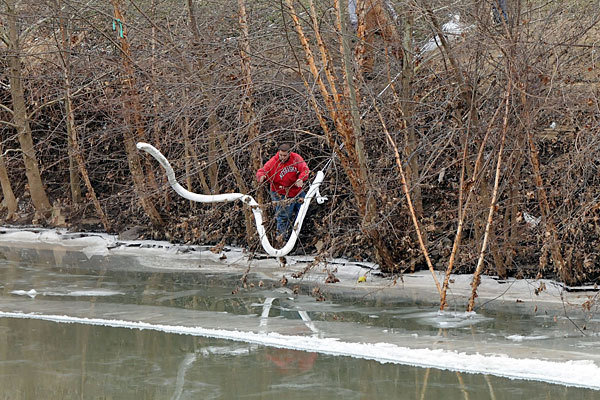 IMAGINE YOURSELF in the rugged countryside of the Appalachian Mountains, where you and your neighbors have lived with a history of poverty and lack of economic development–and you learn that the water piped into your home has been poisoned and can’t be used, even after it is boiled, until further notice.
 This site is not the official webpage of the Industrial Workers of the World.