You are here

capitalism, colonialism, and fascism

From Banks and Tanks: A Strategic Framework for a Just Transition

By MG Collective - Movement Generation Justice and Ecology Project, January 2017

Just Transition is a framework for a fair shift to an economy that is eco-logically sustainable, equitable and just for all its members. After centuries of global plunder, the profit-driven, growth-dependent, industrial economy is severely under-mining the life support systems of the planet. An economy based on extracting from a finite system faster than the capacity of the system to regenerate will eventually come to an end—either through collapse or through our intentional re-organization. Transition is inevitable. Justice is not.

Just Transition strategies were first forged by labor unions and environmental justice groups who saw the need to phase out the industries that were harming workers, community health and the planet, while also providing just pathways for workers into new livelihoods. This original concept of Just Transition was rooted in building alliances between workers in polluting industries and fence-line and frontline communities. Building on that history, Just Transition to us represents a set of aligned strategies to transition whole communities toward thriving economies that provide dignified, productive and ecologically sustainable livelihoods that are governed directly by workers and communities.

A Just Transition requires us to build a visionary economy for life in a way that is very different than the economy we are in now. Constructing a visionary economy for life calls for strategies that

democratize, decentralize and diversify economic activity while we damper down consumption, and (re)distribute resources and power. Just Transition initiatives shift the economy from dirty energy to energy democracy, from funding highways to expanding public transit, from incinerators and landfills to zero waste, from industrial food systems to food sovereignty, from gentrification to community land rights, and from rampant destructive development to ecosystem restoration. Core to a Just Transition is deep democracy in which workers and communities have control over the decisions that affect their daily lives.

Read the report (English PDF) | (Spanish PDF).

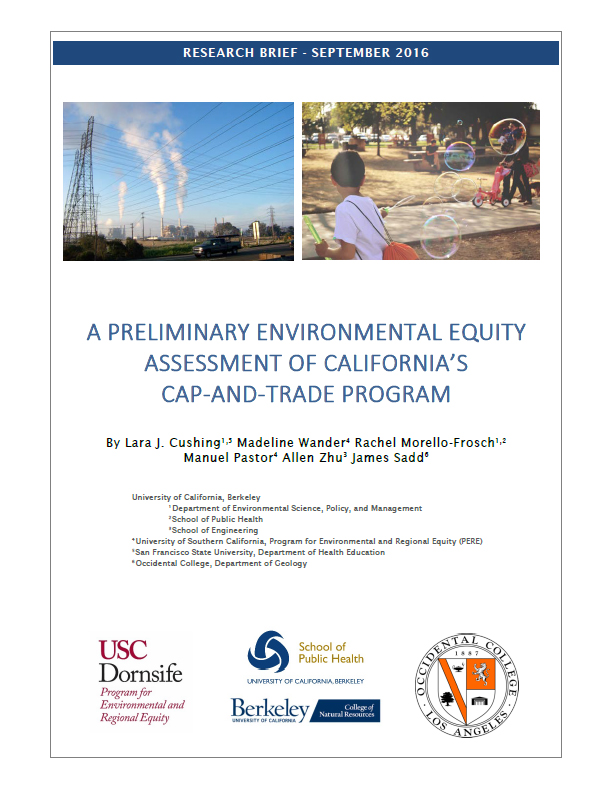
“A Preliminary Environmental Equity Assessment of California’s Cap-And-Trade Program

By Rachel Morello-Frosch, Manuel Pastor, James Sadd, Lara Cushing, Madeline Wander, and Allen Zhu - California Environmental Justice Alliance, September 2016

California’s cap-and-trade program is a key strategy for achieving reductions in greenhouse gas (GHG) emissions under AB32, the California Global Warming Solutions Act. For residents living near large industrial facilities, AB32 offered the possibility that along with reductions in GHGs, emissions of other harmful pollutants would also be decreased in their neighborhoods. Carbon dioxide (CO2), the primary GHG, indirectly impacts health by causing climate change but is not directly harmful to health in the communities where it is emitted. However, GHG emissions are usually accompanied by releases of other pollutants such as particulate matter (PM10) and air toxics that can directly harm the health of nearby residents.

In this brief, we assess inequalities in the location of GHG-emitting facilities and in the amount of GHGs and PM10 emitted by facilities regulated under cap-and-trade. We also provide a preliminary evaluation of changes in localized GHG emissions from large point sources since the advent of the program in 2013. To do this, we combined pollutant emissions data from California’s mandatory GHG and criteria pollutant reporting systems, data on neighborhood demographics from the American Community Survey, cumulative environmental health impacts from the California Environmental Protection Agency’s CalEnviroScreen tool, and information from the California Air Resources Board (CARB) about how regulated companies fulfilled their obligations under the first compliance period (2013-14) of the cap-and-trade program. Our methodology is described in greater detail in the appendix to this report.

In this analysis, we focus primarily on what are called “emitter covered emissions,” which correspond to localized, in-state emissions (derived mostly from fossil fuels) from industries that are subject to regulation under cap-and-trade. The cap-and-trade program also regulates out-of-state emissions associated with electricity imported into the state and, beginning in 2015, began regulating distributed emissions that result from the burning of fuels such as gasoline and natural gas in off-site locations (e.g., in the engines of vehicles and in homes).

We found that regulated GHG-emitting facilities are located in neighborhoods with higher proportions of residents of color and residents living in poverty. In addition, facilities that emit the highest levels of both GHGs and PM10 are also more likely to be located in communities with higher proportions of residents of color and residents living in poverty. This suggests that the public health and environmental equity co-benefits of California’s cap-and-trade program could be enhanced if there were more emissions reductions among the larger emitting facilities that are located in disadvantaged communities. In terms of GHG emission trends, in-state emissions have increased on average for several industry sectors since the advent of the cap-and-trade program, with many high emitting companies using offset projects located outside of California to meet their compliance obligations. Enhanced data collection and availability can strengthen efforts to track future changes in GHG and co-pollutant emissions and inform decision making in ways that incentivize deeper in-state reductions in GHGs and better maximize public health benefits and environmental equity goals.

Read the report (PDF).

An Ecologically Sound and Socially Just Economy

By Fred Magdoff - Monthly Review, September 2016

Two weeks ago I returned from my fiftieth class reunion at Oberlin College in Ohio. The brief discussions I had there with environmental faculty and students left me feeling a bit dazed. So many good and intelligent people, so concerned, and doing what they think and hope will help heal the environment—this college has one of the best environmental education programs in the country. However, I was left disappointed and profoundly discouraged by the lack of discussion—or even interest in having a real continuing discussion and debate—regarding the root causes of our environmental disasters. Not just climate change, but also pollution of the air, water, soil, and living organisms, the loss of biodiversity both aboveground and in the soil, the extinction of species, and the overuse and misuse of both renewable and nonrenewable natural resources.

It is as though there is a flat tire with perhaps a thousand holes and people are working on the best way to patch this hole or that one. No one there seems to consider that the problem might be the tire itself—that the design and materials utilized are not appropriate to the way it is being used. And, if that is the case, then no amount of patching can solve the flat tire problem. It is of the utmost importance to be able to distinguish between symptoms (that most people call “problems” or “crises”) and underlying causes.

I ran into this confusion between symptoms and underlying causes time and time again in agricultural science and farming practices. Soils may be prone to erosion, store little water, grow crops that are susceptible to diseases and insect attack, become compacted, or have low fertility. Farmers (and extension specialists), usually think of and deal with these as individual problems—using pesticide applications, lots of commercial fertilizers, irrigating more frequently, using heavier equipment, and so on. In fact, I spent a significant portion of my career as a soil scientist helping to deal with the negative side effects of one of these responses—excess fertilizer use, especially nitrogen and phosphorus.

(As an aside, as I was preparing this talk, an unbelievable thirty-five tons of nitrogen in the nitrate form, worth approximately $35,000, flowed down the Raccoon River past Des Moines, Iowa, on the way to the Mississippi and the “dead zone” in the Gulf of Mexico. This flushing of nitrate out of the soil by prolonged spring rains, partially the result of nitrate left over after last year’s drought [2012], was mainly a consequence of an ecologically damaging, but profitable, emphasis on growing corn and soybeans without an ecologically sound crop rotation.)

However, what I learned over time was that in reality these are symptoms of an unhealthy soil and a simplified approach to soil and crop management. The same is true of never-ending unemployment, inequality and poverty, the systemic necessity of perpetual growth, and pollution of air, water, soil, and organisms. As harmful as each of these is, they are all only symptoms—of an economic system that is essentially unmanaged. Of course large corporations and politicians that represent them try to manage national and international laws, regulations, and markets in such ways that it becomes easier for them to make more money. But with individual corporations and other private capital making decisions which consider only their own interests, the system as a whole alternates between periods of growth (that nowadays are pretty lackluster) and periods of recession. Addressing individual symptoms alone is not sufficient for the tasks we need to undertake—either to create healthy soils or to create an ecologically based and humane society.

One of the neglected issues regarding thinking and acting about the environment—perhaps the most critical of all—is, to borrow a phrase from the first President Bush, the vision thing. The environmental movement is lacking any kind of meaningful vision as to what a truly ecologically sound and socially just society would look like and how it might operate. I am not talking about a blueprint with all sorts of details, but rather an agreement on essential characteristics of such a system. Without a vision—including some conception of the essential parts of such a system, the chances of actually getting to such a society are essentially zero. Or, as James Baldwin put it in a commonly cited but still very appropriate passage, “Not everything that is faced can be changed; but nothing can be changed until it is faced.” It is my contention that we are not facing the root cause of our problems, and until we do, there is no hope of solving the social and ecological problems confronting the world.

Smoke and Mirrors: Lonmin’s failure to address housing conditions at Marikana, South Africa

By staff - Amnesty International, August 16, 2016

Since 2012 Amnesty International has commented and campaigned on the serious policing failures that led to the deaths at Marikana, calling for full accountability and reparations for the victims and their families. That work continues.

This report examines abuses of the right to adequate housing of mine workers at Lonmin’s Marikana mine operation. Its primary focus is an examination of Lonmin’s response to the findings of the Farlam Commission.

In this regard it looks both at what Lonmin has done and what the company has said about the situation.

Read the text (PDF).

Going to Extremes: The Anti-Government Extremism Behind the Growing Movement to Seize America’s Public Lands

By staff - Center for Western Priorities, July 7, 2016

The 2016 armed standoff at the Malheur National Wildlife Refuge in Oregon provided the American public with a ringside seat to a disturbing trend on U.S. public lands: extremist and militia groups using America’s national forests, parks, monuments, and wildlife refuges to advance their anti-government beliefs.

But these far right-wing organizations are not operating in a vacuum. To the contrary, the armed insurrection in Oregon and Nevada before—led by Ammon Bundy and the Bundy family—share the same foundations as land transfer schemes promoted by some elected leaders in states throughout the West. Both rely upon a philosophy based in vehement anti-government ideologies, both have connections to organizations that espouse armed resistance, both employ pseudo-legal theories to justify their actions, and both use scholarly support from conspiracy theorists and discredited academics.

Our nation’s parks and network of public lands are one of our finest democratic achievements. Americans see management of public lands as one of the things our government does best. But over the last four years, politicians and special interest groups in 11 Western states and in Congress have tried to seize many of these places and turn them over to state and private control.

The elected officials supporting state seizure of U.S. public lands couch their arguments carefully, but our research shows their close associations to extreme individuals, groups, and ideology characterized by antigovernment paranoia and a pseudo-legal approach to the Constitution.

Since the beginning of 2015, 54 land seizure bills have been introduced into Western states, including Alaska, Arizona, Colorado, Idaho, Montana, Nevada, New Mexico, Oregon, Utah, Washington, and Wyoming. At least 22 state legislators with direct connections to anti-government ideologies or extremist groups were the primary sponsors on 29 of those bills.

Sitting at the hub of the movement and functioning as the bridge between extremism and the mainstream political debate are Utah Rep. Ken Ivory, Montana Sen. Jennifer Fielder, and their non-profit, the American Lands Council. A close analysis of Rep. Ivory and Sen. Fielder’s activities, and those of other active land seizure proponents at the state level, shows how these efforts are a functional part of an aggressive anti-government movement that will grow more potent if reasonable Americans don’t take action.

Read the report (PDF).

A Deadly Shade of Green: Threats to Environmental Human Rights Defenders in Latin America

By staff - Center for International Environmental Law, et. al., Summer 2016

On 3 March 2016, a wave of indignation and repudiation swept the world, condemning the brutal and cowardly assassination of Berta Cáceres, a Honduran environmental activist and community leader who inspired thousands of people through her work promoting the rights of the Lenca people.

Her death came amid a growing number of attacks against human rights defenders, particularly campaigners peacefully defending the environment, the right to land and the rights of indigenous peoples. This situation is not limited to Honduras, but can be seen throughout the continent, in Colombia, Brazil, Peru, Mexico, Guatemala, and Ecuador. This long list is being added to by an increasing number of countries that seem willing to put economic interests before those of people and territories. Reports from numerous organizations confirm a steady deterioration of the situation, highlighting the fact that Latin America has become the most dangerous region in the world for environmental activists.

Various types of attack have been committed against campaigners and their organizations. They range from surveillance campaigns, harassment, and being discredited in the media and social networks, to physical assaults, acts of torture, enforced disappearances and assassinations. In addition, there is widespread corruption and impunity in many countries where relations between state and non-state actors are often ambiguous. We should note, in particular, the attacks against female human rights defenders, who face threats of sexual violence and smear campaigns based on their gender. All of this is exacerbated by the context of increasing criminalization of social protest, and use of the law to suppress dissent in Latin American and Caribbean societies.

Despite the grim outlook, there are reasons to remain optimistic. Civil society has never looked so strong, organized and determined. International solidarity strengthened by the globalization of exchanges between people and organizations makes it possible to bring these struggles out of isolation, and demand accountability to ensure the effective implementation of human rights commitments.

Read the report (EN PDF) | (ES PDF).

Pitch Black: The Journey of Coal from Colombia to Italy; the Curse of Extractivism

By various - Re:Common, April 2016

By presenting the horrors suffered under the domination of multinational companies, this work by Re:Common will dispel any lingering doubt that the current economic system based on extractivism is a war against the poor (what subcommander Marcos called the “Fourth World War”).

If someone who trusts the mainstream media and academic analyses thinks that at some point colonialism disappeared from the face of the Earth, this work, based on documents and testimonies, demonstrates otherwise.

For those who believe that progress is the most striking characteristic of our times, starting with the post-World War II period, the voices of the missing that populate these pages will convince you that present-day capitalism is a just a revamped version of the Spanish conquest of five centuries ago.

Throughout this work, all the variables of extractivism can be seen: from occupation of the territory and displacement of people to the role of the offshore banking and financial system, as two complementary and inseparable parts of accumulation by theft/dispossession. In the occupied territories, the displacement occurs in the form of war, with the participation of military, paramilitary, guerrilla and the greatest variety of imaginable armed actors.

The victims are always the weak: poor women and their children, elderly men and women, peasants, Indians, blacks, mestizos, the “wretched of the Earth,” as Frantz Fanon calls them. I want to emphasize, though it may seem anachronistic, and without reference to academic sources, how the extractive model coincides with colonialism, despite the different eras. This is not only due to the violent occupation of territories and the displacement of populations, but also to the salient features of the model.

Economically, extractivism has generated enclave economies, as it did in the colonies, where the walled port and plantations with slaves were its masterworks. This colonial/extractive model held populations 6 hostage in both 1500 and 2000.

Extractivism produces powerful political interventions by multinational enterprises, often allied with States, which manage to modify legislation, co-opting municipalities and their governors. It is an asymmetrical relationship between powerful multinationals and weak states, or better, states weakened by their own local elite who benefit from the model.

Like colonialism, the extractive model promotes the militarization of the territories, because it is the only way to eradicate the population, which, recalling Subcommander Marcos, is the real enemy in this fourth world war. Militarization, violence, and systematic rape of women and girls are not excesses or errors; they are part of the model because the population is the military objective.

To understand extractivism, we must consider it not as an economic model, but as a system. Like capitalism. Certainly there is a capitalist economy, but capitalism is not just the economic aspect. Extractivism (as stated by Re:Common) is capitalism in its financial phase and cannot be understood only as an economic variable. It implies a culture that promotes not work but consumption, which has (systemic) corruption as one of its central features. Put in another way, corruption is the extraction mode of governing.

Therefore, extractivism is not an economic actor; it is a political, social, cultural, and of course also economic actor. At this point, it’s crucial that the central part of this work describes human beings and the Earth as the subjects for looting, which is much more than the theft of the commons. Understanding dispossession only as robbery places property ownership at the center of the matter, in the place of people and land; e.g., life.

Read the text (PDF).

Beyond Coal: Scaling Up Clean Energy to Fight Global Poverty

By lmi Granoff, et. al. - Overseas Development Institute, 2016

Eradicating global poverty is within reach, but under threat from a changing climate. Left unchecked, climate change will put at risk our ability to lift people out of extreme poverty permanently by 2030, the first target of the Sustainable Development Goals. Coal is the world’s number one source of CO2 emissions. Most historic emissions came from the coal industry in the developed world in the last century, with China joining the biggest emitters at the beginning of this one. It is widely accepted that a rapid and just response to climate change will require the urgent replacement of coal with low-carbon energy sources in rich economies.

Now the coal industry claims that expanding coal use is critical to fighting extreme poverty and improving energy access for billions of people in developing countries. In fact, the opposite is true. The global commitment to eradicate extreme poverty and energy poverty by 2030 does not require such an expansion and it is incompatible with stabilising the earth’s climate. The evidence is clear: a lasting solution to poverty requires the world’s wealthiest economies to renounce coal, and we can and must end extreme poverty without the precipitous expansion of new coal power in developing ones.

This paper explores the role of energy in fighting poverty, arguing that:

  • More coal will not end energy poverty
  • Coal is given too much credit for the reduction of extreme poverty
  • Better energy options exist to lift people out of income poverty
  • More coal will entrench poverty.

Read the report (EN PDF) | (JA PDF) | (ZH PDF).

We Are Mother Earth’s Red Line: Frontline Communities Lead the Climate Justice Fight Beyond the Paris Agreement

By staff - It Takes Roots to Weather the Storm - January 2016

The Paris Climate Agreement of December 2015 is a dangerous distraction that threatens all of us. Marked by the heavy influence of the fossil fuel industry, the deal reached at the United Nations Framework Convention on Climate Change (UNFCCC) never mentions the need to curb extractive energy, and sets goals far below those needed to avert a global catastrophe. The agreement signed by 196 countries does acknowledge the global urgency of the climate crisis, and reflects the strength of the climate movement. But the accord ignores the roots of the crisis, and the very people who have the experience and determination to solve it.

Around the world, negotiators use the term “red line” to signify a figurative point of no return or a limit past which safety can no longer be guaranteed. Our communities, whose very survival is most directly impacted by climate change, have become a living red line. We have been facing the reality of the climate crisis for decades. Our air and water are being poisoned by fossil fuel extraction, our livelihoods are threatened by floods and drought, our communities are the hardest hit and the least protected in extreme weather events—and our demands for our survival and for the rights of future generations are pushing local, national, and global leaders towards real solutions to the climate crisis.

We brought these demands to the UNFCCC 21st Conference of Parties (COP21) as members of the delegation called “It Takes Roots to Weather the Storm.” Grassroots Global Justice Alliance (GGJ), the Indigenous Environmental Network (IEN), and the Climate Justice Alliance (CJA) organized the delegation, which included leaders and organizers from more than 100 US and Canadian grassroots and Indigenous groups. We helped to mobilize the thousands of people who took to the streets of Paris during the COP21, despite a ban on public protest—and amplified the pressure that Indigenous Peoples, civil society, and grassroots movements have built throughout the 21 years of UN climate talks.

The Paris Agreement coming out of the COP21 allows emissions from fossil fuels to continue at levels that endanger life on the planet, demonstrating just how strongly world leaders are tied to the fossil fuel industry and policies of economic globalization. The emphasis within the UNFCCC process on the strategies of carbon markets consisting of offsets and pollution trading created an atmosphere within the COP21 of business more than regulation. The result is a Paris Agreement that lets developed countries continue to emit dangerously high levels of greenhouse gasses; relies on imaginary technofixes and pollution cap-and-trade schemes that allow big polluters to continue polluting at the source, and results in land grabs and violations of human rights and the rights of Indigenous Peoples. Our analysis of the Paris Agreement echoes critiques from social movements around the world, led by those most impacted by both climate disruption and the false promises that governments and corporate interests promote in its wake.

“Frontline communities” are the peoples living directly alongside fossil-fuel pollution and extraction—overwhelmingly Indigenous Peoples, Black, Latino, Asian and Pacific Islander peoples in working class, poor, and peasant communities in the US and around the world. In climate disruption and extreme weather events, we are hit first and worst.

We are Mother Earth’s red line. We don’t have the luxury of settling for industry or politicians’ hype or half measures. We know it takes roots to weather the storm and that’s why we are building a people’s climate movement rooted in our communities. We are the frontlines of the solution: keeping fossil fuels in the ground and transforming the economy with innovative, community-led solutions.

“Anarcho-capitalism,” “Free Markets,” Jumbo Shrimp, and Other Oxymorons

By A S Goldstein - Tools of Control, December 14, 2015

Lately, I have been having endlessly frustrating debates with people who call themselves “anarcho-capitalists” or “ancaps” and who seem to be stuck in the McCarthy Era as they still view socialism as some kind of “Red Terror.” Ironically, these people are about as fervent in their support of capitalism and their hatred of socialism as the very government they supposedly want to destroy. These debates generally devolve into ad hominem attacks as the people arguing for capitalism tend to lose their cool rather quickly, and like most people they do not want to hear opposing opinions, especially ones supported by facts. I strongly believe in anarchism and autonomy as I believe they are the only foundations for a truly free society, so I have joined many anarchist groups, but it seems like many of the them (in America anyway) are overrun by so-called “ancaps,” which is why I end up having these silly arguments, and it is sad because they don’t understand “anarcho-capitalism” is an oxymoron or a contradiction of terms that are diametrically opposed. People who believe in this contradiction of terms do not understand what anarchism or capitalism is, and so I hope they read this explanation and do their own research, (and read authors that do not just reinforce their own opinions) instead of reacting defensively or reflexively.

Anarchy means a system without rulers. The etymology of the word demonstrates that as its root Greek words are “an” and “arkhos”, which together mean “without ruler.” Yet capitalism inherently has rulers. It puts people with massive capital and monopolies on resources at a much greater advantage over people who don’t have such capital or resources. The super rich also rely on state thugs and governments and their monopoly on violence and force to protect them. In a world without violent governments or police without the ability to use force, there would be no billionaires. Without police and governments that protect the rich and powerful, there is no way common people would allow a handful of incredibly greedy, misanthropic individuals to hoard billions while 80% of the world lives on less than $10 a day. Capitalist managers rely on cops to break worker strikes and quell worker dissent, they rely on state armies to secure resources, and they rely on government subsidies, tax breaks, bailouts, and bribes to politicians and judges for legislation that favors them.

“Ancaps” remind me of these Ron Paul “libertarians” who misunderstand libertarianism and anarchy as meaning a system with no rules where they think their freedom is defined by how much they can hoard and how much they can disregard other people’s rights and freedoms. But our freedom is not defined by how much we can take away the freedom of others. That is a zero sum equation (as is capitalism) and not true freedom. In this system, one person’s loss is always another person’s gain. For example, the loss of someone’s house due to foreclosure is a gain for the bank that lent the homeowner money, and it is also a gain for the person who buys the property from the bank because banks generally sell foreclosed homes for less than they are worth. We are not truly free unless everyone is free. As Martin Luther King said, “An injustice anywhere is a threat to justice everywhere.”

Pages

The Fine Print I:

Disclaimer: The views expressed on this site are not the official position of the IWW (or even the IWW’s EUC) unless otherwise indicated and do not necessarily represent the views of anyone but the author’s, nor should it be assumed that any of these authors automatically support the IWW or endorse any of its positions.

Further: the inclusion of a link on our site (other than the link to the main IWW site) does not imply endorsement by or an alliance with the IWW. These sites have been chosen by our members due to their perceived relevance to the IWW EUC and are included here for informational purposes only. If you have any suggestions or comments on any of the links included (or not included) above, please contact us.

The Fine Print II:

Fair Use Notice: The material on this site is provided for educational and informational purposes. It may contain copyrighted material the use of which has not always been specifically authorized by the copyright owner. It is being made available in an effort to advance the understanding of scientific, environmental, economic, social justice and human rights issues etc.

It is believed that this constitutes a 'fair use' of any such copyrighted material as provided for in section 107 of the US Copyright Law. In accordance with Title 17 U.S.C. Section 107, the material on this site is distributed without profit to those who have an interest in using the included information for research and educational purposes. If you wish to use copyrighted material from this site for purposes of your own that go beyond 'fair use', you must obtain permission from the copyright owner. The information on this site does not constitute legal or technical advice.