You are here

green syndicalism

United Campaign Workers Challenge the Predatory Tactics of Grassroots Campaigns Inc. and the Nature Conservancy

By Shane Burley - LibCom.org, October 12, 2014. A shorter version of this article was originally published at In These Times.

Disclaimer: The views expressed here are not the official position of the IWW (or even the IWW’s EUC) and do not necessarily represent the views of anyone but the author’s.

Outside of coffee shops and bookstores, crowded Whole Foods stores and worker-run co-ops nationwide, you‘re bound to find canvassers asking for donations or signatures in support of a host of causes. They’re often young people shaking the can for high-profile nonprofits. But as we get deeper into the post-crash precarious economy, the image of canvassers as idealistic college students making a few extra bucks on summer break quickly disintegrates. People are turning to this occupation as their primary source of income, according to many active campaigners. They are hired by independently contracted companies to canvas for nonprofits. The quotas are demanding, making the work one of the most difficult low-wage jobs to hold on to.

In Portland, Oregon, one union local as formed precisely to take on this precarious world of street canvassing, and they are growing at a pace no one could have predicted.

Last week, the United Campaign Workers union, an affiliate of the Portland Industrial Workers of the World, announced its second organized workplace in its less than two months of existence. (The first was the Campaign for the Restoration and Regulation of Hemp.)

Canvassers working for Grassroots Campaigns Inc. (GCI), a third-party contractor that does street canvassing and fundraising for progressive nonprofit organizations such as Planned Parenthood and the Southern Poverty Law Center, informed management of their unionization drive two weeks ago. The union drive began in response to what workers say were unsustainable turnover rates from firings and overly complicated pay scales.

Dangerous Working Conditions and Lack of Reasonable Workplace Accommodations Concern Unions

Contributed by Emma Hartley - October 21, 2014

Disclaimer: The views expressed here are not the official position of the IWW (or even the IWW’s EUC) and do not necessarily represent the views of anyone but the author’s.

There are key sectors of the economy and workforce where unions--like the Industrial Workers of the World (IWW)--are rarely present, due the isolated or remote nature of some workplaces that effectively function as camps. Yet the need for union representation in some of the most difficult and dangerous working conditions is perhaps the greatest, especially where temporary and contract labor is widely used. Those contract workers, for instance who are employed in oil refineries often get only minimal safety training and were sent from one work site to another by the employment agencies who hired them out at far below union rates to major multinational oil companies. One such worker told the IWW of how at his work site, even his team's supervisor was unclear about safety regulations concerning hazardous materials and expected workers to evacuate the work site using a path and area that were both heavily contaminated. The oil industry, as well as those sectors of the economy that rely on employment agencies to offer cheap, temporary labor are often black holes for workers, where there remains much work to be done in terms of workers' rights.  

Mapping Climate Justice

By Dr Joanna "Jody" Boehnert - EcoLabs, October 16, 2014

Disclaimer: The views expressed here are not the official position of the IWW (or even the IWW’s EUC) and do not necessarily represent the views of anyone but the author’s.

Web Editor's Note: The IWW Environmental Unionism Caucus is featured on the climate map as one of the "climate justice" organizations.

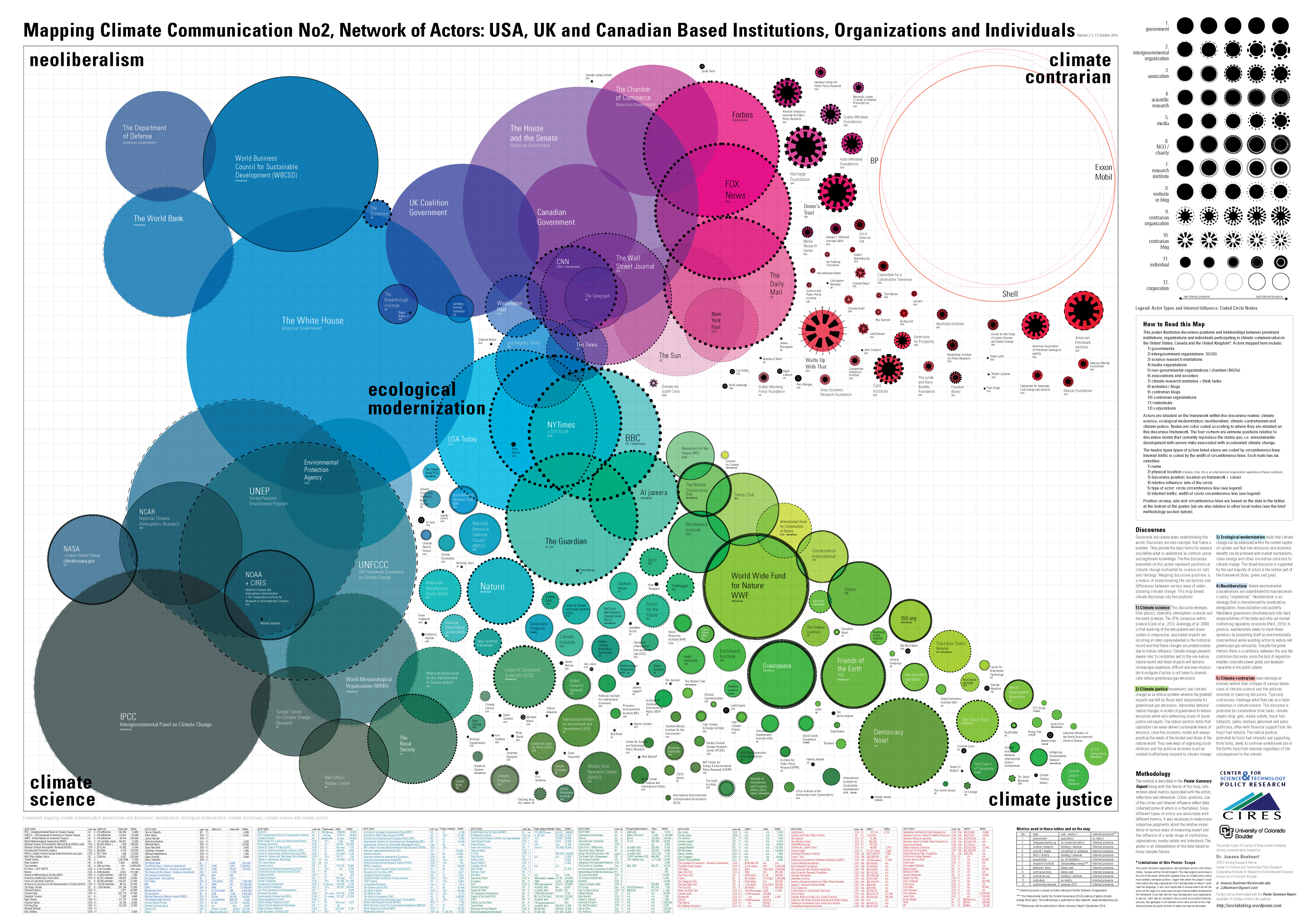
The Mapping Climate Communication Project illustrates key events, participants and strategies in climate communication.

1) Climate Timeline visualizes the historical processes and events that have lead to various ways of communicating climate change. Key scientific, political and cultural events are plotted on a timeline that contextualizes this information within five climate discourses. These reveal very different ideological, political and scientific assumptions on climate change.

2) Network of Actors displays relationships between 237 individuals, organizations and institutions participating in climate communication in Canada, United States and the United Kingdom.

Details about this project can be found in the Mapping Climate Communication: PosterSummary Report. This report can be downloaded here:


The maps reveal how specific details in climate communication are contextualized within complex debates. For example:

  • How does a climate march impact the volume of media coverage of climate change?
  • How does the work of the climate denial industry potentially impact climate policy?
  • Do popular movies and books on climate result in activity in the climate movement?
  • What are the relationships between organizations active in climate communication?

By illustrating key events and actors over time and within five discourses this work makes links between disparate factors and reveals dynamics that contribute to public understanding of climate change.

The project also explores politicised issues in climate communication by using a discourse approach to analyse the various strategies and ideologies held by those organizations, institutions and individuals participating in climate communication in the public realm. This report describes the impact of neoliberal dogma and modes of governance on climate communication as one of the central problems preventing a global response to climate change. Theorizing the impact of neoliberalism on climate change communication and policy is key to an understanding of why emissions continue to rise despite the significant work by the climate science community and the environmental movement over the past four decades.

Green Unionism and the IWW

By Martin Zehr - IWW Environmental Unionism Caucus, October 14, 2014

Disclaimer: The views expressed here are not the official position of the IWW (or even the IWW’s EUC) and do not necessarily represent the views of anyone but the author’s.

“Every union should have a vision of the future,” stated Jock Yablonski as he announced his candidacy for the UMWA presidency. “What good is a union that reduces coal dust in the mines only to have miners and their families breathe pollutants in the air, drink pollutants in the water, and eat contaminated commodities?”  

This presentation by Jock Yablonski presents a concise analysis of the relationship between the working class and the environment. Because the environmental issue has been dominated for so many years by NGOs and advocacy groups, there remains a fundamental schism in substance and politics between the working class and sound environmental and resource planning advocates. The much celebrated blue-green unity of Seattle is a fading memory. In the age of the increasing role of the AFL-CIO in promoting corporate profits for jobs, we have seen how unions like the Mineworkers, Boilermakers, Steelworkers and others have adopted a pro-corporate militarization stance. This significance of this collaboration goes beyond simply environmental issues. In fact, it threatens an independent class role for all unions, whether it's quality of life issues or shop floor issues.  

To date, the IWW’s reputation remains in geographical locales and in small retail or commercial local unions. Our presence within the labor movement remains marginal. The re-emergence of an active IWW presents a new stage for workers in the class stage. More than a revival of the sixties mass struggles and beyond the single issue advocacies of the late 20th century, the IWW can play an leadership role given our willingness to consciously analyze our role, our strategies  and our tactics. For example, the drive to organize in basic industry is a task that remains ahead of the IWW. The service economy will provide certain in-roads needed to establish our validity and are important in establishing real credentials that workers can see. But, the task ahead remains in steel, electrical, maritime, auto and other industries that have become open shops, or even non-union (such as auto). Likewise, organizers and political education of organizers need to be developed to a generation that has minimal experiences in the class struggle.  

Syndicalism: An International and Historical Perspective (Dek Keenan)

By Dek Keenan - Zabalaza Books, October 12, 2014

This paper will introduce syndicalism both as an historical international phenomenon and as a contemporary international model and movement. It presupposes very little knowledge of, but hopefully some substantial interest in, the subject on the part of the reader.

What does Syndicalism mean to us as labour movement activists? It may mean the million workers in the Spanish CNT fighting with a new world in their hearts during the Spanish Civil War. It may mean the legendary Industrial Workers of the World organising the One Big Union across craft and trade, race and gender lines. It may mean a vast movement of workers across Latin America during the first half of the 20th Century. It may mean Starbucks baristas fighting today to build unions in coffee houses in New York and Santiago. But it very possibly means none of these things.

Because syndicalism constitutes one of the least understood currents in the workers movement. And yet syndicalism was the driving force of immense and powerful labour movements across the globe in the first decades of the 20th Century; from Argentina to Japan and from Australia to Portugal workers gathered under its flag. And today it represents a small, but growing, part of the international labour movement; albeit one that remains unduly obscure and marginal.

Of course, for speakers of a Romance language syndicalism will be recognised as simply the word for ‘unionism’. So, when we talk of syndicalism in the context of this paper we are actually talking about revolutionary syndicalism and, later on, anarcho-syndicalism. Revolutionary syndicalism or revolutionary unionism (I will for brevity use the term syndicalism to indicate revolutionary syndicalism throughout this paper) emerged in the latter part of the 19th century as an alternative vision to the dominant unionism which had developed and which were aligned with social democratic political parties or which simply followed a class collaborationist line. Syndicalists, aware of the failure of this form of unionism to defend the interests of workers and generally informed by socialist ideas, of both anarchist and Marxist origin (Darlington, 2013), looked to establishing workers’ organisations that would provide both day to day resistance to the bosses and a structure able to establish a new society based on a collectivised system of worker-managed production and distribution. In the United States and Canada this vision tended to be described as Revolutionary Industrial Unionism rather than syndicalism, but this can be understood as a ‘local’ variant of syndicalism re-named to reflect a notion of advanced industrial development (Dubofsky, 1969).

Syndicalists took diverse routes in building such organisations, sometimes based upon federations of small trade and even craft unions, sometimes upon national industry-wide unions and sometimes co-ordinated in one big union (e.g. Industrial Workers of the World (IWW) in the United States and globally). What they shared, however, were the following common characteristics.

Progressive Union Busting

By The Angry Syndicalist - October 9, 2014

Disclaimer: The views expressed here are not the official position of the IWW (or even the IWW’s EUC) and do not necessarily represent the views of anyone but the author’s.

Grassroots Campaigns Inc is in the process of being unionized by the newly formed United Campaign Workers who have canvassed for the progressive non-profit organization. The canvassers have been denied paychecks owed by the organization and have been running a campaign for the regulation and restoration of hemp. Apparently these progressives have bounced checks before as well, since management wasn't willing to discuss these problems, the workers walked off the job.

The UCW was formed in concert with the help of the IWW. A phone blast was the first response to the liberal organization, with supporters calling in for the UCW. The demands were simple, $15.00 an hour and the overtime pay they were owed. When these were handed in to the director, he apparently thought the word grassroots and the IWW were strangers, naivety abound.

The campaign has been gathering signatures for I-21, the Oregon Cannabis Amendment, which would end all legal penalties for marijuana products and extend growing permissions to Oregonians. It’s paired with the Oregon Cannabis Tax Act, I-22, which would override existing laws to create a new regulatory framework and funnel money from marijuana sales into state programs.

The crew pulls 600 signatures a day and it would make sense since they are in favor of the campaign they'd be brought back to work? No. The canvassers have support in the community in the form of Jobs for Justice and other union members.

Nonprofits have been using methods normally reserved for the conservative wing of liberal politics to bust unions i.e. Sisters Camelot, which has left a sour taste in many Wobblies mouths. Who resorted to a lawyer whose goal was to destroy the union, despite the fact the NLRB recognized them as workers.

I do not put it past progressives to have the not in my backyard mentality if it affects them. So much so, they hired scabs who ironically were offered $15.00 an hour. Since then the workers have done what they can to get management back to the bargaining table, including demanding enough dignity from the work they perform in the payment of bonuses so they can feed their children.

A confused liberal called this heteronormative, however I question if this liberal has ever had to starve before.

Part II: Boston Wobblies in Solidarity.

GCI has had their reputation for union busting spread throughout the local community in Boston(where their HQ is). Their quotas were unrealistic and union busting isn't a thing a labor democrat would do would they? Anyways, they resorted to hiring private security who were too cowardly to show their faces to the world.

Grassroots Campaigns was founded in December 2003. By April 2004 Grassroots Campaigns had opened offices in 40 cities throughout the country. By July 2004 they had over 2,000 staff knocking on doors and fund raising on behalf of the  Democratic National Committee With continued work on behalf of MoveOn PAC to run "Leave No Voter Behind," (LNVB). This was a "get out the vote" (GOTV) program intended to give Democratic candidate John Kerry an edge in the swing states. 

Grassroots Campaigns, Inc clients are a who's who for those who like to name drop, from the ACLU to the SPLC to the Sierra Club. It's one big club and the canvassers aren't in it. Praise be to the liberal elite with college degrees and Starbucks addictions.

Why Is The World Ignoring The Revolutionary Kurds in Syria?

By David Graeber - Boston IWW, October 8, 2014

Disclaimer: The views expressed here are not the official position of the IWW (or even the IWW’s EUC) and do not necessarily represent the views of anyone but the author’s.

In 1937, my father volunteered to fight in the International Brigades in defence of the Spanish Republic. A would-be fascist coup had been temporarily halted by a worker’s uprising, spearheaded by anarchists and socialists, and in much of Spain a genuine social revolution ensued, leading to whole cities under directly democratic management, industries under worker control, and the radical empowerment of women.

Spanish revolutionaries hoped to create a vision of a free society that the entire world might follow. Instead, world powers declared a policy of “non-intervention” and maintained a rigorous blockade on the republic, even after Hitler and Mussolini, ostensible signatories, began pouring in troops and weapons to reinforce the fascist side. The result was years of civil war that ended with the suppression of the revolution and some of a bloody century’s bloodiest massacres.

I never thought I would, in my own lifetime, see the same thing happen again. Obviously, no historical event ever really happens twice. There are a thousand differences between what happened in Spain in 1936 and what is happening in Rojava, the three largely Kurdish provinces of northern Syria, today. But some of the similarities are so striking, and so distressing, that I feel it’s incumbent on me, as someone who grew up in a family whose politics were in many ways defined by the Spanish revolution, to say: we cannot let it end the same way again.

Twenty Things YOU Can Do To Address the Climate Crisis!

By Patrick Robbins - This Changes Everything, October 6, 2014

Disclaimer: The views expressed here are not the official position of the IWW (or even the IWW’s EUC) and do not necessarily represent the views of anyone but the author’s.

Getting your mind around climate change is hard. Confronting it requires us to deal with the ways that coal, oil, and gas have shaped nearly every aspect of our world, from our built environments to our economic systems — even our ideologies and patterns of thought. But that doesn’t mean there aren’t concrete actions each of us can take, right now. Here are 20 examples of things YOU can do (some details are US-specific).

1. Reorganize the mode of production so that surplus and capital is distributed equally throughout society, and workers have decision-making power over their labor.

2. Find out about fossil fuel projects being built or proposed in your neighborhood (most of which can be found in the records of the Federal Energy Regulatory Commission or the Environmental Protection Agency) and mobilize your community against them. Read these excellent resources on how to start organizing your community and spread them far and wide.

3. Understand that while climate change affects us all, there are specific populations who are more vulnerable than others — these are low-income communities, communities of color, coastal communities and communities on the frontlines of fossil fuel extraction. Find a frontline organization near you and offer to support their work. Ask them what kind of help they need and take direction from them.

4. Lay off the policeman, the commodities trader, the real estate agent and the speculator in your head.

5. Read about what the crisis could potentially look like — go HERE or HERE or HERE or HERE or HERE — and think about what this could mean for you personally, or for people and places you love.

John Holloway: Cracking Capitalism vs. the State Option

By Amador Fernández-Savater  - ROAR Magazine, September 29, 2014

Disclaimer: The views expressed here are not the official position of the IWW (or even the IWW’s EUC) and do not necessarily represent the views of anyone but the author’s.

Interview by Amador Fernández-Savater. Translated by Richard Mac Duinnsleibhe and edited by Arianne Sved of Guerrilla Translation.

In 2002, John Holloway published a landmark book: Change the World without Taking Power. Inspired by the ‘¡Ya basta!’ of the Zapatistas, by the movement that emerged in Argentina in 2001/’02, and by the anti-globalization movement, Holloway sets out a hypothesis: it is not the idea of revolution or transformation of the world that has been refuted as a result of the disaster of authoritarian communism, but rather the idea of revolution as the taking of power, and of the party as the political tool par excellence.

Holloway discerns another concept of social change at work in these movements, and generally in every practice—however visible or invisible it may be—where a logic different from that of profit is followed: the logic of cracking capitalism. That is, to create, within the very society that is being rejected, spaces, moments, or areas of activity in which a different world is prefigured. Rebellions in motion. From this perspective, the idea of organization is no longer equivalent to that of the party, but rather entails the question of how the different cracks that unravel the fabric of capitalism can recognize each other and connect.

But after Argentina’s “que se vayan todos” came the Kirchner government, and after Spain’s “no nos representan” appeared Podemos. We met with John Holloway in the city of Puebla, Mexico, to ask him if, after everything that has happened in the past decade, from the progressive governments of Latin America to Podemos and Syriza in Europe, along with the problems for self-organized practices to exist and multiply, he still thinks that it is possible to “change the world without taking power.”

Video: Boots Riley On Workers Revolution At Oakland Climate Rally

By Steve Zeltser - Labor Video Project, September 21, 2014

Disclaimer: The views expressed here are not the official position of the IWW (or even the IWW’s EUC) and do not necessarily represent the views of anyone but the author’s.

Boots Riley spoke and performed with a fellow artist at the Oakland Climate rally on September 21, 2104. He discussed the need to organize workers to make fundamental change in the system.

Pages

The Fine Print I:

Disclaimer: The views expressed on this site are not the official position of the IWW (or even the IWW’s EUC) unless otherwise indicated and do not necessarily represent the views of anyone but the author’s, nor should it be assumed that any of these authors automatically support the IWW or endorse any of its positions.

Further: the inclusion of a link on our site (other than the link to the main IWW site) does not imply endorsement by or an alliance with the IWW. These sites have been chosen by our members due to their perceived relevance to the IWW EUC and are included here for informational purposes only. If you have any suggestions or comments on any of the links included (or not included) above, please contact us.

The Fine Print II:

Fair Use Notice: The material on this site is provided for educational and informational purposes. It may contain copyrighted material the use of which has not always been specifically authorized by the copyright owner. It is being made available in an effort to advance the understanding of scientific, environmental, economic, social justice and human rights issues etc.

It is believed that this constitutes a 'fair use' of any such copyrighted material as provided for in section 107 of the US Copyright Law. In accordance with Title 17 U.S.C. Section 107, the material on this site is distributed without profit to those who have an interest in using the included information for research and educational purposes. If you wish to use copyrighted material from this site for purposes of your own that go beyond 'fair use', you must obtain permission from the copyright owner. The information on this site does not constitute legal or technical advice.