You are here

green syndicalism

EcoUnionist News #16

Compiled by x344543 - IWW Environmental Unionism Caucus, December 31, 2014

Disclaimer: The views expressed here are not the official position of the IWW (or even the IWW’s EUC) and do not necessarily represent the views of anyone but the author’s.

The following news items feature issues, discussions, campaigns, or information potentially relevant to green unionists:

Lead Stories:

Railroad Workers, Safety, and the Environment:

Other News of Interest:

For more green news, please visit our news feeds section on ecology.iww.org; Twitter #IWWEUC

EcoUnionist News #14

Compiled by x344543 - IWW Environmental Unionism Caucus, December 29, 2014

Disclaimer: The views expressed here are not the official position of the IWW (or even the IWW’s EUC) and do not necessarily represent the views of anyone but the author’s.

The following news items feature issues, discussions, campaigns, or information potentially relevant to green unionists:

Lead Story:

Other News of Interest:

For more green news, please visit our news feeds section on ecology.iww.org; Twitter #IWWEUC

Strike! for Climate Justice

By Jeffrey Free Luers - Strike for Climate Justice, March 20, 2009

Disclaimer: The views expressed here are not the official position of the IWW (or even the IWW’s EUC) and do not necessarily represent the views of anyone but the author’s. Note that this call wasmade five years ago, but is still entirely relevant today.

Twenty years ago governments of the world met for the first ever climate talks. The talks, then, focused largely on the growing hole in the world’s ozone layer (a hole that still exists today) and the need to eliminate CFC emissions (which also still exist today though in much smaller amounts). The other climate item on the agenda was global warming. Scientists warned that there was growing evidence that the world was warming, possibly due to human activity much like the root cause of the ozone hole.

Unfortunately, in 1988 it was decided that global warming did not pose a significant threat to warrant action. The problem could wait to be addressed.

Nearly a decade later, in 1997, the governments of the world met for their annual climate talks in Kyoto, Japan. The United Nations Intergovernmental Panel on Climate Change (IPCC), a panel of the world’s leading scientists from countries around the globe, presented growing evidence that the world faced a severe threat from climate change. These scientists concluded that the single largest contributor to climate change were human greenhouse gas emissions, most notably carbon dioxide (CO2).

For the first time since the inception of the climate talks, world leaders agreed action was needed to combat climate change. The world took notice with a collective gasp as 180 governments pledged their support to a worldwide climate treaty to reduce CO2 emissions in an effort to conquer global warming.

In 2007, a decade after Kyoto and twenty years since the first climate talks, the IPCC declared in its strongest language yet that the world faced imminent global catastrophe unless immediate and drastic action was taken to reduce and then eliminate greenhouse emissions.

In the years following the Kyoto protocol, the United States – the highest emitter of greenhouse gases per capita in the world – pulled out of the treaty. CO2 emission around the world continued to rise. Governments that had promised to reduce emissions failed to impose strict limits, instead relying on voluntary cuts from industry. As industries refused to limit their emissions and governments balked at regulation, the Kyoto protocol collapsed.

The U.S. and numerous other countries with high greenhouse emissions have steadfastly refused to cut CO2 emissions, claiming that doing so would harm their ability remain economically competitive.

In the face of the largest economic collapse in world history, brought about by the very same green, deceit and malfeasance of the worlds most powerful multinational and government deregulation that has allowed CO2 emissions to go unchecked. Government and corporate claims that reducing emissions would create economic hard ring hollow.

People around the world put faith in our governments and institutions to act on our behalf and in our best interests. Our governments have had 20 years to act on global warming and climate change. 20 years to act on a threat that the world’s leading scientists say is the greatest threat to human kind the world has ever faced.

EcoUnionist News #11

Compiled by x344543 - IWW Environmental Unionism Caucus, December 18, 2014

Disclaimer: The views expressed here are not the official position of the IWW (or even the IWW’s EUC) and do not necessarily represent the views of anyone but the author’s.

The following news items feature issues, discussions, campaigns, or information potentially relevant to green unionists:

Lead Story:

Dispatches from Lima COP20:

Other News of Interest:

For more green news, please visit our news feeds section on ecology.iww.org; Twitter #IWWEUC

My Social Credo

By Arthur J. Miller - IWW Environmental Unionism Caucus, December 12, 2014

Disclaimer: The views expressed here are not the official position of the IWW (or even the IWW’s EUC) and do not necessarily represent the views of anyone but the author’s.

1. ALL THINGS ARE CONNECTED: There are many needed struggles, but they are all connected because in one way or another, we all struggle against the same oppressors and the same abusive system. In the natural world all life is connected.

2. LIFE IN BALANCE: Life out of balance with all is the greatest threat we face to our survival. Life out of balance, a violent world of pursuit of greed and power for some at the expense of the many is leaving our world a wasteland of human folly and suffering. Life in balance with all around us is our only means of survival.

3. HUMAN RIGHTS FOR ALL: The right to exist, the right to food, shelter and medical care, the right to dwell upon the land, the right of free speech, free assembly and the right to organizing for better conditions, the right to live without oppression, should be the rights of all of humankind.

4. DIVERSITY AWARENESSS AND RESPECT: Humankind is a great diversity of cultures. When we treat that diversity with acknowledgment and respect, that diversity becomes our strength and not our weakness.

5. INCLUSION: The oppressed and exploited are a great mass of people. But they are not all the same. Seeking to include all people and their concerns makes real social change possible. Seeking to exclude people makes real social change impossible. For in that you only change things for the better of some at the expense of the many.

6. SELF-DETERMINATION: The oppressed organizing against our oppressions and struggling to control our own fate.

7. SPEAKING FOR OURSELVES: The oppressed and exploited people need to be able to speak for ourselves by means of writing, speaking, art, music and so on, because we are the only ones that are truly able to understand what we are going through. And that understanding is necessary in order to free ourselves from the way things were not meant to be.

8. GENERATIONS IN BALANCE: Creating balance between the old and the new. What came before lays the foundation, the new adds to it and passes it on to the future generations.

9. THE 7TH GENERATION: Instant gratification of greed is a suicidal direction. In all things, look to the 7th Generation to come as to what we do now will effect the future, many Indigenous cultures teach us this.

10. WORKING FOLKS: We live in a class society where those that do the useful work are of a lower class while those that oppress and exploit us exist as a higher privileged class. There is great dignity in the labor of working people, for we do all that is needed for our needs and wants. No society can exist without us. There is no dignity or usefulness in the class that oppresses and exploits us, they do nothing useful, they are unneeded and they stand in the way of the well-being of all.

11. FOR A CLASSLESS SOCIETY: The idle rich on top living off the labor of the classes below them, and thus creating endless class conflict. Organize for a classless society for the peace and well-being of all humanity.

12. REPLACING EUROCENTICISM WITH MULTI-ETHNIC INTERNATIONALISM: Eurocenticism seeks conquest of the world by the domination of a few imperialists, and to impose their cultural/political/economic system on all, which they view as superior to all else. Eurocentic supremacy needs to be replaced with multi-ethnic internationalism. True multi-ethnic internationalism is open to all the knowledge and cultures of the people of the world.

13. ENDING THE GENOCIDE: The Western lands are built upon genocidal policies against the Original People. It is important to understand this so that we can put an end to those policies that started with Columbus and continue to this day. FREE LEONARD PELTIER!

My Whole Foods nightmare: How a full-time job there left me in poverty

By Nick Rahaim - Salon.com, December 8, 2014

Disclaimer: The views expressed here are not the official position of the IWW (or even the IWW’s EUC) and do not necessarily represent the views of anyone but the author’s.

Despite the corporate talk of "team" and "love," here's what working there was really like -- and why I had to quit

After years of organizing in secret, building bonds over beer and supporting co-workers when issues have arisen with management, team members at a Whole Foods Market in San Francisco disrupted the normal workday and demanded a $5 an hour pay increase last month. More than 20 employees beckoned store management to the floor and presented a petition signed by more than 50 of the store’s workers calling for more paid time off, better health and retirement benefits as well as steady, consistent schedules.

I worked at Whole Foods in the spring of 2012. As is the typical way of getting to know co-workers, I went out for drinks with a tight-knit group of employees. Conversations went quickly from the getting-to-know-you banter to politics, and it was at the time the Occupy Movement was running out of steam. We exchanged battle stories of political engagement and mused about how best to carry the momentum from Occupy in new directions. I asked about organizing at Whole Foods; a few of my co-workers smirked while others played dumb. A week later I was brought into the fold, and found people had been organizing for more than two years. I was feisty for action, but the others knew better; they were in it for the long haul.

Since workers came out after plotting in the shadows for nearly five years, store managers have reportedly attempted to kill them with kindness, while saying nothing of their demands. On the corporate side, Whole Foods Market announced a pay increase in its San Francisco stores effective Jan. 1, shortly after the Whole Foods Union went public. The $1.25 increase in the starting wage, from $11.50 to $12.75, sits 50 cents above San Francisco increase in minimum wage that will take effect in May of 2015. Outside of that, both the store and corporate management have refused to publicly address the situation. Workers organizing at Whole Foods claim the announced wage increase four months ahead of schedule was likely in response to their demands.

In an attempt to put teeth to their demands workers held pickets at the Whole Foods Northern California Regional distribution center in Richmond, California. The picket fell short of stopping the flow of goods to the Bay Area stores it had envisioned, in the spirit of the Black Friday actions taken in 2013 by retail workers. Although the Teamsters did agree that their drivers would not cross the picket line. To that Ruan, the shipping company contracted by Whole Foods, hired temporary workers — scabs — to cross.

Organizing with the radical-syndicalist union, the Industrial Workers of the World, Whole Foods employees are shunning traditional unions that represent the majority of workers at Safeway, Alberson’s and other national grocers. In doing so, they have given up access to the deep pockets of United Grocery Workers and the like, but have the added agility to stealthily maneuver. The IWW is also the only union to have successfully created union shops at Starbucks.

RWU to Co-Sponsor Railroad Conferences on the West Coast

Press Release - Railroad Workers United, December 1, 2014

Disclaimer: The views expressed here are not the official position of the IWW (or even the IWW’s EUC) and do not necessarily represent the views of anyone but the author’s.

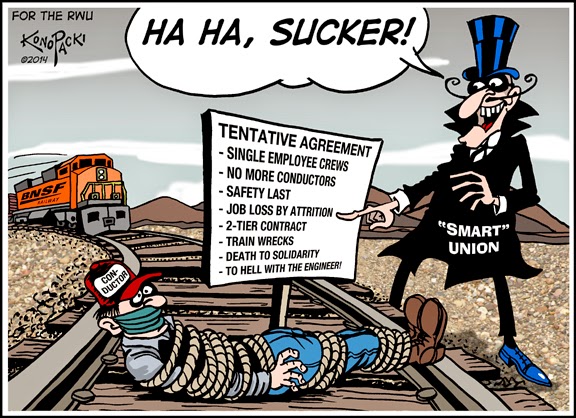
This coming winter, RWU will co-sponsor two conferences, one in the Bay Area and one in the Pacific Northwest. Tentatively entitled “The Future of Railroads: Safety, Workers, Community and Environment”, Railroad Workers United is partnering with the Backbone Campaign and other citizens and environmental groups to organize these innovative and cutting edge conferences.

In recent months, public attention has focused on the railroad in a way that it has not been for decades. In the wake of Lac Megantic and other derailments and resulting fires and explosions, the public is alarmed about oil trains and the movement of trains in general through their communities.

Environmental activists are up-in-arms about the amounts of fossil fuels moving by rail. Farmers and other shippers are concerned about the congestion that has occurred in recent months, due in part to the oil boom. All of this attention gives railroad workers a golden opportunity to educate the general public about the railroad, its inherent efficiencies, its value to society, and its potential. It also give us an invaluable opportunity to inform non-railroad workers about the situation that we face on the job every day.

The public generally has no idea what goes on daily on America’s railroads. At this conference, we plan to talk about crew fatigue, single employee train crews, excessively long and heavy trains, draconian availability policies, short staffing, limited time off work and other concerns. These issues are of concern not just to railroaders, but are of concern to environmentalists, the community at large and society in general. Non-railroaders in attendance at the conference will come away with a deeper understanding of our workplace and a greater appreciation of the issues facing us. They will without a doubt, become valuable allies in our future fights with the rail carriers.

Some Thoughts on the Environmental Movement

By Flint Jones - December 2, 2014

In 2010, I was part of a workshop at the Renewing the Anarchist Tradition conference in Baltimore, MD.  Also on the panel were Michael Loadenthal and Chris Spannos. The panel was givein these questions:

  • What types of nonhierarchical organizational forms are applicable to the environmental movement as well as up to the challenge of contesting and ultimately offering a dual power to those forces that are destroying the planet and separating humans from the nonhuman world? 
  • How would a society based on anarchist principles resolve the ecological problems inherent in various aspects of the current system, from transportation to the food supply to energy production?

My answers, I think, still hold up: One thing that environmental movement has been successful at is atleast temporarily halting some kinds of ecological destruction;whether it’s stopping construction of a lumber mill or a nuclear power plant.  Unfortunately, many of these campaigns are quite localized andexamples of “Not In My Backyard” environmentalism.   Ecological destruction can then often relocate to a location in which thepolitical climate is more open to natural exploitation.  WhileNIMBYism might work in a limited matter in terms of conservation ofsome relatively underexploited bit of wilderness--it doesn’t matter where coal is being burned for it to effect global warming and climate change.  Stopping a particular environmental abuse in one location does not change the demand that stimulated that environmentally destructive process.  I grew up in rural West Virginia and my fatherworked the coal trains.  While many people have turned against mountain top removal or coal mining in general, the coal industry hasa simple effective slogan, “Coal keeps the lights on!”.   Until we either convince people to do without light, produce light with less energy or find another way to produce the light without coal... there is still going to be a huge demand for mining and burning coal--regardless of which ancient mountain they destroy in which county, state or country.

There has been considerable emphasis in the environmental movement in regards to influencing consumers to individually change their consumption practices.  One example is the advocacy of a vegetarian or vegan diet.  I’m a vegetarian, myself.  In terms of bringing about a shift in food consumption in the U.S. for environmental reasons--that movement has failed; and spectacularly so.  While the number ofvegetarians/vegans amounts to 3.7% of population (with 10% being vegetarian inclined), since the 1950s the per capita meat consumptionin the U.S. has increased from 150 to 200 pounds (even with the growth of vegetarianism).  Americans eat twice the global average for meat. At about 5 percent of the world’s population, we grow and kill nearly 10 billion animals a year, more than 15 percent of the world’s total. When we are talking about environmental problems we are talking about the collective impacts of all people.   In terms of the impact of diet upon the environment, we would have been more effective if we had encouraged the majority to only reduce their meat consumption or if we had limited meat production to only open range grass fed meat (rather than grain fed feed lots)--rather than convincing a tiny minority to eliminate meat entirely from their diet. Individual consumption patterns matter far less than the aggregate impact of all people. The infrastructure and industrial method of how energy and goods areproduced and delivered matter more than the specific product beingconsumed.

When white people start talking about overpopulation, I get nervous. Globally, the population growth rate has been reducing for some time. In many industrialized countries, there is now even negative population growth.  Population predictions have the global population growing to nine billion before declining--all the while the median age will increase.  The problem isn’t so much the sheer quantity of people but how those people use resources.  The third most populated country in the world is the United States. The problem is very much with the U.S. and. how it has been built up and consumes resources.  Outside of some black carbon from cooking fires, the carbon footprint of the poorest billion people on the planet is negligible. The impact of of 310 million folks in the U.S. is huge.  An average U.S. resident emits twice as much carbon dioxide as an European and 20 times as much as an African.  We must meet the needs and demands of nine billion peopleand a discussion on how to more rapidly decrease population in the next fifty years is as much a distraction as any kind of viablepolicy.  If noone in the U.S. environmental movement ever mentioned overpopulation again and we stuck only to a conversation about how to reduce our per capita resource use nationally--I think we’d be better off.

For similar reasons, attempts to form small autonomous communities within the U.S that are disconnected from the majority of the population will not solve our environmental problems.  This panel description suggested a dual power situation between our anarchist ecological ideas and presumably the status quo.  Given that climate change is a global phenomenon and any intentional anarchist community would share bio-region and watersheds with environmentally destructive capitalists states; there can be no parallel development.  We must systematically transform the current industrial mode of production and we can not wait to do that by building an separate alternative as merely a demonstration.  Green Potemkin villages will not change people’s mind or have any significant impact.  It’s not enough for asmall group of activists to create a back yard victory garden in abandoned lots to address our demands for food.  If we are serious about addressing the ecological destruction caused by our food production, we need large scale systematic change of how we grow food. If small urban farms can’t even provide all calories their farmers need, they certainly can’t meet the demand of all those people who are not farming.  The new society must be built literally in the shell ofthe old; not just down the road from it.  We must build organizations capable of winning immediate demands from the status quo.

Cultivating Climate Justice: Brazilian Workers Leading the Charge Toward Zero Waste

By Beverly Bell - Climate Connections, November 18, 2014

Disclaimer: The views expressed here are not the official position of the IWW (or even the IWW’s EUC) and do not necessarily represent the views of anyone but the author’s.

This is part 1 of a four-part article series “Cultivating Climate Justice” which tells the stories of community groups on the front lines of the pollution, waste and climate crises, working together for systems change. United across six continents, these grassroots groups are defending community rights to clean air, clean water, zero waste, environmental justice, and good jobs. They are all members of the Global Alliance for Incinerator Alternatives, a network of over 800 organizations from 90+ countries.

This series is produced by the Global Alliance for Incinerator Alternatives (GAIA) and Other Worlds.

The streets of Belo Horizonte were filled with singing, dancing, chanting, and marching. It was not a holiday or an election day or a soccer game. The chant was: “We don’t want incineration! Recycle! Recycle!”

It was September 19, 2014, and this was the launch of a national Zero Waste Alliance, Brazil style. Exuberant, celebratory, and led by recycling workers.

The recycling workers of Brazil have long been a powerful force in protecting their communities and the climate. Now they are on the forefront of a nation-wide movement for zero waste.

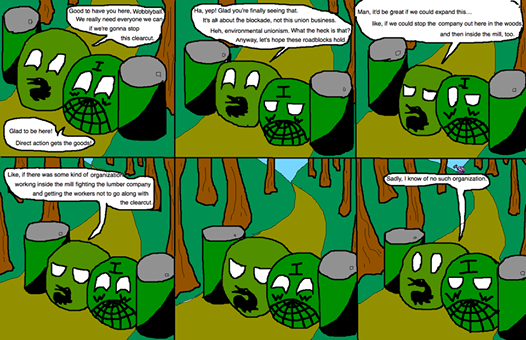
The Adventures of WobblyBall - Green Syndicalism, Part1

By Anonymous - Wobblyball, November 15, 2014

Disclaimer: The views expressed here are not the official position of the IWW (or even the IWW’s EUC) and do not necessarily represent the views of anyone but the author’s.

EUC Wobblyball encounters a critic of green syndicalism within the environmental movement, now with speech bubbles for legibility (any resemblance to real organizations or movements with problematic-as-hell gender politics is purely intentional).

Pages

The Fine Print I:

Disclaimer: The views expressed on this site are not the official position of the IWW (or even the IWW’s EUC) unless otherwise indicated and do not necessarily represent the views of anyone but the author’s, nor should it be assumed that any of these authors automatically support the IWW or endorse any of its positions.

Further: the inclusion of a link on our site (other than the link to the main IWW site) does not imply endorsement by or an alliance with the IWW. These sites have been chosen by our members due to their perceived relevance to the IWW EUC and are included here for informational purposes only. If you have any suggestions or comments on any of the links included (or not included) above, please contact us.

The Fine Print II:

Fair Use Notice: The material on this site is provided for educational and informational purposes. It may contain copyrighted material the use of which has not always been specifically authorized by the copyright owner. It is being made available in an effort to advance the understanding of scientific, environmental, economic, social justice and human rights issues etc.

It is believed that this constitutes a 'fair use' of any such copyrighted material as provided for in section 107 of the US Copyright Law. In accordance with Title 17 U.S.C. Section 107, the material on this site is distributed without profit to those who have an interest in using the included information for research and educational purposes. If you wish to use copyrighted material from this site for purposes of your own that go beyond 'fair use', you must obtain permission from the copyright owner. The information on this site does not constitute legal or technical advice.