You are here

green unionism

(Working Paper #11) Trade Unions and Just Transition

By Sean Sweeney and John Treat - Trade Unions for Energy Democracy, January 2018

In late 2015, after more than a decade of tenacious lobbying of government negotiators, union representatives led by the International Trade Union Confederation (ITUC) succeeded in getting the phrase “Just Transition” into the preamble to the Paris Climate Agreement negotiated at COP21. The text affirmed “the imperatives of a just transition of the workforce and the creation of decent work and quality jobs in accordance with nationally defined development priorities.”

More than two years have passed since COP21, and calls for a Just Transition have emerged from all corners of the global progressive community. Once more or less exclusively a trade union priority, calls for a Just Transition increasingly appear, in varying forms, in the campaigns of major environmental organizations, climate justice and green NGOs, and indigenous and farmers’ movements. However unevenly, Just Transition has begun to feature in discussions around national politics and policy, and unions increasingly refer to the current period as Just Transition’s “implementation phase.”

The Need for an Integrated and Transformative Politics

Unions for the most part understand that they must strive to develop a Just Transition politics that somehow addresses the immediate concerns of workers while keeping the need for a transition of the entire economy in view. A transition that is “just” from the perspective of workers or “the workforce,” but which fails to help achieve the needed socioeconomic transformation, will ultimately accomplish little to address pressing climate-related and broader ecological concerns. Alternatively, policies aimed at driving a socioeconomic transformation that are robust enough to achieve climate and environmental targets, but which ignore the impact on workers in specific locations or industries, risk being unable to secure the support from workers that such a transformation requires in order to be successful.

Social Dialogue” or “Social Power”?

In this eleventh TUED Working Paper, we argue that, in order to effectively achieve this full range of aims, the international trade union movement must collectively formulate and pursue a comprehensive, integrated approach. Doing so requires a sober examination of the origins and current state of debates over Just Transition.

Unions at all levels of the international trade union movement recognize that a broad transformation of our economy and society is urgently necessary. But the insistence on keeping “Social Dialogue” at the center of such discussions holds trade union debates captive to the narrative of the liberal business establishment, and to a very narrow and de-mobilizing interpretation of Just Transition. Anchored in the particular realities of post-war Europe, Social Dialogue has been effectively elevated to the status of an official ideology in recent years–one that is increasingly out of step with both the challenges facing workers and their organizations, and the pressing demands for action posed by the climate and ecological crisis more broadly.

This paper makes the case for a different and more expansive trade union conversation-one that can address worker-focused concerns while advancing deeper socioeconomic transformation. We call this the “Social Power” approach. This approach is guided by the belief that a Just Transition cannot be accomplished without a deep restructuring of the global political economy. Existing power and ownership relations must be challenged and changed. This is, of course, an extremely difficult task. But if this does not occur, then the vast majority of the world’s working people will never see anything vaguely resembling a Just Transition. We can at least begin by openly acknowledging that this needs to be our movement’s long term goal and then organize accordingly.

The paper offers examples from around the world that illustrate how this new approach is cohering within day-to-day trade union struggles, as well as at the level of ideas across the political left.

Download the full paper here.

Can Ecosocialist Praxis be a Real Alternative?

By Gordon Peters - London Left Green Blog, December 17, 2017

How can ecosocialism respond to the operation of power in capitalist accumulation and reproduction? Does ecosocialism help provide answers to struggles taking place in the local state and in sites of contest?

I want to suggest that it does in 4 broad ways:

1] The Refusal Strategy

This has a long lineage in class struggles in many different ways, but came to be articulated by the Italian Autonomists. Here I can only draw together some links from very different places in recent times and which all have as their distinct characteristics a refusal to yield to the capitalist logic and to say no to displacement.

For instance, indigenous struggles in Latin America particularly against mining, deforestation and land grabbing demand an anti-capitalist sustainability and in Bolivia were enshrined in the Cochabamba Declaration and the Rights of Mother Earth.

The Boycott, Divestment and Sanctions movement when applied to fossil fuels and Leave It in the Ground, anti-fracking protests in southern England and in Lancashire and Yorkshire, and campaigns on housing rights against estate demolition are increasingly confronting the demands of corporate capital and in their own sites of struggle re-framing demands in terms of rights to land, community, place to live, clean air and water, and freedoms, which are essentially ecosocialist.

The housing struggles in London are having to resist speculation and maximising value from land which depends on further debt creation and the actual emisseration of working class people by displacement of social housing, and in some cases further polarising class relations by building blocks with separate entries for ‘affordable’ and higher price housing.

I am involved in Haringey with the StopHDV campaign where the local state and the multi-national corporation Lendlease aim to establish a financial nexus worth several billion pounds as a 'development vehicle’ and in the process re-make Tottenham and Wood Green thereby displacing thousands of people.

As the plaintiff in a Judicial Review I have taken this struggle into the High Court, along with a broad coalition of people on the ground. Marching and protesting against the Council we refuse to accept the Haringey Development Vehicle, and in the court our final submission to the Council/corporate argument is ‘we say not so’.

This is the Refusal Strategy and it echoes to some degree the methods of 'In and Against the State’, in the 1970s, where workers were employed by but refused to be co-opted by the local state. It is however broader and puts much more emphasis on the protection of place and the right to a decent environment, mobilising residents as well as trades unionists.

Corporate profiteers plunder Puerto Rico

By Roberto Barreto - Socialist Worker, December 20, 2017

CORPORATIONS ARE making out like bandits from hurricane recovery efforts in Puerto Rico. The wheeling and dealing behind the scenes is enriching the few, to the tune of millions of dollars in government contracts, at the expense of the many on the island.

The vultures are making off with millions in contracts that include inflated rates of pay, which were agreed upon through a highly suspect and corrupt process. The elites are also trying to get away with privatizing the few public services that we have left.

But these aren't even the worst aspects of the whole contracting process in Puerto Rico today. The main problem with these deals and government-awarded contracts is that they hold back desperately needed reconstruction efforts at every step of the way. The politicians and business people are squandering time and resources while Puerto Rico continues to reel.

Facing Massive Discrepancy, Puerto Rico Governor Demands Recount of Hurricane Maria Deaths

By Julia Conley - Common Dreams, December 18, 2017

Following numerous reports that Hurricane Maria's death toll in Puerto Rico has been drastically under-counted by more than one thousand casualties, Gov. Ricardo Rosselló ordered an official recount of deaths related to the storm.

"This is about more than numbers, these are lives: real people, leaving behind loved ones and families," said Rosselló in a statement on Monday. "Every death must have a name and vital information attached to it, as well as an accurate accounting of the facts related to their passing."

Analysis by the New York Times has shown that the hurricane has led to far more casualties than the 64 that have been officially reported. While relatively few deaths may have been directly caused by the storm, the Times found that between Maria's landfall on September 20 and early December, 1,052 more Puerto Ricans had died than had over the same period of time in 2016.

The Center for Investigative Journalism (CPI), based on the island, found an even bigger discrepancy, reporting that 1,065 more people had died in September and October than in the previous year—a rise in mortality that could only be attributed to the storm, said the group. CPI blamed the huge gap in reporting on "the poor methodology being used to analyze and account for cases."

The higher-than-reported death toll is likely related to a lack of clean drinking water for many residents and the power outage that is still affecting nearly a third of the island.

While President Donald Trump insisted in early October that 16 people had died as a result of Hurricane Maria, 556 more deaths than usual had been counted by demographers since the storm. Around the same time, at least one million people were resorting to drinking water from Superfund sites and hospitals were struggling to care for people with diabetes, kidney disease, and other conditions, amid the power outage.

Rosselló has previously stood by the official count of 64 deaths. On social media, critics praised his call for a review of the death toll.

NUMSA condemns NERSA for granting Eskom a tariff increase

By Irvin Jim - NUMSA, December 18, 2017

The National Union of Metalworkers of South Africa condemns the National Energy Regulator of South Africa (NERSA) for granting Eskom a 5.2% tariff increase. Last month NUMSA and the United Front participated in public consultations on Eskom’s request for a 19.9% price increase in the 2018/2019 financial year, where we rejected the request. Below are five reasons why NUMSA rejects any increase in the cost of electricity:
  1. NUMSA is dismayed by NERSA’s decision to grant Eskom an above inflation 5.2% price increase. By doing so the energy regulator is demonstrating it does not act in the interests of the working class majority and the public in general. Most companies big and small simply cannot afford it. The tariff hike is likely to result in plant closures which will lead to more job losses and stifle growth in the economy.
  2. For the working class, access to electricity, like water, is a human right and therefore we demand free electricity for the working class and the poor, and affordable electricity for industry. The working class majority and the poor cannot afford to pay and the state should not commodify this basic human necessity.
  3. Eskom is poorly led and its senior management team is drowning in scandals. The management team has shown that it cannot be trusted to clean up the power utility. The outcome of the disciplinary hearing of Matshela Koko, the suspended acting CEO shows proves this. Koko was disciplined for failing to declare a conflict of interest regarding his step-daughters ownership of shares in a company which was awarded more than a billion rand in contracts by an Eskom division which he led. He was cleared of all charges and the chairperson has reinstated him. This is despite the fact that the hearings have been discredited because of allegations of board interference, and threats of intimidation.
  4. Furthermore in a period of just two years Eskom has had three CEO’s. It’s CFO has been suspended under a cloud of corruption and mismanagement.  Clearly the participation of private companies such as KPMG, Mackenzie and Trillian in the looting of Eskom resources, and the undue influence of the Gupta family in allegations of state capture, is a clear indication that paying more for electricity means endorsing this blatant theft of our country’s resources.
  5. NERSA has demonstrated that it is completely oblivious to the suffering of the working class majority. StatsSA has confirmed that more than half the population lives in abject poverty; more than 36% of the working population is unemployed and the gap between the rich and poor is ever widening. To make matters worse the economy is in junk status and growth prospects are very low. The majority of the working class cannot afford to pay for electricity. Therefore an above inflation increase of 5.2% will compound all these problems and increase the chances of a violent explosion in the country.

NUMSA together with the United Front will be holding regular demonstrations and pickets across the country next year to highlight these issues. What we need is free, safe and accessible energy for the working class and the poor. We reject any price increase because it will put electricity out of economic reach of the majority of people in the country.

Worker Solidarity with Camp Makwa and the Movement for Environmental Justice

By the Twin Cities GDC - It's Going Down, December 14, 2017

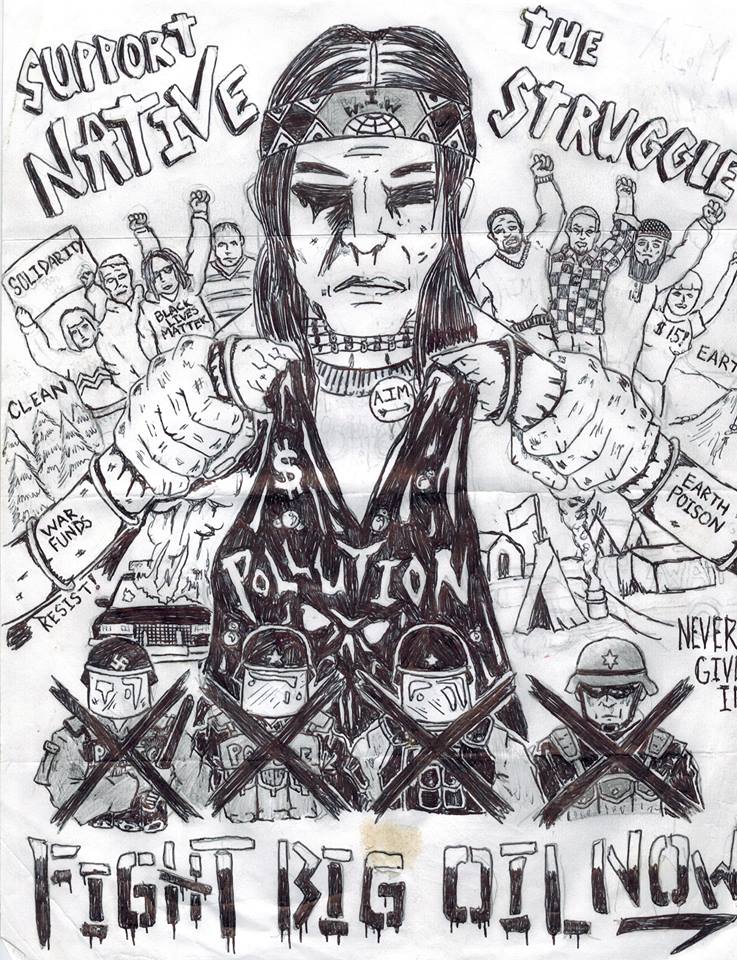
On Tuesday, December 5, 2017, the Twin Cities IWW unanimously passed a resolution reaffirming the IWW’s opposition to the construction of the Dakota Access Pipeline and the Keystone XL Pipeline as well as officially declaring its opposition to the construction of the Enbridge Line 3 Pipeline. The Twin Cities IWW pledged material support to water protectors, rejecting Enbridge’s arguments that the pipeline is necessary for jobs and prosperity for working class people, and put forward a vision of a “Just Transition” to a sustainable economy.

The resolution pledged two donations of $100 each to the legal defense fund and the supply fund of Camp Makwa, a resistance camp using direct action to protect the land and water that Anishinaabe people and other working class Minnesotans depend on. The resolution further endorsed the Black Snake Killaz Circuit, a series of fundraising concerts for Camp Makwa running across the Twin Cities and other towns in Minnesota and Wisconsin throughout the winter.

No Jobs on a Dead Planet

In the resolution, the Twin Cities IWW rejected the attempts by Enbridge and certain unions to paint the pipeline as good for workers. Instead, the resolution focuses on the harm that the oil industry does to its workers, surrounding communities, and the environment.

Enbridge’s existing Line 3 is the cause of the largest inland oil spill in US history, spilling 1.7 million gallons of oil into the Prairie River in 1991. In 2007, tragedy struck in Minnesota again with a pinhole leak explosion in Clearbrook, killing two workers, sparking a large fire, and spilling 15,000 gallons. This spill burned for three days, contaminating the air in the surrounding community. In 2010, Enbridge’s Line 6B pipeline also spilled, releasing around a million gallons of oil into Talmadge Creek and the Kalamazoo River and causing 30,000-50,000 houses to evacuate—and leaving twice as many without clean drinking water. In the aftermath of these spills, union workers have spoken out against Enbridge for failing to clean up their mess which has resulted in birth defects, illness, cancer, and death of both humans and animals in the area of the disaster.

In addition to these specific acts of negligence, the resolution noted the way in which the oil industry exposes working class communities and especially communities of color and indigenous people to the worst risks. These communities are often ignored and their well-being violated during the permitting process for pipelines and other infrastructure projects. For example, pipeline routes often avoid wealthier or majority-white towns and are directed rather through poorer areas, especially near indigenous land. This was the case with the Dakota Access Pipeline, and the same pattern can be seen with Line 3.

The resolution further emphasizes the reality of climate change, an accelerating trend that is already disrupting and destroying lives, economies, ecologies, and communities around the world. As the resolution notes, “there are no jobs on a dead planet.”

Faced with environmental dangers on a local and global scale, and unable to stop the lobbying power of well-connected companies, marginalized communities of workers are left with few choices except direct action. Water protectors face violence from the state and private security to defend the land and the people who live on it from the harm done by the oil industry.

The Invisibility of Poverty in Puerto Rico

By Oscar Oliver-Didier - CounterPunch, December 11, 2017

It has been more than two months since Hurricane María, a catastrophic category four hurricane, took a heavy toll on Puerto Rico’s infrastructure and dismally affected its local residents. People in the mainland saw pictures and videos of entire communities being physically disconnected due to bridges collapsing and roads being covered with debris. The news cycle kept repeating how extremely difficult it was to send rescue teams and aid to these heavily hit areas. And it is pretty common to know by now that any form of communication was basically inexistent—due to cellphone towers being torn down by strong winds—and that 100 percent of users were left without electricity right after the storm. Although some improvements have occurred, to this date, not much has changed. Only a little over half of the island has recovered electrical power—mostly intermittently.

Even though it has lost its persistent media coverage, what this dire aftermath and the subsequent relief and recovery effort have revealed is the island’s century-old unequal colonial relationship with the United States, and the local elites’ role in sustaining it. Recent controversy over the mishandling of the humanitarian crisis after Hurricane María should not surprise anyone. In the territory, as subaltern subjects, Puerto Ricans have been continuously subjected to a capitalist and racial hierarchical system.

These unjust core-periphery relations are a still evolving colonial condition that has made the territory a contested realm for economic extraction and injustices since the U.S. invaded the island in 1898. In fact, there is a similar case that dates back to an 1899 hurricane that devastated Puerto Rico called San Ciriaco—after which the U.S. quickly moved to devalue the local currency, raise property taxes, and put in place a corporate takeover of land that unleashed the sugarcane economic boom of this period.

As multiple recent news articles have highlighted, it has also laid bare the extreme inequality and conditions of poverty present throughout the U.S territory. Even the politically vocal Mayor of San Juan, Carmen Yulín Cruz pronounced recently in an interview that: “We will no longer be able to hide our poverty and our inequality with palm trees and piña coladas.”

It is important to note, however, that Puerto Rico has had a long history of obscuring poverty—especially after the Operation Bootstrap program was implemented in the island during the mid-twentieth century. This expedited modernization project was to become the Cold War’s antithesis to communist Cuba. Deemed a beacon for freedom and a laboratory for democracy in Latin America, huge amounts of federal money were transferred from the mainland to the territory in order to showcase Puerto Rico as capitalism’s success story.

However, this process of modernization was not working hand in hand with a long-term economic project that would actually lift most islanders out of poverty—today, more than 40 percent of residents live under the federal poverty line. By the 1970s, the economy started a downturn, so in 1976 Section 936 of the U.S. tax code was created to grant mainland corporations a tax exemption from their incomes originating from its Puerto Rico subsidiaries. Without a strong local economy—just a huge profit increase for mainland companies—when the tax exemption finally expired in 2006, Puerto Rico was left in economic shambles and has not recovered since.

Amid Worst Winter Wildfires in California History, Farmworkers Are Laboring in Hazardous Air

By Amy Goodman - Democracy Now!, December 11, 2017

In California, drought-fueled wildfires raged toward Southern California’s coastal cities over the weekend. The fires have scorched some 230,000 acres of land and forced nearly 200,000 people to evacuate. At least one woman has died so far. The wildfires are already the fifth largest on record in California history. Climate experts say the intensity of the winter blazes is linked to climate change. Authorities have warned residents to stay inside because of the dangerous air quality caused by smoke and carcinogenic ash from the fires. But a number of farms have stayed open, sparking concerns that farmworkers are laboring in hazardous conditions without proper equipment. Last week, volunteers handing out free protective masks to farmworkers say they were kicked off some farms, despite the fact that the pickers were asking for the safety equipment. For more, we speak with Lucas Zucker, who was evacuated last week due to the wildfires. Zucker is the policy and communications director for CAUSE—Central Coast Alliance United for a Sustainable Economy—and he helped distribute respirator masks to farmworkers who had to continue working despite the hazardous air quality conditions. We also speak with Democratic California State Assemblymember Monique Limón, who represents Santa Barbara and Ventura County.

AMY GOODMAN: This is Democracy Now! I’m Amy Goodman, as we turn to California, where drought-fueled wildfires raged toward Southern California’s coastal cities over the weekend, the fires scorching 230,000 acres of land, forcing nearly 200,000 people to evacuate. At least one woman has died so far. The wildfire is the fifth largest on record so far in California history, the largest ever recorded in December. Climate experts say the intensity of the winter blazes is linked to climate change.

Authorities have warned residents to stay inside because of the dangerous air quality caused by smoke and carcinogenic ash from the fires. But a number of farms have stayed open, sparking concerns farmworkers are laboring in hazardous conditions without proper equipment. Last week, volunteers handing out free protective masks to farmworkers say they were kicked off some farms, despite the fact the pickers were asking for the safety equipment.

For more, we go now to Southern California, where we’re joined by two guests. Via Democracy Now! video stream, Lucas Zucker, joining us from Ventura in Southern California, evacuated last week due to the wildfires. He’s policy and communications director for CAUSE—Central Coast Alliance United for a Sustainable Economy—helped distribute respirator masks to farmworkers who had to continue working despite the hazardous air quality conditions. By phone, we’re joined by Democratic California State Assemblymember Monique Limón, who represents Santa Barbara and Ventura County.

How Northwest Communities Are Stopping Big Oil Projects

By Sarah van Gelder - Yes! Magazine, December 7, 2017

“This is more fun than I’ve ever had in my life,” Don Steinke told me when I called him last week. Steinke, a retired science teacher, is a leader in the fight to stop what would be the nation’s largest oil-by-rail terminal. Last week, the state agency in charge of reviewing the application voted unanimously to oppose the terminal—a vote that could spell the end of the project.

First proposed in 2013 by Vancouver Energy, the terminal would have been built along the Columbia River in Vancouver, Washington; 360,000 barrels of oil a day were to be brought by rail and then loaded on ships for transport to West Coast refineries. But the project quickly ran into local opposition.

The power of local organizing to stop this project got my attention. The opposition is fueled both by local impacts on water and air, and by the fact that building new oil-transport infrastructure is a terrible idea at a time when we must phase out the use of fossil fuel if we are to avert climate catastrophe.

Communities throughout the Northwest, often led by Native American tribes, have been stopping one project after another.

Just last year, for example, what would have been the largest coal export terminal in the United States was cancelled in response to opposition from the Lummi Tribe, which holds treaty fishing rights to the nearby waters. The Otter Creek mine in southeast Montana was also canceled in the face of opposition from the Northern Cheyenne Tribe and area ranchers. Early this year, Washington state Public Lands Commissioner Peter Goldmark rejected a lease for a coal export facility in Longview, Washington, along the Columbia River; a county hearing examiner later denied the plant shoreline permits. Also this year, plans for a large oil terminal on the Washington coast were set back by a state Supreme Court ruling. The proposed terminal, which was opposed by the Quinault Tribe, would have shipped 17.8 million barrels of oil a year.

Seattle-based think tank Sightline Institute calls this opposition the “thin green line” separating tar sands oil, Powder River Basin coal, and Bakken fracked gas and oil from Asian markets. If these projects go through, Sightline estimates, they will release the carbon equivalent of five KXL pipelines.

How are these local groups able to succeed in the face of the power and money of huge energy corporations? What is it about place-based work that succeeds?

Farmworkers Resist and Organize: Connected Struggles for Farmworker Justice in South Africa and the US

By Edgar Franks - US Food Sovereignty Alliance, December 7, 2017

This past October I was part of the delegation sent by the US Food Sovereignty Alliance to South Africa. The delegation is part of a process to connect with groups throughout Africa with US-based Food Sovereignty groups to build an international analysis on the food system and to be in solidarity with one another.

During the 11 days our delegation was in South Africa, we were able to meet with many organizations throughout different regions, each with their unique struggles. Our delegation was small but represented many different sectors within the food system, including farmworkers, Black farmers, and immigrants; we all brought our own area or expertise to the trip and complimented each other well.

Even though every place we visited we learned a lot and were impacted by the amount of work and organizing that was happening, I want to share about the exchange that we had with the farmworkers in Robertson in the Western Cape.

Personally, I was able to connect to the farmworker struggle in the Western Cape, as there was a familiarity with the way issues and conditions were discussed. The analysis that was shared resonated with me profoundly considering that farmworkers here in the United States are also going through the same exploitation.

At Community to Community in Washington, we try to recognize that the struggle for farmworker justice is not limited to the workplace. Farmworkers’ lives are complex and have many intersections which is why we know that in order to achieve our goals – especially when it comes to transforming the food system – that we must go beyond just fighting for union contracts. Food Sovereignty for farmworkers also means being recognized as humans who are capable of leading ourselves. That is why we also organize for immigrant rights, climate justice, women’s rights, and food sovereignty.

Pages

The Fine Print I:

Disclaimer: The views expressed on this site are not the official position of the IWW (or even the IWW’s EUC) unless otherwise indicated and do not necessarily represent the views of anyone but the author’s, nor should it be assumed that any of these authors automatically support the IWW or endorse any of its positions.

Further: the inclusion of a link on our site (other than the link to the main IWW site) does not imply endorsement by or an alliance with the IWW. These sites have been chosen by our members due to their perceived relevance to the IWW EUC and are included here for informational purposes only. If you have any suggestions or comments on any of the links included (or not included) above, please contact us.

The Fine Print II:

Fair Use Notice: The material on this site is provided for educational and informational purposes. It may contain copyrighted material the use of which has not always been specifically authorized by the copyright owner. It is being made available in an effort to advance the understanding of scientific, environmental, economic, social justice and human rights issues etc.

It is believed that this constitutes a 'fair use' of any such copyrighted material as provided for in section 107 of the US Copyright Law. In accordance with Title 17 U.S.C. Section 107, the material on this site is distributed without profit to those who have an interest in using the included information for research and educational purposes. If you wish to use copyrighted material from this site for purposes of your own that go beyond 'fair use', you must obtain permission from the copyright owner. The information on this site does not constitute legal or technical advice.