You are here

green unionism

Remake Puerto Rico’s power grid and create a universal basic income

By Elsie Bryant  - Climate Change News, December 6, 2017

Hurricane Maria, which made landfall at the end of September, left the island of Puerto Rico without energy, as more than three-quarters of its energy infrastructure was lost to the storm.

As Puerto Ricans sought help in restoring power to the people, for green energy enthusiasts, the destruction of Hurricane Maria was an opportunity to rethink – not just rebuild – Puerto Rico’s energy infrastructure by going off-grid with solar energy.

Puerto Rico has a once in a lifetime opportunity to rethink how it gets electricity”, wrote Earther journalist, Brian Kahn; “Solar industry wants to build Puerto Rico’s grid of the future” was the Bloomberg headline. Even the energy and environment minister for the Maldives, Thoriq Ibrahim, weighed in: “Puerto Rico hurricane shows islands must have renewable energy,” he wrote. Elon Musk has been one of the more prominent players in the space, with his company Tesla offering solar systems and batteries.

While any move away from fossil fuels is welcome, we need to think bigger about what resilience could mean for Puerto Rico. There’s an even larger opportunity here to transform Puerto Rico, where before the natural disaster happened, an economic and social crisis has been playing out for nearly a decade.

Puerto Rico’s economy has been in recession for over 10 years, the population is in drastic decline and the household income is less than half of what it is in the poorest US state. All the while, the island’s debt burden continues to grow, making private firms very rich. A resilient Puerto Rico needs not just a new grid but a new economic system, one that is localised and community driven, with Puerto Ricans owning and managing those resources.

This is not a vision that Puerto Ricans are waiting for the wider world to bring to them. Ángel Figueroa Jaramillo, head of Utier, the electrical workers’ union in Puerto Rico, told reporters “solar power and wind power in Puerto Rico is really the key to the future of the island’s energy independence”, adding that “all the alternatives have to be owned by the community”.

The benefits of community ownership are clear when the evidence shows that some of the most resilient communities following the hurricane were cooperatives such as the Cooperativa de Vivienda Ciudad Universitaria. The co-op is a community of over 1000 people, who as the Orlando Sentinel reported, “learned to formalise the neighbour-to-neighbour mentality so well that in situations of crisis – such as this one – they don’t have to wait for the government to show up or feel the need to flee”.

Thinking even more radically, the gains of a commons-based solar network, could be extended by advocating that dividends from any energy sold back to the grid could be redistributed to every Puerto Rican as a basic income.

Twin Cities IWW Resolution in Solidarity with Camp Makwa and the movement for environmental justice

Adopted Unanimously by the Twin Cities IWW General Membership Branch - December 5, 2017
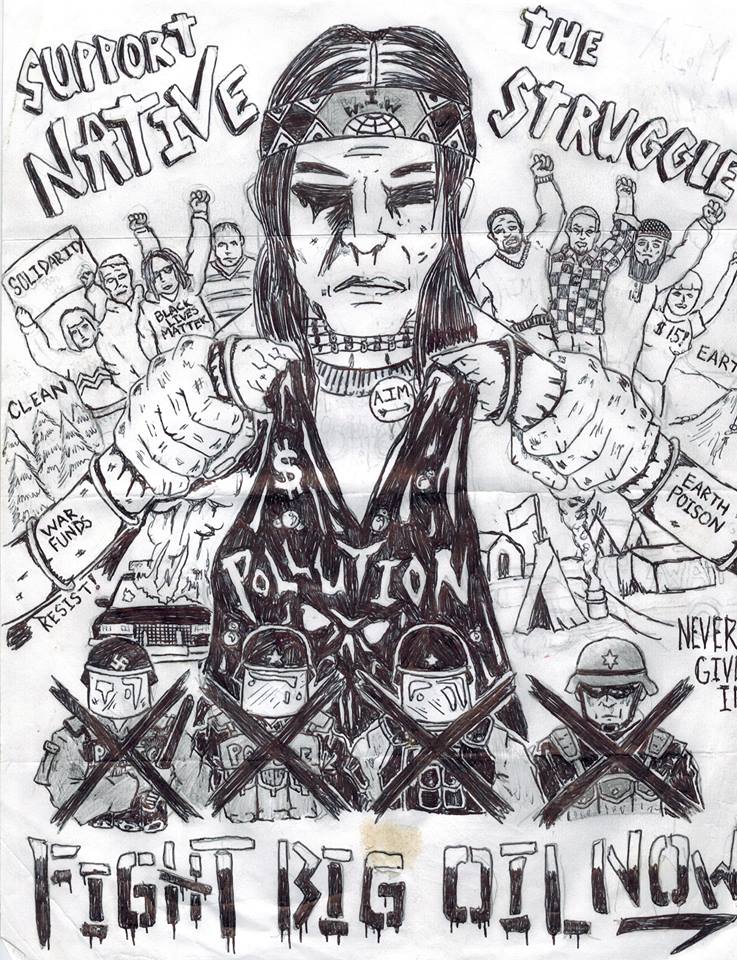
Whereas: On March 3rd 1991 the Line 3 pipeline caused the largest inland oil spill in US history, rupturing in Grand Rapids, Minnesota spilling 1.7 million gallons of oil into the Prairie River; and

Whereas: In July 2010, Enbridge also spilled about a million gallons of Dilbit Oil in the Kalamazoo River when the Line 6B pipeline burst and flowed into the Talmadge Creek and then the Kalamazoo before the the spill was contained. On 29 July 2010, the Calhoun County Health Department asked 30 to 50 thousand households to evacuate, and twice as many were advised not to drink their water. Union workers cleaning up the Kalamazoo Spill have spoken against Enbridge for insufficiently cleaning up the spill which has resulted in birth defects, illness, cancer and death of both humans and animals in the area of the disaster; and

Whereas: In 2007, 2 Enbridge workers were killed in Clearbrook, Minnesota when a pinhole leak explosion sparked a huge fire and spilled 15,000 gallons of oil. Enbridge let the spill burn for three days poisoning the air of the surrounding community; and

Whereas: The Oil Industry and many other unsustainable industries sacrifice the health and safety of the working class and poor communities, especially many indigenous and communities of color. These communities are subject to environmental racism and classism and often ignored and violated during the permitting process of such projects; and

Whereas: These communities often are forced to defend themselves with direct action which puts them at greater risk of violence and incarceration from the state and private security; and

Whereas: The construction of these pipelines will contribute to the acceleration of already dangerous levels of currently existing greenhouse gas emissions which are contributing to the already dangerous effects of climate change, which could lead to a dead planet with no jobs; and

Whereas: Camp Makwa was established in August of 2017 to resist the pipeline using direct action to protect the water and natural resources such as the wild rice lakes, fishing and hunting, and farming that the Anishinaabe Tribe and working class in the area depend on. They have taken several direct actions to shut down construction of the Line 3 pipeline in Superior, Wisconsin and will resist the possible expansion in the spring. They are currently still camping during the harsh Minnesota winter.

Whereas: Neither the Line 3 Pipeline Dakota Access Pipeline, or the Keystone XL Pipeline will provide anywhere near the number of permanent union jobs the promoters of these projects promise they will, and

Whereas: More permanent union jobs can be created at union wages by decommissioning oil pipelines and upgrading water pipeline infrastructure, such as in Flint, Michigan. LIUNA and many labor unions currently have jobs working in the renewable energy sector such as solar, wind, and hydroelectric and could organize for a rapid transition of energy production and manufacturing to be safe for the workers, the surrounding communities and the environment. Though these renewable energy jobs are currently, typically non-union, trade unions if so determined, could easily develop a successful green energy organizing program, using solidarity unionism, that would revitalize the currently struggling labor movement. Far more jobs currently exist in the growing renewable energy sector than in the declining fossil fuel sector. Also these pipeline projects will not deliver the promised "energy security" or "energy independence" promised by their promoters, including the Building Trades and AFL-CIO Union officials among them and;

Whereas: Many unions, including the IWW, ILWU, ATU, APWU, LIUNA-City Employees Local 236, CWA, UE, SEIU, NNU, Pride at Work, A. Phillip Randolph Institute, the Asian Pacific American Labor Alliance, the Coalition of Black Trade Unionists, the Coalition of Labor Union Women, the Labor Council for Latin American Advancement, Labor for Standing Rock, and many members of other Labor organizations have already publicly stated opposition to the Dakota Access Pipeline and or the Keystone XL Pipeline; and

Whereas: President Donald Trump's executive orders that dismantle environmental regulation and ostensibly "clear a path" for the completion of the aforementioned pipelines are contradictory in nature and are designed primarily to divide workers and environmentalists over the false dichotomy of "jobs versus the environment"; and

Be Resolved that: The Twin Cities IWW reaffirms the IWW’s opposition to the construction of the Dakota Access Pipeline and the Keystone XL Pipeline as well as officially declares its opposition to the construction of the Line 3 Pipeline; and

Be it Also Resolved that: The Twin Cities IWW donates $100 each to both Camp Makwa’s legal and supply fund (Legal | CAMP SUPPLIES FUND) and urges our Union’s members, the Labor Movement, and working class to pass resolutions like this one, donate, join, and organize in solidarity with Camp Makwa, the resistance to Line 3, and the movement for environmental justice, locally and abroad.

Be it also Resolved that: The Twin Cities IWW endorses Black Snake Killaz Circuit, a collection of benefit shows created by organizers, artists, and eco-activists who are standing in solidarity with indigenous water protectors and their accomplices fighting Line 3 to defend Anishinaabe land and water from the extractive industry; and

Be it Further Resolved that: The Twin Cities IWW calls on rank and file members of the Building Trades, Teamsters, and other unions who have declared support for these pipelines and other unsustainable projects to implement Green Bans and take direct action by striking and or slowing down in solidarity with the communities resisting Line 3, additional pipelines, and other projects that are exploitive of the working class and the plant we inhabit.

Be it Additionally Resolved that: The Twin Cities IWW calls on the working class, unions, and the unsustainable companies that employee them, such as Enbridge, as well as their financial supporters to develop and rapidly implement a "Just Transition" plan for workers in unsustainable industries, such as pipeline and oil industry workers, to be trained in and given union jobs in the green energy sector. ; and

Be it Finally Resolved that: The Twin Cities IWW reaffirms our belief and commitment to revolutionary industrial unionism, environmental justice, and community self-defense with our goal to “organize as a class, take possession of the means of production, abolish the wage system, and live in harmony with the Earth.”

COPPING OUT AT COP, Avoidance and possibility in a burning world

By Dave Bleakney - Global Justice Ecology Project, November 30, 2017

During the recent Bonn summit a taxi driver provided a clear summary. Asked what he thought of COP 23, he replied “the climate is in crisis, but here, this is about money”. He had provided what had been missing inside. As we race toward certain and expanding catastrophe, he underscored that profiteering off a destructive cycle production, consumption, shipping, the unnecessary transport of products over vast distances and continuous growth models form the basis from which these discussions are framed. It is as though the elephant in the room is never acknowledged, with few exceptions.

How does this appear? In North America you can try this experiment. Turn down the volume of your TV and watch the myriad of commercial advertisements where someone is unhappy until they possess a certain product and suddenly, presto! Everything is great and everyone is happy. The same rubric repeats, again and again. Buy and smile. Smile and buy. Crave to belong as if this will somehow connect us together and create momentary windows of happiness while the earth burns. A crude system of modern feudalism has engulfed the planet where a handful of men – eight, to be precise – own half the planet. In this obscene reality a man can be worth more than a nation. Political leaders and major institutions act as though by convincing a handful of rich sociopaths we can save life on the planet.

Yet power does not, and never has, surrendered anything without a fight or creation of something new. Our uncomfortable future demands that climate criminals should not be enabled with our caps in hand with appeals to do the right thing – certainly those outcomes have been far too modest to date. The rules of the game must change that would remove them from their pedestals of power and our addictions to things we really do not need (and often having them increases the cycle and need for more) while altering the current definitions of value including patriarchal approaches thousands of years old of competition and “winning” at the expense of another.

At COP we are like hamsters on a wheel, living off the ripples of colonialism and wealth accumulation while discussing the speed at which the wheel turns through a series of silos and frameworks. What is needed is to get off that wheel and reconnect with our essence, the earth, and one another.

In this madness, the darker your skin the more you pick up the slack now resulting in myriads of climate refugees fleeing a crisis created while a minority of the planet went shopping. Under current conditions this phenomenon will play out over and over. Hungry people intent on survival will be blamed and shamed, even attacked for doing the only thing left to them: escape to a better place. When people are hungry, what can you expect? Famine breeds war and conflict. The world’s greatest militarist, the United States, built on dispossession has essentially been at war with someone on a continuous basis for nearly two centuries of conquest, often aided by one ally or another. Since 2001, that nation alone has spent $7.6 trillion on the military and Homeland Security in an ongoing war economy.

Little was accomplished at COP, a few very modest breakthroughs (or diversion) lacking any enforcement mechanisms or meaningfully incorporating a gender or Indigenous analysis into the core of action. While climate talks are essential, they are rendered ineffective by living in this bubble. One former UNFCCC official told me that people know this but are locked into a series of “frameworks” and disconnected silo building that does not dare upset the apple cart, a centuries-long mercantilism built on exploitation, greed and accumulation at the expense of the other and all living systems. This same system that uses the atmosphere as a chemical sink for profit. The oil continues to flow and the coal dug.

No longer can it be business as usual where the new normal is unprecedented and frequent catastrophic weather conditions (which can only get worse) and will be normalized for new generations. A tweak here and there won’t cut it.

Indigenous peoples appear to have a better grasp of living with the earth rather than against it as their lands continue to be exploited for resource extraction and profits. Indigenous voices are tolerated, welcomed even, but rarely is this wisdom applied to our reality. In the Canadian context, this vision is met by a system where Indigenous colonized peoples are undermined by super mines, pipelines and general disrespect.

It does feel good to see any progress whatsoever and we hang our hat on that. Political cachet can be earned by playing to domestic audiences as part of this theatre. No better example exists than the myth of Canada as a progressive nation and its new proposed phase-out of coal policy. Through carbon offsets, which shall keep the coal burning until at least 2060 and exports continuing after that date (hardly a victory). While presented as progress it is ineffective, and a diversion which obscures the continuing plan to build pipelines and keep dirty Canadian oil flowing. The tyranny of oil extraction and the use of the atmosphere as a chemical sink for profit remains while the human and animal population subsidize this senseless tragedy.

Who will take on international transport, shipping and aviation? If these sectors were a country they would be the seventh largest polluter where products that could be produced locally at less environmental cost are shipped vast distances.

What does this mean for workers? As we say, don’t oppose, propose. The Union I represent, the Canadian Union of Postal Workers know that a just transition out of destructive practices requires better approaches that we all need to be a part of. We live in a society where some work too much and others have no possibility at all. Incorporation of other more holistic and sustainable values allows us to step outside the box and refocus. Our Delivering Community Power initiative, driving Canada Post to be an engine of the next economy including the use of renewable non-polluting energy, transforming and retro-fitting post offices to produce energy at the local source and eliminate carbon from delivery systems– the latter which has already happened in over 20 cities in Norway (and is growing). Putting more postal workers on the street and less cars also means more face to face contact and added community value by checking in on senior citizens who are isolated. Postal workers have put climate change on the bargaining table. By incorporating Indigenous and feminist values of nurture and care into our future we shift the nature of work and become meaningful actors in solutions. This approach was energized and inspired by the LEAP Manifesto which calls for a restructuring of the Canadian economy and an end to the use of fossil fuels. This is framed by respect for Indigenous rights, internationalism, human rights, diversity, and environmental stewardship. We cannot leave it to corporations and politicians. We are all part of this solution now and have the opportunity to claim the space to do it.

The indigenous Ojibwe have a saying about the seven generations. They say that for every move we make, it must always be done with a view on how it could impact people seven generations from now. The leaders of this planet would do well to listen to that advice.

We require a new kind of COP. There will be no shopping on a dead planet and reassembling the deck chairs of the Titanic will not help. Creativity and better value systems can.

NUMSA and United Front Joint Memorandum on the Eskom tariff increase

By Irvin Jim, Trevor Ngwane, and Lindiwe Malindi - NUMSA, December 1, 2017

The National Union of Metal Workers (NUMSA) and the UNITED FRONT (UF) are extremely dismayed by the opportunistic call made by the Eskom board and its management to increase the electricity tariff by 19.9%. We view this demand by Eskom as nothing more than a gross abuse of power, and an attempt by the State Owned Entity (SOE) to hold the entire country and the economy hostage. This is being done by an entity which has been moving from one scandal to another with absolutely no leadership. In fact, it is extremely shocking that in a period of just two years, Eskom has changed CEO’s three times, and its CFO, Anoj Singh, has been suspended under a cloud of corruption and mismanagement allegations. But the same company and its board have the audacity to make an outrageous demand for a 19.9% tariff increase. They have no regard for the catastrophic implications which will trigger a national crisis of plant closures of small, medium and large companies; as well as causing retrenchments in all big companies. It will in fact destroy all opportunities to stimulate real economic growth and jobs.

Socio-Economic Situation

NUMSA and the UF are of the view that the economy has been in a technical recession for several months which means the working class of this country are facing a job-loss blood bath across all sectors. Currently more than 36% of the working population is unemployed, and the numbers are increasing. More than 30.4 million of the population lives in abject poverty; the average worker supports at least 5 dependents on his/her meagre income, and at least 26 million South Africans go to bed hungry. Any change in the price of electricity will compound all these problems and increase the chances of a violent explosion in the country.

It is against this backdrop that NUMSA and the United Front reject Eskom’s outrageous demand for a 19.9% tariff increase. The Eskom board are clearly completely deaf and blind to the suffering of the working class because they decided to make this proposal in spite of the fact that there is glaring evidence that the working class majority simply cannot afford an increase in the electricity rate. The United Front and NUMSA have decided to hold this demonstration to express our anger with Eskom for wanting to increase the suffering of the working class, by requesting a tariff increase.

Hamilton transit in the Age of Austerity

By Blake McCall and Caitlin Craven - Rank and File, November 29, 2017

Editor’s introduction: This is the second half a two-part series on how austerity has damaged public transit. In this article Blake McCall, a Hamilton bus operator and ATU Local 107 member, and Caitlin Craven, a CUPW Local 548 and local Fight for $15 and Fairness organizer, examine how decades of underfunding has undermined Hamilton’s transit system, the HSR.

Like all transit systems in the province, the HSR was the victim of city budget cuts in the 1990s stemming from provincial cuts under Premier Mike Harris and others.  A startling statistic is that the total number of buses on the street was higher in the 1980s than it is now, despite the city having grown in size. This unsurprisingly has seen a drop in ridership from 29 million trips per year in the late 1980s to roughly 22 million trips per year today.  In recent years the city has started to put more money back into the system, but it has never recovered from these cuts.

Survival on the island of the portable generator

By Judith Lavoie - Socialist Worker, November 28, 2017

IT IS now more than two months after Hurricane Maria struck, and Puerto Rican society is completely reliant on portable electrical generators.

Businesses and services that we thought were back to normal frequently have to close up shop because their generators break down or are in need of maintenance or repair. Everywhere you go, almost all the businesses that are open are only open part time--and even these have to open and close depending on when electricity is available to them.

Doctors have to postpone critical medical services such as CT scans because some generators simply can't sustain the machines.

These days, when we make any kind of plans, they are always tentative, because an unexpected power outage can quickly force us to cancel. These power outages can happen because of yet another failure in the electrical grid or because someone's generator has failed--yet again.

The government insists that 50 percent of homes have had electrical services re-established. They arrive at this percentage by taking the total amount of electricity being generated and estimating the number of homes served based on the island's maximum electrical load.

"This isn't the way it is done," said Matthew Cordaro, a trustee of the Long Island (N.Y.) Power Authority, told El Nuevo Dia. "The first thing you have to do is figure out how many of the distribution lines reach customers and how many have been re-established...What electricity is being generated and sent to the network is not actually being tracked. Instead of this, chaos reigns."

At the beginning of November, in the midst of the controversy about how they calculated the number of homes connected to the grid, the U.S. Department of Energy stopped counting the number of homes without electric service in Puerto Rico altogether.

Alternatives to the Site C Dam Will Create Way More Jobs: UBC Analysis

By Judith Lavoie - DeSmog Canada, November 28, 2017

Alternatives to the $10 billion Site C dam would produce significantly more jobs than construction of the controversial hydroelectric dam, according to a new study led by the University of British Columbia.

The analysis by researchers from UBC’s Program on Water Governance found that if Site C is scrapped, there would be modest job losses in the short-term — 18 to 30 per cent until 2024 — but job gains of between 22 and 50 per cent through 2030.*

A recent three-month investigation conducted by the B.C. Utilities Commission found alternatives to Site C, including wind energy and conservation measures to reduce provincial electricity demand, could replace the dam at an equal or lower unit energy cost.

By 2054, the B.C. Utilities Commission alternative portfolio will have created three times as many jobs as Site C,” Karen Bakker, one of the authors of the report and co-director of the Program on Water Governance, told DeSmog Canada.

Site remediation, geothermal construction and energy conservation will create thousands of jobs each year,” she said.

Alternative energy, such as wind power, creates many more jobs for every dollar spent, Bakker told DeSmog Canada.

A Green New Deal for Washington State: Climate Stabilization, Good Jobs, and Just Transition

By Robert Pollin, Heidi Garrett-Peltier, and Jeannette Wicks-Lim - Political Economy Research Institute, December 4, 2017

This study examines the prospects for a transformative Green New Deal project for Washington State.  The centerpiece of the Green New Deal will be clean energy investments—i.e. both investments in the areas of renewable energy and energy efficiency.  The first aim of this Green New Deal project is to achieve a 40 percent reduction in all human-caused carbon dioxide (CO2) emissions in Washington State relative to the state's 2014 emissions level.  The second aim is to achieve this 2035 CO2 emission reduction standard while also supporting existing employment levels, expanding job opportunities and raising average living standards throughout Washington State.   

We estimate that clean energy investments in Washington State that would be sufficient to put the state on a true climate stabilization trajectory will generate about 40,000 jobs per year within the state.   We consider a series of policies to support this state-level Green New Deal program.  These include a carbon tax, which we estimate can raise an average of about $900 million per year even with a low-end tax rate of $15 per ton of carbon.   We also consider a series of regulatory policies, direct public spending measures, and private investment incentives.

Read the text (PDF).

Landworkers’ Alliance launch new Horticulture Policy Proposals

By staff - Land Workers Alliance, October 30, 2017

To meet the UK demand for fruit and vegetables a massive scaling up of production is required. Currently UK production represents 58% of vegetables consumed and only 11% of fruit. Only 1% of Pillar 1direct agricultural payments are offered to the horticultural sector, despite public health advice to increase consumption of fruit and vegetables, and reduce meat, dairy and sugar.

The Landworkers’ Alliance propose that a dramatic increase in the number of small and medium scale horticultural enterprises producing fruit and vegetables for local and regional markets would bring benefits, including:

  • Fresher produce, often bought within hours of harvest, brings greater nutritional benefit and better flavour, encouraging increased consumption.
  • Diverse market gardens provide fulfilling, varied and attractive career/employment opportunities for UK workers, whereas large scale, industrial production often struggles to attract local labour.
  • Spreads production risks over a much larger number of businesses in different geographic areas, insuring against problems of poor business management, spread of pests and diseases, and climatic extremes, compared with dependency on a handful of large businesses.

Author of the “A Matter of Scale” report, Rebecca Laughton says, “Contrary to popular belief, for labour intensive crops such as peas, kale, green beans and salad leaves, small-scale ecological growers often produce higher yields than industrial systems, while generating multiple environmental and social benefits. If every village, town and city was served by a network of these diverse and productive market gardens, which provide attractive opportunities for work, training and connection to the countryside, as well as fresh and tasty produce, the UK population would be healthier and happier”.

Today, the Landworkers’ Alliance outlines their proposals for how this increase in market gardens could be achieved in their new policy document, “A New Deal for Horticulture”. Seven specific measures are outlined, including:

· A coupled support scheme to incentivise domestic production and reward delivery of public goods, until the sector has strengthened sufficiently to meet a high percentage of UK demand.

· A programme to rapidly increase the number of growers, recruitment, training and access to land and start-up capital.

· A “Mixed Farms” scheme, supporting creation of horticultural units on larger farms.

· An orchard planting and maintenance scheme to encourage long term investment in fruit production.

The policy proposals are being launched on the eve of the Food Foundation’s Vegetable Summit, at which a number of leading figures in public health, agricultural policy and retail will be making pledges about measures they will take to increase fruit and vegetable consumption. The Landworkers’ Alliance supports this initiative to promote the production and consumption of UK fruit and vegetables, and believes that given an appropriate policy framework, agroecological horticulture could play a significant role in meeting the UK’s need for fresh produce.

Trump’s war on science

By Cliff Connor - Socialist Alternative, November 27, 2017

— Cliff Conner is currently writing a book entitled “The Tragedy of American Science.”

How loathsome is the Trump administration? Let me count the ways. On second thought, let me not—it would take too long. But one important threat it poses to the United States and the world is to the integrity of American science. Earlier this year, on Earth Day, April 22, hundreds of thousands of people responded to that danger by participating in the March for Science in Washington, D.C., and 600 other cities and towns across the country. How has American science fared since then?

Many right-wing politicians and public intellectuals are torn between repugnance for Donald Trump’s truculent ignorance and exuberance at the prospect that he can help them accomplish their goal of “dismantling the administrative state.” Trump’s first year in office helped advance their strategy of destroying public faith in “big government” by discrediting it. Not only are the Trump administration’s various agencies and cabinet offices laughably incompetent and ethically compromised; the office of the presidency itself has forfeited all claim to the respect of intelligent citizens.

The offensive against “big government” is driven by billionaire donors who finance right-wing think tanks, political campaigns, and media outlets. Their single-minded goal is to reduce their taxes and roll back governmental regulation of their businesses, especially with regard to environmental and public health protection. Their crusade against federal regulatory powers entails going to battle against empirical reality, rationality, knowledge, and expertise—in short, they have declared war against science.

The deregulation of corporate activities that have compromised the credibility of American science did not begin with Trump. Nor was it exclusively a Republican political project; the Carter, Clinton, and Obama administrations all likewise furthered the deregulation agenda.

It should not be forgotten that many of the environmental rules and regulations Trump’s team has rescinded were only put in place by Obama in the closing days of his eight-year tenure as president. All they accomplished was to provide easy targets for Trump to knock over. The tawdry assemblage of antiscience policymakers appointed by Trump, however, amounts to a reductio ad absurdum of the whole process.

Pages

The Fine Print I:

Disclaimer: The views expressed on this site are not the official position of the IWW (or even the IWW’s EUC) unless otherwise indicated and do not necessarily represent the views of anyone but the author’s, nor should it be assumed that any of these authors automatically support the IWW or endorse any of its positions.

Further: the inclusion of a link on our site (other than the link to the main IWW site) does not imply endorsement by or an alliance with the IWW. These sites have been chosen by our members due to their perceived relevance to the IWW EUC and are included here for informational purposes only. If you have any suggestions or comments on any of the links included (or not included) above, please contact us.

The Fine Print II:

Fair Use Notice: The material on this site is provided for educational and informational purposes. It may contain copyrighted material the use of which has not always been specifically authorized by the copyright owner. It is being made available in an effort to advance the understanding of scientific, environmental, economic, social justice and human rights issues etc.

It is believed that this constitutes a 'fair use' of any such copyrighted material as provided for in section 107 of the US Copyright Law. In accordance with Title 17 U.S.C. Section 107, the material on this site is distributed without profit to those who have an interest in using the included information for research and educational purposes. If you wish to use copyrighted material from this site for purposes of your own that go beyond 'fair use', you must obtain permission from the copyright owner. The information on this site does not constitute legal or technical advice.

