You are here

green unionism

How corporate thieves prey on Puerto Rico

By Christopher Baum - Socialist Worker, November 17, 2017

ALMOST TWO months after Hurricane Maria struck Puerto Rico, more than 750,000 Puerto Rican homes and businesses remain without electricity.

Yet political and business elites in the U.S. and on the island itself seem more interested in continuing the project of turning Puerto Rico into a cash machine for private companies than in giving the Puerto Rican people the aid they desperately need.

In the weeks following the hurricane, the Puerto Rico Electric Power Authority (PREPA) signed two highly dubious contracts with private U.S. firms to help with the rebuilding of the island's utilities infrastructure.

The more notorious of the two deals was a $300 million contract with a little-known Montana company called Whitefish Energy, which at the time Maria struck had only two permanent employees--and no experience on any projects even remotely approaching the scale of rebuilding Puerto Rico's power infrastructure.

In fact, as a two-year-old company, Whitefish could claim very little experience of any kind. What they did have going for them, apparently, was ties to the Trump administration's Interior Secretary Ryan Zinke.

This deal was so suspicious that even many congressional Republicans cried foul. In the face of enormous public and political pressure, Puerto Rico Gov. Ricardo Rosselló announced on October 29 that he had instructed PREPA to cancel the Whitefish contract.

The deal still works out pretty well for Whitefish, however. As the New York Times reported, the company will continue to do repair work on the island through November 30.

The contract permits Whitefish to bill PREPA $319 an hour for each worker--of which the workers themselves, according to the Times, will receive between $42 and $100 an hour.

Whitefish is also authorized to charge $412 per worker per day for food and lodging, along with similarly exorbitant rates for equipment and transportation. As the Times notes, all of these figures as far above the norm, even for emergency work in remote areas.

And to top it all off, millions of Puerto Ricans who had their power restored were plunged into darkness again when a high-voltage transmission line supposedly repaired by Whitefish failed again.

NUMSA’s Submission to NERSA on Eskom’s Application for a tariff increase

By Irvin Jim - NUMSA, November 15, 2017

NUMSA is a manufacturing union and since 2009, the union has witnessed the deep global crisis of capitalism in the manufacturing sector. NUMSA has witnessed hemorrhaging of jobs, plant closures retrenchments the downward variation of conditions and benefits of workers and the casualization of labour. At the centre of this crisis, especially in small, medium-sized companies has been the uncompetitive Eskom electricity tariffs.

The history of job losses can be traced to wrong the ANC government neo-liberal policies such as liberalization of trade, removal of exchange controls, continuous and the maintenance of high interest rates by the Reserve Bank. This situation was worsened the day government made the decision to move Eskom away from its core mandate which was to supply cheap electricity to the economy in order to grow the economy, to electrify communities and to create jobs. This mandate was replaced by a backward government and NERSA with the decision to prioritize their balance sheet, which was nothing more than to chase profits.

NUMSA has consistently called for the nationalization of all commanding heights of the economy and all our minerals. In the case of Eskom, we have consistently made a call that government must nationalize the strategic coal mines that must supply the national grid with cheap quality coal, so that we can escape the continuous exorbitant prices of primary coal, and deliver a competitive electricity tariff. If one were to look at the exorbitant primary coal tariff increases from 2007 to 2016, they are indeed shocking and appear to be a money-making scheme which is not in line with the original mandate of Eskom.

Imagining a New Social Order: Noam Chomsky and Robert Pollin in Conversation

Interview by C.J. Polychroniou - Truthout, November 19, 2017

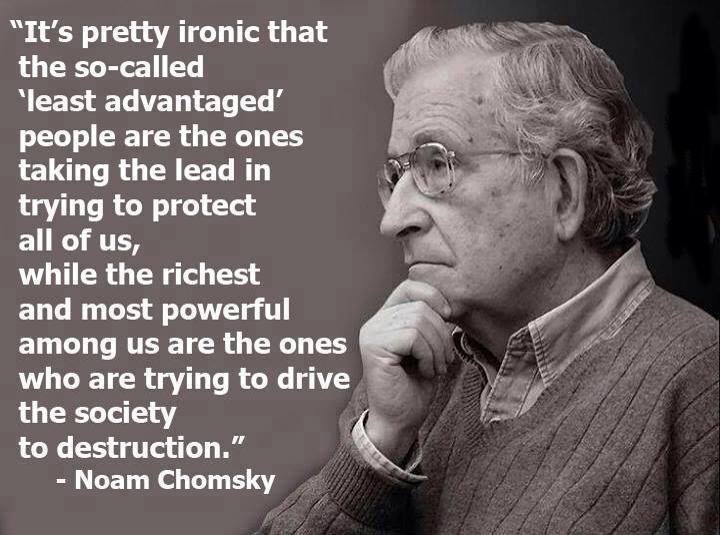
We live in an age of illegitimate neoliberal hegemony and soaring political uncertainty. The evidence is all around: citizen disillusionment over mainstream political parties and the traditional conservative-liberal divide, massive inequality, the rise of the "alt-right," and growing resistance to Trumpism and financial capitalism. 

Yes, the present age is full of contradictions of every type and variety, and this is something that makes the goals and aims of the left for the reordering of society along the lines of a true democratic polity and in accordance with the vision of a socialist reorganization of the economy more challenging than ever before.

In this context, the interview below, with Noam Chomsky and Robert Pollin, which appeared originally in Truthout in three separate parts, seeks to provide theoretical and practical guidance to the most pressing social, economic and political issues facing the United States today. It is part of an effort to help the left reimagine an alternative but realistic social order in an age when the old order is dying but the new has yet to be born.

Noam Chomsky is professor emeritus of linguistics at MIT and laureate professor in the department of linguistics at the University of Arizona. Robert Pollin is distinguished professor of economics and co-director of the Political Economy Research Institute at the University of Massachusetts at Amherst. These two thinkers are pathbreakers in the quest to envision a humane and equitable society, and their words can provide a helpful framework as we strive -- within an oppressive system and under a repressive government -- to fathom new ways of living together in the world.

C.J. Polychroniou: Noam, the rise of Donald Trump has unleashed a rather unprecedented wave of social resistance in the US. Do you think the conditions are ripe for a mass progressive/socialist movement in this country that can begin to reframe the major policy issues affecting the majority of people, and perhaps even challenge and potentially change the fundamental structures of the US political economy?

Noam Chomsky: There is indeed a wave of social resistance, more significant than in the recent past -- though I'd hesitate about calling it "unprecedented." Nevertheless, we cannot overlook the fact that in the domain of policy formation and implementation, the right is ascendant, in fact some of its harshest and most destructive elements [are rising].

The Spotted Owl or: How the Right Won the Working Class

By staff - Cited, November 17, 2017

Judi Bari’s effort to ally forest workers and environmentalists could have changed the course of climate activism forever. Could her parable help us today? 

Cited teams up with Dissent’s Hot and Bothered podcast and the Pacific Institute for Climate Solutions to tell the story of tree spiking, a Texas millionaire, and the Northern Spotted Owl.

In this hour we look at the jobs vs. environment problem and explore how forest management might be able to mitigate climate change on a massive scale. with documentary filmmaker Mary Liz Thomson, University of Oregon sociology professor John Bellamy Foster, and independent forester Herb Hammond.

Listen to the podcast here.

Prison Drinking Water and Wastewater Pollution Threaten Environmental Safety Nationwide

By John E. Dannenberg - Prison Legal News, November 15, 2017

Aging infrastructure concerns are not limited to America's highways, bridges and dams. Today, crumbling, overcrowded prisons and jails nationwide are bursting at the seams -- literally -- leaking environmentally dangerous effluents not just inside prisons, but also into local rivers, water tables and community water supplies. Because prisons are inherently detested and ignored institutions, the hidden menace of pollution from them has stayed below the radar. In this report, PLN exposes the magnitude and extent of the problem from data collected over the past several years from seventeen states.

Alabama

The Alabama Department of Corrections (ADOC) has been ignoring complaints of wastewater pollution from its prisons since 1991. Back then, the problem was limited to leaking sewage from the St. Clair prison. Although the Alabama Legislature promised to provide the $2.3 million needed to build a new wastewater treatment plant that would match St. Clair's vastly expanded population, no money has been appropriated.

Today, the problem has grown statewide and includes pollution from ADOC's Draper, Elmore, Fountain/Holman, Limestone prisons and the Farcquhar Cattle Ranch and Red Eagle Honor Farm. The problem has drawn the ire of the private watchdog group, Black Warrior Riverkeeper (BWR) and of the state Attorney General (AG), both of whom have filed lawsuits against ADOC. The AG's office claims ADOC is violating the Alabama Water Pollution Control Act (Act) by dumping raw sewage into Little Canoe Creek, from which it flows into the Coosa River. The AG has demanded that ADOC fix the problems and pay fines for the damage they have caused. All parties acknowledge that the problems stem from ADOC's doubling of its population to 28,000, while the wastewater treatment facilities were designed for less than half that number.

The environmental damage is huge. ADOC is pumping extremely high levels of toxic ammonia, fecal coliform, viruses, and parasites into local streams and rivers. When raw sewage hits clean water, it sucks up the available dissolved oxygen to aid decomposition. But in so doing, it asphyxiates aquatic plants and animals that depend on that oxygen.
Telltale disaster signs include rising water temperatures and the appearance of algae blooms. The pollution renders public waterways unfit for human recreation as well.

BWR notes in its suit that Donaldson State Prison has committed 1,060 violations of the Clean Water Act since 1999, dumping raw sewage into Big Branch and Valley creeks, and thence into the Black Warrior River. BWR seeks fines for the violations, which could range from $100 to $25,000 each. Peak overflows were documented at 808,000 gallons in just one day, which isn't surprising for a wastewater treatment plant designed to handle a maximum of 270,000 gallons per day. Donaldson, designed to hold only 990 prisoners, has 1,500 today.

One path to reformation was found in turning over wastewater treatment to privately-run local community water treatment districts. Donaldson came into compliance with its wastewater permit after contracting with Alabama Utility Services in 2005. Limestone and other ADOC prisons are now seeking privatization solutions.

Dispatches from Puerto Rico: Front Line Relief

By Mutual Aid Disaster Relief - It's Going Down, November 10, 2017

Our current Mutual Aid Disaster Relief team in Puerto Rico has concentrated efforts mostly on HIV/AIDS prevention, safe water outreach/education, breastfeeding in disasters and also is addressing other health needs with our team of nurses, a lab chemist, lactation counselors and a medic.

We provided health education materials, triage, screening, and assisted 100 patients one of the first days we were here, based out of a little church 1/2 way up a mountain in a little community called Quebrada Prieta. This community lacks potable water: one woman was using the water from her pool to wash and clean, most are drinking from the river that drains from the rain forest. We were able to provide lab testing, exams, and assist a home bound, double amputee diabetic patient with a host of diabetes supplies.

Another day we were in Vega Baja, close to the ocean. We saw 89 patients in a pop-up clinic inside of a restaurant called El Right Field de Tommy. Since the storm, this restaurant has been providing free rice and beans every Tuesday to residents of this severely affected neighborhood. Yet another example of mutual aid in practice. Many of the folks seen had just got water back in their homes, but were unsure if it was safe to drink and some only had a steady drip coming out of the tap, insufficient for a day’s water needs. And yet others noted that some days the water worked and other days nothing came out of the taps. So we discussed ways to make water potable, such as boiling for 2 minutes if they have a gas stove or using a bleach + water recipe to make it safer to drink.

With so many people saving rainwater, we also talked about ways to safely store it and how to prevent mosquitoes. Very few in this community had generators. However we did do a home visit with a bedridden, oxygen dependent patient in which the generator was running outside of her bedroom windows. When we walked in we could smell it in her bedroom. We talked about the impact of carbon monoxide on her lungs and helped her husband move the generator to a safer spot, further away from his wife’s windows. We also got to do some more breastfeeding education as there were a lot of moms with babies and toddlers. Many of the moms were happily breastfeeding their babies. We were able to answer their questions and provide support and encouragement that they were doing the right thing.

Still another day, we saw 54 patients at a community Center in Los Naranjos, a community that saw flooding up to peoples necks during the storm. Most lost a lot, some lost everything, most have no potable water, none have electricity. All are helping each other: one woman had 70 people on her roof during the floods. The last 6 patients of the day were home bound. All of them are strong men women and kids. The oldest was 102 years old, the youngest was still in her moms belly!

There is a much wider context, including socioeconomic status and availability of resources that factor into health and food access. First, Puerto Rico had above 40% poverty before the storm; Unemployment was above 12%. Staying healthy and eating healthy costs more money, in the form of direct costs (for example: $4 for milk) and indirect costs (taking the day off work to care for a sick family member).

Second, going to the doctor or store implies that you have a car, which implies you are driving, which implies that your car didn’t flood or get blown to pieces in the storm. Then we must assume that you bought gas, which implies that you may have stood in line for 0 minutes to 2 hours (depending on the city, it’s short in the metro area), and all of this implies that you have money, which brings me to…

Returning to your job. Many people’s jobs are too damaged to even exist anymore or they cannot work the way they once did. For example, yesterday we saw a school that was destroyed, covered in mud, windows shattered to pieces, metal cables sticking out of cracked cement, no running water, bathroom walls crumbled. These children are not in school anymore. If their parents both used to work, someone now needs to stay home or adjust their schedule to take care of the kids during the work day or they can find someone else to care for their kids, which costs money. Their days are spent collecting water for washing and cleaning from the river; arriving early at the store or the water truck to stand in line for water that’s sold out within 20 minutes; cleaning up mud from every surface of their home; caring for sick or injured family and friends and neighbors; looking for accessible/cheap food; removing every piece of furniture that was submerged in water including the children’s mattresses which are now on the curb growing mold…. and the list goes on and on and on and on.

It’s not always possible to just go to the doctor. Sometimes the doctor is the one living the scenarios described above. Sometimes the traditional organizations tasked with assistance don’t have the people-power to maintain their services. Sometimes the closest store is miles away and the land you were living off is now a bare pile of sticks.

New Study Shows Urgently Needed 100% Renewable Transition More Feasible Than Ever

By Julia Conley - Common Dreams, November 9, 2017

A transition to 100 percent renewable energy by 2050—or even sooner—is not only possible, but would also cost less and create millions of new jobs, according to new research presented in Bonn, Germany on Thursday.

The German non-profit Energy Watch Group (EWG) teamed up with Finland's Lappeenranta University of Technology to present a study at the COP23 climate summit.

The results of the study, according to a forward written by EWG's president Hans-Josef Fell, show "that a 100% renewable electricity system is an effective and urgently needed climate protection measure. A global zero emission power system is feasible and more cost-effective than the existing system based on nuclear and fossil fuel energy."

To achieve the Paris Agreement's goal of limiting the warming of the earth to well below two degrees Celsius above pre-industrial levels, the report argued that "we need a two-fold strategy: to reduce greenhouse gas emissions down to zero and to remove surplus carbon dioxide from the atmosphere. A key aspect of this strategy should be a transition to an emission-free global economy, based on 100 percent renewable energy."

Moving to this system through the use of solar and wind power, combined with establishing energy storage systems, would bring the total cost of energy from more than 80 dollars to about 60 dollars per MWh.

Thirty-six million jobs would also be created by 2050 through the transition, compared with 19 million energy jobs in the current economy, according to the research.

In an interview with Deutsche Welle published Thursday, author and 350.org co-founder Bill McKibben agreed with the study's assertion that a complete shift from fossil fuels is necessary to avoid even more dangerous effects of global warming than those the planet is already experiencing.

"If we have any hope of preventing absolute civilization challenge and catastrophe, then we need to be bringing down carbon emissions with incredible rapidity, far faster than it can happen just via normal economic transition," McKibben said.

While entirely possible from an economic standpoint as the new research shows, the political feasibility of the transition is another story. "That depends entirely on whether we can build movements large enough to break the power of the fossil fuel industry that holds us where we are," said McKibben. "To go further what we need are many people in the streets demanding action and pushing governments to move much, much faster than they're currently contemplating."

Earth Watch: Activist Dezeray Lyn on Relief Efforts in Puerto Rico

By staff - Global Justice Ecology Project, November 10, 2017

This week’s Earth Watch guest on the Sojourner Truth Radio Show is Dezeray Lyn. Lyn has been involved in organizing and solidarity work rooted in intersectional struggle for social/climate/economic justice for 16 years.  She spent five months in occupied Palestine documenting and intervening in human rights abuse of Palestinians between 2015 and 2016. 

Lyn co-founded the radical, autonomous Refugee solidarity group Love Has No Borders and have been an active, long time Food Not Bombs Tampa member. She has done autonomous relief work in New Orleans, St Augustine, West Virginia and Puerto Rico as well as across Florida post hurricane Irma. Lyn is preparing to go on tour with Mutual Aid Disaster Relief for 3 months to grow the movement in 40 plus workshops. 

Among the topics discussed are relief efforts in Puerto Rico and the lack of resources available to effected people. Lyn’s interview begins at about the 37 minute mark below.

In Puerto Rico, Unions Lead in Hurricane Relief Efforts

By Stephanie Basile - Labor Notes, November 7, 2017

In the aftermath of Hurricane Maria, as Puerto Rico faces government neglect, unions’ relief efforts have been critical.

Teachers and students across the island have cleared debris off the roads and delivered medical supplies. On the outskirts of San Juan, communications and transport workers cooked and distributed hot meals. Union volunteers on Isla Verde drove door to door with water and supplies. And these are just a handful of stories among hundreds.

On September 26, less than a week after the storm barreled through the island, Puerto Rico’s storied teachers union, the Federación de Maestros de Puerto Rico (FMPR), sprang into action. FMPR teamed up with the island’s labor federation (CGT) to set up “brigades.” Teams of teachers, retirees, and students were dispatched to remove fallen trees, clear roads, and put up tents in roofless houses.

Such large-scale efforts require cross-union coordination. The teachers have worked hand in hand with other Puerto Rican unions through the CGT, and with mainland unions such as the New York State Nurses.

Members of Transport Workers (TWU) Local 501—the union of ground service and baggage handling workers at American Airlines in New York and San Juan—and Communications Workers (CWA) Local 3140, which represents American Airlines passenger service workers in Puerto Rico and Florida, teamed up to cook and distribute 400 meals of rice, beans, and chicken in the outskirts of San Juan.

They chose neighborhoods that hadn’t received much attention. “These were the forgotten areas,” said Local 3140 Vice President Georgina Felix. “Everybody’s focusing on San Juan and forgetting everywhere else.”

“Without labor down there right now, half the things that are getting done wouldn’t be getting done,” said Local 501 Executive Vice President Angelo Cucuzza. “Besides being a feel good story, it’s an important story.”

A just transition from climate change and unemployment – a trade union perspective

By Joseph Mathunjwa - Daily Mavrick, November 7, 2017

The global economy is facing numerous structural challenges. With the looming fourth economic revolution characterised by even more technological development and mechanisation, the future of productive labour is bleak. Most unskilled and semi-skilled workers are likely to lose their jobs. Even some skilled workers are not spared from this emerging catastrophe, as numerous job categories – such as brick-layers – are increasingly becoming redundant.

This points to the urgent need for planning, for conscious investment in job-rich, growth opportunities that enable economies to build productive capacity in labour intensive sectors. One way of achieving this is to strengthen wage led growth, which, in turn, stimulates aggregate demand through enlarged household incomes. Without a dramatic increase in the wages of mine workers, farm workers and all employed people in our country, we will never be able to deal with South Africa’s most urgent problems: inequality, mass unemployment and poverty.

Since unemployment is the greatest determinant of poverty and income inequality, we can expect these, too, to worsen. Already, in 2015, 30.4-million people, that is, 55.5% of the population live on less than R441 per month, or less than R15 per day. The fact that 10% of South Africa’s population earn around 60% of all income, points to South Africa’s widening inequality. Even more alarming is that the richest 10% of the population own at least 90–95% of all assets. 

With these terrible statistics in mind, it becomes redundant to repeat what we have been saying as a trade union for a long time, namely, SA urgently requires the redistribution of wealth.

When the millions of working people in our country can afford what the few take for granted – a television set, a washing machine, dining room table, etc – we create the conditions for developing the economies of scale that can sustain local industries from the intense competition coming from a globalised economy. In this way, we will be able to make in-roads into the almost 10 million people who are out of work, out of income and out of dignity.

The importance of the climate jobs work the Alternative Information & Development Centre (AIDC) has been leading is that it identifies where the jobs can be created. As AIDC’s latest research – One Million Climate Jobs – Moving South Africa forward on a low-carbon, wage-led and sustainable path – makes clear, there are potentially hundreds of thousands of jobs in championing low carbon development, as the complimentary strategy to a wage-led development path.

The AIDC’s solidarity with AMCU (the Association of Mineworkers and Construction Union) is greatly appreciated. It is a solidarity based on a shared approach and conviction of the urgent need to confront the numerous challenges facing our economy, the people whose needs the economy is supposed to meet and the sustainability of human life on a planet heating to unsustainable levels.

However, AMCU is a trade union representing mine workers and construction workers. These workers are embedded in the very industrial processes that are at the centre of contributing to global warming and other environmental problems. It is inescapable that, if we are going to move decisively to a low carbon less polluting economy, it is going to be at the cost of coal mining, coal fired energy plants, coal to liquid gas, etc. Unless jobs are offered to our members in clean industries, they would never voluntarily agree to the shutting down of mining and energy industries. It would be like asking them to commit suicide.

Pages

The Fine Print I:

Disclaimer: The views expressed on this site are not the official position of the IWW (or even the IWW’s EUC) unless otherwise indicated and do not necessarily represent the views of anyone but the author’s, nor should it be assumed that any of these authors automatically support the IWW or endorse any of its positions.

Further: the inclusion of a link on our site (other than the link to the main IWW site) does not imply endorsement by or an alliance with the IWW. These sites have been chosen by our members due to their perceived relevance to the IWW EUC and are included here for informational purposes only. If you have any suggestions or comments on any of the links included (or not included) above, please contact us.

The Fine Print II:

Fair Use Notice: The material on this site is provided for educational and informational purposes. It may contain copyrighted material the use of which has not always been specifically authorized by the copyright owner. It is being made available in an effort to advance the understanding of scientific, environmental, economic, social justice and human rights issues etc.

It is believed that this constitutes a 'fair use' of any such copyrighted material as provided for in section 107 of the US Copyright Law. In accordance with Title 17 U.S.C. Section 107, the material on this site is distributed without profit to those who have an interest in using the included information for research and educational purposes. If you wish to use copyrighted material from this site for purposes of your own that go beyond 'fair use', you must obtain permission from the copyright owner. The information on this site does not constitute legal or technical advice.