You are here

green unionism

Donald Trump, the Paris Agreement, and the Meaning of America

By Paul Arbair - Paul Arbair, June 12, 2017

Donald Trump’s decision to withdraw the United States from the Paris Agreement on climate change has sparked a global uproar. Yet America’s reluctance to reduce its use of fossil fuels is, in fact, logical. Not only because of the U.S. president’s overt denial of man-made climate change, but also and more fundamentally because it reflects America’s historical essence and trajectory.

So he did it. Donald J. Trump, 45th president of the United States of America, finally announced his decision to withdraw his country from the Paris Agreement on climate change. According to the White House occupant, this agreement negotiated by the Obama administration was a ‘bad deal’ for America, undermining its competitiveness and jobs, costing millions to its taxpayers, imposing disproportionate and unfair restrictions on its carbon emissions, and weakening its sovereignty. This agreement, he said, “is less about the climate and more about other countries gaining a financial advantage over the United States”. It is “a massive redistribution of United States wealth to other countries”, and “the American family will suffer the consequences in the form of lost jobs and a very diminished quality of life.” Such a bad deal is unacceptable to a president who has pledged to ‘Make America Great Again’ and to put America and its workers first.

Obviously, Trump’s core supporters have cheered this momentous decision. The billionaire real estate mogul-turned-president, they say, has made good on a pledge he made during last year’s campaign, showing once again that he meant what he said. The rest of America, on the other hand, as well as much of the world, couldn’t be more outraged. By reneging on its commitment to help fight climate change alongside the international community, America is abdicating its claim to global leadership, many argue. By joining the group of countries that are not signed up to deal reached in the French capital in December 2015, a group that so far comprises only Nicaragua and Syria, it is even turning into a ‘rogue state’, some suggest. A state that rejects science, progress and enlightened values, choosing instead a one-way trip back to the ‘Dark Ages’. A state that cannot anymore be relied upon, as German Chancellor Angela Merkel put it just a few days ago, or even that represents a growing danger to the world. Sad!

In the U.S., Trump’s announcement has triggered a sharp reaction from cities, states and businesses, which have vowed to meet U.S. climate commitments regardless of what Washington says or does. More than 1,000 city mayors, state governors, college and university leaders, businesses, and investors signed a “We Are Still In” open letter to the international community, saying they are committed to delivering concrete carbon emissions reductions that will help meet America’s emissions pledge under the Paris Agreement. Billionaire and former New York City mayor Michael Bloomberg even promised to provide up to $15 million in funding that he says the United Nations will lose as a result of President Trump’s decision to pull out from the climate deal. Emblematic CEOs such as Tesla’s Elon Musk and Disney’s Robert Iger announced they would quit Trump advisory councils, and anti-Trump demonstrations have been held across the country.

Outside the U.S., the reaction has been no less virulent, and Donald Trump’s decision has been vehemently condemned across the international community. Emmanuel Macron, the young and newly elected French president, rebuked his U.S. counterpart in a televised speech – the first speech ever given in English by a French President from the Elysée Palace – condemning his decision as a historic “mistake” and issuing a call to “make our planet great again“. This call, a direct jibe at Trump’s ‘Make America Great Again’ election slogan, went immediately viral on social media… The leaders of the European Union and China, backed by India and Japan, announced they would fully implement the Paris Agreement despite Washington’s withdrawal. The deal, they insisted, is not up for renegotiation, despite what the U.S. president might say. Trump’s decision, many observers suggested, could actually trigger a wide-ranging geopolitical shake-up that would isolate the U.S., or even make it a ‘global pariah’, and hand China a chance for global leadership.

Beyond America’s geopolitical standing and diplomatic reputation, the reactions to Donald Trump’s decision have of course focused on what it may mean for the planet’s climate. A number of observers have suggested that the American president might actually be doing the world and global climate a favour: outside of the Paris deal, the U.S. will not be in a position to block progress as it has done so many times in the past on climate negotiations, and the rest of the world will therefore be able to step up its efforts. The ‘climate revolution’ they say, is already unstoppable anyway, including in the U.S. The stunning growth of renewable energies, fuelled by rapid technological progress and by their falling costs, will ensure that the ‘decarbonisation’ of the global economy accelerates in the coming years, whatever Mr. Trump may say or do.

Most analysts and climate activists, however, consider that the U.S. withdrawal will severely undermine the international community’s fight against climate change. The disengagement of the world’s only superpower and current second largest CO2 emitter – and by far the biggest carbon polluter in history – might in fact weaken the Paris Agreement in many ways. Not only because it may reduce incentives for some countries that only reluctantly signed up to the deal to meet their voluntary emissions reductions pledges, but also because it may slow down the pace of technological progress needed to enable the transition to ‘clean energy’. The U.S. indeed remains the world’s technological powerhouse, and a lot of the ‘solutions’ required to accelerate the deployment and use of renewable energies (e.g. concerning electricity storage or carbon capture) are expected to come from its research labs and tech companies. Without sufficient political support and government funding, these solutions may take longer to be developed, or even never emerge. In addition, America’s withdrawal will also undermine the Green Climate Fund, which aims to help developing countries reduce emissions and adapt to the changes already set in motion by past emissions, and to which the U.S. was the largest contributor in absolute terms. Trump’s decision, hence, appears to many as an irresponsible move, a ‘moral disgrace’ or even a ‘crime against humanity’. Future generations will reap catastrophes and conflicts, and “people will die” because of this reckless withdrawal, some have warned.

List of Green Bans, 1971-1974

By Steven - Libcom.Org, June 17, 2017

References: BLF (NSW) 15 June 1973; 22 October 1973; 5 June, 1974; Joe Owens Deposit, Noel Butlin Archive, ANU

To Executive Members and Fulltime Workers:- A list of our Green Bans and other community actions in support of residents. The following is the list:

1. Kelly’s Bush
2. The Rocks
3. Victoria Street
4.Congregational Church
5. Opera House Car Park
6. Theatre Royal
7. Moore Park (Centennial Park Sports’ Complex)
8. Cook Road (Centennial Park)
9. Mt. Druitt
10. North-West Expressway
11. “Lyndhurst” – Glebe
12. Ryde – Dunbar Park
13. Darlinghurst
14. Helen Kellar House – Woollahra
15. Woolloomooloo
16. Royal Australasian College of Physicians – Macquarie St
17. Pyrmont and Ultimo (NW Freeway)
18. Fowler-Ware Industries – Merrylands
19. Jeremy Fisher
20. Diethnes
21. East End – Newcastle
22. Rileys Island
23. Colonial Mutual Building
24. Dr. Busby’s Cottage
25. Eastern Hill – Manly
26. Eastlakes

27. A.N.Z. Bank – Martin Place
28. National Mutual Building – Martin Place
29. C.M.L. Building – Martin Place
30. Mascot High-Rise
31. Newcastle Hotel
32. Regent Theatre
33. Redfern Aboriginal Centre
34. Eastern Freeway
35. Botany High Rise
36. Motorway – Newcastle
37. St. George’s Hill
38. Kings Cross
39. South Sydney
40. St. John’s Park
41. New Doctors Dwellings
42. Tomaree Peninsula
43. Burwood
44. Western Expressway
45. Freeways
46. Soldiers Garden Village
47. Education Department – North Newtown
48. Port Kembla
49. East Woonona
50. Botany Municipality
51. Sydney University Women’s Course
52. Port Macquarie
53. Waterloo
54. Newcastle Motorway

ILWU Local 10 Speaks Out Against the ORCEM/VMT project in Vallejo

ILWU Local 10 President Edwin Ferris speaks out against corporate greed and the ORCEM/VMT project - Fresh Air Vallejo, June 1, 2017

This is the powerful 2-minute statement from Edwin Ferris, President, Int’l Longshore & Warehouse Union, Local 10, at the May 30, 2017, City Council of Vallejo meeting. He spoke on the long history of ILWU in the Bay Area on- and off-loading ships, barges and rail cars. He told the City Council neither VMT or Orcem had ever contacted them. But stated that this detail was secondary to health of the vulnerable.

The people of Vallejo thank the ILWU-10 for their work on our behalf. And the volunteers of Fresh Air Vallejo would like to thank all of the organizations who have endorsed our research and eduction efforts for the past 20 months. Other great speakers on May 30th included the Sierra Club, Audubon Society, Migrante Napa-Solano and Voices of Vallejo as well as almost 100 individuals. To view the entire proceeding, please click on the City link and scroll down to the meeting date. Public comment start at 7pm and lasted until 11:30pm.


What premium do you place on the lives of the people of South Vallejo? - Fresh Air Vallejo, June 1, 2017

This is the 3-minute statement from Derrick Muhammad, Int’l Longshore & Warehouse Union, Local 10 Secretary and Treasurer, at the May 30, 2017, City Council of Vallejo meeting. A beautifully written speech that not only targets what we need to do now to stop the proposed VMT/Orcem private port and cement project—but also the problems we need to solve next for South Vallejo: Air, Food, Schools, Housing.

For more information, see this article.

An Open Letter to Our Allies in the Fight for Safe Rails and a Sustainable Environment

Open Letter - By Railroad Workers United, June 7, 2017

No More Lac-Mégantics – Drop the Charges

July 6th marks four years since a runaway train carrying volatile Bakken crude crashed and burned in the small town of Lac-Mégantic, Quebec, killing 47 and destroying half the town. It’s time to recommit to making sure tragedies like this don’t happen again. It’s also the right time to speak up against the criminal trial beginning in early September this year, that unfairly and inaccurately hangs the Lac-Mégantic crash on two railroad workers.

Some of us focus on how dangerous this kind of cargo is. Trains carrying volatile crude are called “Bomb Trains” for a reason. Some of us focus more on rail safety, no matter what or who is on the train. We push for safer work schedules and big enough train crews to handle an unusual situation or an emergency. Railroad managers push hard to squeeze every dollar they can out of every train run. The Lac-Mégantic train had a dangerous cargo, a single crew-member and work rules that cut the margin of safety down to just about zero. The result was a disaster that still impacts the Lac-Mégantic community.

You’d expect railroaders to point the finger at management. But we’re not the only ones. Multiple government safety investigations and independent journalists looked at what happened in Lac-Mégantic and came to the same conclusion. Railroad management policies made this kind of runaway train crash likely to happen sooner or later. Lax government oversight looked the other way until it did.

You would think that four years later there would be stronger safety regulations on every railroad, with extra layers of protection for dangerous cargo. Sadly, this is not the case. Railroad policymakers are still cutting corners and government regulators are still looking the other way. They want people to believe that the big safety problem is a few careless railroad workers.

Even after all the reports and exposes, the Canadian and Quebec governments are still not going after the railroad policy makers and their unsafe policies. Instead railroad workers Tom Harding and Richard Labrie will be on trial this fall in Quebec. The managers who made the critical policies will not even get a slap on the wrist. That’s just wrong, and it guarantees that the danger continues. Every year since the crash, the number of reported runaway trains in Canada has increased. That’s a sign of a reckless culture, not the actions of two rail-road workers one night in Quebec.

Whether your main issue is the environment, community safety, rail safety, or worker’s rights, it comes down to stronger government regulations and stronger railroad safety policies, with real community and labor enforcement. The two railroad workers were not the cause of the Lac-Mégantic crash or any of the runaway trains since then. They are not the ones still running trains right through the town of Lac-Mégantic, ignoring the demands of the survivors for a simple rail bypass. The people in Lac-Mégantic know that sending Harding and Labrie to prison won’t address any of their problems with the railroad. But if that happens, you can bet the government will close the book as the official verdict on Lac-Mégantic and railroad management will be standing there with them.

Railroad Workers United is going to mark the Lac-Mégantic anniversary wherever we are. We’ll stand in solidarity with the people of Lac-Mégantic like we have for four years, and talk about rail safety. That’s who we are. But we’ll make sure to point out that scapegoating two railroad workers for this tragedy will make railroads and communities across the continent less safe.

When you hold public commemorations this year, we ask you to make this point your way. Blaming Harding and Labrie for the Lac-Mégantic tragedy weakens all of us and all our causes. So all of us have to speak up.

Justice for Lac-Mégantic requires Dropping the Charges Against Harding & Labrie

Sign on to this appeal! - Contact: (202) 798-3327 | info@railroadworkersunited.org

Sacrifice Zones

By Barbara Bernstein - Locus Focus, KBOO FM, June 5, 2017

As the fossil fuel industry turns up its pressure to turn the Pacific Northwest into a fossil fuel export hub, a Thin Green Line stands in its way. On this special one-hour edition of Locus Focus, we premiere Locus Focus host Barbara Bernstein's latest radio documentary, SACRIFICE ZONES.

Since 2003 a rash of proposals have surfaced in communities throughout the Northwest to export vast amounts of fossil fuels to Asian markets via Oregon, Washington, and British Columbia. If these plans go through the Northwest would become home to the largest oil terminal in North America, the largest coal export facility in North America and the largest methanol refinery in the world.

SACRIFICE ZONES is a story about the pressure to transform a region of iconic landscapes and environmental stewardship into a global center for shipping fossil fuels. This one-hour radio documentary investigates how petrochemical development of the scale being proposed for the Pacific Northwest threatens the region’s core cultural, social and environmental values. And it shows how opposition to these proposals has inspired the broadest and most vocal coalition of individuals and groups ever assembled in the Northwest, a Thin Green Line of opposition that has so far slowed or stopped all the fossil fuel projects being proposed.

In SACRIFICE ZONES we hear from Native American tribes, longshoremen, environmentalists, business leaders, health care professionals, first responders and local residents along the blast zones of oil trains and terminals, who are raising their voices in public hearings, court proceedings, rallies and marches.

This program was funded in part by the Regional Arts and Culture Council and the Puffin Foundation.

Listen Here.

Wrong way! A climatic baby step forward beats a giant leap back

By Pete Dolack - The Ecologist, June 7, 2017

The world surely is approaching a danger point when the abrogation of an inadequate agreement is cursed as a disaster.
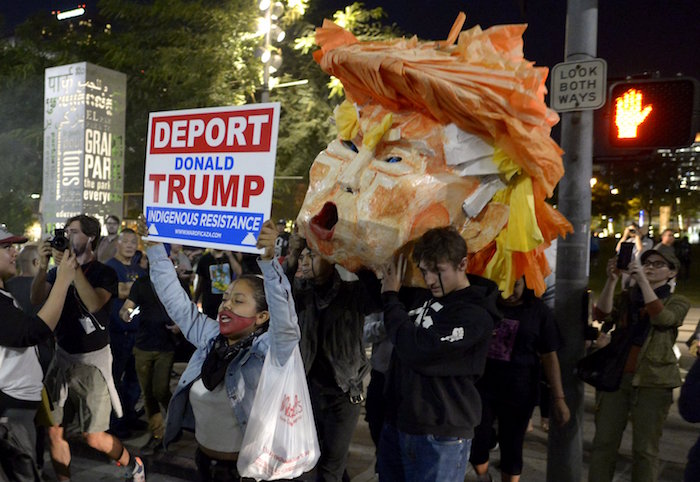
The Paris Climate Summit goals can't be characterized as anything significantly better than feel-good window dressing, but the argument that the world has to start somewhere is difficult to challenge.

Better to take a baby step forward than a giant leap backward!

As always, we must ask: Who profits? The Trump administration's decision to withdraw from the Paris Accord is due to factors beyond Donald Trump's astounding ignorance and his contempt for science or reality. There is a long history of energy company denial of global warming, a well-funded campaign.

Never mind that a widely cited 2015 study by the Stockholm Resilience Center, prepared by 18 scientists, found that the Earth is crossing several "planetary boundaries" that together will render the planet much less hospitable.

Or that two scientific studies issued in 2015 suggest that so much carbon dioxide already has been thrown into the air that humanity may have already committed itself to a six-meter rise in sea level.

Or that the oceans can't continue to act as shock absorbers - heat accumulated in them is not permanently stored, but can be released back into the atmosphere, potentially providing significant feedback that would accelerate global warming.

Trump spurns Paris Climate Accord

By Michael Schrieber - Socialist Action, June 5, 2017

“We’re getting out!” President Trump declared before the press and a knot of governmental officials who had gathered in the White House Rose Garden on June 1. “In order to fulfill my solemn duty to protect America and its citizens, the United States will withdraw from the Paris Climate Accord.”

Trump characterized the Accord as being “less about the climate and more about other countries’ gaining a financial advantage over the United States.”

He continued his xenophobic message: “The rest of the world applauded when we signed the Paris agreement—they went wild; they were so happy—for the simple reason that it put our country, the United States of America, which we all love, at a very, very big economic disadvantage.”

Trump singled out in particular the “Green Climate Fund,” which he said has been siphoning billions of dollars out of the U.S. economy, “a massive re-distribution of United States wealth to other countries.” The fund was intended to help underdeveloped nations move to renewable energy and mitigate the effects of climate change. So far, the fund has raised a total of around $10 billion from wealthier capitalist countries, including $3 billion from the U.S. (about one-hundredth of one percent of the U.S. budget).

According to the precepts of the Paris Accord, it will take more than three years for the U.S. to formally withdraw from it. But Trump indicated in his speech that he believes his announcement can help dampen any legal challenge to the measures that his administration has already put into place that weaken environmental safeguards in order to ramp up oil, coal, and other extractive industries.

And what about the climate? That burning issue was scarcely apparent in Trump’s June 1 speech. Although his address was long, rambling, and repetitive, Trump never found a single moment to utter the words “climate change.”

Our Responsibility After Trump's Climate Withdrawal

By Kevin Zeese and Margaret Flowers - Popular Resistance, June 3, 2017

President Donald Trump’s decision to withdraw from the Paris climate agreement follows the path of previous presidents who have undermined international climate agreements. We disagree with Trump but it is important to understand his actions in the context of the history of the United States regarding previous climate agreements. Once again, the political problems in the US are bigger than Trump. His action brings greater clarity to the inability of the US government to confront the climate crisis and clarifies the tasks of people seeking smart climate policy.

The US Has Always Prevented Effective International Climate Agreements

The US has consistently blocked effective climate agreements because both parties in power have put the profits of big energy before the climate crisis when it comes to domestic and international policies. The Republicans proclaimed themselves the “drill baby drill” party while the Democrats are the “all of the above energy” party. Both slogans mean the parties seek to ensure US corporations profit from carbon energy. Both have supported massive oil and gas infrastructure and extreme energy excavation including the most dangerous forms, i.e. tar sands and fracking. Both parties have also supported wars for oil and gas. All of these positions will be viewed as extreme as the world confronts the great dangers of the climate crisis and the US will be deservedly blamed.

Vigorous Campaign Revives Transit Union in Right-to-Work Virginia

By John Ertl - Labor Notes, May 31, 2017

Going into its latest contract, the transit union in Fairfax County, Virginia, was in tough shape. People weren’t active because they didn’t believe the union could do much—and the union couldn’t do much because people weren’t active.

Management never budged on the issues that stewards brought up. Grievances piled up, unresolved. And since Virginia is a “right-to-work” state, half the workers in the bargaining unit weren’t even members of Transit (ATU) Local 1764.

But after a robust union campaign, in a matter of months the Fairfax Connector went from a unit at risk of decertifying to a strong union shop.

Fairfax County is one of the wealthiest counties in the nation—yet the 600 bus drivers, mechanics, and utilities staff at the Fairfax Connector have no pension, because they work for a private company rather than the county. Many can’t afford to live in the affluent Washington, D.C., suburb where they work.

Workers were seething because they had been cheated out of a retirement plan. In the previous contract, they had given up a 2 percent raise in exchange for a pension. But when a pension plan could not be set up according to the contract’s poorly written terms, the company exploited the loophole and kept the money.

“People saw that the union wasn’t working on their behalf, and they saw that management just did whatever it wanted,” said bus driver Rachid Mhamdi. “There was no trust in the union.”

Paris is Burning

By James P. Hare - Rosa Luxemburg Stiftung, June 2017

With Trump’s decision to formally withdraw from the Paris Agreement, he has put an end to months of apparent indecision. This withdrawal does not dissolve the agreement, which still includes nearly every nation on the planet, but it is hard to imagine how an already weak agreement can be expected to slow—not to mention reverse—greenhouse gas emissions without the participation of the United States. Seeing this decision as anything other than a nail in the coffin of the global climate regime is nothing but wishful thinking.

For an administration that has promoted a seemingly unending series of bad policies—from healthcare to immigration to militarism to the unceasing transfer of wealth from working people to the wealthy—this may be its worst. When future generations look back at the harm done by this president, they may remember this as his greatest crime. This is not to minimize the damage of his other policies or of the racism, xenophobia, and misogyny that drove his campaign and brought him into the White House, but climate change is the ultimate issue. It will affect everyone while exacerbating existing inequalities, and we only have one chance to get it right.

This decision is no surprise. Throughout his campaign, Trump promised to pull out of the Paris Agreement as part of his “America First” agenda that pits the promise of domestic jobs against environmental protections and international cooperation. We must reject Trump’s noxious brand of nationalism and climate denialism. It is critical, however, not to sugarcoat the nature of much of what passes as international cooperation. So-called trade agreements have benefitted corporations and the wealthy at the expense of working people both in the United States and abroad.

It is not, as Trump’s nativist critique would have it, that the United States made a bad deal with Mexico when negotiating NAFTA. Rather, elites in the United States, Mexico, and Canada made a good deal for themselves at the expense of the citizens of each country. Still, working people understand what NAFTA did to their workplaces and their communities, and Trump’s attack on trade deals may have helped him to win enough working-class support in critical states to shift the electoral map in his favor, even if the extent of his working-class support has been greatly overstated by centrist commentators.

Pages

The Fine Print I:

Disclaimer: The views expressed on this site are not the official position of the IWW (or even the IWW’s EUC) unless otherwise indicated and do not necessarily represent the views of anyone but the author’s, nor should it be assumed that any of these authors automatically support the IWW or endorse any of its positions.

Further: the inclusion of a link on our site (other than the link to the main IWW site) does not imply endorsement by or an alliance with the IWW. These sites have been chosen by our members due to their perceived relevance to the IWW EUC and are included here for informational purposes only. If you have any suggestions or comments on any of the links included (or not included) above, please contact us.

The Fine Print II:

Fair Use Notice: The material on this site is provided for educational and informational purposes. It may contain copyrighted material the use of which has not always been specifically authorized by the copyright owner. It is being made available in an effort to advance the understanding of scientific, environmental, economic, social justice and human rights issues etc.

It is believed that this constitutes a 'fair use' of any such copyrighted material as provided for in section 107 of the US Copyright Law. In accordance with Title 17 U.S.C. Section 107, the material on this site is distributed without profit to those who have an interest in using the included information for research and educational purposes. If you wish to use copyrighted material from this site for purposes of your own that go beyond 'fair use', you must obtain permission from the copyright owner. The information on this site does not constitute legal or technical advice.

