






You are here
green unionism
 We are in a critical political moment. The impacts of climatechange are increasingly severe, taking a toll on our health, environment and our economies. In the midst of this growing crisis, the United States now has a President and Congressional leadership that simultaneously attack climateclimate science and aim to comprehensively roll back climate protection measures and the rights of workers to organize.
 Trades unionists have launched
  Tacoma has been one of the main dumping grounds for polluting industry in western Washington. We are home to nine EPA Superfund clean up sites.
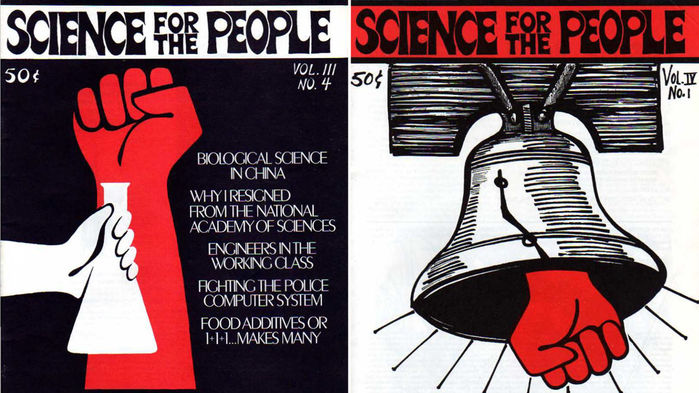 On April 22, 2017, the March for Science will pull several thousands of people into the streets to stand up for science and resist funding cuts proposed by the current US administration. Our organization, Science for the People, sees this development as a mostly positive step in the right direction. The scale of the political and economic crises facing people across the world is enormous and will require mass movements to resist and organize for change. However, we believe there is a need to advance radical solutions to face these crises. As such we have been interested in how the March for Science has developed since its inception around January 25, 2017. Our members have been taking measured approaches to engaging with the March for Science–nationally and locally–with the overall goal of putting forward a politics capable of both taking seriously the multitude of contradictions that define scientific enterprise and accounting for the people affected by and disaffected with the pursuit, uses, and abuses of science.
 Back in 2009, when I was an undergraduate student, I went to a talk given by Eriel Tchekwie Deranger of the Athabasca Chipewyan First Nation which had a significant impact on my understanding of environmental justice.
 Appalachia voted overwhelmingly for Trump, who won it by a resounding 63%-33%. Appalachia as a region is defined by federal law, and consists of 490 counties in 13 states. Hillary Clinton won only 21 of these counties. According to the right-wing
 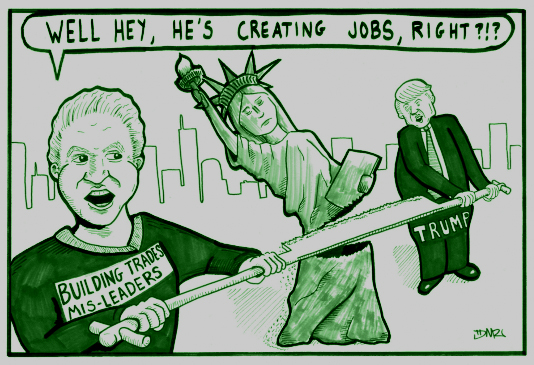 The authors of this Blog have continually focused on the refusal of the trade union leaders to fight the bosses and the offensive of the bosses capitalist system against working people and the environment. We believe we are correct to do so. The US trade union leaders control organizations with a membership of up to 14 million and with huge full time resources, a massive infrastructure and hundreds of millions of dollars. Their potential power is confirmed by the fact that people like Obama, and now Trump stroke these union leaders to make sure they remain on their side. Just have a look at how far these union leaders are prepared to go to boot lick the bosses and their political stooges.
 The election of Donald Trump has sparked an unprecedented outpouring of public mobilization across the United States and around the world. From the Women’s March to rallies against the Muslim Ban, people are demonstrating creative and powerful ways to take action, in Washington, D.C. and beyond, to resist Trump and fight for the world they want.
 Reversing regional of ficials who sided with refiners to claim pollution trading policies force them to allow increasing refinery pollution, the State Air Resources Board supports pollution limits to “cap” increasing particulate and greenhouse gas air pollution from five Bay Ar ea refineries in a letter to the Bay Area Air Quality Management District sent late yesterday.
 As soon as barricades are destroyed in the Hambacher Forest they have been rebuild often even right behind bulldozers and before cops left the forest. This friday was no exeption but for the fact that this time also bread and roses have been put up in the place of destroyed barricades protecting the forest. This is connected not just with not continuing the resistance on an empty stomach but also with "Stones Are Our Breads and Barricades Our Dinner Tables." action that happened during this cutting season. It was also inspired by 1912 Breads and Roses Textile Strike and Riots in Lawrence Massachusetts which were organized by women and united over 30 different ethnic groups and also used workplace sabotage. The striking mothers with their children were brutally attacked by police at a train station as the kids were being sent to live with supporters when due to the prolonged strike the families could no longer feed them themselves. This resulted in international solidarity and finally with congressional hearings, positive workplace pay increase settlements, changing of work conditions and eventual shortening of the work week itself.
The Fine Print I:
Disclaimer: The views expressed on this site are not the official position of the IWW (or even the IWW’s EUC) unless otherwise indicated and do not necessarily represent the views of anyone but the author’s, nor should it be assumed that any of these authors automatically support the IWW or endorse any of its positions.
Further: the inclusion of a link on our site (other than the link to the main IWW site) does not imply endorsement by or an alliance with the IWW. These sites have been chosen by our members due to their perceived relevance to the IWW EUC and are included here for informational purposes only. If you have any suggestions or comments on any of the links included (or not included) above, please contact us.
The Fine Print II:
Fair Use Notice: The material on this site is provided for educational and informational purposes. It may contain copyrighted material the use of which has not always been specifically authorized by the copyright owner. It is being made available in an effort to advance the understanding of scientific, environmental, economic, social justice and human rights issues etc.
It is believed that this constitutes a 'fair use' of any such copyrighted material as provided for in section 107 of the US Copyright Law. In accordance with Title 17 U.S.C. Section 107, the material on this site is distributed without profit to those who have an interest in using the included information for research and educational purposes. If you wish to use copyrighted material from this site for purposes of your own that go beyond 'fair use', you must obtain permission from the copyright owner. The information on this site does not constitute legal or technical advice.
 This site is not the official webpage of the Industrial Workers of the World.