You are here

green unionism

Climate Movement to May Day Strikers: "We've Got Your Back"

By Deirdre Fulton - Common Dreams, April 27, 2017

Just as labor leaders are standing firmly behind this Saturday's national climate mobilization, the environmental movement has declared its support for workers who plan to strike as part of Monday's May Day demonstrations.

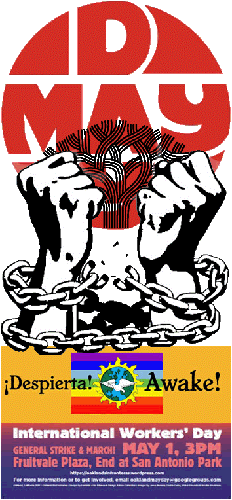
May 1st, International Workers Day, will see rallies, marches, and strikes around the country and the world; in the United States, acts of civil disobedience, work stoppages, and boycotts will target the Trump administration and support immigrants who have experienced an increase in raids and racist rhetoric since the election of President Donald Trump.

"May 1st is the first step in a series of strikes and boycotts that will change the conversation on immigration in the United States," said Maria Fernanda Cabello, a spokesperson from Movimiento Cosecha, which is part of a coalition organizing the actions. "We believe that when the country recognizes it depends on immigrant labor to function, we will win permanent protection from deportation for the 11 million undocumented immigrants, the right to travel freely to visit our loved ones abroad, and the right to be treated with dignity and respect."

An open letter signed this week by more than 80 environmental and climate justice groups recognizes that these demands and those of green groups have many points of intersection. 

"Today, workers face unprecedented attacks on wages, benefits, workplace safety, and the right to organize free from fear and retaliation," reads the letter, whose signatories include 350.org, Greenpeace, Rising Tide North America, and the Sierra Club. "But we know that we are all stronger when workers in our communities have safe, fair, and dignified employment with which they can support their families without fear of deportation or violence."

What's more, the letter continues:

The effects of our fossil fuel economy fall first and worst on working class communities, communities of color, immigrants, and Indigenous peoples who have not only contributed the least to climate disruption, but have the least resources to shoulder the burden of a transition to a new, climate-friendly economy. It is these frontline communities who are also at the forefront of change and whose solutions and leadership we most need.

[...] As environmental and climate justice organizations, we support workers who choose to walk off their jobs on May 1st because we know that the fight to protect land, water, air and soil is inseparable from the fight to protect the life and dignity of workers, migrants, and communities of color.

This language dovetails with that of Mary Kay Henry, international president of Service Employees International Union (SEIU), who declared Wednesday, "Every day SEIU members and our communities experience the impact of toxic pollution in our air and water and the catastrophic impacts from climate change that are made worse from this pollution."

Of Saturday's Peoples Climate March, Henry said: "We march because we are on the frontlines. As working people, people of color, and immigrants, we march because our families are disproportionately hardest hit by pollution and climate change's impacts. We march because as service and care workers we are on the frontlines of caring for and responding to impacted families and communities."

The letter from eco- and climate-justice groups calls on employers not to retaliate against workers who choose to go on strike, and pledges to defend workers who face retaliation.

USFSA’s Participation in the #PeoplesClimateMarch

By staff - The US Food Sovereignty Alliance, April 28, 2017

The US Food Sovereignty Alliance, an alliance of food justice, anti-hunger, labor, environmental, faith-based, and food producer groups, is joining in solidarity with the It Takes Roots Coalition at the People’s Climate March in Washington D.C. on April 29, 2017 to stand for “the rights, actions, and leadership of communities who are at the frontlines of fighting for water, land, and home.”

As a US-based organization, the USFSA upholds the right to food as a fundamental human right and works to connect our local and national struggles to global movements led by farmers, fishers and indigenous people. Corporate-controlled industrial agriculture and fishing are significant contributors to climate change and smallholder farmers producing and harvesting food build the resiliency of ecosystems which contribute to both nourishing people and cooling the planet.

Humans have a right to the resources required to meet their basic needs and provide themselves with shelter, sustenance, and an adequate livelihood. The means of meeting these needs are often embedded in cultural practices that are vital for people’s sense of identity. Food feeds more than the body.

Climate change increases hunger.  A sustainable and nutritious food supply is essential for the entire human population, but it’s also essential for the economic well-being of food producers.  People who produce food – like farmers and fishers – are often hardest hit by climate change, which directly affects their family’s food supply and sources of income.  With 78 percent of the world’s poor relying on farming to support their families, it’s important to develop sustainable ways of farming that support both the environment and those who rely on crops for economic stability.

Tribunal judges: Monsanto isn't feeding the world - it's undermining food security

By Claire Robinson - The Ecologist, April 24, 2017

Monsanto promotes its genetically modified (GM) crops and associated pesticides on the claimed grounds that they are needed to help 'feed the world'.

But the five judges of the Monsanto Tribunal found that far from contributing to food security, Monsanto's activities have "negatively affected food availability for individuals and communities."

The judges of the Tribunal, held last October in The Hague, listened to the testimony of 28 witnesses from around the world whose health and livelihoods had suffered as a result of Monsanto's products and activities.

The judges are all renowned for their expertise in human rights and international law issues. They were led by the Belgian Françoise Tulkens, former vice-president of the European Court of Human Rights.

Last week the Monsanto Tribunal judges announced their damning verdict, based on a number of considerations. First, the judges found that Monsanto had interfered with the ability of individuals and communities to feed themselves directly from productive land:

"Monsanto's activities have caused and are causing damages to the soil, water and generally to the environment, thereby reducing the productive possibilities for the production of adequate food.

"Communal agricultural activities as well as forests that provide food resources are being devastated by the spread of genetically engineered seeds that use large amounts of herbicides like glyphosate. These activities by Monsanto are interfering with the right to produce food."

An Eco-Revolutionary Tipping Point?

By Paul Burkett - Monthly Review, May 2017

In the summer of 2016, the acceleration of climate change was once again making headlines. In July, the World Meteorological Association announced that the first six months of 2016 had broken all previous global temperature records, with June being the fourteenth month in a row of record heat for both land and oceans and the 378th straight month of temperatures greater than the historical average. Heating has been especially rapid in Arctic regions, where thawing effects are releasing large amounts of methane and carbon dioxide. On July 21, 2016, temperatures at locations in Kuwait and Iraq reached 129oF, the hottest ever recorded in the Eastern Hemisphere. The disruptive effects of bi-polar warming were evident in the unprecedented crossing of the equator by the Northern Hemisphere jet stream, where it merged with the Southern Hemisphere jet stream, further threatening seasonal integrity with unforeseen impacts on weather extremes and the overall climate system.1 Meanwhile a report from the United Nations Environment Program (UNEP) described the December 2015 Paris Agreement on climate change as “outdated even before it takes effect,” with climatologists now expecting a global warming of at least 3.4oC (more than double the 1.5oC limit supposedly built into the agreement) even if the promised emissions goals of the nations involved are somehow achieved despite the lack of binding enforcement mechanisms. “The world will still be pumping out 54–56 gigatons of carbon dioxide equivalent a year by 2030 under current plans, well above the 42 gigatons needed to limit warming to 2 degrees,” according to the UNEP report.2

The historical irony in this situation is hard to miss. Just a couple decades ago, we were told that neoliberal capitalism marked the “end of history.” Now it appears that the system’s ideologues may have been right, but not in the way they envisioned. The system of fossil-fueled neoliberal capitalism is indeed moving toward an end of history, but only in the sense of the end of any historical advance of humanity as a productive, political, and cultural species due to the increasingly barbaric socio- economic and environmental conditions the system creates. There is now no alternative to the end of history as we know it. The sustainable development of human society co-evolving with nature including other species now depends on a definite historical break with capitalism (wage-labor, market competition, production for profit) as the dominant mode of production. That is the main lesson of three recent books: Ian Angus’s Facing the Anthropocene, Andreas Malm’s Fossil Capital, and Naomi Klein’s This Changes Everything. To solve the climate crisis—which is only part of the broader environmental crisis created by capitalism—competitive, profit-driven production under unequal class control must be replaced with a system in which working people and their communities collectively and democratically regulate production and other interactions with their material and social environment. Sustainable development of people cooperatively co-evolving in a healthy way with other species must replace the profit motive, exploitation, and competition as the motive force in production and in the entire system of material provisioning. To deny that the climate crisis is hardwired into capitalism, and that we need a new system to deal with it, is just as misleading and dangerous as to deny the existence of human-induced global warming. Both forms of climate denial must be overcome in theory and practice.

Restoring the Heartland and Rustbelt through Clean Energy Democracy: an Organizing Proposal

By That Green Union Guy - IWW Environmental Unionism Caucus, April 29, 2017

The world faces a crises of enormous proportions. Global warming, caused by the continued burning of fossil fuels, threatens life on Earth as we know it, and yet, those most responsible for causing the crisis, the fossil fuel wing of the capitalist class, seems hell bent on doubling down on business as usual. In the United States of America, whose corporate overlords are among the worst offenders, they are led by the recently elected Donald Trump, whose cabinet is bursting at the seams with climate change denialists and fossil fuel capitalist industry representatives. Instead of transitioning to a clean energy economy and decarbonizing society as quickly as possible, as climate scientists overwhelmingly recommend, Trump and his inner circle would seemingly rather not just maintain the status quo; they’ve signaled that they intend to make the worst choices imaginable, putting all of the US’s energy eggs into the oil, natural gas, and coal basket.

Worse still, Trump claims to enjoy a good deal of support for such moves from the Voters who elected him, which includes a good portion of the "White working class" who have traditionally supported the Democratic Party, whose policies are just barely more favorable to addressing the problems of global warming (which is to say, still woefully inadequate). Meanwhile, the leadership of the AFL-CIO, pushed principally by the Building Trades unions, have doubled down on their efforts to continue to serve as capital’s junior partners, even as the latter continues to liquidate them in their ongoing campaign of systemic union busting.  Just recently, science teachers across the country began to find packets in their school mailboxes, containing a booklet entitled "Why Scientists Disagree About Global Warming", a DVD, and a cover letter urging them to "read this remarkable book and view the video, and then use them in your classroom," courtesy of the climate change denialist Heartland Institute.

One might think, given all of these situations, that…well, to put it mildly…we’re doomed. However, nothing could be further from the truth. In fact, in spite of the bleakness of these circumstances, a deeper look behind them reveals that fossil fuel capitalism is in terminal decline, that their hold over our lives hangs by a thread, so much that we the people, the workers and peasants of the world, have the ability to transform the human existence to one based not on plundering the Earth and exploiting the masses for the profit of a few, but one based on true grassroots democracy, free of suffering and want, and one that exists in harmony with the Earth. The key to making this transformation lies with clean energy, and the people who can make this transformation are the very people who helped elect Donald Trump themselves. One may justifiably ask, how is this even remotely possible?

This new organizing proposal, Restoring the Heartland and Rustbelt through Clean Energy Democracy, offers a potential solution and practical steps to achieve it which can not only break the reactionary tide, perhaps once and for all, but also can greatly accelerate the very necessary process of abolishing capitalism and building a new, ecological sustainable world in the shell of the ecocidal old by building an intersectional movement championing "Clean Energy Democracy". Such a movement has the potential to unite workers, rural and rustbelt communities, climate justice activists, environmentalists, indigenous peoples, and farmers of all backgrounds and revitalize a vibrant and grassroots democratic anti-capitalist left, and it offers goals that help address the intertwining crises of global warming, decadent capitalism, failing economies, and demoralized communities plagued by economic depression, racism, and reactionary nationalism.

While the burgeoning "resistance", loosely led by a coalition of groups and movements with a smorgasbord of goals and demands, many of which are reformist and defensive (though not undesirable if seen as steps along the way to more revolutionary and transformative demands) has so far successfully held back much of the worst intentions of Trump and the forces he represents, making the latter fight tooth and nail for every single inch (as well they should), such resistance still lacks the positive vision needed to truly meet the needs of most people, including especially the most oppressed and downtrodden. By contrast, Restoring the Heartland and Rustbelt through Clean Energy Democracy offers one piece of a revolutionary and transformative vision that can truly help build a new world within the shell of the old, thus putting an end to capitalist economic oppression as well as the ongoing systematic destruction of the Earth's ability to sustain life.

Download the Proposal (PDF File).

A climate insurgency: building a Trump-free, fossil-free future

By Jeremy Brecher - The Ecologist, April 28, 2017

As the thousands of foot-weary protesters leave the April 29 Peoples Climate March in Washington, DC - and its scores of sister marches around the country - one question will no doubt be foremost on their minds:

How can a march, or indeed any other action they take, force a reversal in the world's hurtle to climate doom?

After all, a single march, no matter how large, is not going to force President Trump and his administration of fossil-fuel company executives and climate-change deniers to reverse course.

They have already cancelled the Environmental Protection Agency's Clean Power Plan, authorized drilling and mining on public lands, and gutted regulations that protect local people and environments against the extraction of fossil fuels.

He has cleared the way for the Keystone XL and Dakota Access pipelines. His allies in Congress are whetting their knives to gut the Clean Air, Clean Water and Environmental Policy Acts. The fossil fuel industry is lining up for permits to build new infrastructure that will accelerate global warming and threaten local environments to boot.

An Open Letter from Environmental & Climate Justice Organizations on May Day

By Climate Workers and Movement Generation Justice & Ecology Project - Originally posted on Climate Workers, April 28, 2017

An Open Letter from Environmental & Climate Justice Organizations on May Day

Worker power, immigrant rights, and racial justice must be at the heart of environmental and climate movements

As environmental and climate justice organizations, we declare our support for protests planned for International Workers Day (“May Day”), May 1st, 2017 and for workers who choose to participate by honoring the general strike.

International Workers’ Day was first established to commemorate the deaths of workers fighting for the 8-hour work day in Chicago in 1886. It has long been a day to uplift the struggles, honor the sacrifices, and celebrate the triumphs of working people across the world. The day has taken special significance in the U.S. since May 1st, 2006 when 1.5 million immigrants and their allies took to the streets to protest racist immigration policies.

Today, workers face unprecedented attacks on wages, benefits, workplace safety, and the right to organize free from fear and retaliation. But we know that we are all stronger when workers in our communities have safe, fair, and dignified employment with which they can support their families without fear of deportation or violence.

The effects of our fossil fuel economy fall first and worst on working class communities, communities of color, immigrants, and indigenous peoples who have not only contributed the least to climate disruption, but have the least resources to shoulder the burden of a transition to a new, climate-friendly economy. It is these frontline communities who are also at the forefront of change and whose solutions and leadership we most need.

As organizations working to transition our economy away from profit-seeking resource extraction toward ecological resilience and economic democracy, we know that worker power has to be at the heart of that transition.

We urgently need the wisdom and skills of millions of workers to transform our food, water, waste, transit, and energy systems in order to live within the finite resources of this planet that we call home. But the Trump agenda only promises jobs building more prison cells, border walls, bombs, and oil pipelines. Workers deserve not only fair wages, but work that makes our ecosystems and communities more resilient, not destroys them.

Extraordinary times call for extraordinary measures. No significant social change in this country has come without tremendous risk and sacrifice by ordinary people – from workers who walk off the job to water protectors facing down water cannons and attack dogs.

As environmental and climate justice organizations, we support workers who choose to walk off their jobs on May 1st because we know that the fight to protect land, water, air and soil is inseparable from the fight to protect the life and dignity of workers, migrants, and communities of color.

To workers participating in protests on May 1st, we say: “Thank you. You deserve better. And we’ve got your back.”

To that end, we join with unions and worker-led organizations throughout the country in asking that there be NO RETALIATION against any worker – union or non union – who exercises their rights by taking time off from work on May 1. Further, should workers face retaliation, we pledge our strong support for efforts to defend those workers.

Railroad Workers and Our Allies Must Unite in Support of AMTRAK

By Ron Kaminkow - Teamsters for a Democratic Union, April 25, 2017

On March 16th, President Trump released a blueprint budget that proposes to slash funding for the Department of Transportation by $2.4 billion, including funding for all Amtrak “long distance” trains, along with funding for dozens of transit expansion projects nationwide. In recent months, Trump has voiced support for massive investment in the nation’s infra-structure. Yet ironically, his first proposed budget not only fails to deliver, it guts funding for existing infrastructure.

The blueprint budget proposes the elimination of most Amtrak routes across the country. If we are to save the national passenger rail system, railroad workers and their unions must unite with passenger advocacy groups, environmental organizations, and communities across the country. The vast majority of Americans want more - not less - passenger trains. In this fight, just like in others, railroad workers have lots of potential allies.

All railroaders – freight, as well as transit and passenger – should be alarmed and concerned by this proposal. Should Amtrak be defunded and dismembered, it is near certain that nothing would replace it. Privately run passenger trains fail to turn a profit – the reason that the rail carriers abandoned such service in the 1960's. And it is highly unlikely that private vendors – even if there were any – who wished to enter such a market would even be allowed by most – if not all – carriers access to their railroads. Amtrak is barely tolerated by the host railroads as it is, and then only because the act which created the entity in 1970 mandates that it be entitled to operate passenger trains on the nation’s railroads.

Thankfully, the President’s blueprint budget is not the last word on the question. We have the potential to save Amtrak – and transit funding too – over the course of the coming weeks and months, as Congress fashions what will be ultimately be the final budget. We have been down this road before of course, when George Bush was President. We will need to mobilize now like we did then. Because if Amtrak is defunded, thousands of fellow rails will lose their jobs, and as a result, we will all potentially suffer as the income for Railroad Retirement is dramatically diminished.

Ironically, as it turns out, Amtrak is one of the most efficient passenger railroads in the world, covering 94% of its operating costs at the fare box! Adjusted revenue of $2.15 billion was the most ever for a fiscal year (2016). Amtrak set an all-time ridership record despite record low gasoline prices inducing travelers to drive rather than seek public transportation. Demand for trains is out there! Considering that all forms of transportation – including airline, inland waterway, as well as automobile, bus and anything else that goes down the highway – are heavily subsidized by the states and federal government, far more than Amtrak, we are getting a great deal with the limited subsidy that Amtrak receives to keep the trains running. And in some cases – especially in rural areas – the train is the only form of public transportation available!

And trains are the safest form of transportation known to humanity. Railroad transport utilizes less land and space to transport an equivalent number of passengers in any other mode. And trains emit less pollutants than other forms, and can make use of alternative and renewable energy. As the nation’s highways and airports become ever more congested, we should be expanding passenger train options, not reducing them! As fossil fuel shipments decline, and demand for public transportation continues to grow, passenger trains could fill the void and excess track capacity in certain lanes. And in select mid-range corridors of 400 miles or less; e.g. Chicago to St. Louis, Chicago to Twin Cities; Bay Area to L.A., Houston to Dallas; Jacksonville to Miami; L.A. to Las Vegas, there is great potential to develop and expand multi-train departures on faster and more reliable schedules.

But to save Amtrak and expand the use of passenger rail – thereby increasing union rail employment, and ensuring the future of Railroad Retirement – will take a gallant effort. Rail unions cannot do this themselves, passenger advocacy groups cannot, neither can environmental organizations nor municipalities, all of whom are supporters of passenger rail. Therefore, we need a “Grand Alliance” of all of these forces to win the day. While all of us may have a specific agenda and focus, we have far more in common with one another than we have differences, there is far more that unites us than divides us. It is high time that our labor unions reach out, network, and build the necessary alliances with these forces, not just for a one-time lobbying effort for a specific narrow goal, as important as it may be. Rather, we need to build a strategic long-term alliance – despite our differences - with these forces, where we come to see one another as natural coalition partners for the long run.

Governments around the world are investing heavily in passenger rail. They understand that it is the safest, most convenient, environmentally sensitive, and often fastest way to get around. We can do it here too. But it will take the political will power and the formation of a lasting progressive coalition to bring it about. What better time than now to get started!

An American Uprising: Assessing Opportunities for Progressive Political Change

By Anthony DiMaggio - CounterPunch, April 20, 2017

We live in a time of tremendous instability and change. Concerns about growing authoritarianism in American politics – as reflected in the rise of corporate power in politics, the intensification of militarism, and the diversion of the masses from political participation – are legitimate. There’s always been negativity on “the left” regarding American politics and society, and for good reason. We live in a time of ecological unsustainability that threatens human survival. Record inequality means a growing number of Americans are economically insecure and struggling to pay for basic goods such as health care and education. The threat of militarism is real, with the Trump administration’s saber rattling against Russia and North Korea. Militarism was a problem under Obama as well, although many Americans held out hope based on Trump’s rhetoric that he’d cool relations with Russia.

Progressives are right to spotlight the dangers to democracy and human survival we face, and to condemn a political-economic system that’s engaged in an all-out assault on the public. But these dangers are far from the whole story when we talk about American politics today. There’s also a pathology that defines much of left discourse, marked by a fixation on condemning the political system, independent of any constructive effort to develop positive suggestions for transforming politics. This negativity suggests a refusal to recognize the unique moment we find ourselves in regarding the rising intensity of social protests over the last decade. Simply put, we are in the middle of what I’d call a second renaissance of social movement activism, equaled only by the social movements of the 1960s and early 1970s. This earlier period was a time of rapid change. Activists came together to protest state repression on many fronts, in opposition to America’s racial caste system, to resist an imperialist, murderous, immoral war in Asia, in support of challenging misogynist patriarchal norms, in opposition to environmental degradation via air pollution and nuclear power, and in pursuit of basic consumer protections.

We find ourselves in another critical and historic juncture today. Post-2008, we see movement after social movement emerge to assault a political-economic status quo that is rejected by the vast majority of Americans. Citizens are realizing that U.S. political system is working only to benefit the wealthy few. Gallup found in 2015 that less than one-in-four Americans trusted the national government “a great deal” or a “fair amount” – a record low since the organization started tracking this question in 1972. Just one-in-five Americans said in 2015 that government was “run for the benefit of all,” rather than for the few. As the Washington Post reported that year, “across party lines, Americans believe our economic system is rigged to favor the wealthy, and big corporations, and that our political system is, too – so much so that by nearly a 2-to-1 margin, Americans believe their ‘vote does not matter because of the influence wealthy individuals and big corporations have on the electoral process.’”

As a young, idealistic undergraduate college activist 15 years ago, I would have died if this many Americans had articulated such distrust of government. This is fertile ground for organizing, and progressives should rejoice at this historic opportunity. Young Americans are increasingly estranged from an economy that provides income gains only to the top one percent, while assaulting the rest of the population. This anger was on display in a 2016 Harvard Survey finding that just 42 percent of Millennials expressed support for capitalism. Young Americans aren’t stupid. They can read the writing on the wall, and they recognize that our economy is broken, functioning for the affluent few at the expense of the many. And young Americans will be vital to producing structural political or economic change in the coming decades.

We don’t have to wait to see growing pressure for change. A mass public uprising has been going on for years. I’m reluctant to say it started with the “Tea Party,” since polls demonstrated that these protesters were largely nativist, racist reactionaries who were preoccupied with preventing future tax increases and stifling efforts to repair our country’s broken health care system. Polls from the early 2010s found that Tea Partiers were quite privileged economically speaking, earning incomes well above the national average, and benefitting from high education levels. And there was no evidence that these individuals were more likely than other Americans to have been hurt by the outsourcing of manufacturing jobs. Since the decline of the Tea Party, however, many progressive waves of protest have emerged. Some are now gone, others remain. These include the Madison uprising against Governor Scott Walker (2011); Occupy Wall Street (2011), “Fight for $15” (2013 to present); Black Lives Matter (2013 to present); the Sanders uprising within the Democratic Party’s base (2016), and the anti-Trump protests (2016 to present), not to mention the environmental movement, which has remained relevant on numerous fronts over the last few decades.

Review – “Trade Unions in the Green Economy”

By x384117 - Environmental Unionism Caucus, April 25, 2017

Trade Unions in the Green Economy: Working for the Environment (2013) is a compilation of essays on the intersection of labor organizing and environmentalism, with contributions from workers, union staffers, activists, and researchers from around the world.  The usefulness of each chapter varies; some focus on the policies of various technocratic bodies, while others look at the actual social and political dynamics within pro-ecology unions, and a few advance anti-capitalist analysis.  Overall, it is a very useful introductory survey on the modern state of eco-unionism, and contains useful information for revolutionary unionists and environmental syndicalists.

The first three chapters look at the way international bodies of unions and labor organizations, such as the International Trade Union Confederation (ITUC) and the International Labour Organization (ILO), have incorporated environmental concerns into their programs and advocacy efforts.  This is of limited interest to revolutionary unionists, since we primarily concern ourselves with the dynamics of the rank-and-file and on-the-ground organizing, rather than what far-off committees and technocrats are pushing around on paper.  But these chapters are still of some use, insofar as they push back against the idea that unions are generally in opposition to environmental protections and ecological concerns. International and transnational bodies of labor groups have been including environmental provisions since the 1970s, and this itself has connected more recently with the inclusion of environmental concerns in local workplace bargaining strategies since the mid-2000s in the US, UK, Canada, and Spain (among other countries).  It is also useful to know what resources these international bodies could offer to more radical local efforts; for example, the ILO has a research wing dedicated to the labor market in clean energy sectors, which could potentially be leveraged by revolutionary unionists in efforts to build up workers cooperatives. 

Subsequent chapters were much more interesting, as they looked more at campaigns and ideas more rooted in local realities, and thus more dependent on grassroots initiative and militancy.  A chapter on eco-unionism in Spain discussed efforts to redefine the subject of the worker beyond being merely an appendage of the workplace, and as somebody who is also part of the larger environment that is degraded by the externalities of capitalism; this redefinition lays the groundwork for pushing unions to advocate for revolutionizing society away from carbon-based energy systems and privatized modes of transportation, and toward an economy of green energy, public transportation, and closed-loop production cycles.  Similar types of analysis are discussed in chapters on trade unions in Australia, many of whom have adopted the Just Transition framework as a way to reconcile the contradictions of extractive industries such as mining.

Some of the most compelling chapters were on struggles where worker self-interest and ecological protection wasn’t just a matter of theoretical convergence, but of obvious and immediate importance.  One chapter discussed the Rural Workers Trade Union (STTR), an organization of workers in rural northern Brazil, in the Amazon Rainforest.  The region’s economy is a site of deep contradiction, where dependence on the land for food and water clashes with the need to extract resources to sell to regional and global markets for additional income.  The STTR helped coordinate communities in the area on options for developing sustainable industries (as opposed to the common and destructive industry of logging), and also served as the organ of local, democratic, and sustainable governance of the natural resources.  Another chapter discussed how occupational health standards became increasingly important to unions in the US who worked with dangerous and toxic materials, in industries involving energy and chemical production.  Decreasing pollution and exposure to toxins was of immediate concern to workers, as critical issues of workplace safety and working conditions.  Addressing issues of occupational health and workplace safety was pushed hard by unions like the Oil, Atomic, and Chemical Workers (OACW) of the ‘70s and ‘80s, who eventually merged into the United Steelworkers (USW). 

Demands for a safe and healthy workplace can sound relatively moderate, but in some industries they could have an explosive and revolutionary impact.  This is the argument made in an excellent chapter on the status of food workers across the world, a segment of the working class which is often marginalized in both union and environmental discourse.  The global industrial agriculture system is a massive source of greenhouse gas emissions, and this is deeply connected with the low status and power of farmworkers, who are routinely exposed to toxic chemicals and brutally long working hours.  If farmworkers—who number roughly 1 billion worldwide—organized and demanded proper wages, reasonable hours, and safe and healthy working conditions, this would lead to revolutionizing agriculture, and an inevitable move away from petrochemical-intensive techniques toward sustainable alternatives like agro-ecology.  This point about organizing is important; in a brief critique of the Just Transition framework, the author argues that the use of the framework relies too much on the assumption that socio-economic restructuring and technological change comes about from rational discourse and good-faith debate, instead of recognizing that rights are fought for, not granted.  Thus a Just Transition requires workers to organize and actively fight and implement the framework, instead of simply asking the wealthy and powerful to do so for them. 

Worker power is the topic of another compelling chapter, written by a Swedish autoworker, on the subject of transforming the auto industry for the green economy of the future.  The author argues that workers need to seize the initiative and not only advocate for a complete reconfiguration of the industry toward products like public transit and green energy systems, but to also build up systems of worker self-management and actively participate in the planning and development of new production systems that can leverage their own skills and knowledge.  The example of the Lucas Plan, an attempt by aerospace workers in the UK to reconfigure a weapons plant in the 1970s, is given as a key model for how workers today can think about a worker-driven initiative toward seizing and restructuring their own workplaces, and the wider economy.

Indeed, if there is one takeaway from Trade Unions in the Green Economy, it is that worker self-organization and power are the central pillar of effective environmental unionism.  Transforming production via environmental reforms on capitalist lines will always result in a combination of 1) the displacement and destruction of working-class communities (and a concurrent shift toward reactionary politics in the absence of left-wing alternatives, as we are currently seeing in the Western world), and 2) the offshoring of dirty production to the Global South, which means that at the global level, we’re not necessarily reducing the net rates of pollution.  Furthermore, we must also recognize the limits of traditional liberal strategies for social change, which revolve around lobbying elites through the alleged power of ideas and rational discourse, and a focus on an abstract space of “public opinion”.  What we need instead is a strategy that brings politics into everyday life, where our neighborhoods and workplaces are sites of struggle for livable wages and healthy environments.    

The only way forward is to tie together unionism and environmentalism in a substantive manner, and build a strategy where we are the primary actors in transforming the economy—not politicians, technocrats, or capitalists. 

Pages

The Fine Print I:

Disclaimer: The views expressed on this site are not the official position of the IWW (or even the IWW’s EUC) unless otherwise indicated and do not necessarily represent the views of anyone but the author’s, nor should it be assumed that any of these authors automatically support the IWW or endorse any of its positions.

Further: the inclusion of a link on our site (other than the link to the main IWW site) does not imply endorsement by or an alliance with the IWW. These sites have been chosen by our members due to their perceived relevance to the IWW EUC and are included here for informational purposes only. If you have any suggestions or comments on any of the links included (or not included) above, please contact us.

The Fine Print II:

Fair Use Notice: The material on this site is provided for educational and informational purposes. It may contain copyrighted material the use of which has not always been specifically authorized by the copyright owner. It is being made available in an effort to advance the understanding of scientific, environmental, economic, social justice and human rights issues etc.

It is believed that this constitutes a 'fair use' of any such copyrighted material as provided for in section 107 of the US Copyright Law. In accordance with Title 17 U.S.C. Section 107, the material on this site is distributed without profit to those who have an interest in using the included information for research and educational purposes. If you wish to use copyrighted material from this site for purposes of your own that go beyond 'fair use', you must obtain permission from the copyright owner. The information on this site does not constitute legal or technical advice.