You are here

just transition

EcoUnionist News #84

Compiled by x344543 - IWW Environmental Unionism Caucus, December 29, 2015

The following news items feature issues, discussions, campaigns, or information potentially relevant to green unionists:

Lead Stories:

Ongoing Mobilizations:

COP21 and Paris:

The Thin Green Line:

Bread and Roses:

An Injury to One is an Injury to All:

Disaster Capitalism:

Carbon Bubble:

Just Transition:

Other News:

For more green news, please visit our news feeds section on ecology.iww.org; Twitter #IWWEUC; Hashtags: #greenunionism #greensyndicalism #IWW. Please send suggested news items to include in this series to euc [at] iww.org.

EcoUnionist News #83

Compiled by x344543 - IWW Environmental Unionism Caucus, December 22, 2015

The following news items feature issues, discussions, campaigns, or information potentially relevant to green unionists:

Lead Stories:

Ongoing Mobilizations:

COP21 and Paris:

The Thin Green Line:

Bread and Roses:

After Paris: A Global Movement for Climate Jobs

By Jonathan Neale - Global Climate Jobs, December 18, 2015

This post looks at the results of the Paris climate talks, and says what the climate movement and the social movements need to do next, how climate jobs fit into that, and what you can do to help build a campaign for climate jobs in your country.

The Paris Climate Talks

Many have hailed the result of the UN climate talks as a breakthrough, for two reasons. One: all of the countries of the world signed an agreement about climate change. Two: there are some good abstract hopes in that agreement.

But there are also concrete promises about emissions. Some countries have promised to cut emissions by a little in the next fifteen years. They may, or may not, keep their promises. Many more countries, with more emissions, have promised to increase their emissions by a lot. Taken together, these are promises to increase emissions every year between now and 2030. That’s the bottom line. (For the details, see our earlier post, Paris: World Promises to Increase Emissions.)

What We Need to do Now

The good news is that we have a growing and increasingly radical global climate movement. And the organisations who think the agreement is a breakthrough also think it is only a beginning. In addition most people in the climate movement saw the result of Paris coming, so we do not have a demoralised movement.

As we return from Paris, it is clear that the leaders of all the countries in the world have failed us. They did so because nowhere did we have the political and social power to make them take decisive action on climate. So now we have to build that power, country by country. The only force we have on our side is seven billion people. We have to mobilise them.

This will not be an easy or quick task. We all know that. After all, we need cuts of 80% in global emissions, as soon as possible. That means deep changes in energy use and society.

Two kinds of campaigns will be central. One is fighting to leave the coal, gas and oil in the soil. There will be a global day of action against fossil fuels in May; national campaigns; local resistance to pipelines, new mines, new drilling, new power stations, extreme energy, fossil few sponsorship, and investments in fossil fuels.

The other kind of campaign will be to build an alternative. If we are to leave the fossil fuels in the ground, we have to do four things. We need to replace fossil fuels almost entirely with renewable energy. To do that we need renewable energy for all our electricity. We need a switch from cars to public transport, and almost all transport run on renewable electricity. We need conversions of all homes and buildings to save energy, and then to heat and cool all buildings with renewable electricity. And we need to protect and extend the great forests.

We need to do thousands of other things, but those four things will make most of the difference. All that will take a lot of work – we estimate at least 120 million new jobs worldwide each year for 20 years. This is what we mean by ‘climate jobs’ – jobs that have a direct effect in cutting greenhouse gas emissions.

(For more detailed explanation in English, French or Spanish, see our booklet on Global Climate Jobs here.)

Moreover, we want government climate jobs programs to ensure a retraining and a permanent job to anyone who loses a high carbon job during the transition. That is only fair, and if we don’t do it we will split unions and communities.

‘We need social ownership and democratic control of energy’

By Tabby Spence - New Internationalist, December 16, 2015
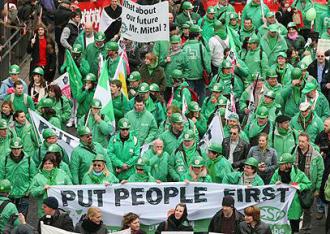
The dust has settled in Paris, where hundreds of thousands of delegates, journalists and activists spent the last two weeks buzzing around on little sleep and carrying heavy agendas. Despite the news of a ‘historic, world-saving agreement’ flooding the airwaves, tens of thousands flooded the streets on Saturday to express grief, despair, anger, defiance, and a commitment to continue strengthening the climate justice movement. According to the activists, who were literally drawing massive red lines through central Paris (and in other places around the world), the Paris Agreement permits governments to cross many important red lines representing the basic requirements for a just and liveable planet (you can see more detailed analysis on just how bad the deal really is here).

Given the decades of international meetings not yielding any cuts in greenhouse gas emissions (but rather growth by 63%), most of the civil-society groups were prepared for another epic failure at COP21. Yet many of these groups are developing strategies to drive scientifically adequate and historically fair transformations at local and national scales. A diversity of groups are working to remove the social licence of polluting corporations, the legality of company fiduciary duty over human lives and ecological systems, and the political and economic incentives granted to climate-warming industries.

While some of these groups have gained notoriety on social media for their creative actions, trade union groups and allies have been working quietly and diligently in their own locales to develop rapid phase-out plans for fossil fuel-emitting industries and vamping up renewables, as well as increasing energy efficiency in buildings, and reducing emissions in transport, food production and other important areas.

Jonathan Neale of the One Million Climate Jobs campaign in the UK explains, ‘These plans aim for a just transition – with the public creation of the climate jobs needed, a training programme for people leaving fossil sectors and moving into the new industries, and guaranteed work with decent pay for working people.’

Members of the Global Climate Jobs campaigns active in South Africa, Norway, Canada, the Philippines, the UK, New York State, and Mauritius held a number of workshops over the duration of the two weeks in Paris to explain how the existing campaigns in particular national contexts were developed, and to offer support for people who want to begin climate-jobs campaigns in their own countries. New campaigns are being launched in countries all over the world as a result of these discussions.

Trade Unions for Energy Democracy (TUED), like many of the climate jobs campaigns, emphasize the need for the jobs created to be public-sector jobs, and for the carbon-free energy, transportation and housing to be affordable and accessible for all.

The way forward is with ‘social ownership and democratic control of energy’, Sean Sweeney, founder of the Global Labor Institute, said at a sold-out event in Paris, titled ‘Now is not the time for small steps: solutions to the climate crisis and the role of trade unions’. Clara Paillard, who is the National Executive Secretary of the UK-based Public and Commercial Services Union, elaborated, emphasizing that addressing climate change is too important to be left to the market, and that the transition needs to be managed across scales by the public, not for short-term, private gains.

Leader of the British Labour Party Jeremy Corbyn and renowned writer and activist Naomi Klein joined for the lively conversation of the crucial link between the imperatives for social, economic and political transformation in the context of a warming climate. One of the panellists, leading trade unionist Josua Mata of Sentro (Philippines), posed one of the most salient and challenging questions: ‘If the deal is going to be so bad, why don’t we just reject it? Isn’t no deal better than a bad deal?’ Naomi Klein’s response was that, even if we want to, we don’t get to reject it.

The lack of democracy and the hold of powerful countries and interests over the international processes means that the local and national scales are the actual planes at which we can operate to bring about large-scale changes.

Many of the climate-jobs campaigns are gaining traction and, thanks to the tireless work of trade unionists, allies and other organizers for social justice, it looks like we may see large-scale 'operationalization of the first climate-jobs campaign in Canada within the year. The strategy of developing transitional blueprints on national or local scales, with an aim to put power back into the hands of the public, may be the best bet we have to massively rejig the world as quickly and democratically as possible.

How labor is working on climate justice

By Sean Petty - Socialist Worker, December 14, 2015

Many political leaders and the mainstream media are hailing the agreement signed by nearly 200 countries at the United Nations climate summit in Paris as "groundbreaking." But for the many thousands of people and hundreds of organizations struggling for climate justice, the deal struck at COP 21 doesn't go far enough--and not nearly fast enough.

Sean Petty, a pediatric ER nurse in New York City and member of the New York State Nurses Association, traveled to Paris during the two weeks of COP 21 to be part of protests and discussions organized by climate justice organizations. Here, he answered SW's questions about the presence of unions during the summit and what lies ahead for labor and the struggle to save the planet:

WHY WERE people from your union present at the climate talks?

FOR A number of reasons. Especially after Superstorm Sandy in 2012 caused heavy damage in large parts of New York City, including several public hospitals where our members care for patients, we have become very active in the movement to stop climate change.

We opposed the Keystone XL pipeline, we opposed fracking in our state, and we helped mobilize for the People's Climate March in September 2014. We also developed lunchtime educational meetings in our hospitals around climate change and are organizing a Climate Justice committee, which is something we hope other unions emulate.

We wanted to come to Paris to relate these experiences and join with other unions in sending a clear message that we have to keep global temperature rise below 2 degrees Celsius, and that the necessary transition to renewable energy has to happen on a world-historic scale, has to involve the creation of good, union jobs, and has to happen through a massive expansion of public investment in energy, infrastructure and transportation.

HOW WAS the union presence organized during the COP 21?

THE MAIN global federation of unions is the International Trade Union Congress (ITUC), and it is the official voice of unions within negotiations. The ITUC also organized a two-day series of workshops called the "Trade Union Forum on Climate and Jobs," where a number of unions contributed to panel discussions around different aspects of the climate crisis.

The ITUC also held workshops at the broader assembly of climate justice organizations called the "Sommet citoyen pour le climat" (People's Climate Summit), which took place in Motreuil, a close suburb of Paris, over the weekend of December 5-6.

The ITUC's main objective in the talks over the last decade or so was to fight for two words to be included in any final agreement: "just transition." This language was included in drafts leading up to the COP 21, but was dropped pretty early on during negotiations.

This triggered a significant action on December 10, where as many as 400 members of the union delegation and their allies staged a sit-in for several hours in the social space adjacent to the talks. This was a somewhat bold move, as the French ban on protests, imposed following the November 13 terrorist attacks in Paris, was still in effect. The French authorities chose not to have a confrontation and allowed to action to proceed without incident.

The protest gained attention for this issue. But the strategy of focusing on getting vague language into a nonbinding agreement as the primary focus of international trade union action has to be questioned. The stakes are way too high for such low expectations.

EcoUnionist News #81 - The #COP21 Greenwash

By x344543 - IWW Environmental Unionism Caucus, December 15, 2015

Paris, France: COP21 has concluded, and the results could be summed up as less-than-inspiring, but just about what many of us in the green unionist movement (small thought it still is) expected: a complete and total capitalist greenwash designed to make it look like more business as usual was somehow a change from business as usual. Without going into all of the gory details, the so-called "agreement" which took two weeks to hammer out doesn't even rearrange deckchairs on the Titanic. It rearranges the fabric on the deckchairs on the Titanic while at the same time proclaiming to seal the breach in the hull and pump out all of the water, yesterday.

In short, the backers of the deal (capitalists, politicians, mainstream Big Green environmental NGOs, and all of the fossil fuel capitalists pulling the strings) are proclaiming that somehow this "achievement" is "groundbreaking" because it advises, suggests, or pleads (depending on which part of the thesaurus one chooses) that the capitalist class voluntarily reduces the world's GHG emissions to a point "substantially lower than" 2°C (but doesn't even specify what many believe to be the needed limit of 1.5°C).

Of course, there are no hard limits, no enforcement mechanisms, no penalties for "ignoring" the suggested reductions. Worse still, the agreement removes all references to the rights of Indigenous peoples, does not address the disproportionate effects of capitalist GHG emissions on the Global South, women, or the working class. The excessive hoarding of wealth and disproportionate emissions caused by the Global North are not referenced. No mention is made of agroecology (thus paving the way for capitalist driven "climate-smart agriculture" (read "privatization")). No limits are to be placed on air travel. Nothing is said of energy democracy or just transition.

Worse still, all of this deal making took place in the shadow of what has become a fascist police-state atmosphere in Paris, France, in response to the tragic bombings and attacks that took place on November 13, 2015. While capitalist delegates and their enablers were allowed to seal the fate of the rest of us with near impugnity, dissent was smashed by placing restrictions on where protesters could demonstrate, and several clmate justice leaders were placed under house arrest (though, at the end of the two week clusterfuck, many defied the bans anyway, but only after many of the NGOs had demobilized the 100,000s more that would've joined in had the ban not been in place). Meanwhile, other events that had nothing to do with protesting COP21 were allowed to happen with little or no restriction.

While this is not the worst possible outcome one could have envisioned, it still leaves an enormity to be desired, and all of the self-congratulatory fawning over it by Big Green and the capitalist class won't change that.

Fortunately, this is not the end of the story.  In spite of the capitalist greenwashing attempts, most climate justice activists are not buying the official line, and have declared, rightly, that the struggle doesn't end here. The power does not lie in the hands of the capitalists or their enabling delegates. It does not lie in the halls of state or the inside-the-beltway offices of the Big Green NGOs. It belongs to the many who make up the noncapitalist class of the world, and when we realize it, organize, and act accordingly, this sham of a deal, and the capitalist system that spawned it can be banished to the dustbin of history where it rightly belongs, and replaced by a truly effective and tranformative framework for achieving the systemic change that is needed. An essential part of that change will involve the workers of the world organizing as a class along industrial lines. While this is not the only part of the strategy, it is nevertheless an important one.

There are many stories to be told about COP21, and they simply cannot be summarized into a single article, certainly not without much reflection.

"Obama Has Killed Coal"

By Nick Mullins - The Thoughful Coal Miner, December 12, 2015

I keep seeing people pointing fingers at Obama and the EPA for the woes of the Appalachian Coal Miner, so let’s think about it…

How hard would it be to believe that the power companies, the natural gas (oil) companies, and the coal companies sat down over a nice steak dinner to discuss our nations energy future?

Perhaps they worked things out like this….

The coal industry knows there’s not that much coal left, but they can still get to it and make a hell of a profit if they can do it cheaply, but there’s a catch—they have to surface mine it and tear up hell to do it (mountain top removal). The natural gas companies know they have a product that is cleaner than coal and the power companies know they can build cheaper plants, but they don’t want to leave their long time buddies with the coal industry hanging either. I should also add that they are all investing in each others stock.

So let’s devise a plan. Natural gas can get by  as a “clean” energy alternative or “bridge” fuel. In the mean time, they can allow their politician buddies to garner a few votes by enacting new regulations which doesn’t affect natural gas as badly, makes them look good with the “treehuggers” and puts a squeeze on coal markets. The benefit to the coal industry is it makes it look like there is a “War on Coal” which does two things. Not only does it get the democratic vote with people thinking they’re helping fight MTR and climate change, but it also gets all the republican voters to fight against regulations and vote in candidates who they think will help them keep their jobs.

On the surface (no pun intended) it appears like a big struggle, the “liberal” politicians hold up 36 surface mining permits letting the “treehuggers” feel like their winning, but it also gets all the working people in Appalachia to ignore the “treehugger’s” information on climate change and cancer rates, and to even go a step further and fight for de-regulation that paves the way for the coal companies to tear up hell without any consequence.

At the same time all the working people are so damn job scared they are willing to do whatever it takes to keep their jobs. This would mean working mandatory overtime and being forced into taking short cuts for fear of getting fired if they don’t meet production (Upper Big Branch). The coal companies can even get by with filing bankruptcy and jerking all the benefits from their pensioners while everyone points all their blind hatred towards the EPA and the president. Coal mining families continue to vote in the conservatives who have everyone thinking they’re for the working people, but in truth they are cutting the working man’s throat by blocking safety regulations (giving miners the right to shut a section down if it’s unsafe to operate) and labor rights laws (that could put an end to mandatory overtime and cause them to have to hire more miners). The “War on Coal” also focuses everyone’s hatred away from where it should be.

Everyone should be focusing their hatred on all the coal companies and politicians who have manipulated them into believing coal is all there is and ever will be, while not lifting one single finger to build up local infrastructure and bring in job alternatives. Billions of dollars of coal have left Appalachia in just the last decade and not a damn thing has been done to bring in job alternatives or build up our roads, or our towns, or our education systems. Instead, they give everyone “Friends of Coal” stickers and go into the public schools to teach our kids about their version of coal in Appalachia without all the bloody union struggles and company hired mercenaries killing the families of coal miners trying to fight for a living wage.

They want people poor and desperate enough to fight for the high wages of a mining job and who aren’t afraid to cut their neighbors throat to keep it, whether it’s in the superintendent’s office or running equipment and destroying some poor person’s backyard.

And it looks like the companies and politicians have done a hell of a job at it because people aren’t thinking about the bigger picture. They just want to blame the EPA and Obama.

That’s business my friends. Each company get’s what they want. The coal companies walk away with everything and have all their earnings invested in natural gas, the natural gas industry makes bank, and the politicians—on both sides—get all the perks and votes they can handle.

Just imagine if one day we all woke up and realized we didn’t have to go in debt and work full time jobs for companies that treat us like crap, that we can still grow our own food and live simpler, happier lives with plenty of time to spend with friends and family, raising our children the right way—to be good to each other, to give freely, and that happiness doesn’t come attached to a dollar bill dangling from a coal company’s fishing pole….

"Liberté Is Not Just A Word": Klein, Corbyn Call for Mass Protest at COP21

By Nadia Prupis - Common Dreams, December 8, 2015

"By taking to the streets, we will be clearly and unequivocally rejecting the Hollande government's draconian and opportunistic bans on marches, protests, and demonstrations."

Video: At a packed meeting in Paris, Naomi Klein, supported by UK Labour Party leader Jeremy Corbyn, calls for mass civil disobedience to break the ban on demonstrations on December 12. Trade unionists and others discuss the real solutions to climate change: an end to fossil fuels, energy democracy, and a just transition to millions of cllimate jobs.

Additional Speakers: Sean Sweeney (Trade Unions for Energy Democracy), Lyda Forero (Transnational Institute–TNI, Columbia), Josua Mata (Philippino Workers Central–SENTRO, Philippines), Clara Paillard (Public & Commercial Services Union–PCS, United Kingdom) and Judy Gonzalez (New York State Nurses Association, USA)

In Paris on Monday, a panel of activists, including author Naomi Klein and UK Labour Party leader Jeremy Corbyn, spoke to a packed crowd on the role of the global labor sector in the climate justice movement and called for mass civil disobedience to break French President François Hollande's ban on demonstrations during the COP21 summit.

Klein spoke candidly about the global climate agreement being hammered out by world leaders this month, stating, "The deal that will be unveiled in less than a week will not be enough to keep us safe. In fact, it will be extraordinarily dangerous."

Wealthy nations have set up inadequate climate targets that could allow average global temperatures to rise by 3 or 4 degrees Celsius, Klein said—far higher than the agreed-on threshold of 2°C, which scientists say would cause catastrophic extreme weather events. The deal is going to "steamroll over crucial scientific red lines... it is going to steamroll over equity red lines... it is going to steamroll over legal red lines."

"Which is why on December the 12th, at 12 o'clock—that's 12-12-12—many activists will be peacefully demonstrating against the violation of these red lines," Klein said, prompting a round of applause from the audience of roughly 800 trade unionists and other workers and activists.

There are no jobs on a dead planet

By John Evans - Trade Union Advisory Committee to the OECD (TUAC), December 6, 2015

A structural shift to a low-carbon economy will entail gains in jobs, but also losses, and the first jobs to be lost are not those that you think. A just energy transition will be needed, but how? 

Climate action is a trade union issue. That is why the international trade union movement under the umbrella of the International Trade Union Confederation (ITUC), working closely with us at TUAC, is prioritising our advocacy on climate issues. From the protection of jobs and livelihoods that are in the front lines of climate change impacts, to organising new quality jobs in the emerging green economy, to fighting for what we refer to as a “just transition”, so that workers gain and are not left behind when their sectors move to achieve a zero-carbon world. Climate change is clearly an immense challenge for workers and their families globally, but so is the transition. Practical policy solutions and targets that reinforce and go beyond COP21 will be needed.

Make no mistake: climate catastrophes and extreme weather conditions, including cyclones, floods, drought, fires, melting glaciers, season changes, threats to agriculture and more, are increasing and impacting working people everywhere.

In the United States, Hurricane Sandy left 150 000 workers displaced and employment was overall reduced by 11 000 workers in New Jersey alone in 2012. In Bangladesh, Cyclone Sidr disrupted several thousand small businesses and adversely affected 567 000 jobs in 2007. Typhoon Haiyan that hit the Philippines in November 2013 affected around 800 000 workers, with their source of livelihood damaged or displaced overnight. The effects of these weather events rippled through international supply chains, affecting workers in other countries.

Over the next 10-15 years, we will face ever more serious impacts across the board, which will destroy whole communities and their jobs, if not their lives. The disruption will be socially and economically destabilising across whole regions, and will be worse than anything we have witnessed so far. That’s what catastrophic climate change means, and unless we prevent it, then decent work, social protection and rights for all will remain an illusion, particularly for the most vulnerable.

Much has been said about the potential for climate action to deliver on job creation. The trade union movement has strongly supported this enthusiastic view. We will certainly see jobs created in renewable energy, energy efficiency, public transport and organic agriculture among others. They may even outnumber those which might be lost in sectors that are not compatible with fighting climate change. The question of their quality (in terms of wages, benefits and working conditions, unions have launched a dedicated organising strategy to ensure that the jobs we consider critical for the future bring gender impact, etc.) remains to be assessed. Still, trade unions have launched a dedicated organising strategy to ensure that the jobs we consider critical for the future bring together the social and environmental dimensions of sustainability.

Leave no one behind

All economic sectors must change. But if there is something we can learn from past economic transitions since the Industrial Revolution, it is that they have been far from fair in terms of social justice. Some might think: then there is no need to do things differently and all should just stay the same. This is a false and dangerous assumption. Governments face opposition to climate action. Often it is from actors with vested interests. Sometimes opposition comes from working people who are afraid of losing their jobs or part of their income. It is an understandable fear. However, it can be addressed and resolved. Trade unions are convinced that a proactive, fair approach to this transition can accelerate change and keep us on course to stay below the 2°C limit. We want to see the transition happen on the ground with investment in skills and lifelong learning, income protection and other social protection measures for workers in sectors hit by climate policies. We believe that dialogue and participation have to be ensured to secure workers’ involvement in the design of future jobs and adequate funding for transforming local economies and communities.

And COP21 in all of this? For the ITUC and TUAC, COP21 must respond adequately to these challenges. An agreement in Paris needs to ensure that country commitments are reviewed through an effective process so that the gap in emission reductions is absorbed fairly and quickly.

COP21 needs to make clear that financing commitments to the most vulnerable countries are not being given away as charity, but are the logical and considered international response to climate change and how it risks both undermining the development progress these countries have made in the last 20 years and hampering their ongoing efforts to achieve prosperity and decent work for all. Finally, COP21 needs to send a political message to workers: not only will governments commit to achieving a zero-carbon world, but they will also commit to a “just transition” for all workers concerned.

These three policy imperatives are still on the negotiating table. The way in which they will be addressed in December will be a crucial indicator in judging the final outcome.

For the labour movement, climate change is a challenge that puts everything we care about at risk. Workers must be fully involved in shaping that “just transition”, in which their rights and prosperity are paramount and where they are able to build and decide their own future. Workers need strong policies on climate. Low climate ambitions would be a social progress killer.

At Paris Trade Union Forum: A call to ban fracking worldwide

By Blake Deppe - People's World, December 4, 2015

PARIS -- In the Climate Generations event area here at COP 21, the Trade Union Forum on Climate and Jobs presented on Dec. 3 an event called Resisting Extreme Extraction. Labor organizations including the New York State Nurses Association (NYSNA), the Argentine Workers' Central Union (CTA), and the Public and Commercial Services Union (PCS) addressed the audience with a clear declaration: that fracking, in every country and every part of the world, has got to go.

These organizations are part of the Trade Unions for Energy Democracy, an initiative coordinated by the International Program for Labor, Climate and Environment (IPLCE). Their call for a global moratorium on the harmful natural gas extraction process is bolstered by the findings of Robert Howarth, the David R. Atkinson Professor of Ecology and Environmental Biology at Cornell University. He published his findings about the disastrous effects of fracking in an article titled A bridge to nowhere: methane emissions and the greenhouse gas footprint of natural gas, and shared them at COP 21.

"Natural gas is widely promoted as a 'bridge fuel,' " Howarth said, referencing the publication. "It is said that it allows continued use of fossil fuels while reducing greenhouse gas emissions compared to oil or coal. And since 2009, over 40 percent of natural gas has come from shale gas, which is such a driver for climate change, because of methane. Most climate scientists, in their studies, are focusing on carbon, but methane is 120 times more powerful while both gases are in the atmosphere."

He explained that carbon, of course, is the larger instigator behind climate change, as there is more of it in the atmosphere, but in terms of actually slowing global warming, there is a key difference between the two. "Because of its long residence time," he said, "reductions in carbon emissions can only slowly change the atmospheric concentration." On the other hand, "methane emissions reductions lead to almost immediate reductions in atmospheric concentration. If we cut methane emissions today, we could really slow warming and prevent the [planet] from exceeding that two degree mark."

What Howarth is referring to is the very goal of COP 21: to avert a planetary warming of two degrees Celsius. This is a slightly more realistic ambition - in comparison with last year's climate conference in Copenhagen, which sought to avoid 1.5 degrees of warming - and one based on assessments made on global warming by the Intergovernmental Panel on Climate Change.

But curbing that methane output can best be done by putting an end to fracking, and increased transparency, based on recent studies not funded by the fossil fuel industry, is shifting public opinion on this false 'energy alternative.' "There have been about 32 new research papers published on fracking recently," said Hogarth. This, he conveyed, provides an excellent counterbalance to the problematic studies carried out by the Environmental Protection Agency and the Environmental Defense Fund, with the latter in particular notorious for its biased and industry-collaborative approach. He said that both the agency and the EDF "misuse their instruments during their studies, and thus draw unrealistic conclusions about fracking. The truth is, it is globally warming the planet today."

Pages

The Fine Print I:

Disclaimer: The views expressed on this site are not the official position of the IWW (or even the IWW’s EUC) unless otherwise indicated and do not necessarily represent the views of anyone but the author’s, nor should it be assumed that any of these authors automatically support the IWW or endorse any of its positions.

Further: the inclusion of a link on our site (other than the link to the main IWW site) does not imply endorsement by or an alliance with the IWW. These sites have been chosen by our members due to their perceived relevance to the IWW EUC and are included here for informational purposes only. If you have any suggestions or comments on any of the links included (or not included) above, please contact us.

The Fine Print II:

Fair Use Notice: The material on this site is provided for educational and informational purposes. It may contain copyrighted material the use of which has not always been specifically authorized by the copyright owner. It is being made available in an effort to advance the understanding of scientific, environmental, economic, social justice and human rights issues etc.

It is believed that this constitutes a 'fair use' of any such copyrighted material as provided for in section 107 of the US Copyright Law. In accordance with Title 17 U.S.C. Section 107, the material on this site is distributed without profit to those who have an interest in using the included information for research and educational purposes. If you wish to use copyrighted material from this site for purposes of your own that go beyond 'fair use', you must obtain permission from the copyright owner. The information on this site does not constitute legal or technical advice.


