You are here

just transition

A Response to Nick Mullins’s December 2015 blog post “The Problem with Environmentalism in Appalachia.”

By Lou Martin - RAMPS, January 14, 2016

RAMPS web editor's note: Our friend and ally Lou Martin wrote this (in response to Nick Mullins’s blog post “The Problem with Environmentalism in Appalachia“) and asked us to post it. Although this isn’t an official communique from RAMPS, we’re posting it in the spirit of fostering dialogue so that our movement can be stronger and more effective…

I wish more people knew the environmental movement in central Appalachia the way I have gotten to know it in the last four years.

I have been a longtime fan of Nick Mullins’s blog The Thoughtful Coal Miner, and I hope Nick knows that I appreciate and respect him and his family for their work—work of all kinds—to end mountaintop removal.  And I appreciate this recent blog post because it is grappling with a difficult subject and because, to be effective, we need to take a hard look at ourselves and our strategies.

As I understand the post, the main problem with environmentalism in Appalachia is that environmental organizations have not won over coal mining families.  Nick writes, “Coal mining families are not very receptive to environmentalists—and that’s putting it lightly. Why should they be? In what way have environmentalists approached coal mining families over the past two decades? In what way have environmentalists presented themselves to the public?”

Throughout the blog post he talks about “environmentalists” and “coal mining families” as being two different groups, opposed to each other.  In another place he writes, “At the end of the day, I had to realize that perhaps many environmental organizations are just as ‘out of touch’ as Appalachian people think them to be.”  Here, environmental organizations and Appalachian people as if they are almost mutually exclusive.

When I think back to why I got involved fighting mountaintop removal, I think of the people who inspired me, and almost every one of them came from a coal mining family or were former coal miners—and all those people belonged to environmental organizations.

But Nick is talking about a general perception of “the environmental movement” that someone in the region might get if they only watch the occasional news report or witness a demonstration.  Those people, I suppose, might not really be able to differentiate between a small organization based in the region and a national organization like the Sierra Club.  Between an organization that advocates civil disobedience and those that do not.

EcoUnionist #87 - Carbon Bubble Bursting Edition

Compiled by x344543 - IWW Environmental Unionism Caucus, January 18, 2016

The following news items feature issues, discussions, campaigns, or information potentially relevant to green unionists:

Lead Stories:

Ongoing Mobilizations:

The Thin Green Line:

Bread and Roses:

An Injury to One is an Injury to All:

EcoUnionist News #86

Compiled by x344543 - IWW Environmental Unionism Caucus, January 12, 2016

The following news items feature issues, discussions, campaigns, or information potentially relevant to green unionists:

Lead Stories:

Ongoing Mobilizations:

The Thin Green Line:

Bread and Roses:

The Oregon Standoff

An Injury to One is an Injury to All:

One Million Climate Jobs: A Challenge for Canadians

By Jonathan Neale - One Million Climate Jobs, January 5, 2016

In Canada, an alliance of unions, with environment, youth, public interest, faith-based organizations and First Nations are working together through the Green Economy Network to put these principles to practice, by calling for “one million climate jobs” in Canada within the next five years.

The Canadian Labour Congress (CLC) has recently adopted its COP21 Statement, emphasizing that climate change is already affecting production and consumption patterns in many sectors of our economy.

The warnings by the United Nations’ Intergovernmental Panel on Climate Change (IPCC) that the current pace of emissions is already consuming the entire global carbon budget is a clear indication that market forces on their own are not in a position to provide the kind of transition that will prevent catastrophic climate change.

Governments must step up to the plate by working and providing leadership for the common good and public interest. With a new government in Ottawa, Canada is now in a position to commit ambitious, achievable, science-based targets to significantly reduce greenhouse gas emissions.

At the 2009 COP15 in Copenhagen, Canada pledged with other G8 countries to cut its carbon emissions by 80 percent by 2050. Such a target implies emission cuts by 2030 of no less than 38 percent of 2005 levels. Now, at COP21, we urge the federal government to recommit to at least this target.

As have Germany and Australia with their coal industries, there is a need to be proactive in regulating the petroleum industry in Canada and curbing expansion of the oil sands, which remains the fastest growing sector of the economy for greenhouse gas emissions, despite the falling oil prices.

This calls for significant industrial transformation toward a new low-to-zero carbon economy. A transformation that will eliminate or transform existing jobs, likely bringing about resistance to change, which could undermine a much needed social consensus in Canada for a way forward.

To address this resistance, a just transition strategy that is supported by workers, employers and governments is needed, with a focus on creating new jobs and incorporating training and education for displaced workers. The strategy must embody social support, re-employment and compensation measures, and be devised with the participation of workers and their representatives.

These measures must also go hand in hand with efforts to deal with unemployment overall, as rising CO2 levels and job losses are the products of the same economic model. A commitment to Decent Work, as understood by the International Labour Organization (ILO), can pave the way to an economic model that addresses social injustice, poverty and inequality at the same time. In 2013, the Canadian government, employers and unions agreed, along with those of other countries, to a set of guiding principles that can do just that. Now is the time to apply these principles for dealing with climate change in Canada.

In Canada, an alliance of unions, with environment, youth, public interest, faith-based organizations and First Nations are working together through the Green Economy Network to put these principles to practice, by calling for “one million climate jobs” in Canada within the next five years.[1] Similarly, the Blue Green Canada also brings together unions and environmental groups to tackle these issues.

The Problem with Environmentalism in Appalachia

By Nick Mullins - The Thoughtful Coal Miner, December 30, 2015

I tend get flak from both sides of the argument surrounding coal. Environmentalists distance themselves from me because I am often critical of them, and some even hate me these days. Pro-coal folks tend to dislike me for my stance against coal companies. It only goes to show that telling the truth has never been popular, or easy.

So let’s get to it.

Coal mining families are not very receptive to environmentalists—and that’s putting it lightly. Why should they be? In what way have environmentalists approached coal mining families over the past two decades? In what way have environmentalists presented themselves to the public?

Though most environmentalists have their hearts in the right place when it comes to helping other people, I’m afraid they’ve done a poor job of translating it to the public. So when the knee jerk reaction of coal miners and their families is to identify environmentalists as “out of touch,” I am not entirely surprised.

Decades of outside media infiltration has portrayed our people (Appalachians) in a negative way. The “War on Poverty” brought thousands of people from outside the mountains to tell us how to live (like we were to stupid or something). Let’s not forget that the first outsiders to come into the mountains were the land agents and coal companies who would lie, cheat, and steal to take our lands and mineral rights, and would then force us into a mono-economy making us dependent on mining coal to survive. Appalachian people have had enough of outsiders and for good reasons. That being said, I am very skeptical of many outsiders myself, and will gladly tell anyone who even remotely appears to be looking down their nose at us to go &#*^ themselves, no matter how “well intentioned” they think they are. But I digress.

For the longest time, unions helped us remind ourselves that coal companies were the outsiders, but when the unions were busted, the industry seized the opportunity to re-image themselves as part of our communities. Through industry public relations organizations, we were told that Appalachia was “coal” (see Bell & York, 2010) and that any threat against coal was a threat to our pride and heritage. They have even pointed to environmentalists as the new outside threat. Since the coal industry has the money to promote their message (see Friends of Coal), and they have the coal miner’s ear at work and through paychecks, they can paint a picture of environmentalists as being “out of touch tree hugging idiots” who support the “War on coal.” Many environmentalists have played right into this portrayal, sometimes so perfectly that I’ve wondered if it was intentional. Let me repeat that last statement. Many environmentalists have played right into the negative stereotypes, sometimes so perfectly that I’ve wondered if it was intentional. If the coal companies infiltrated the unions, you know they infiltrated the environmental movement.

EcoUnionist News #85

Compiled by x344543 - IWW Environmental Unionism Caucus, January 5, 2016

The following news items feature issues, discussions, campaigns, or information potentially relevant to green unionists:

Lead Stories:

Ongoing Mobilizations:

The Thin Green Line:

Bread and Roses:

An Injury to One is an Injury to All:

Retraining Investment for U.S. Transition from Coal to Solar Photovoltaic Employment

Edward P. Louie and Joshua M. Pearce - Energy Economics, 2016

Although coal remains the largest source of electricity in the U.S., a combination of factors is driving a decrease in profitability and employment in the coal-sector. Meanwhile, the solar photovoltaic (PV) industry is growing rapidly in the U.S. and generating many jobs that represent employment opportunities for laid off coal workers. In order to determine the viability of a smooth transition from coal to PV-related employment, this paper provides an analysis of the cost to retrain current coal workers for solar photovoltaic industry employment in the U.S. The current coal industry positions are determined, the skill set evaluated and the salaries tabulated. For each type of coal position, the closest equivalent PV position is determined and then the re-training time and investment are quantified. These values are applied on a state-by-state basis for coal producing states employing the bulk of coal workers as a function of time using a reverse seniority retirement program for the current American fleet of coal-powered plants. The results show that a relatively minor investment in retraining would allow the vast majority of coal workers to switch to PV-related positions even in the event of the elimination of the coal industry.

Read the report (PDF).

We Are Mother Earth’s Red Line: Frontline Communities Lead the Climate Justice Fight Beyond the Paris Agreement

By staff - It Takes Roots to Weather the Storm - January 2016

The Paris Climate Agreement of December 2015 is a dangerous distraction that threatens all of us. Marked by the heavy influence of the fossil fuel industry, the deal reached at the United Nations Framework Convention on Climate Change (UNFCCC) never mentions the need to curb extractive energy, and sets goals far below those needed to avert a global catastrophe. The agreement signed by 196 countries does acknowledge the global urgency of the climate crisis, and reflects the strength of the climate movement. But the accord ignores the roots of the crisis, and the very people who have the experience and determination to solve it.

Around the world, negotiators use the term “red line” to signify a figurative point of no return or a limit past which safety can no longer be guaranteed. Our communities, whose very survival is most directly impacted by climate change, have become a living red line. We have been facing the reality of the climate crisis for decades. Our air and water are being poisoned by fossil fuel extraction, our livelihoods are threatened by floods and drought, our communities are the hardest hit and the least protected in extreme weather events—and our demands for our survival and for the rights of future generations are pushing local, national, and global leaders towards real solutions to the climate crisis.

We brought these demands to the UNFCCC 21st Conference of Parties (COP21) as members of the delegation called “It Takes Roots to Weather the Storm.” Grassroots Global Justice Alliance (GGJ), the Indigenous Environmental Network (IEN), and the Climate Justice Alliance (CJA) organized the delegation, which included leaders and organizers from more than 100 US and Canadian grassroots and Indigenous groups. We helped to mobilize the thousands of people who took to the streets of Paris during the COP21, despite a ban on public protest—and amplified the pressure that Indigenous Peoples, civil society, and grassroots movements have built throughout the 21 years of UN climate talks.

The Paris Agreement coming out of the COP21 allows emissions from fossil fuels to continue at levels that endanger life on the planet, demonstrating just how strongly world leaders are tied to the fossil fuel industry and policies of economic globalization. The emphasis within the UNFCCC process on the strategies of carbon markets consisting of offsets and pollution trading created an atmosphere within the COP21 of business more than regulation. The result is a Paris Agreement that lets developed countries continue to emit dangerously high levels of greenhouse gasses; relies on imaginary technofixes and pollution cap-and-trade schemes that allow big polluters to continue polluting at the source, and results in land grabs and violations of human rights and the rights of Indigenous Peoples. Our analysis of the Paris Agreement echoes critiques from social movements around the world, led by those most impacted by both climate disruption and the false promises that governments and corporate interests promote in its wake.

“Frontline communities” are the peoples living directly alongside fossil-fuel pollution and extraction—overwhelmingly Indigenous Peoples, Black, Latino, Asian and Pacific Islander peoples in working class, poor, and peasant communities in the US and around the world. In climate disruption and extreme weather events, we are hit first and worst.

We are Mother Earth’s red line. We don’t have the luxury of settling for industry or politicians’ hype or half measures. We know it takes roots to weather the storm and that’s why we are building a people’s climate movement rooted in our communities. We are the frontlines of the solution: keeping fossil fuels in the ground and transforming the economy with innovative, community-led solutions.

Floods, climate change and job cuts

By Martin Empson - One Million Climate Jobs, December 28, 2015

In 2015 Britain has seen repeated flooding causing large-scale damage. Tens of thousands of people have had to evacuate their homes, suffered days without power and seen their homes and businesses destroyed as storms repeatedly hit the country. In the latest bout of flooding, thousands of people in Manchester, Leeds and York have been hit, sometimes with the worst floods ever, as rivers broke banks.

Trade unions that represent workers in the emergency services have repeatedly warned of the impacts of austerity measures on their ability to deal with flooding and other severe weather.

Unison, for instance, which represents workers at the Environment Agency, reported how cuts would reduce its ability to prevent and respond to flooding and tidal surges. In 2012/13 the grant was £124 million less than in 2009/10.

Staff numbers at the Agency have been reduced by around 1000. The November 2015 autumn statement pledged that the Agency would have its funding for flood defences “preserved”, but the rest of its budget would decrease by 15%. The government claims that it is protecting front line services that respond to emergencies and help prevent flooding, but cutting behind the scenes staff and resources hit the ability of workers to deal with crises, and the ability to make long term plans for future, worsening, weather.

The Fire Brigades Union (FBU) has also highlighted the way that cuts will affect its ability to respond to emergencies such as flooding. In response to the most recent floods the FBU said that “threats posed by such large scale floods are beyond the capacity of local services to cope. The impact of massive cuts to funding of the country’s fire and rescue service is being felt by all firefighters, including those who are aiding flood rescue.”

Simon Hickman, Manchester FBU Brigade Organiser, whose members were on the front line dealing with floods in Salford said, “We’re stretched to the limit with the lack of resources due to the cuts, and we’ve just been told that £15.8 million is to be cut locally. It is bad enough this time but it will be far worse next time. We had 56 fire engines available, the majority were committed to incidents. Yet we are told we may be cut down to as few as 30 at night time, which will remove any resilience in the future”.

Even Coastguard services have been cut back.

Prime Minister David Cameron has expressed sympathy with victims, and celebrated the work of the emergency workers. But his government’s policies have made the situation far worse. Back in 2011, the then Tory-Liberal coalition government announced an 8 percent cut (£540 million) in spending on flood defences. Government policies that favour the fossil fuel industry, such as fracking, will only increase emissions leading to further climate change and more frequent floods.

The government is well aware of the increased risks of flooding because of climate change.  Almost a decade ago, in 2006, Nicolas Stern wrote an extensive report into the economic impacts of climate change for the then Labour government which warned that “Infrastructure damage from flooding and storms is expected to increase substantially” unless there were flood management policies that could avoid this. In purely economic terms, Stern saw the situation as getting far worse as global warming increased, warning that

“The costs of flooding in Europe are likely to increase, unless flood management is strengthened in line with the rising risk. In the UK, annual flood losses could increase from around 0.1% of GDP today to 0.2 – 0.4% of GDP once global temperature increases reach 3 to 4°C.”

These floods are not “unprecedented” they are the new norm. Climate change means that we are going to see more frequent and more extreme flooding. In order to protect lives, homes and businesses we need to reverse the cuts to emergency services and the Environmental Agency and increase funding.

We also need investment that can reduce the impact of climate change. Writing in The Guardian, environmental campaigner George Monbiot has shown that planting trees can help the soil absorb water. Rather than cuts, we should be creating jobs that can save lives, protect property and reduce the impact of climate change.

But we also need to drastically reduce emissions of greenhouse gases that cause climate change. This is why the Campaign against Climate Change, with seven national trade unions, and the National Union of Students are calling for One Million Climate Jobs. The creation of such jobs, through investment in renewable energy, insulation schemes, public transport and energy reduction could reduce emissions from the UK by 86% in twenty years. The trade union movement recognises that climate change is no longer an abstract discussion, but a reality. Dealing with it can help create jobs and improve society.

In 2014 David Cameron told flooded communities in the South-West that “money was no object” in helping them recover from that year’s floods. In 2016 we must hold him to that statement and demand the sort of investment that can prevent future disasters.

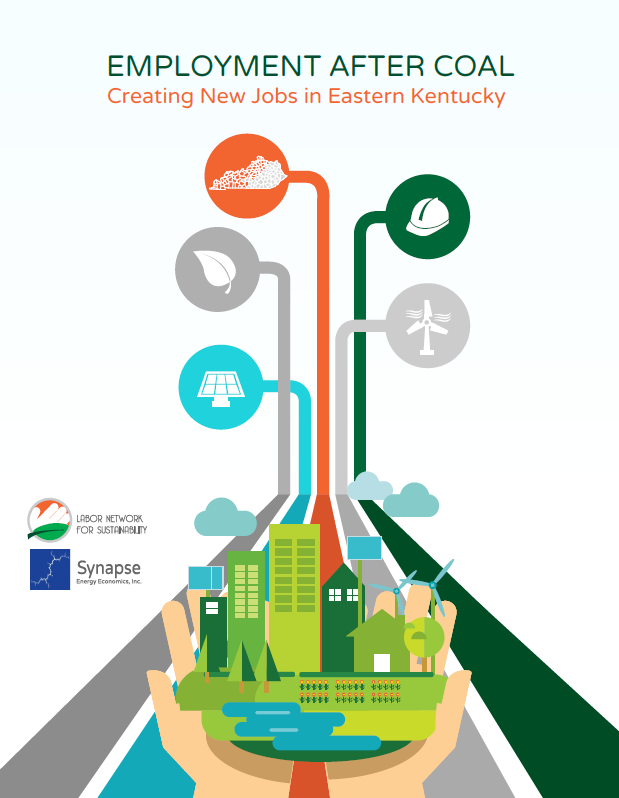
Employment After Coal: Creating new jobs in eastern Kentucky

By Frank Ackerman, PhD and Tyler Comings - MACED, December 30, 2015

The steep, ongoing decline of coal mining has caused the loss of 30,000 coal jobs in eastern Kentucky in the last 30 years. Trends in energy markets and public policy make it clear that a coal‐based economy is not coming back. A successful response to this crisis, replacing the lost kingdom of coal with a sustainable, community‐controlled economy, is crucial to the hopes for forward‐looking economic development in the region.

The issue reverberates far beyond the coalfields, as the national search for clean energy alternatives confronts impassioned claims about the need to protect coal mining jobs. In Kentucky and in the nation, a common but misleading frame on the debate suggests that there is no alternative, that “real” jobs can only be created by traditional industries, even if they are environmentally damaging.

In fact, the narrow, coal‐centered vision of “real” jobs is fading away, and discussion of newer, cleaner alternatives is already underway. Community organizations such as the Mountain Association for Community Economic Development (MACED) and Kentuckians for the Commonwealth (KFTC) have sponsored grassroots job creation initiatives, and have identified key sectors where employment growth should be possible. Both MACED and KFTC advocate for a Just Transition, a bigger picture that combines existing initiatives into a single vision of a working economy, mapping the sustainable occupations and industries that will fill the void left by coal.

Our analysis describes a new pattern of employment that Appalachian Kentucky could aspire to reach by 2030. It is a more challenging and longer‐term goal than is usually found in immediate grass‐roots campaigns. At the same time, it is more limited, detailed and practical than a grand statement of ultimate objectives. It occupies an intermediate level of abstraction, a mid‐range strategic vision of what the regional economy could look like in ten to twenty years.

Read the text (PDF).

Pages

The Fine Print I:

Disclaimer: The views expressed on this site are not the official position of the IWW (or even the IWW’s EUC) unless otherwise indicated and do not necessarily represent the views of anyone but the author’s, nor should it be assumed that any of these authors automatically support the IWW or endorse any of its positions.

Further: the inclusion of a link on our site (other than the link to the main IWW site) does not imply endorsement by or an alliance with the IWW. These sites have been chosen by our members due to their perceived relevance to the IWW EUC and are included here for informational purposes only. If you have any suggestions or comments on any of the links included (or not included) above, please contact us.

The Fine Print II:

Fair Use Notice: The material on this site is provided for educational and informational purposes. It may contain copyrighted material the use of which has not always been specifically authorized by the copyright owner. It is being made available in an effort to advance the understanding of scientific, environmental, economic, social justice and human rights issues etc.

It is believed that this constitutes a 'fair use' of any such copyrighted material as provided for in section 107 of the US Copyright Law. In accordance with Title 17 U.S.C. Section 107, the material on this site is distributed without profit to those who have an interest in using the included information for research and educational purposes. If you wish to use copyrighted material from this site for purposes of your own that go beyond 'fair use', you must obtain permission from the copyright owner. The information on this site does not constitute legal or technical advice.