You are here

just transition

What the Industry Doesn’t Want You to Know About Fracking

By Josh Fox and Lee Ziesche - EcoWatch, September 12, 2015

Disclaimer: The views expressed here are not the official position of the IWW (or even the IWW’s EUC) and do not necessarily represent the views of anyone but the author’s.

TRAILER FOR GASWORK THE FIGHT FOR CJ's Law A NEW SHORT FILM BY JOSH FOX from JFOX on Vimeo.

When we hear politicians and gas companies extoll the virtues of fracking, jobs created by drilling is usually high on their list of talking points. But the jobs created by fracking are not the kind of quality jobs American workers deserve.

They are not the kind of jobs American laborers have fought and died for throughout our country’s history.

They are extremely dangerous, exposing workers to chemicals whose long-term impacts on human health are yet unknown. In fact, the fatality rate of oil field jobs is seven times greater than the national average.

In our new short film, GASWORK: The Fight for C.J.’s Law, we conduct an investigation into worker safety and chemical risk. We follow Charlotte Bevins as she fights for CJ’s law—a bill to protect workers named for her brother CJ Bevins, who died at an unsafe drilling site.

We interview many workers who have been asked to clean drill sites, transport radioactive and carcinogenic chemicals, steam-clean the inside of condensate tanks which contain harmful volatile organic compounds, polycyclic aromatic hydrocarbons and other chemicals, and have been told to do so with no safety equipment.

Can Autoworkers Save the Climate?

By Lars Henriksson - Jacobin, October 2, 2015

Disclaimer: The views expressed here are not the official position of the IWW (or even the IWW’s EUC) and do not necessarily represent the views of anyone but the author’s.

At the COP 19, the even-more-depressing-than-usual climate summit that took place in Warsaw in 2013, one small ray of light made it through the dark corporate clouds that were otherwise suffocating even the slightest effort to address the ongoing environmental disaster.

On the last day of the conference, an unusual alliance was formed as environmental organizations and trade unions together walked out of the venue under the banner of “Enough Is Enough.” Sick of the meaningless talks, they stated:

We are now focusing on mobilizing people to push our governments to take leadership for serious climate action. We will work to transform our food and energy systems at a national and global level and rebuild a broken economic system to create a sustainable and low-carbon economy with decent jobs and livelihoods for all. And we will put pressure on everyone to do more to realize this vision.

If not entirely unique, this action nevertheless promised a new hope for a climate movement that never recovered after its (greatly exaggerated) expectations cruelly disappointed at the summit in Copenhagen four years earlier. The relationship between trade unions and environmentalists has often been strained, if there has been one at all. More often than not, those claiming to defend the earth and workers’ rights are operating at a crossroads, sometimes colliding in head-to-head confrontation — especially when jobs are pitted against environmental interests.

I found myself in that squeeze when the financial crisis hit the auto industry in 2008. The previous year, Al Gore and the Intergovernmental Panel on Climate Change (IPCC) were awarded the Nobel Peace Prize, and climate change topped worldwide headlines. But with the bankruptcy of Lehman Brothers and the auto industry in free fall, the climate crisis quickly disappeared from general discussion, even more so among auto-industry workers. Profits (disguised as “jobs”) were the main issue, not the complicated and distant phenomenon of global warming.

New York Climate Jobs Initiatives

By J. Mijin Cha, Lara Skinner and Josh Kellermann - Global Climate Jobs, September 11, 2015

Disclaimer: The views expressed here are not the official position of the IWW (or even the IWW’s EUC) and do not necessarily represent the views of anyone but the author’s.

In 2014-2015, the New York labor movement and its allies in other movements launched two complementary Climate Jobs initiatives for New York City and New York State. The city-level campaign, Climate Works for All, is anchored by ALIGN, the NYC Environmental Justice Alliance (NYC-EJA) and the NYC Central Labor Council (CLC). Climate Works for All is a broad coalition of over 40 community, labor, environmental justice, faith and other organizations united to ensure that efforts to address climate change also create good, career-track jobs and prioritize low-income, climate-vulnerable communities. The coalition released a 10-point platform in early 2015 that focused on five primary sectors that contribute most to NYC’s climate crisis: Buildings; Energy; Transit; Waste; and Community and Infrastructure Resiliency. The 10-point platform ranges from demanding a mandatory energy efficiency retrofit program for large privately-owned buildings, to solar installations on 100 schools, to flood and stormwater infrastructure improvements, to making NYC’s public hospitals more resilient to climate change impacts.

The New York State initiative, coordinated by The Worker Institute at Cornell, brings together unions in the building, energy and transport sectors to develop a comprehensive climate jobs plan for New York State. A Climate Jobs report for New York State will be released in Fall 2015 along with specific climate jobs policy proposals for the energy, transport and buildings sectors – policies that the labor movement along with its allies will push to implement in the next year. The Worker Institute at Cornell and its union partners have also developed a labor-climate training curriculum for union members and leaders that will be used to build engagement and support for the climate jobs work in NY.

How Do We 'Change Everything' without Pitting Workers against the Planet?

By Alexandra Bradbury; image by Sam Churchill - Labor Notes, September 8, 2015

Disclaimer: The views expressed here are not the official position of the IWW (or even the IWW’s EUC) and do not necessarily represent the views of anyone but the author’s.

As fights erupted in the Pacific Northwest this summer over fuel export terminals and Arctic drilling, the idea of a just transition has been on my mind.

The late Tony Mazzocchi of the Oil, Chemical, and Atomic Workers (now part of the Steelworkers) coined the term. A “just transition” away from fossil fuels wouldn’t pit workers against the planet. Those displaced should be able to count on decent new green jobs and retraining.

“There’s a Superfund for dirt,” Mazzocchi used to say. “There ought to be one for workers.”

SHELL NO?

As Shell Oil’s drilling rig and ice cutter churned toward the Arctic, activists in Seattle and Portland, paddling kayaks and dangling from cables, tried to block them. Some unions backed the protests, but not the usually progressive Longshore Workers (ILWU).

Servicing Shell’s fleet will provide “an awful lot of family-wage jobs,” said Justin Hirsch, an ILWU Local 19 executive board member—at a time when condo developers are eyeing the waterfront and longshore jobs are squeezed by shipping industry consolidation.

Don’t get him wrong. Hirsch also says “climate change is a massive issue, and it’s going to have to be dealt with by labor.”

But he’s worried the shift to a green economy offers employers an opportunity to destroy the pay, benefits, and workplace control it took generations of struggle to achieve. Will green jobs be lower-waged and nonunion?

Serious climate action must challenge the system

By Mel Barnes - Green Left Weekly, August 29, 2015

Disclaimer: The views expressed here are not the official position of the IWW (or even the IWW’s EUC) and do not necessarily represent the views of anyone but the author’s.

This week Canadian author Naomi Klein is visiting Australia to speak about why capitalism is incompatible with action on climate change.

Her book This Changes Everything: Capitalism vs the Climate encourages everyone already involved in fighting for social justice and equality to see climate change as the “best chance we’ll ever get to build a better world”.

This vision is the antidote to the bleak picture painted by climate scientists and the knowledge that not just Australia, but the US and China have set targets that put the world on track for rises far above what the science says we can all survive.

Last week, the US National Oceanic and Atmospheric Administration announced that July was the warmest month ever recorded and with a predicted El Nino, Australia is set to experience another hot summer.

Rising temperatures and chaotic weather are not the only outcomes of climate change. When this intersects with poverty, racism and unemployment, it is clear that the most vulnerable will be the worst off.

The good news is these issues can be tackled through the same measures we take to tackle climate change. It means transforming our economy and society from one where power is concentrated in the hands of the rich, into one where we enjoy a higher quality of life and greater equality thanks to the need to share resources.

It will mean investing in public infrastructure, such as transport, housing and health, and the creation of permanent, green jobs. It will mean greater democracy for communities to make decisions about issues that affect them; this includes Aboriginal communities having control over their land.

But it will not happen if we leave it up to politicians negotiating through international agreements.

Global Climate Jobs

By various - Global Climate Jobs Network, September 2015

We have to stop climate change, and we have to do it quickly. To do it, we will need 120 million new jobs globally for at least twenty years.

There are now campaigns in several countries fighting for mass government programs for climate jobs. Most of them started with union support, and all of them are trying to build an alliance of unions, environmentalists, NGOs, and faith groups.This booklet has been produced by several of these campaigns, because we want people in other countries to do the same.

The first half of this booklet explains the idea of climate jobs in broad strokes. But each country is different, so the second half of this booklet sketches what climate jobs would mean in South Africa, Norway, Canada, New York State, and Britain.

Read the report (English PDF) | (French PDF) | (Spanish PDF).

Mass Incarceration vs. Rural Appalachia

By Panagioti Tsolkas - Earth Island Journal, August 24, 2015

Disclaimer: The views expressed here are not the official position of the IWW (or even the IWW’s EUC) and do not necessarily represent the views of anyone but the author’s.

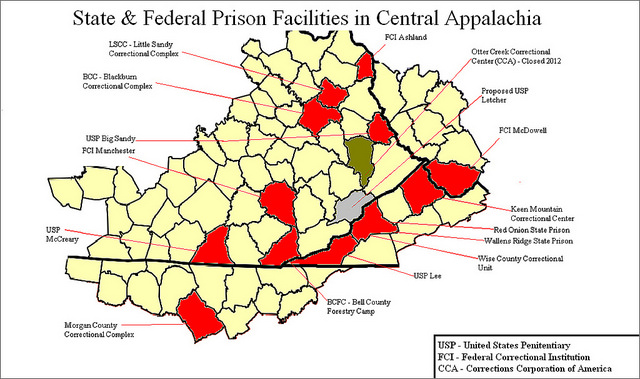
Feds want to build a maximum-security prison on top of a former mountaintop removal mining site in eastern Kentucky

For all practical purposes the [Cumberland Plateau] has long constituted a colonial appendage of the industrial East and Middle West, rather than an integral part of the nation generally. The decades of exploitation have in large measure drained the region.

Harry M. Caudill, author, historian, lawyer, legislator, and environmentalist from Letcher County, in the coalfields of southeastern Kentucky (May 3, 1922 – November 29, 1990)

The United States Bureau of Prisons is trying to build a new, massive maximum-security prison in the Appalachian mountains of eastern Kentucky — and there’s a growing movement to stop it.

The prison industry in the US has grown in leaps and bounds in the past 20 years— a new prison was built at an average rate of one every two weeks in the ’90s, almost entirely in rural communities. As of 2002, there were already more prisoners in this country than farmers. The industry seems like an unstoppable machine, plowing forward at breakneck speed on the path that made the world’s largest prison population.

Today, about 716 of every 100,000 Americans are in prison. Prisoners in nations across the world average at 155 per 100,000 people. And in the US, Southern states rule the chart. Viewing these states as countries themselves, Kentucky ranks at lucky number seven.

“Sounds terrible…” you may be thinking, “But what does it have to do with the environment?”

Well, this seemingly impenetrable multi-billion dollar bi-partisan government-driven industry does have a weak point: it’s a well-verified ecological mess. For a 10-year period of the Environmental Protection Agency’s Prison Initiative, prison after prison that the EPA’s inspected in the Mid-Atlantic region was plagued with violations. Violations included air and water pollution, inadequate hazardous waste management and failing spill control prevention for toxic materials.

From the initial breaking ground on construction in rural and wild places to the inevitable sewage problem from operating chronically over-populated facilities — running a prison is dirty business. And when you factor in the plethora of environmental justice issues facing the prisoners, disproportionately low-income and people of color, it becomes an outright nightmare.

Moving Beyond Protests and Counter Protests; the transition to a renewable economy requires the climate movement and unions to work in solidarity together

By Catherine Nadel - 350.org, August 15, 2015

Disclaimer: The views expressed here are not the official position of the IWW (or even the IWW’s EUC) and do not necessarily represent the views of anyone but the author’s.

In the lead up to the Ende Gelände action, that will see a mine shut down in the Rhineland this weekend, there have been rumours of a counter protest organised by the union for RWE employees. This possibility is disappointing for a number of reasons. The climate movement’s mission is not only to respond to the climate crisis by dismantling our reliance on fossil fuels, but to a build a movement that is capable of achieving this in a way that is just and fair. Central to this strategy are workers. It is understandable that the actions of climate activists, such as Ende Gelände can seem threatening to those who rely on the fossil fuel industries for their jobs and livelihoods. It is our hope that the communities that currently depend on these jobs, understand that there is no greater threat to them than the threat of climate change. This is a threat that will fundamentally change the way we live. If we do not work together to confront this challenge and transition to a cleaner, fairer future, we risk not only jobs and livelihoods, but everything.

Research into the fossil fuel industry reveals that the interests of unions and the climate movement are fundamentally aligned. The two groups share many common values; financial stability, job security and strong communities are among the clearest of them. We also share a common challenge, responding to an industry that values profit margins over the safety and security of both their employers and the climate.

RWE is not only the single biggest emitter of CO2 in Europe, it is also one of the continent’s most negligent companies. According to research commissioned by Greenpeace in 2012, RWE’s coal power stations cause over 900 deaths a year in Germany. RWE’s failure to adapt its business model at a time when the rest of Germany is transitioning to a low-carbon economy has caused its share price to drop by 70% since 2007. Predictably, these losses have not fallen on the executives of the company, but on the workers. In 2014 alone RWE slashed over 5000 jobs.

RWE’s business model is founded on disregard for both social and environmental consequences. When Ende Gelände activists walk into the mine tomorrow, their aim will be to disrupt this destructive model. They do this in the knowledge that when the action disrupts RWE’s business tomorrow, it will also be disrupting an ordinary workday for many people. This can justifiably be perceived as inconvenient and inconsiderate to the employees of the mine. This is regrettable, however climate change is disruptive and inconsiderate. It poses a threat to every one of us, a threat that we must respond to together.

It is for this reason that when Ende Gelände calls on RWE to change its ways, it also calls on the German government to invest in a transition to an economy based on renewable energy and sustainable long-term jobs. To us, this means investing time and money in the re-skilling and employment of workers, to rapidly deploy decentralised renewable energy solutions, that support whole communities rather than profits for a few and climate disruption for the rest. We want to extend an invitation to the workers and communities of the Rhineland, to join us in this fight.

The fight for a clean future involves transition for all of us. This includes transition for the workers of fossil fuel industries; this transition must not only be just and fair, it must be lead by workers. This is why the idea of a worker counter protest is so deeply saddening. As a climate movement we know we can do better to put the rights of working people at the centre of our work, but we know that to change everything, it will take everyone. Climate change is not just a siloable environmental issue, it is a people issue; and it is a threat to communities everywhere. That is why it is so important that we move beyond protests and counter protests and work together to build a fossil free future that is centred on fairness and justice for all.

How to Support Clean Energy and Not Be a Jerk; As the nation turns away from coal, what do we owe coal workers?

By Jonathan Tasini - Sierra, July-August 2015

Disclaimer: The views expressed here are not the official position of the IWW (or even the IWW’s EUC) and do not necessarily represent the views of anyone but the author’s.

Michael Phillippi makes $28.50 per hour working as a mechanic at Murray Energy's Monongalia County coal mine in West Virginia. That's almost double what he made as a crane operator before snagging this coveted job four years ago. With healthcare and pension, that figure is close to $60 per hour, all because he's a member of the United Mine Workers of America (UMW). That's a hefty paycheck in a state where the minimum wage is $8 per hour and the poverty rate is one of the highest in the nation.

The amiable, broad-shouldered Phillippi brings home more than twice what his wife makes as a teacher's assistant. He puts 10 percent of his paycheck into a 401(k) and invests another chunk in education savings for his three kids. He pays the bills and still has enough left over for a boat and a little camp where his family spends time in the summer. "I know guys making eighteen, twenty thousand," he says. "We had a banker start a few months ago—he was in charge of loans at a bank. He makes more money and has better benefits as a coal miner."

If the mine closed, Phillippi says, he'd have to learn to live off $15 an hour or less. To find a salary comparable to his current job's, he'd have to drive 75 miles north to Pittsburgh. But he probably wouldn't. "I won't move," he says. "I am from here. My family is from here. My grandparents are from here. My wife and her family. This is our community. I want to raise my children here. I plan on dying here. It's the sad truth that the good jobs aren't here."

Phillippi's paycheck also matters to the small businesses he sprinkles money on, like the mom-and-pops he stops at on his 35-minute drive from his home in Morgantown to the mine. Sitting in a small conference room in the UMW regional office in Fairmont, Phillippi points across the table to Mark Dorsey, who worked underground for 34 years before retiring in 2010: "For every hour I work, I'm helping to pay his pension." 

There are hundreds of thousands of Michael Phillippis spread out across the nation, from the coalfields of West Virginia and Kentucky to the more than 500 coal-generating power stations located in virtually every state. These workers now face the loss of their good-paying jobs due to the declining competitiveness of coal compared to other energy sources and new Environmental Protection Agency regulations intended to address air pollution and climate change. 

Those regulations, of course, have clear benefits for Phillippi, Dorsey, and everyone who breathes. Stronger soot standards alone would prevent 35,700 premature deaths per year and 1.4 million cases of aggravated asthma. Shifting to renewable energy, says the Union of Concerned Scientists, would create three times as many jobs—although likely not as well paid—as an equivalent investment in fossil fuels. And the value of avoiding catastrophic climate change is incalculable. 

But it won't pay the mortgage. As the coal industry withers, what will happen to Phillippi, Dorsey, and the communities they live in? The classic free market answer: That's life. Economies change, so suck it up. When the car replaced the horse and cart, buggy manufacturers moved on. 

That is not the only answer. Slowly, tentatively, unions and environmentalists are beginning to talk about an entirely different option called Just Transition, a guarantee that the cost of bringing down the curtain on the coal industry will not be paid by coal workers alone, but will be spread across society. It would be a huge undertaking, ideally encompassing the tens of thousands of workers directly employed in coal, from mining to electric-power generation, plus the communities that depend on their spending and taxes.

The EPA’s Clean Power Plan: How Unions and Allies Can Protect Affected Workers

By Joe Uehlein, et. al. - Labor Network for Sustainability, August 5, 2015

Disclaimer: The views expressed here are not the official position of the IWW (or even the IWW’s EUC) and do not necessarily represent the views of anyone but the author’s.

The Environmental Protection Agency (EPA) has just issued the final text of the Clean Power Plan (CPP), a regulation whose purpose is to reduce the greenhouse gas emissions (GHGs) that climate scientists say are causing global warming. EPA and independent studies indicate that the CPP will create far more jobs than it eliminates. However, some jobs will be lost as a result of the plan, almost entirely concentrated in coal mining and electrical utilities. Affected workers and their communities should not have to bear the burden of environmental protection that benefits all. Public policy can and should provide a “just transition” that protects their wellbeing.

The EPA has released a “regulatory impact analysis” of job and other effects of the CPP. Dr. Josh Bivens of the Economic Policy Institute (EPI) conducted a further analysis to evaluate and extend the EPA findings and has produced the recently-released study “A Comprehensive Analysis of the Employment Impacts of the EPA’s Clean Power Plan.”

Between now and 2020, the CPP will require large investments in renewable energy and energy efficiency. It will also reduce jobs in power plants and mining. The new “direct” jobs created by 2020 will outnumber the jobs lost by 96,000 jobs.

Pages

The Fine Print I:

Disclaimer: The views expressed on this site are not the official position of the IWW (or even the IWW’s EUC) unless otherwise indicated and do not necessarily represent the views of anyone but the author’s, nor should it be assumed that any of these authors automatically support the IWW or endorse any of its positions.

Further: the inclusion of a link on our site (other than the link to the main IWW site) does not imply endorsement by or an alliance with the IWW. These sites have been chosen by our members due to their perceived relevance to the IWW EUC and are included here for informational purposes only. If you have any suggestions or comments on any of the links included (or not included) above, please contact us.

The Fine Print II:

Fair Use Notice: The material on this site is provided for educational and informational purposes. It may contain copyrighted material the use of which has not always been specifically authorized by the copyright owner. It is being made available in an effort to advance the understanding of scientific, environmental, economic, social justice and human rights issues etc.

It is believed that this constitutes a 'fair use' of any such copyrighted material as provided for in section 107 of the US Copyright Law. In accordance with Title 17 U.S.C. Section 107, the material on this site is distributed without profit to those who have an interest in using the included information for research and educational purposes. If you wish to use copyrighted material from this site for purposes of your own that go beyond 'fair use', you must obtain permission from the copyright owner. The information on this site does not constitute legal or technical advice.