

You are here

wind power

Wind turbine ports run by union labor could help Maine be leader in climate, industry

By Dan Neumann - Maine Beacon, June 19, 2023

A bill introduced by Gov. Janet Mills that would create visual impact standards for future offshore wind projects has passed the Maine Legislature and is on its way to her desk. 

Advocates are describing the amended version of the bill as “groundbreaking,” as it now includes requirements that any port facilities that are built to support offshore wind energy in Maine include strong labor, community benefit and environmental standards.

Proponents say the changes would put Maine in a strong position to attract federal funding for future ports as President Joe Biden signed an executive order last year prioritizing federal funding for large-scale builds that include project labor agreements (PLAs). PLAs ensure construction is done by union workers making a prevailing wage determined to be livable. 

However, it remains to be seen if Mills will support the final legislation. A conservative Democrat who has sided with business interests over workers on several proposals since taking office in 2019, Mills has so far been non-committal about her position on the proposed labor standards.

“A broad coalition of working people and environmental advocates have come together to support the creation of a new industry in Maine that can help us combat climate change, create good jobs and support coastal communities,” Francis Eanes, director of the Maine Labor Climate Council, said in a statement last week. “We are grateful for the strong support we’ve seen in the Legislature, and we are hopeful that Gov. Mills will support this groundbreaking step forward on one of her most high-profile priorities.”

AB 525 Workforce Development Readiness Plan

By Brooklyn Fox and Sarah Lehman - California State Lands Commission, June 16, 2023

The purpose of this Assembly Bill (AB) 525 Workforce Development Readiness Plan is to provide recommendations for workforce development efforts ahead of the necessary seaport investments and activities identified in the AB 525 Port Readiness Plan.
The workforce development readiness plan was developed considering the workforce required in California to deliver 25 GW of offshore wind power generation capacity by year 2045.This assessment includes the potential direct workforce required for the delivery of offshore wind projects, the workforce required for related port infrastructure upgrades as outlined in the AB 525 Port Readiness Plan, and the workforce requirement related to transmission network upgrades.

The workforce development assessment consists of three discrete pieces: (1) a needs assessment that analyzed the scale, timing and necessary skills of the required workforce; (2) an assessment of the currently available workforce and training infrastructure in California to support the growth of the offshore wind industry; and (3) a gap and opportunity analysis between the needs and availability assessments.

For more details, see: AB 525 Reports: Offshore Renewable Energy

Download a copy of this publication here (PDF).

The New Math for Wind and Solar Manufacturing Supports Good Jobs and U.S. Manufacturing

By Yohan Min, Maarten Brinkerink, Jesse Jenkins, and Erin Mayfield - Blue Green Alliance, June 9, 2023

Researchers at Dartmouth and Princeton released a BlueGreen Alliance-funded report on the estimated impacts the Inflation Reduction Act will have on the U.S. wind and solar industry, including changes in wind and solar manufacturing, labor standards for clean energy workers, job creation, and demand for materials. Specifically, the report explores the impacts of the law’s clean electricity production and investment tax credits (PTC and ITC) and the 45x Advanced Manufacturing Production Tax Credit.

The report finds that the Inflation Reduction Act offers wind and solar developers an airtight business case to use U.S.-manufactured components and pay workers fair wages. It has always been the right thing to do. Now it’s also the most economical thing to do. 

By transforming the economics of wind and solar power, the Inflation Reduction Act will spur the creation of millions of new U.S. solar and wind manufacturing and deployment jobs, with strong incentives for fair wages and career pathways.

The findings show strong, unprecedented potential to build our clean energy future on a foundation of good jobs, clean manufacturing, a reliable industrial base, and greater equity.

Bypassing the Culture Wars to Energize Rural-led Climate Solutions

BPRA: A Win in the Fight for a Green New Deal

Offshore: North Sea Oil workers on the future of our energy system

Steel built the Rust Belt. Green steel could help rebuild it

By Katie Myers - Grist, May 11, 2023

In the Mon Valley of western Pennsylvania, steel was once a way of life, one synonymous with the image of rural, working-class Rust Belt communities. At its height in 1910, Pittsburgh alone produced 25 million tons of it, or 60 percent of the nation’s total. Bustling mills linger along the Monongahela River and around Pittsburgh, but employment has been steadily winding down for decades.

Though President Trump promised a return to the idealized vision of American steelmaking that Bruce Springsteen might sing about, the industry has changed since its initial slump four decades ago. Jobs declined 49 percent between 1990 and 2021, when increased efficiency saw the sector operating at its highest capacity in 14 years. Despite ongoing supply chain hiccups and inflation, demand continues growing globally, particularly in Asia. But even as demand for this essential material climbs, so too does the pressure to decarbonize its production.

Earlier this month, the progressive Ohio River Valley Institute released a study that found a carefully planned transition to “green” steel — manufactured using hydrogen generated with renewable energy — could be a climatic and economic boon. It argues that as countries work toward achieving net-zero emissions by 2050, a green steel boom in western Pennsylvania could help the U.S. meet that goal, make its steel industry competitive again, and employ a well-paid industrial workforce.

“A transition to fossil fuel-free steelmaking could grow total jobs supported by steelmaking in the region by 27 percent to 43 percent by 2031, forestalling projected job losses,” the study noted. “Regional jobs supported by traditional steelmaking are expected to fall by 30 percent in the same period.”

How to Win a Green New Deal in Your State

By Ashley Dawson - The Nation, May 11, 2023

New York passed a publicly funded renewable energy program. This is how DSA did it—and how you can too.

New York just became the first US state to pass a major Green New Deal policy. After four years of organizing, the Build Public Renewables Act (BPRA) is now in the New York state budget. Passage of the act is a massive challenge to fossil fuel hegemony and a major victory for public power.

The BPRA authorizes and directs the state’s public power provider—the New York Power Authority (NYPA)—to plan, build, and operate renewable energy projects across the state to meet the ambitious timetable to decarbonize the grid mandated by the Climate Act of 2019. The NYPA, the largest public utility in the country, provides the most affordable energy in the state, but until now, it has been prohibited from building and owning new utility-scale renewable generation projects because of lobbying by profit-seeking private energy companies.

How did we win passage of this plan to start a publicly funded renewable energy program?

The Public Power NY movement began in late 2019 with a campaign organized by the eco-socialist working group of the NYC Democratic Socialists of America (DSA) against a rate hike request from the private utility ConEd. According to a 2018 report from the US Energy Information Administration, ConEd was already charging the second-highest residential rates of any major utility in the country (nearly double the national average), and now they wanted to raise electricity rates an additional 6 percent and gas rates by 11 percent.

To thwart this request, the Public Power campaign did intensive research into the for-profit utility’s recent history and found that though ConEd was making a billion dollars per year in profits, it had threatened to shut off power for 2 million low-income New Yorkers in 2018. Moreover, ConEd had failed to carry out grid upgrades that it had received $350 million to perform, a failure that left the power grid in an increasingly unstable state.

Responsible Offshore Wind Development Starts with a Green Port

By Luis Neuner, Jennifer Kalt, Caroline Griffith, and Colin Fiske - Lost Coast Outpost (reposted at Wild California), May 10, 2023

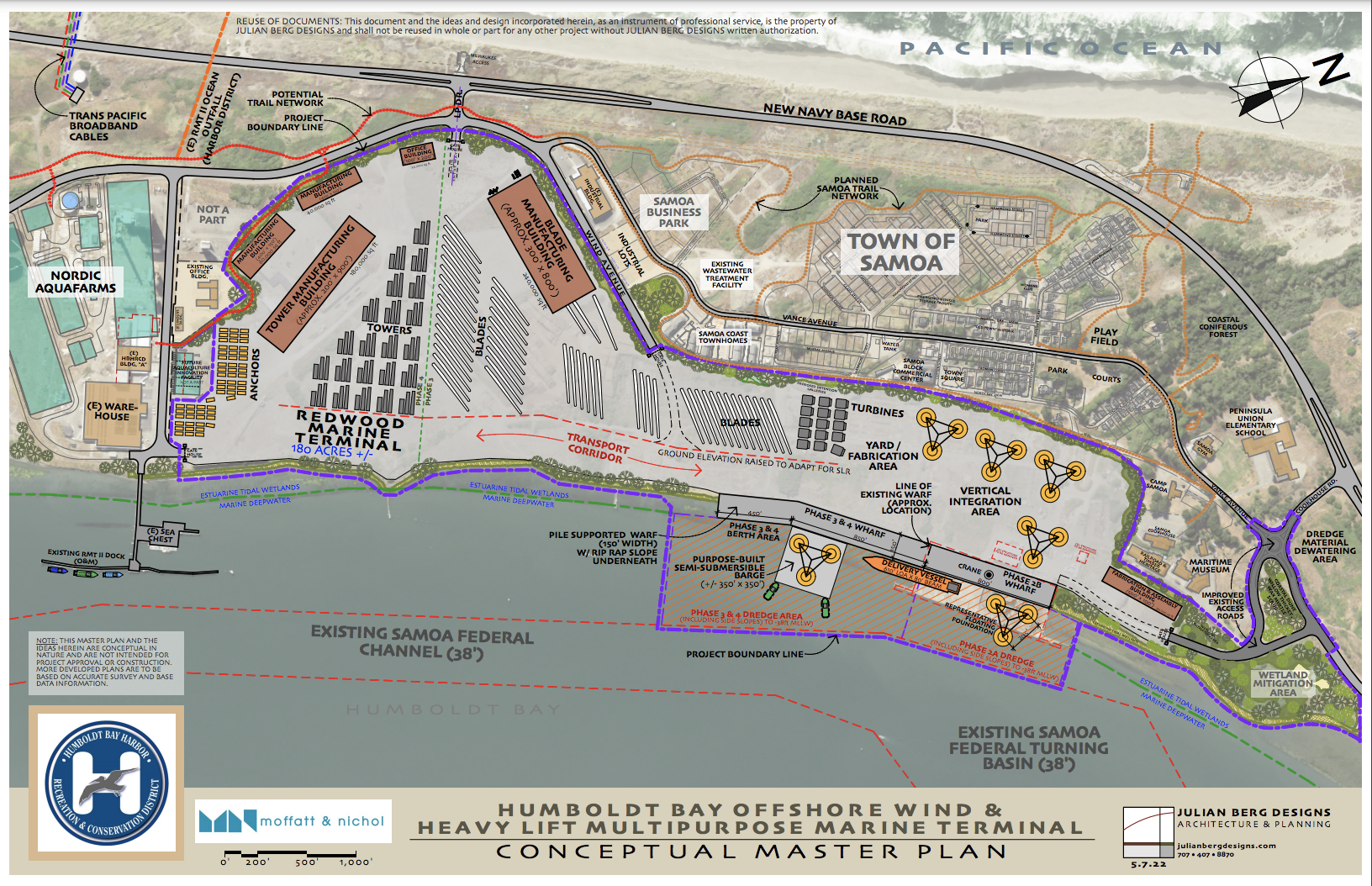
Humboldt Bay Offshore Wind & Heavy Lift Multipurpose Marine Terminal Conceptual Master Plan. Image from Humboldt Bay Harbor Resource & Conservation District.

Humboldt County’s proposed offshore wind project would significantly reduce carbon emissions throughout California by providing upwards of 1.6 gigawatts of clean, renewable-sourced energy. But to ensure the success of offshore wind and to meet the promise of climate action, decision-makers must commit to a green port facility capable of building and servicing the turbines while not further contributing to greenhouse gas emissions or polluting Humboldt Bay.

A key component of a thriving offshore wind industry is a port capable of constructing, assembling, and maintaining wind turbines. The Humboldt Bay Harbor District has partnered with Crowley Wind Services, a multinational port development company, to build this heavy lift terminal on the Samoa Peninsula. There are various potential benefits: port development could create many family-wage jobs and substantially contribute to a growing local economy—all while making important strides towards a clean-energy future to address the climate crisis.

Unfortunately, these types of heavy-lift terminals have a mixed track record for communities. On land, port equipment such as terminal tractors, forklifts, yard trucks, cranes, and handlers commonly run on diesel. In the water, most heavy-duty cargo ships and tugboats also run on diesel or heavy fuel oil, polluting the air. Ships and tugs even burn fuel while docked at the terminal to maintain a base load of electricity. As a result, communities surrounding these ports often suffer from the effects of air pollution. In Los Angeles, for example, air quality studies revealed that these diesel fumes significantly raised cancer risk for people within fifteen miles of the terminals.

Our port doesn’t have to be this way. Recent technological developments have made major progress towards enabling the possibility of a ‘green port.’ Green ports seek to make all aspects of operation sustainable, from the heavy machinery on land to the ships docked at the harbor. This work requires moving away from fossil fuels and shifting towards electrification and other zero-carbon energy sources, such as green hydrogen.

Best Practices for Implementation: How the Lessons from the Bipartisan Infrastructure Law Can Ensure the Inflation Reduction Act Delivers Good Jobs and Community Benefits

By staff - Blue Green Alliance, May 1, 2023

On November 15, 2021, President Joe Biden signed the Bipartisan Infrastructure Law (BIL)—also known as the Infrastructure Investment and Jobs Act. The law includes $550 billion in new federal funding to repair and help rebuild the nation’s infrastructure. The following year, on August 16, 2022, President Biden signed the Inflation Reduction Act into law. These two laws hold the transformational potential to reduce pollution, prevent the worst impacts of climate change, make our workers and communities safer and healthier, and create the good-paying, union jobs we need to give all workers in the United States the opportunity for a middle-class life.

Federal agencies are playing a crucial role in uplifting workers and communities as they develop programmatic requirements and incentives to implement BIL and Inflation Reduction Act investments. In parallel, the Biden administration laid out clear commitments to maximize the job quality, equity, and community benefits of these laws and other federal spending through executive orders and initiatives. The president and his administration are seeking to deliver on their commitment to working people by advancing high-road labor standards and securing worker rights and protections through policies such as Executive Order 14063 on Project Labor Agreements (PLAs).

By working to more consistently apply the Good Jobs Principles and associated metrics across Inflation Reduction Act and BIL-funded programs, agencies can help advance equity and rebuild the middle class. Federal agencies that have not already entered into MOUs with the DOL to support this effort should do so.

Download a copy of this publication here (link).

Pages

The Fine Print I:

Disclaimer: The views expressed on this site are not the official position of the IWW (or even the IWW’s EUC) unless otherwise indicated and do not necessarily represent the views of anyone but the author’s, nor should it be assumed that any of these authors automatically support the IWW or endorse any of its positions.

Further: the inclusion of a link on our site (other than the link to the main IWW site) does not imply endorsement by or an alliance with the IWW. These sites have been chosen by our members due to their perceived relevance to the IWW EUC and are included here for informational purposes only. If you have any suggestions or comments on any of the links included (or not included) above, please contact us.

The Fine Print II:

Fair Use Notice: The material on this site is provided for educational and informational purposes. It may contain copyrighted material the use of which has not always been specifically authorized by the copyright owner. It is being made available in an effort to advance the understanding of scientific, environmental, economic, social justice and human rights issues etc.

It is believed that this constitutes a 'fair use' of any such copyrighted material as provided for in section 107 of the US Copyright Law. In accordance with Title 17 U.S.C. Section 107, the material on this site is distributed without profit to those who have an interest in using the included information for research and educational purposes. If you wish to use copyrighted material from this site for purposes of your own that go beyond 'fair use', you must obtain permission from the copyright owner. The information on this site does not constitute legal or technical advice.
