






You are here
reports
 Web editors' note: In this document, the Canadian foresty workers' union, Unifor, is proposing to accept (limited, "strongly regulated") "Cap & Trade", "REDD+", and "Market Based Solutions" (policies that front line communities and First nations generally oppose, because they allow capitalists to continue to profit by "trading" carbon "credits", much like the "Catholic Indulgences" of the Middle Ages, at the expense of the affected communities) whereas the IWW argues that capitalism cannot be reformed, but having said that, some of the other ideas presented within are a good foundation for a workers' based forestry, so we are presenting it here with that in mind.
 This guide is a project of Save EPA, an all-volunteer organization based in Colorado and made up of former employees of the U.S. Environmental Protection Agency. We have expertise in environmental science, law and policy. We are using our collective expertise to educate and advocate about environmental science, environmental protections and the Trump Administration’s assault on EPA and our public health.
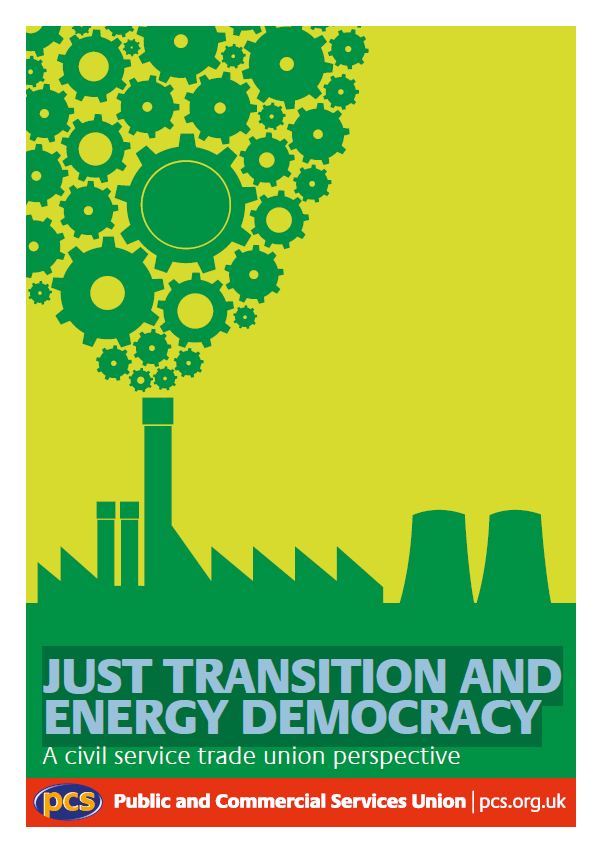 New PCS pamphlet Just Transition and Energy Democracy : a civil service trade union perspective
 You would be forgiven, especially if you live in Europe, to think that public services are by nature expensive, inefficient, maybe even somewhat outdated, and that reforming them to adapt to new challenges is difficult. It would seem natural to assume – because this is what most politicians, media and so-called experts tell us continuously – that we, as citizens and users, should resign ourselves to paying ever higher tariffs for services of an ever lower standard, and that service workers have no choice but to accept ever more degraded conditions. It would seem that private companies will inevitably play an ever larger role in the provision of public services, because everything has a price, because politicians have lost sight of the common good and citizens are only interested in their own individual pursuits.
 Tackling poverty and inequality means bringing an end to the fossil fuel era, beginning with no new coal and supporting renewable energy for all.
 We are in a critical political moment. The impacts of climatechange are increasingly severe, taking a toll on our health, environment and our economies. In the midst of this growing crisis, the United States now has a President and Congressional leadership that simultaneously attack climateclimate science and aim to comprehensively roll back climate protection measures and the rights of workers to organize.
 From the introduction: Six years ago, the US coal industry was thriving, with demand recovering from the Great Recession, and global coal prices at record highs along with the stock prices of US coal companies. By the end of 2015, however, the industry had collapsed, with three of the four largest US miners filing for bankruptcy along with many other smaller companies. While coal mining employment has been on the decline for decades – from a peak of more than 800,000 in the 1920s to 130,000 in 2011 – the pace of job loss over the past six years has been particularly dramatic. After campaigning on a promise to end what he called his predecessor’s “War on Coal,” President Donald Trump signed an Executive Order in March 2017 ordering agencies to review or rescind a raft of Obama-era environmental regulations, telling coal miners they would be “going back to work.”
The Fine Print I:
Disclaimer: The views expressed on this site are not the official position of the IWW (or even the IWW’s EUC) unless otherwise indicated and do not necessarily represent the views of anyone but the author’s, nor should it be assumed that any of these authors automatically support the IWW or endorse any of its positions.
Further: the inclusion of a link on our site (other than the link to the main IWW site) does not imply endorsement by or an alliance with the IWW. These sites have been chosen by our members due to their perceived relevance to the IWW EUC and are included here for informational purposes only. If you have any suggestions or comments on any of the links included (or not included) above, please contact us.
The Fine Print II:
Fair Use Notice: The material on this site is provided for educational and informational purposes. It may contain copyrighted material the use of which has not always been specifically authorized by the copyright owner. It is being made available in an effort to advance the understanding of scientific, environmental, economic, social justice and human rights issues etc.
It is believed that this constitutes a 'fair use' of any such copyrighted material as provided for in section 107 of the US Copyright Law. In accordance with Title 17 U.S.C. Section 107, the material on this site is distributed without profit to those who have an interest in using the included information for research and educational purposes. If you wish to use copyrighted material from this site for purposes of your own that go beyond 'fair use', you must obtain permission from the copyright owner. The information on this site does not constitute legal or technical advice.
 This site is not the official webpage of the Industrial Workers of the World.