You are here

North America's Building Trades Unions (NABTU)

A healthy planet for our children to inherit, or destroying the earth for jobs? Join Thousands of Workers in Saying: We Will No Longer Accept This Choice!

By Labor for Standing Rock - Labor for Standing Rock, February 2017

Dear Fellow Workers:

We are the people whose blood, sweat and tears built this country’s infrastructure. Our hard work keeps our families fed—and it should also protect the world our children will live in tomorrow.

We play a critical role in making America what it is, and what it will become. Now we have united as thousands of workers across the country to ask a tough question: “What kind of world are we building?”

President Trump recently cleared a path for the completion of the controversial Dakota Access (DAPL) and Keystone X-L (KXL) Pipelines, despite massive global protest against these projects. In violation of the right of all people to clean water, air and land - and in violation of Indigenous peoples’ Treaty Rights - the corporations behind these pipelines continue to dangle the promise of good paying jobs in front of people like us, who need work. In doing so, they force us to trade temporary pay—for the future health of everyone we care about.

As working people, of course we demand decent, well-paid jobs. There is no question about that. But we also demand long-term health and safety for our children and grandchildren. Corporations have been lying in order to profit off our lives and the healthy lives of future generations. They tell us pipelines are safe and that they do not fail, which is demonstrably not true. That leaves working people with a choice between one or the other: a job today or a livable planet tomorrow. We will no longer accept this choice.

Even Trump Can’t Stop the Tide of Green Jobs

By Yana Kunichoff - In These Times, February 22, 2017

Donald Trump was elected in November on a platform that included both climate denial and the promise of jobs for Rust Belt communities still hurting from deindustrialization. In the months since, his strategy to create jobs has become increasingly clear: tax breaks and public shaming of companies planning to move their operations out of the country.

Take the case of Carrier, a manufacturing plant in Indianapolis that produces air conditioners. Trump first threatened to slap tariffs on Carrier’s imports after the company announced it would move a plant to Mexico. Then, he reportedly called Greg Hayes, CEO of the parent company United Technologies, who agreed to keep the plant in the United States in exchange for $7 million in tax breaks. (Carrier later admitted that only a portion of the plant’s jobs would remain in the country.)

The company’s decision to keep jobs in the United States was declared a victory for the Trump PR machine, but it’s unclear that it can create a major change in access to jobs in the long-term. Hayes, announcing that the tax breaks would allow additional investment into the plant, noted that the surge of money would go towards automation. And with automation, eventually, comes a loss of jobs.

“Automation means less people,” Hayes told CNN. “I think we’ll have a reduction of workforce at some point in time once they get all the automation in and up and running.”

Unlike traditional manufacturing jobs, green jobs in the clean energy industry have been on a steady upward swing. This past spring, for example, U.S. jobs in solar energy overtook those in oil and natural gas, and a Rockefeller Foundation-Deutsche Bank Climate Change Advisors study found that energy retrofitting buildings in the United States could create more than 3 million “job years” of employment.

That means green jobs remain one of the key hopes for revitalizing communities. But can they move forward under a climate-skeptic and coal-loving president?

A just transition to sustainable jobs

By Bill Onasch - Socialist Action, February 22, 2017

The Trump administration wasted no time before launching a veritable blitzkrieg on all fronts in pursuit of an “alt-right” America First agenda. But resistance has been swift and massive.

In addition to various movements mobilizing we also heard from scientists. Agence France Presse (AFP) reported: “Comments by U.S. President Donald Trump on nuclear weapons and climate change have helped make the world less safe, the Bulletin of the Atomic Scientists warned … moving its symbolic ‘Doomsday Clock’ 30 seconds closer to midnight.”

This heightened warning by atomic scientists about two overarching crises closely followed an announcement by climate scientists at the National Oceanic and Atmospheric Administration that, for the third consecutive year, 2016 had been the hottest since record keeping began in 1880.

Trump replaces an Obama administration that offered token gestures to reduce greenhouse gas emissions, which are the prime culprit in heating our planet, while at the same time also promoting fossil-fuel expansion through destructive fracking of gas and oil.

Now, the 45th president has dismissed global warming as a job-killing hoax perpetrated by China to sabotage the American economy. Rather than presenting any of his signature “alternative facts” to bolster this fantastic conspiracy theory, he has focused on the job-killing argument. Jobs are a big and legitimate concern of the working-class majority.

US Labor Unions Push Back At Trump On Pipelines And Environmental Deregulation

By Seth Sandronsky - Mint News Press, February 17, 2017

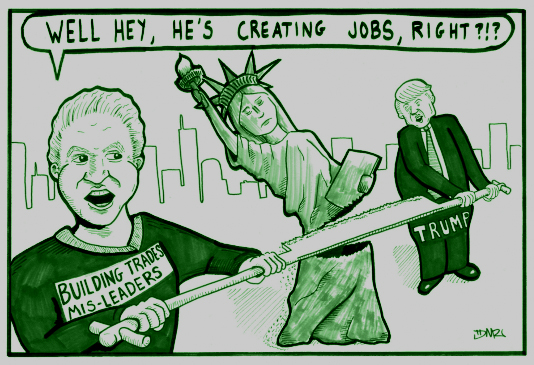
President Donald Trump claims that his energy policy creates high-wage construction jobs. Some of organized labor in the United States agrees with him, including North America’s Building Trades Unions, which is affiliated with the AFL-CIO, the country’s largest federation of unions.

On Jan. 24, NABTU released a statement in support of Trump after the president issued an executive order for completion of the Keystone XL and Dakota Access pipelines to move fossil fuel around North America.

“We are grateful that President Trump understands that 32 percent of today’s construction industry workforce is employed on energy projects, amounting to over 2 million workers, and that projects such as the Keystone XL and Dakota Access pipelines are significant job creators that generate above-average wages and benefits for hard-working Americans,” said the statement prepared by the alliance of 14 national and international unions in the building and construction industry that represent over 3 million skilled craft professionals in the United States and Canada.

In April of 2015, well before Trump was elected to the Oval Office, Sean McGarvey, president of NABTU, addressed the union’s ties to the Koch energy titans, major funders of the GOP and its tea party wing. In an interview with Kent Hoover, Washington Bureau chief of The Business Journals, McGarvey explained:

“Even if you look at Koch Industries — they’re one of our biggest clients. You’ll never see us making public statements saying negative things about Koch Industries. They’re a huge client of ours. Do we agree with some of the things that they supposedly support? No. Do we understand why they do it? Yeah, Ok, because they’re looking for political advantage for a political point of view, and the Democrats don’t see it the way they see it. And other unions in the labor movement tend to be much more Democratic unions. And if you can hurt the labor movement, i.e. you hurt the Democratic Party. It’s just a system that we really don’t want to be engaged or involved in.”

According to OpenSecrets, a project of the Center for Responsive Politics, Koch Industries spent $9.84 million on political lobbying in 2016. This followed years of a heavy spending from the Kansas-based multinational corporation, which had spent $10.83 million on lobbying in 2015 and $13.7 million in 2014. In the 2016 election cycle, Koch Industries donated more than $1.86 million to GOP Congressional candidates and just $23,000 to Democratic candidates, OpenSecrets reports. The top Republican recipients were the recently appointed CIA director, Mike Pompeo, a representative from Kansas who received $71,100 from Koch Industries; Sen. Roy Blunt of Missouri, who received $40,700; and Speaker of the House Paul Ryan, a representative from Wisconsin, who received $39,522.

Yet there are other views of the U.S. labor movement as the Trump administration wages a “shock and awe” campaign of rolling back climate and environment-related rules.

Brothers and Sisters, It’s Time to Fight

By Kevin Norton - Labor Notes, February 15, 2017

The speed of events since Trump’s inauguration has made my head spin. The administration’s absolute onslaught against women, environmentalists, Muslims, immigrants, and the government itself began on day one. So I was a little shocked to see some of the building trades union leadership meet so happily with our nation’s first orange president.

“We have a common bond with the president,” Building Trades President Sean McGarvey said. “We come from the same industry. He understands the value of driving development, moving people to the middle class.” McGarvey also commented that President Obama had never met with the trades.

Some enthusiastic Trump supporters have lit up my Facebook page with stories about how he is going to “Make America Great Again.” One wrote, “I was told Trump was anti-union... Being an informed voter, I knew it was hogwash... here’s the proof.” He left a link to an article about the new president’s meeting with the union leaders.

Fawning over Trump Shuts Out Our Movement’s Future

By Len Shindel - Labor Notes, February 15, 2017

Surrounded by key union leaders, Trump was relaxed and smooth. He thanked the Sheet Metal Workers for their work on his hotel down the street—even as an electrical contractor was suing his company after allegedly getting stiffed on the job.

Union leaders clapped when Trump announced he was trashing the Trans-Pacific Partnership. Trump said their members would soon be needed to complete a load of new projects as he terminated the “disastrous” trade policies that had sent jobs out of the country.

He assured them they would be building new Ford plants and pharmaceutical manufacturing facilities for companies like Johnson and Johnson. The union leaders said they also asked Trump to move ahead, despite widespread protests, on the Keystone XL Pipeline and the Dakota Access Pipeline.

Is It Time for the AFL and the CIO to Part Ways Again?

By Ruth Needleman - Portside, February 6, 2017

Now more than ever we need a strong united labor movement. We do not, however, have one.

The Trump administration has further deepened the wedge dividing workers by hosting the Building and Construction Trades leaders on January 25, 2017. Trump dangled before their eyes his rejection of an already dead TPP trade deal, and, even more to their liking, a commitment to build pipelines, in particular, the Dakota Access pipeline and the Keystone XL pipeline. 

The AFL-CIO had already disappointed members and allies nationally when Trumka, president of the AFL-CIO, came out in support of the pipelines during the massive protests organized by indigenous nations at Standing Rock. Trumka pointed to jobs. But what kind of jobs and for whom and at what cost? There are jobs and then there are jobs with justice.  Temporary construction jobs on the pipelines for the building trades would come at the expense of clean water, land, environmental and indigenous rights.

Nonetheless, Sean McGarvey, president of the North American Building Trades, called the pipeline jobs “an economic lifeline.” In a letter to President Trumka, dated September 14, 2016,  McGarvey referred to the Standing Rock protestors as “environmental extremists,” and “professional agitators.” He denounced the Amalgamated Transit Union (ATU), National Nurses United (NNU), Communications Workers of America (CWA), and the American Postal Workers Union (APWU) for their support of the Standing Rock Sioux Nation. He claimed that building trades members “have been subjected to intimidation, vandalism, confrontation, and violence.”

His insulting tirade went on to say, “Now, rather unfortunately but I suppose not surprisingly, it seems the same outdated lowest common denominator group of so-called labor organizations has once again seen fit to demean and call for the termination of thousands of union construction jobs…I fear that this has once again hastened a very real split within the labor movement.” Further on he added, “It is both offensive and inappropriate for them as General Presidents to be so narrow minded, disregard facts, dismiss and disparage careers in the Building Trades, support lawlessness and violence at the workplace, and jump to the beckon call of outside interests and politicians at the expense of AFL-CIO members.”(sic)

Now the Trades are embracing Trump; “We have a common bond with the president,” according to McGarvey.  Terry O’Sullivan of the Laborers International, a dinosaur on climate issues and environmental concerns, stressed Trump’s “remarkable courtesy and the commitment to creating hundreds of thousands of working-class jobs.” Union Participants described their meeting with Trump as “incredible.”

McGarvey’s “all-out verbal assault and slanders directed at me and other union leaders,” answered APWU president Mark Dimondstein, “will not go unanswered. First, I do not answer to Brother McGarvey, nor seek his permission for the views of the APWU,” Dimondstein stressed. “Nor will I be intimidated by him and his innuendos and insults.”

Also responding to the ideas promoted by the Trades were over 3 million women who protested against Trump and many against the pipeline. The immigrants, Muslims, African Americans, Latinos, LGBTQ activists and Indigenous nations who stand to lose so much are the heart of the US working class and labor movement. The ever-shrinking labor unions, down again in 2016 to 10.7% of the workforce, (only 6.4% of the private sector) cannot afford to turn their back on members and allies, thereby surrendering to right-to-work, frozen minimum wages, lost access to health care, all in exchange for pipeline jobs.

The problem with these Trades misleaders is their narrow self-interested philosophy and practice of looking out only for themselves and their willingness to throw other workers under the bus.  Bill Fletcher, Jr, journalist and black labor activist, compared the collaboration of these Trades’ leaders with Trump to the Vichy government’s collusion with Hitler in France during World War II. A harsh but sadly accurate comparison.

IWW Resolution Against DAPL and KXL

Resolution passed by the IWW General Executive Board - January 28, 2017

Whereas: Neither the Dakota Access Pipeline nor the Keystone XL Pipeline will provide anywhere near the number of permanent union jobs the promoters of these projects promise they will, and

Whereas: Far more permanent union jobs can be created at comparable wages by repairing existing pipeline infrastructure, such as water mains in Flint, Michigan, or repairing leaks in existing pipelines (which, if unfixed, release harmful amounts of methane, a known greenhouse gas that contributes to global warming); and

Whereas: Far more jobs currently exist in the growing renewable energy sector than in the declining fossil fuel sector; and

Whereas: Though these renewable energy jobs are currently, typically nonunion, unions if so determined, could easily develop a successful organizing program, using solidarity unionism, that could revitalize the currently struggling labor movement; and

Whereas: Neither pipeline project will deliver the promised "energy security" or "energy independence" promised by their promoters, including the Building Trades and AFL-CIO Union officials among them; and

Whereas: oil pipelines, such as the aforementioned pipelines tend to leak and create unnecessary risk to the surrounding environment both through methane gas leaks and crude oil spills; and

Whereas: such pipelines endanger the communities along their routes, including many indigenous communities whose tribal sovereignty has been often ignored or violated during the permitting process by agencies subject to regulatory capture by the capitalist interests that promote them; and

Whereas: the construction of these pipelines will contribute to the acceleration of already dangerous levels of currently existing greenhouse gas emissions which are contributing to the already dangerous levels of climate change, which could lead to a dead planet with no jobs of any kind; and

Whereas: many unions, including the IWW, have already publically stated opposition to one or both the Dakota Access Pipeline and Keystone XL Pipeline; and

Whereas: President Donald Trump's "executive orders" that ostensibly "clear a path" for the completion of the aforementioned pipelines  and mandate that they be constructed using US manufactured steel are contradictory in nature and are designed primarily to divide workers and environmentalists over the false dichotomy of "jobs versus the environment", which is utterly false as previously described;

Be it Resolved that: the IWW reaffirms its opposition to the construction of the Dakota Access Pipeline and officially declares its opposition to the construction of the Keystone XL Pipeline; and

Be it Further Resolved that: the IWW stands in solidarity with the First Nations, union members, environmental activists, and community members who oppose both; and

Be it Further Resolved that: the IWW urges rank and file members of the Building Trades, Teamsters, and other unions who have declared support for these pipelines to call upon their elected officials to reverse their support; and

Be it Finally Resolved that: the IWW demands that the promoters of these pipelines develop a "just transition" plan for the pipeline workers that would be affected by the cancellation of these pipeline projects.

Labor can't sit out the fight at Standing Rock

Cliff Willmeng interviewed by Sean Petty - Socialist Worker, November 28, 2016

THE STRUGGLE to stop the Dakota Access Pipeline in North Dakota has become a lightning rod in the concurrent struggle for Indigenous self-determination, to protect the basic water supply for a huge section of the country and to stop climate change. How did you get involved?

SELF-DETERMINATION is a position that cannot coexist within capitalism, since the 1 Percent could never survive an actual democracy.

This is harmful enough at the workplace where the dominant decision-making comes from the CEOs and upper management, instead of those of us actually performing the work. As it's applied to decision-making over the environment, the disenfranchisement of people becomes even more critical. First Nations, of course, have known this for many centuries through the genocide of Western expansion, and the same patterns exist today.

Where I live, my own community and many others attempted to move against the dominance of the fossil fuel industry by enacting local bans or moratoriums on oil and gas drilling in 2012 and 2013.

It resulted in near immediate lawsuits against the communities by the Colorado Oil and Gas Association on the basis that we did not have the authority to stop drilling, since that was in the possession of the state. One lawsuit was even joined by Democratic Gov. John Hickenlooper, who, along with the rest of the two parties, don't believe communities should have superior legal power to corporations.

This is playing out very directly and in the harshest sense against Native Americans in Standing Rock. What they have always known--and what more people are waking up to--is the fact that environmental sustainability is illegal under the American system of law.

THIS STRUGGLE in particular and the effort to stop climate change more generally were completely absent from the presidential debates. Why do you think that is?

IF CLIMATE change is addressed at all, the topic is couched in a set of superficial talking points. The reason is that the dominant forces of the U.S. military and economic system are permanently wedded to fossil fuels. So it doesn't matter if the application is fertilizer and industrial agriculture under Monsanto or war efforts.

The two political parties agree that nothing substantial can be done, or should be done, to address climate change. To do so would threaten their very existence.

AS A former union carpenter and current union nurse, what has been the role of unions in this struggle?

THE UNION leadership has centered itself upon a strategy of integrating the rank and file with management, the Democratic Party and Wall Street, which has meant the widespread demobilization of the membership over the prior 40 years.

This strategy, which some call "business unionism" and some call the "team concept," is based on cooperation with the owners, and has been so successful that unions are at a historic low in membership and strength. The strategy is dependent on removing any leadership role for working people at the workplace or the wider political process of the country. It means elevated positions for union leaders and a diminishing share of crumbs for the workers.

This has led people like AFL-CIO President Richard Trumka to serve as the mouthpiece of the bosses for some time, most recently through his endorsement of Energy Transfer Partners' Dakota Access Pipeline. Thankfully, this extreme position has opened up a debate within organized labor itself, with many unions and rank-and-file members directly opposing the position of the AFL-CIO leadership.

IT SEEMS like the naked business union strategy within the energy and building trades unions is a key factor in providing political cover for the fossil fuel industry. Can you talk more specifically about the potential for organizing resistance against this strategy?

ANY REAL opposition to the fossil fuel industry is going to have to be led by the rank and file. There is the potential or likelihood that union leadership may be pulled in to assist that fight, but the people to lead it have to be the workers ourselves.

Within the fight against the fossil fuel industry, there is the potential for a new debate on the role of working people in forming our world and constructing a planet that is free of fossil-fuel use. This is already taking place in the ranks of the building trades, and those efforts will be opposed by the union leadership for reasons we've already discussed.

The fact is that we can create the best, safest and fullest employment in the process of a just transition from fossil fuels and the repairing of our infrastructure and environment. Where the building trade workers fight for this transition, they will need the support of all workers, and not in only the symbolic sense.

WHAT DO you see as the next steps for building union support?

THERE IS both a lot of work to do and an enormous potential. The vacuum left by the disastrous and weak strategy of business unionism can be filled by a new mobilization of working people to transform our world and our unions.

The first steps will be through bringing the fight and direct action of Standing Rock to our locals and union bodies, and through the education and mobilization of the rank and file. This work will be depend on building through groups like Labor For Standing Rock and a growing coalition of workers ready to lead.

We can join the fight led by the courageous First Nations at Standing Rock and defeat this pipeline. The moment we commit ourselves and unions to that clear goal, an entire world of possibility opens up. It could mean a new power for working people across the country and a powerful alliance of union labor with the frontline fighters ready to build a sustainable world.

Don't sit this one out. It is a true game-changer for us all.

Resolution Against the Dakota Access Pipeline

Resolution passed by Railroad Workers United - November 2, 2016

Whereas, the  unprecedented  $3.78  Billion,  1,172-mile  Dakota  Access  Pipeline would carry over half a million barrels of dirty crude oil from the Bakken oil fields in  North  Dakota,  through  South  Dakota  and  Iowa  to  Illinois  to  connect  to  other pipelines bringing oil to the East Coast and the Gulf; and

Whereas, the  pipeline  is slated to pass through the tribal lands of Standing Rock Sioux  near  Cannon  Ball,  North  Dakota,  and  underneath  the  Missouri  River,  the main source of water for the tribe; and

Whereas, the  pipeline  is  slated  to  pass  under  the  Missouri  River  a  second  time before  passing  under  the  Mississippi  River,  a  total  watershed  coving  40%  of  the continental United States; and

Whereas, the pipeline has already disturbed the lives of millions of Americans; and

Whereas, millions  of  workers--including  many  union  members  and  their  their families--live in communities that are in thepath of the proposed pipeline; and

Whereas, the transport of heavy crude is particularly volatile, leading to 18.4 million gallons of oils and chemicals spilled, leaked, or released into the air, land, and waterways  between  2006  and  2014  in  North  Dakota  alone,  causing  death,  contamination of soil and water, and numerous types of disease; and

Whereas, scientists  have  warned  that  in  order  to  avoid  wide-scale,  catastrophic climate disruption, the vast majority of known remaining fossil fuel reserves must be left in the ground; and

Whereas, people  engaged  in  protecting  their  land  and  water  have  been  brutally attacked by private security forces in both Iowa and North Dakota; and

Whereas, Native  Americans  and  other  activists  defending  their  land  and  water have  the  same  right  to  defend  their  land  and  engage  in  non-violent  protest  as workers who are protesting the actions of an unfair employer; and

Whereas, the  U.S.  Congress  has  repealed  the  ban  on  exporting  oil,  meaning  that the oil transported by the pipeline is likely to be sold overseas and not contribute to US energy independence; and

Whereas, we know that a very real threat to workers’ lives and livelihoods is the prospect of catastrophic climate change; and

Whereas pipelines  accidents,  such  as  the  recent  Helena,  Alabama  gas  pipeline explosion  which  killed  one  and  injured  five,  pose  a  threat  to  workers  and  their communities; and

Whereas, many  large  corporations,  and  especially  fossil  fuel  corporations,  have been  putting  profits  ahead  of  the  common  good  of  workers,  the  public,  and  the environment, and these corporations have been unjustly granted the constitutional  rights  and  powers of “person-hood”, diminishing  democracy and  the  voice  and power of the people; and

Whereas, numerous national and international unions have already passed resolutions against construction of the pipeline, including National Nurses United, the Amalgamated Transit Union, the Communications Workers of America, the United Electrical Workers, Service Employees International Union, and others; and

Whereas, these unions have an economic, environmental and racial justice strategy which has been employed to win membership strikes through broad base support by non-unionized workers and community members; and

Whereas, unions  in  support  of  Standing  Rock,  and  against  the  Dakota  Access  Pipeline  have  come  under  attack from reactionary unions who have engaged in the bad practice of collaborating with bosses, such as the virulently anti-union Koch Brothers; and

Whereas, Railroad  Workers  United  is  already  on  record  supporting  the  development  of  a  just  transition  plan  for

workers affected by fossil fuel elimination; and

Whereas, more long-term good paying jobs would be created by investing in sustainable energy infrastructure projects using already existing technologies while at the same time reducing greenhouse gases; and

Whereas, we support the rights of our union brothers and sisters building the pipeline to work in safe environments at jobs that are consistent with respect for the environment and the rights and safety of frontline communities;

Therefore Be  it Resolved, that we call upon the Federal Government to  make permanent the moratorium  on  construction of the Dakota Access Pipeline by revoking permits for construction issued by the Army Corps of Engineers; and

Be it Further Resolved, that Railroad Workers United calls on the labor movement to support a just transition to a renewable energy  economy  and  investment  in  the  construction  of a  nationwide sustainable energy  infrastructure that will address the growing threat of climate change and its consequent droughts, floods, fire, crop failure, species extinction and other dire consequences of global warming;

Be it Finally Resolved, Railroad Workers United urges all railroad craft unions and the rest of the labor movement to become actively involved in promoting a just transition to a sustainable alternative energy economy that protects the  environment and respects  the rights of all working people to good paying safe  jobs, human  rights and justice for all.

Pages

The Fine Print I:

Disclaimer: The views expressed on this site are not the official position of the IWW (or even the IWW’s EUC) unless otherwise indicated and do not necessarily represent the views of anyone but the author’s, nor should it be assumed that any of these authors automatically support the IWW or endorse any of its positions.

Further: the inclusion of a link on our site (other than the link to the main IWW site) does not imply endorsement by or an alliance with the IWW. These sites have been chosen by our members due to their perceived relevance to the IWW EUC and are included here for informational purposes only. If you have any suggestions or comments on any of the links included (or not included) above, please contact us.

The Fine Print II:

Fair Use Notice: The material on this site is provided for educational and informational purposes. It may contain copyrighted material the use of which has not always been specifically authorized by the copyright owner. It is being made available in an effort to advance the understanding of scientific, environmental, economic, social justice and human rights issues etc.

It is believed that this constitutes a 'fair use' of any such copyrighted material as provided for in section 107 of the US Copyright Law. In accordance with Title 17 U.S.C. Section 107, the material on this site is distributed without profit to those who have an interest in using the included information for research and educational purposes. If you wish to use copyrighted material from this site for purposes of your own that go beyond 'fair use', you must obtain permission from the copyright owner. The information on this site does not constitute legal or technical advice.