You are here

North America's Building Trades Unions (NABTU)

Who is Included in a Just Transition?: Considering social equity in Canada’s shift to a zero-carbon economy

By Hadrian Mertins-Kirkwood and Zaee Deshpande - Adapting Canadian Work and Workplaces to Respond to Climate Change, August 2019

As the international community moves to act on the climate crisis, governments are increasingly being forced to reckon with the social and economic costs of climate policies. The production and consumption of fossil fuels is the primary driver of global heating, so shifting to cleaner alternatives is necessary for long-term environmental and economic sustainability. However, the global economy is highly dependent on fossil fuels, so declines in the production and consumption of coal, oil and natural gas have the potential to negatively impact large numbers of workers and their communities in the short to medium term. In Canada alone, the fossil fuel industry accounts for hundreds of thousands of jobs and more than $100 billion dollars worth of economic output.

Efforts to reduce emissions from the fossil fuel sector have provoked calls for governments to ensure the transition to a cleaner economy is a just transition for affected workers and communities. The concept of a “just transition” for fossil fuel workers has long existed within the North American labour movement, but only in the past few years has it gained mainstream international attention. The 2015 Paris Agreement acknowledged the “imperatives of a just transition of the workforce.” And in 2018, more than 50 countries signed the Solidarity and Just Transition Silesia Declaration, which highlights the essential role of a just transition in the broader fight against climate change.

In Canada, the phrase “just transition” only began appearing in official policy documents around the time of the Paris Agreement, but it is now a formal priority for several governments across the country. Canada’s recent adoption of just transition principles has emerged almost exclusively in the context of the government-mandated phaseout of coal-fired electricity generation. Under a patchwork of provincial and federal policies, nearly all coal power plants and their associated coal mines will be shuttered by 2030.3 To mitigate the costs of the phaseout to coal workers and coal towns, the provincial government of Alberta — home to the largest share of the coal industry — together with the federal government have implemented or announced a variety of just transition policies since 2016. Targeted programs include income support and skills retraining for coal workers as well as infrastructure investments in affected communities. These governments continue to explore initiatives to provide support to coal communities as they undergo the transition to a cleaner economy.

Read the report (PDF).

Pandering to the Predator: Labor and Energy Under Trump

By Sean Sweeney - New Labor Forum, February 3, 2017

Donald Trump’s inauguration on January 20th 2017 saw unions and activist groups from numerous social movements take to the streets and declare an all-out war of resistance to both his presidency and his agenda.  

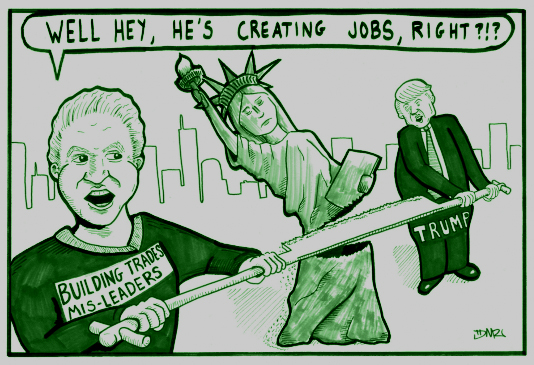
As is now clear, some union officials have not only dodged the draft, but have actually joined the opposition. Trump has made it clear that he intends to give full-on support for the further development of fossil fuels. He plans to revive coal, and get behind fracking for shale oil and shale gas. He also plans to approve major infrastructure projects like the Keystone XL and Dakota Access pipelines. This just happens to be a big part of labor’s agenda also, and agenda that has been largely shaped by the North American Building Trades Unions (NABTU).

A Trump-Trades Confederacy?

Leaders of NABTU have not only openly embraced Trump’s energy agenda, they  quickly warmed up to Trump himself—and some of his proposed appointees. In a pre-inauguration statement, NABTU praised Trump for nominating former Exxon Mobil CEO Rex Tillermen to be Secretary of State. NABTU said, “We believe he will be a tremendous success,” and praised Tillermen’s “resilient and dynamic grasp of both global and domestic policy issues, and a deep and unyielding sense of patriotism for our great nation.” Of this writing, even prominent Republicans are uncomfortable having someone with a pension plan worth $70 million and who owns $218 million’s worth of company stock become the country’s top diplomat.

In another sign of approval for Trump, the Laborer’s union (LiUNA) criticized the outgoing Administration’s decision to remove offshore areas for future leasing. In one of his final acts as president, Obama thwarted oil and gas industry plans to explore and drill in the Arctic and Atlantic Oceans. Attacking Obama, the union stated, “LIUNA looks forward to working with the Trump Administration to reverse this and other regressive energy policies enacted by the outgoing President.”  This from a union that just a few years ago was on the cutting edge of the “green jobs” agenda, an active partner in the Blue-Green Alliance, and one of the first US unions to call on the Obama administration to adopt the science-based emissions reductions targets proposed by the Intergovernmental Panel on Climate Change (IPCC).

Also significant was Trump’s post-inauguration White House meeting with labor leaders on Jan 23rd.  Participants included NABTU President Sean McGarvey, LiUNA President Terry O’Sullivan, Sheet Metal workers’ union President Joseph Sellers, Carpenters President Doug McCarron and Mark McManus, president of the Plumbers and Pipefitters. Progressive unions were, it seems, not invited. McGarvey told the New York Times “We have a common bond with the president…We come from the same industry. He understands the value of driving development, moving people to the middle class.”

Calling All Union Members

By Jonathan Guy - The Trouble, May 20, 2019

Teachers, construction workers, nurses, miners, frycooks—you have an indispensable role to play in the passage of the Green New Deal. Here are five concrete steps to take.

It’s no secret that the American labor establishment is ambivalent about the rising prospects for climate policy change. After battling environmental activists throughout the 2010s over a series of tar sands pipeline projects, unions from carbon-loving industries are balking at the prospect of a Green New Deal, even as the resolution bends over backwards to address their concerns. The AFL-CIO’s energy committee decried the flexible resolution as “unrealistic” and threatening “immediate harm to millions of our members and their families.”  Construction union LiUNA had even harsher words, calling the GND “the sails of fantasy” and its backers’ approach to inclusive coalition-building “exactly how not to enact a progressive agenda to address our nation’s dangerous income inequality”.  In the fossil fuel sector, unions like Mine Workers of America cheer the demise of even modest climate regulations such as the Clean Power Plan, insisting beyond all evidence that carbon capture and storage technology is a viable alternative to renewable energy. Given these union leaders’ stunning obstinacy, even as the climate left dangles gigantic carrots in front of their faces—full severance pay, a job guarantee, project labor agreements, unionization mandates—it would be easy to write them off as inevitable foes.

Such a dismissal, of course, would be gravely mistaken. While the electoral and lobbying influence of unions has waned, they still play a key veto role inside the Democratic Party, and have enjoyed a revival over the past two years as public sector workers found their voice against the devastating Supreme Court decision Janus and endless austerity enacted at the state level in places such as West Virginia and Oklahoma. More to the point, labor unions represent our best hope for organizing the emerging majority-minority working class who must play the central role in a political realignment around a new, low-carbon social compact which emphasizes social equality and economic fairness. Any movement which does not address the concerns of labor—particularly the building trades—is surely doomed.

This article, however, is not yet another paean to the importance of centering a just transition. That genre is well-established. Lord knows that staffers and strategists at 350.org and Sunrise and Ed Markey’s offices have internalized the previous paragraph, and are already tearing their hair out day and night over how to get labor on board. Outside groups like these can surely have some positive impact; see for example, the successful efforts towards a consensus recently won in Maine. But after years of neoliberal environmentalists betraying unions, a lot of distrust has built up which frankly will not be worked out within the short timeframe we have left to avert a two-degree plus warming scenario. In order to really move the needle, pressure on locals and internationals alike will have to be applied from within.

New Calls For A General Strike In The Face Of Coming Climate Catastrophe!

By Joe Maniscalco - Labor Press, May 13, 2019

New York,, NY – Shut. It. Down. Amalgamated Transit Union VP Bruce Hamilton, this weekend, urged U.S. trade unionists to “learn from our past” and start building towards a general strike in a last ditch effort to avert climate disaster. 

“What we need to understand is that climate struggle is class struggle,” Hamilton told the NY Labor History Association’s Annual Spring Conference at NYU on Saturday. “Workers really do want to engage in radical action with a clear chance of making their lives better.”

Convinced that the market-driven energy sector will never voluntarily make the changes climate scientists insist are necessary to save the planet from overheating — panelists participating in a pair of labor and climate change discussions held over the last few days, instead, called for public ownership and democratic control of the energy sector.

Hamilton called the Military Industrial Complex [MIC] the biggest polluter out there, and said that dates should actually be set when “production is going to stop” and then proceed with “a series of escalating strikes” from there. 

“A tool that working people have used in the past that has been, at least temporarily successful, is a general strike,” Hamilton told LaborPress. “It’s something we should never take off the table.”

A general strike, however, requires a level of unity around the question of climate change and the Green New Deal that presently does not exist inside organized labor.

U.S. trade unionists and their leadership remain split on Green New Deal legislation from Congress Member Alexandria Ocasio-Cortez  [D-14th District] and Senator Ed Markey [D-MA]  — despite language in the proposed resolution that clearly calls for “high-quality union jobs that pay prevailing wages” and “protecting the right of all workers to organize, unionize, and collectively bargain free of coercion, intimidation, and harassment.” 

As Todd Vachon, a sociologist with the Labor Network for Sustainability told the Metro NY Labor Communications Council’s Annual Convention on Friday, when talk of a “just transition” to 100-percent renewable energy arises — many union workers “just want to punch you in the face.”

Chris Erikson, head of IBEW Local 3, meanwhile, joked that he’s been branded the “communist” of the Building Trades for advocating a “balanced transition from carbon-based fuels.”

Trading Up Equipping Ontario Trades With the Skills of the Future

By staff - Canada Green Building Council, April 2019

Equipping Canada’s labour force with the skills required for designing, constructing and maintaining low-carbon building infrastructure is critical to achieving a greener economy and to reducing Canada’s emissions by 30% below 2005 levels by 2030. We are pleased to support Canada’s green building industry with a new report, Trading Up: Equipping Ontario Trades with the Skills of the Future, aimed at facilitating a low carbon workforce transition.

This report provides an action plan to close the low-carbon building skills gap in the Ontario construction industry. Green infrastructure investments are expected to create an estimated 147,000 job openings for skilled tradespeople over the next 15 years in the Toronto region alone. The inability to close the skills gap in Ontario is estimated to have an impact of $24.3 billion of Gross Domestic Product (GDP) in foregone company revenues, with an additional $3.7 billion lost in foregone taxation.

The report identifies where shortages in low-carbon skills training currently exist, and highlights the risks to the quality of low-carbon buildings being constructed. It defines specific actions that labour, governments, post-secondary institutions and industry organizations can take to optimize green building skills training.

The “Trading Up” report was compiled by CaGBC with Mohawk College, McCallumSather, The Cora Group, the City of Toronto and the Ontario Building Officials Association (OBOA). The project was funded, in part, by the Government of Ontario. While the report examines the Ontario construction industry, its recommendations can be applied throughout Canada.

Read the text (PDF).

Brothers & sisters in the building trades: Time is running out for the planet

By A WORKING CARPENTER - Socialist Action, March 25, 2019

I’ve been a carpenter my whole adult life. I worked nonunion before I joined the Carpenters’ Union—easily the smartest thing I’ve ever done. For a working-class person, a union is still the best anti-poverty program.
Recently, the heads of the Building Trades unions, alongside the leaders of the United Steelworkers and the United Mine Workers (UMWA), spoke out against the proposed Green New Deal. They claim that the GND will “cause immediate harm to millions of our members and their families.” Right-wing climate deniers immediately seized on union opposition to the GND as proof that proponents are out of touch with reality.

The science is irrefutable: Climate change is real. The energy companies spend millions of dollars trying to convince you that the science isn’t definitive. (Just like the tobacco companies tried to tell us that cigarettes are not a danger to your health.) Politicians crack jokes in the wintertime to downplay the seriousness of the situation.

The dangers are real. We’re already seeing the effects—melting ice caps and rising sea levels, extreme weather, flooding in the Midwest, more intense hurricanes, wildfires in the West, and refugee crises that will only become more dire. Famine is a real threat. Wars may be fought over water and arable land. Democracy could be threatened as a result of social unrest. If left unchecked, climate change could mean the end of life on Earth.

It doesn’t have to be this way. If corporate interests, and the richest 1%, are left in control of the economy and government, they will balance the cost of the climate crisis on our backs. The rich will stop at nothing to keep their wealth and power. This means playing working people against each other, inciting fear of immigrants, and fanning the flames of conspiracy theories about socialists wanting to take away your hamburgers.

AFL-CIO Energy Committee releases letter opposing the Green New Deal

By Elizabeth Perry - Work and Climate Change Report, March 12, 2019

A letter, dated March 8, was addressed to Senator Ed Markey and Representative Alexandra Ocasio Cortez, and signed by  Cecil Roberts, president of the United Mine Workers of America , and Lonnie Stephenson, president of the International Brotherhood of Electrical Workers, on behalf of the  AFL-CIO’s Energy Committee.  The letter  states :   “..the Green New Deal resolution is far too short on specific solutions that speak to the jobs of our members and the critical sectors of our economy. It is not rooted in an engineering-based approach and makes promises that are not achievable or realistic.”  “…We want to engage on climate issues in a manner that does not impinge on enacting other labor priorities, especially much-needed infrastructure legislation…”

How they would engage and what they would propose is contained in a position paper posted on the IBEW website, and drafted by the IBEW, UMWA, and five other unions in the electric utility, construction, and rail transport sectors.  The position paper,  Preliminary  Labor Positions on Climate Legislation , states their opposition to carbon tax legislation and grave concerns about the Green New Deal . It calls for comprehensive, economy wide climate legislation which would include an national emissions trading scheme, to be introduced no earlier than 10 years after enacting legislation, to allow for development of Carbon Capture Utilization and Storage (CCUS)  technologies.  It also calls for worker transition protections, including compensation and retraining.  The policy document was submitted to the House of Representatives Energy and Commerce Committee for the record of their  February 6th meeting:  “Time for Action: Addressing the Economic and Environmental Effects of Climate Change“.

Reaction:  The Washington Post reported:  “AFL-CIO criticizes Green New Deal, calling it ‘not achievable or realistic’” (March 12)  and  in a follow-up piece , “Labor opposition to Green New Deal could be a big obstacle” ( March 14).  The United Mine Workers re-posted the Washington Post article .  Friends of the Earth, in its reaction to the March 8 letter, states “one-fifth of the unions that make up the AFL-CIO energy committee commented on the Green New Deal”,  and,  “With the energy committee’s position, the AFL joins climate deniers like the Koch brothers, the Republican Party and Big Oil. We encourage the AFL and other unions within it to rethink this position.”

Labor Unions and Green Transitions in the USA

By Dimitris Stevis - Adapting Canadian Work and Workplaces to Respond to Climate Change, February 27, 2019

“In broad terms there are now two camps amongst US labour unions with respect to climate change and renewables (the two not always related). On one side, are those unions that believe that something needs to be done about climate change and that renewables are a good strategy. On the other side are those that are opposed to meaningful climate policy –even as they claim that climate change is a problem.”

This report outlines the deep cleavages with respect to climate policy but also argues that the views of unions are more complex and contradictory than the opposition-support dichotomy. Additionally, it seeks to understand what explains the variability in union responses to climate change and policy. What can account for the contradictions evident amongst and within unions?

Read the report (PDF).

The Green New Deal and Labour

By Elizabeth Perry - Work and Climate Change Report, February 27, 2019

The Labor Network for Sustainability in the U.S.  published a new Discussion Paper written by Jeremy Brecher in late February.   18  Strategies for a Green New Deal: How to Make the Climate Mobilization Work  states that initial discussion of the Green New Deal resolution was rightly focussed on values and goals, but this Discussion paper moves on to the “how”- in 18 specific proposals which are itemized individually, but are intended to work together. The paper explains and consolidates many of the goals and strategies which have been proposed before by  LNS, including: protect low-income energy consumers and empower communities; mobilize labour and leave no worker behind; ensure worker rights and good union jobs, and yes, provide a “job guarantee.”  The 18 Strategies Discussion paper is summarized as “The Green New Deal can work: Here’s How”, which appeared in Commons Dreams on February 25  and was re-posted in  Resilience on Feb. 26.  In the article, Jermey Brecher states: “A GND will not pit workers against workers and discourage the growth of climate-protecting industries and jobs abroad. It will oppose both escalating trade wars and the free trade utopia of neoliberalism.”

The Labor Network for Sustainability has worked to build solidarity behind the Green New Deal, and on February 26,  published a Special  Issue of their newsletter, which profiles the GND endorsements and initiatives of the San Diego and Imperial Counties Labor Council in California, SEIU Locals 32BJ in New York, SIEU Local  1021 in San Francisco, and the Business Manager of IBEW Local 103 in Dorchester, Massachusetts, along with other examples and resources.  The LNS  website also hosts a new blog by Todd Vachon,  Green New Deal is a Good Deal for New Jersey workers , in which he argues for the GND and cites some of his research  which shows that union members are more likely than the general population to support environmental action.

Pages

The Fine Print I:

Disclaimer: The views expressed on this site are not the official position of the IWW (or even the IWW’s EUC) unless otherwise indicated and do not necessarily represent the views of anyone but the author’s, nor should it be assumed that any of these authors automatically support the IWW or endorse any of its positions.

Further: the inclusion of a link on our site (other than the link to the main IWW site) does not imply endorsement by or an alliance with the IWW. These sites have been chosen by our members due to their perceived relevance to the IWW EUC and are included here for informational purposes only. If you have any suggestions or comments on any of the links included (or not included) above, please contact us.

The Fine Print II:

Fair Use Notice: The material on this site is provided for educational and informational purposes. It may contain copyrighted material the use of which has not always been specifically authorized by the copyright owner. It is being made available in an effort to advance the understanding of scientific, environmental, economic, social justice and human rights issues etc.

It is believed that this constitutes a 'fair use' of any such copyrighted material as provided for in section 107 of the US Copyright Law. In accordance with Title 17 U.S.C. Section 107, the material on this site is distributed without profit to those who have an interest in using the included information for research and educational purposes. If you wish to use copyrighted material from this site for purposes of your own that go beyond 'fair use', you must obtain permission from the copyright owner. The information on this site does not constitute legal or technical advice.