You are here

class struggle

Against Noxiousness (1971): The Political Committee of the Porto Marghera Workers

By Lorenzo Feltrin - Viewpoint Magazine, April 1, 2021

The paper “Against Noxiousness,” signed by the Political Committee of the Porto Marghera Workers, was presented 50 years ago, on February 28, 1971, at the Veneto Workers’ Congress in Mestre (Municipality of Venice, Italy). The Political Committee was an alliance between the local branches of two radical-left extra-parliamentary groups: Potere Operaio and il Manifesto. The paper, however, is best understood as part of the theory and praxis on noxiousness carried out by the Porto Marghera workerist group.

The Porto Marghera workerist group originated in the early 1960s through an encounter between intellectuals and students – mostly based in Padua and Venice – and militant workers disaffected with the line of the Italian Communist Party (PCI) and its associated union, the Italian General Confederation of labor (CGIL).1 While the industrial area of Porto Marghera2 was an important setting for the early activism of theorists such as Antonio Negri, Mariarosa Dalla Costa, and Massimo Cacciari, the theories produced by the workers themselves have been largely forgotten. Yet this experience was remarkable because it involved workers employed by polluting industries denouncing in both words and deeds the environmental degradation caused by their companies from as early as 1968, when the workerists had a key influence in the local factories.

The Italian word nocività refers to the property of causing harm. Through its use by the labor movement, it came to encompass damage to both human and non-human life; hence it can be translated neither as “harm to (human) health” nor as “(non-human) environmental degradation.” It is rendered here literally as “noxiousness.” Struggles against noxiousness at Porto Marghera contradict the widespread belief that what is today known as working-class environmentalism did not have much significance in the labor unrest of Italy’s Long 1968.

The Porto Marghera group’s core was made up of blue-collar workers, although it also featured a significant presence of technicians and clerks, as well as activists external to the factories. Its stronghold was the major integrated petrochemical complex known as Petrolchimico, which employed some of its main leaders, including Franco Bellotto, Armando Penzo, and Italo Sbrogiò. The group’s theorizing around noxiousness was spearheaded by the Petrolchimico technician Augusto Finzi. Born in 1941 from a well-off Jewish family based in insular Venice, Finzi spent part of his early childhood in a refugee camp in Switzerland to escape the Shoah, in which the German chemical industry – the most advanced of the time – had played a key and dreadful role. 

The group’s original contribution was based on the thesis of the inherent noxiousness of capitalist work and an antagonistic-transformative approach to capitalist technology. This led to the proposal of a counterpower able to determine “what, how, and how much to produce”3 on the basis of common needs, pointing to the utopian prospect of struggling for a different, anti-capitalist technology that would be compatible with the sustainable reproduction of life on the planet.

The group linked noxiousness to the workerist “strategy of refusal.” In this perspective, capitalist work is the production of value and thus the reproduction of a society of exploitation. Therefore, class struggle is not an affirmation of work as a positive value, but its negation. As Mario Tronti put it: “a working-class struggle against work, struggle of the worker against himself [sic] as worker, labor-power’s refusal to become labor.”4 The combination of the refusal of work with the dire health and safety conditions they experienced led the Porto Marghera group to the core idea that capitalist work is inherently noxious.

Pipelines, Pandemics and Capital’s Death Cult: A Green Syndicalist View

By Jeff Shantz - LibCom, March 29, 2021

We can see this within any industry, within any capitalist enterprise. It is perhaps most clearly apparent, in an unadorned fashion, in extractives industries like mining, logging, or oil, where the consumption of nature (as resources) for profit leaves ecosystems ruined, where workers are forced to labor in dangerous, often deadly, conditions, and where it is all is carried out through direct dispossession, invasion, and occupation of Indigenous lands and through processes of mass killing, even genocide. And when it is all done, little remains except the traces of profit that have been extracted and taken elsewhere.

These intersections have come to the forefront with particular clarity under conditions of the Covid-19 pandemic. The death cult of capital on full display in all its variety of ways.

Tesla Found Guilty of Unionbusting

By Kris LaGrange - UComm Blog, March 26, 2021

2018, Tesla CEO Elon Musk wrote on Twitter “Nothing stopping Tesla team at our car plant from voting union. Could do so tmrw if they wanted. But why pay union dues & give up stock options for nothing?” That tweet began an investigation into the company by the NLRB into union-busting at the company.

Now three years later, the board has found that Musk not only violated federal labor law with that tweet but that he also illegally fired an employee, Richard Ortiz for protected union activity. Ortiz was part of a campaign called “Fair Future at Tesla” which is an ongoing campaign by the UAW to organize the electric car company.

In their decision, the NLRB found that Musk’s tweet went above a typical statement that the company wants to stay union-free and was seen as threatening. This was exacerbated by the fact that Tesla considers communications from Musk, who founded the company, as official company communications. It is illegal to threaten to take away pay or benefits from workers if they are found to be organizing a union.

In their decision, the NLRB ordered Tesla to offer Ortiz his job back and compensate him for lost earnings, benefits, and any adverse tax consequences that resulted from his firing. Tesla is also required to revise their confidentiality agreements that are given to employees to take out a section that bars workers from speaking to the media without explicit written permission from the company. National labor law “protects employees when they speak with the media about working conditions, labor disputes, or other terms and conditions of employment,” the NLRB noted.

The NLRB is also requiring Tesla to post notices nationwide and hold meetings at their main US car plant in Fremont to inform workers of their protected rights. At these meetings, Musk or a “board agent” in the presence of Musk, will have to read the notice to workers, including security guards, managers, and supervisors.

The decision from the NLRB was largely in line with a similar decision against Tesla by an administrative judge in September of 2019. Tesla decided to fight the administrative judge’s decision and bring it all the way to the full board.

“This is a great victory for workers who have the courage to stand up and organize in a system that is currently stacked heavily in favor of employers like Tesla who have no qualms about violating the law,” said UAW Vice President Cindy Estrada, Director of the UAW Organizing Department. “While we celebrate the justice in today’s ruling, it nevertheless highlights the substantial flaws in US labor law. Here is a company that clearly broke the law and yet it is three years down the road before these workers achieved a modicum of justice.”

The Future of People Power in the Coronavirus Depression

By Jeremy Brecher - Labor Network for Sustainability, March 25, 2021

What can we learn from the role of people power in the Great Depression and in the first year of the Coronavirus Depression? Based on the seven preceding commentaries on the New Deal and the popular movements of 2020, this commentary maintains that popular direct action can play a significant role in shaping the Biden era. It examines the emerging political context and suggests guidelines for navigating the complex landscape that lies ahead. To read this commentary, please visit this page.

Class Power can Remake Society: Remembering Australia’s "Green Ban” Movement

By Ben Purtill - Organizing Work, March 24, 2021

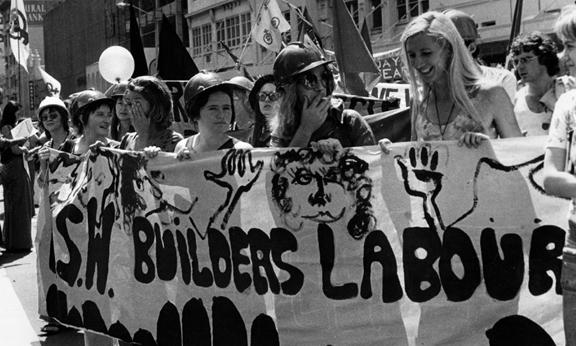
Ben Purtill recounts when building laborers in Australia stopped work, first over wages and working conditions, and then to protect the environment, among other “social” causes. Image: Jack Mundey, Building Labourers’ Federation members and local residents at a Green Ban demonstration, 1973.

Jack Mundey, who died aged 90 in May 2020, first made his name as the union leader associated with one of the most inspiring moments of class struggle of the last 50 years: Australia’s green ban movement. As a secretary of the New South Wales Builders Labourers’ Federation (BLF) from 1968, Mundey — a member, then president, of the Australian Communist Party (CPA) – was widely credited with coining the term “green ban” to describe a form of strike action undertaken in defense of environmental causes. Members of the NSW BLF also downed tools in defense of the gay community, indigenous Australians, and feminists, at a time when these causes were far from the mainstream of Australian society.

Reviled and vilified at the time, Mundey received a State Memorial Service in March 2021. Attended by the great and the good of Sydney, Mundey was hailed as a savior of the city — a renegade who broke with the base concerns of economistic trade unionism to focus on more refined issues than wages or workplace conditions, while prefiguring a social liberalism the nation would only begin to embrace decades later, and a green politics that it has yet to.

While the perceived content of Mundey’s unionism now sits quite comfortably with liberal — even conservative — values and principles, the form of unionism pursued by the NSW BLF at their peak in the early 1970s would undoubtedly be condemned were it revived today. Militant, democratic and regarded as quasi-syndicalist by critics and supporters alike, the story of the Mundey and the NSW BLF is one of both the power of the rank and file and the limits of leadership, no matter how left-wing.

Black Bans, Green Bans and everything in between

Most historical accounts suggest the green ban movement for which Mundey is best remembered began in 1971 at Kelly’s Bush, an area of parkland in Sydney’s affluent Hunter’s Hill suburb. A group of local women contacted the BLF having exhausted all conventional means of halting the development of the area by construction firm AV Jennings. With luxury houses set to be built on what was the last remaining patch of native bush in the suburb, the BLF called a community meeting attended by over 600 local residents and announced a ban, meaning no work would take place on the site. Unions had been using the term “black ban” to designate disputes aimed at an economic end, for example a wage increase, but since this action was being taken to defend the environment, “green ban” was decided to be more appropriate.

Over forty green bans followed until 1974, when the NSW BLF was deregistered as a union, resulting in billions of dollars worth of development being prevented in Sydney; the tactic was also deployed in other towns and cities across Australia, most notably Melbourne. All green bans were declared in a similar manner as a point of principle: the union did not decide to initiate a ban, local residents did so through a public meeting. If it was decided that a site would not be developed, BLF members would not work on it. In following this tactic, large areas of the historic centre of Sydney were saved from development, and the union joined alliances with an unlikely range of characters: early environmentalists, heritage campaigners, and middle-class homeowners.

The NSW BLF also applied the tactic to other causes and concerns, for example the expulsion of a gay student from Macquarie University, the demolition of houses occupied by indigenous Australians in the Redfern suburb of inner-city Sydney, and the right of two women academics to teach a women’s studies course. In each case, the campaigns were won. More broadly still, the BLF campaigned against apartheid South Africa and the war in Vietnam. As union secretary of the NSW branch during this period, Mundey is now typically remembered as the brainchild of this movement, even earning him a speaking slot at the United Nations Conference on the Built Environment, but it reflected much wider changes occurring both within the Australian left and among rank and file union members.

Political and Economic Power in a Period of Social Transformation

By Tom Wetzel - Ideas and Action, March 21, 2021

How does the working class liberate itself from being a subordinate and exploited class? This is where we need thinking about the overall strategy and our vision about new structures to replace the capitalist regime.

The working class has to build its capacity to actually do this. This capacity is built through the more or less protracted process of class formation. This is the process through which the working class overcomes fatalism and internal divisions (as on lines of race or gender), and builds the confidence, organizational capacity and the aspiration for social change. This is the process through which the working class “forms” itself into a force that can effectively challenge the dominating classes for control of society. This is likely to require a kind of social movement alliance that brings together the grassroots worker organizations (such as unions) and social movement organizations that have emerged around the various other areas of struggle in a particular period — tenant unions, environmental justice organizations, and groups that emerge around racial and gender fault lines. And thus the agenda for change is going to reflect the various priorities of these movements.

But what steps should this movement aim at in the transition to socialism? In fact it’s going to be essential for a consensus to emerge already within such a mass movement about the basic structural changes that we need to initiate.

Syndicalists have always argued that a crucial initial task in the transition to a self-managed socialism is direct worker takeover of the workplaces — creating new democratic organizations through which workers can exercise direct power over the labor process. An impressive feature of the Spanish worker revolution in 1936–37 was the widespread expropriation of industries and collectivization of land in rural areas. Although the political events of that moment were not entirely predictable, the movement for worker control was not simply “spontaneous.” The militants of the unions in Spain had discussed for decades the need for workers to take over the industries and re-organize them under worker self-management. This was part of their revolutionary preparation.

Our program for building socialism needs to address the major structural features of the capitalist regime that we want to replace — structural features that are at the root of the oppressive work regime, vast inequality, and ecological destruction inherent to capitalism. The system of class oppression is rooted in two institutional structures of class power which the movement must break. First, we need to get rid of the private ownership of the non-human means of production, which allows for vast extraction of profit to build the wealth of a tiny, super-rich elite who dominate society.

But private ownership is not the only basis of oppressor class power. And here we need to learn from mistakes of the 20th century socialist movement. The 20th century saw major growth for a newly emergent dominating class — the bureaucratic control class, as I call it. The power of this class is based on their monopolization over the decision-making authority (and some related areas of expertise) in the corporations and state, via top-down bureaucratic hierarchies. The bureaucratic control class includes the managers who control workers day-to-day but also high-end professionals who work with the managerial regime such as corporate lawyers, and the people who run the state, such as professional politicians, prosecutors, judges, military brass. A worker’s liberation movement must have a program for eliminating the power of this class over the working class.

The Great Depression and the Coronavirus Depression

What’s Wrong with Single Employee Train Operations?

By Ron Kaminkow - Railroad Workers United, March 2021

At first glance, the casual observer from outside of the rail industry is prone to say that single employee train operation sounds dangerous. “What if the engineer has a heart attack?” is an often heard question. And while this question has merit, there are many other and far more complex and unanswered questions about just how single employee train operations could be accomplished safely and efficiently for the train crew, the railroad and the general public. How will the train make a back-up move? What happens when the train hits a vehicle or pedestrian? How will the train crew member deal with “bad-order” equipment in his/her train, or make pick-ups and set-outs en route? What about job briefings and calling signals, copying mandatory directives and reminders of slow orders? These are just some questions that we take up in this article.
Remote Control and “Utility Conductors”

In recent years, the Class I rail carriers have been biding their time, slowly but surely inserting language into recent contracts with both unions of the operating crafts that will facilitate their schemes to run over the road trains with a lone employee. They have made arrangements with the Brotherhood of Locomotive Engineers & Trainmen (BLET) to allow the BLET represented crew member to make use remote controlled locomotives. With this scenario, the lone operator would strap on a belt pack, dismount from the locomotive, and run the locomotive by remote control operation (RCO) using radio control from the ground. And the carriers have also made deals with the United Transportation Union (UTU) to allow for “utility conductors”; i.e. a conductor who can “attach” to one or more over-the-road trains during the course of a single tour of duty. Between the two arrangements, the rail carriers apparently believe they can safely and efficiently operate road trains with just one employee aboard as opposed to the current standard of two. We disagree.

One of the Best Places to Fight for the Environment Is in Your Workplace

By Libronaught - Medium, February 24, 2021

One of the biggest roadblocks standing in the way of practical, cooperative solidarity between social movements is the idea of “separate issues.” In recent years people have begun chipping away at this shibboleth, but we still have a ways to go. One significant problem within the problem of the single-issue silo effect is that labor is sometimes mistakenly viewed as just another issue.

Labor is not just an issue. Labor is a power base. Labor organizing can be more effective at winning social gains on a range of “single issues” than weekend demonstrations, conscious consumerism, electioneering or lobbying.

In the US, we are often taught to view voting, lobbying and mass demonstrations as ways to participate in democracy. They all are, of course, but it’s not the full picture. As Jane McAlevey persuasively explains in her extraordinary book, A Collective Bargain, US democracy as we know it today would not exist if not for the labor movement. The organizing and solidarity efforts among US workers that eventually won the 8-hour day and the weekend began right after the American Revolution. Labor solidarity and organizing among women has put a driving force behind demands for gender equality for over 150 years. From the 1910s to the 1940s, a massive swell of labor solidarity and organizing crossed race and gender lines, won the current US Labor Rights laws, and led the country out of the Great Depression. Labor unions went on to participate in the 60s Civil Rights movements.

Bows and Arrows: Indigenous Workers, IWW Local 526, and Syndicalism on the Vancouver Docks

By Jeff Shantz - LibCom.Org, February 17, 2021

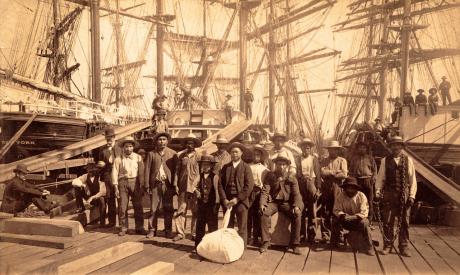
Few may be aware that the first union on the waterfront of Vancouver was organized by Indigenous workers, mostly Squamish and Tsleil-Waututh. And it was organized on an explicitly syndicalist basis as Local 526 of the Industrial Workers of the World (IWW). The IWW group would become known as the Bows and Arrows, a name that spoke to their active and more politically militant perspective and commitment to Indigenous solidarity. The Bows and Arrows organized on a multicultural/multiracial foundation of class solidarity.

While the lifespan of IWW Local 526 was brief (formally only a year while informally for about seven years) it had a lasting impact on working class organizing on the waterfront, anti-racism and racial solidarity on the docks, and on political organizing in Indigenous communities. It also showed the pivotal role of organizing within the logistical chains of global capitalism in sabotaging resource extractive industries, while providing a model of work organization that sustained community relevant work and work cycles rather than the single career monoculture of industrial capitalism at the time.

As historian Andrew Parnaby suggests, the Bows and Arrows:

"Join[ed] in the broader upsurge of support for the Wobblies that took place among loggers, miners, railroad workers, and seafarers prior to the Great War…Reformers, rebels, and revolutionaries: collectively, they were responsible for a level of militancy on the waterfront that was unmatched by most other occupations, provincially or nationally. Vancouver waterfront workers went on strike at least sixteen times between 1889 and 1923; the four largest and most dramatic strikes were in 1909, 1918, 1919, and 1923." (2008, 9)

While Local 526 would finally be broken through battles with waterfront employers that have been described as titanic, these workers provided important and lasting examples of working class militance, workplace organizing tactics, racial solidarity and anti-racism, and cultural defense. They offer a critical model of syndicalism in diverse workforces and changing economic conditions within a context of settler colonial capitalism.

Pages

The Fine Print I:

Disclaimer: The views expressed on this site are not the official position of the IWW (or even the IWW’s EUC) unless otherwise indicated and do not necessarily represent the views of anyone but the author’s, nor should it be assumed that any of these authors automatically support the IWW or endorse any of its positions.

Further: the inclusion of a link on our site (other than the link to the main IWW site) does not imply endorsement by or an alliance with the IWW. These sites have been chosen by our members due to their perceived relevance to the IWW EUC and are included here for informational purposes only. If you have any suggestions or comments on any of the links included (or not included) above, please contact us.

The Fine Print II:

Fair Use Notice: The material on this site is provided for educational and informational purposes. It may contain copyrighted material the use of which has not always been specifically authorized by the copyright owner. It is being made available in an effort to advance the understanding of scientific, environmental, economic, social justice and human rights issues etc.

It is believed that this constitutes a 'fair use' of any such copyrighted material as provided for in section 107 of the US Copyright Law. In accordance with Title 17 U.S.C. Section 107, the material on this site is distributed without profit to those who have an interest in using the included information for research and educational purposes. If you wish to use copyrighted material from this site for purposes of your own that go beyond 'fair use', you must obtain permission from the copyright owner. The information on this site does not constitute legal or technical advice.

