

You are here

United Kingdom (UK)

Sea Change: Climate Emergency, Jobs and Managing the Phase-Out of UK Oil and Gas Extraction

By Greg Muttitt, Anna Markova, and Matthew Crighton - Oil Change International, Platform, and Friends of the Earth Scotland, May 2019

This new report released by Oil Change International, Platform and Friends of the Earth Scotland shows that a well-managed energy transformation based on Just Transition principles can meet UK climate commitments while protecting livelihoods and economic well-being, provided that the right policies are adopted, and that the affected workers, trade unions and communities are able to effectively guide these policies.

This report examines the future of UK offshore oil and gas extraction in relation to climate change and employment. It finds that:

  • The UK’s 5.7 billion barrels of oil and gas in already-operating oil and gas fields will exceed the UK’s share in relation to Paris climate goals – whereas industry and government aim to extract 20 billion barrels;
  • Recent subsidies for oil and gas extraction will add twice as much carbon to the atmosphere as the phase-out of coal power saves;
  • Given the right policies, job creation in clean energy industries will exceed affected oil and gas jobs more than threefold.

In light of these findings, the UK and Scottish Governments face a choice between two pathways that stay within the Paris climate limits:

  1. Deferred collapse: continue to pursue maximum extraction by subsidising companies and encouraging them to shed workers, until worsening climate impacts force rapid action to cut emissions globally; the UK oil industry collapses, pushing many workers out of work in a short space of time. Or:
  2. Managed transition: stop approving and licensing new oil and gas projects, begin a phase-out of extraction and a Just Transition for workers and communities, negotiated with trade unions and local leaders, and in line with climate change goals, while building quality jobs in a clean energy economy.

The report recommends that the UK and Scottish Governments:

  • Stop issuing licenses and permits for new oil and gas exploration and development, and revoke undeveloped licenses;
  • Rapidly phase out all subsidies for oil and gas extraction, including tax breaks, and redirect them to fund a Just Transition;
  • Enable rapid building of the clean energy industry through fiscal and policy support to at least the extent they have provided to the oil industry, including inward investment in affected regions and communities;
  • Open formal consultations with trade unions to develop and implement a Just Transition strategy for oil-dependent regions and communities.

Read the text (PDF).

Steel Arising

By Julian M Allwood, Cyrille F Dunant, Richard C Lupton, and André C H Serrenho - University of Cambridge, April 2019

The global steel industry is transforming from using iron ore to recycling scrap. Global arisings of steel scrap are likely to treble in the next thirty years and we will never need more blast furnaces than we have today. The extent and speed of this global transformation depends on two competing forces: on the one hand, today’s recycling technology cannot currently produce the highest qualities of high-volume steel econonically; on the other, recycling has the critical advantage that it reduces the greenhouse gas emissions released in producing steel to around a third of those from primary production. As the steel industry turns from ore to scrap and action on climate change accelerates, what opportunities does this create for steel in the UK?

UK consumers currently demand around 15 million tonnes per year of steel in final goods. Although the UK’s steel production has fallen to well below this figure, it manufactures goods containing around the same annual total. However, the UK largely exports its steel products and manufactured steel goods at low value, while importing most high-value final goods containing steel. Only one sixth of UK final consumption of steel goods is currently made with steel produced in the UK, and that is mainly lower value components for construction.

Despite this weak current position, the UK has four comparative advantages by which it could profit in the ongoing global transformation of steel production.

Read the report (Link).

I am Not a Criminal; The Air Polluters are the Criminals

By Allan Todd - London Green Left, January 28, 2019

In Milton Keynes, on Friday 25 January, I was one of 24 Greenpeace activists found guilty of ‘aggravated trespass’. All those (myself included) without any previous criminal convictions, were given 12-month conditional discharges, with damages and court costs of £105 each. Those who had got previous convictions were, in addition, fined £200 each.

Our case arose from a Greenpeace ‘air pollution’ action back in August 2018, which peacefully locked-down VoltsWagon's (VW) UK HQ in Milton Keynes for most of one day - according to VW, this prevented 960 employees from getting into work, costing the company £166,000.

After the verdicts, I was minded of what the Ancient Greek playwright, Euripides, wrote: 

‘Those whom the gods wish to destroy, they first make mad.’

The background

Many companies - such as Volvo - have already committed to phasing out the production of diesel vehicles. However, the VW ‘stable’ - which is responsible for 1 in 5 of all new diesel vehicles being put on UK roads today - had refused, for over a year, all Greenpeace requests to discuss this issue.

But, on the very day of that Greenpeace action, VW finally agreed to discuss the issue; and, 3 months later, have announced they will phase out all diesel production by 2040.

Towards a just transition: coal, cars and the world of work

By Béla Galgóczi - European Trade Union Institute, 2019

The role of trade unions and social dialogue is key in demonstrating the major differences between coal-based energy generation and the automobile industry. This book presents two faces of a just transition towards a net-zero carbon economy by drawing lessons from these two carbon-intensive sectors. The authors regard just transition not as an abstract concept, but as a real practice in real workplaces. While decarbonisation itself is a common objective, particular transitions take place in work environments that are themselves determined by the state of the capital-labour relationship, with inherent conflicts of interest, during the transition process.

The case studies presented in this book highlight the major differences between these two sectors in the nature and magnitude of the challenge, how transition practices are applied and what role the actors play.

Read the report (Link).

UK: is the ‘dash for gas’ frackturing the labor movement?

By Francesca Sullivan and Karen Viquerat - Trade Unions for Energy Democracy, June 24, 2015

Unfolding story:  Proposal to frack in North West England leads to a minor earthquake

Just days after the UK’s leading union in the gas industry signed on to a charter with the gas industry to develop fracking, other unions are stepping up efforts to make sure the drilling never starts. The GMB’s Central Executive Committee issued its statement on fracking on June 8. The UK’s largest union, UNITE issued a press release in support of an anti-fracking demonstration organized by ‘Frack Free Lancashire‘ and Chris Baugh, Asst. General Secretary of Public and Commercial Services union, responded to the GMB’s argument.  See below for more details.

Unite Press Release

For immediate use: Monday 22 June 2015

Unite urges councillors to keep Lancashire ‘frack free’

Britain’s largest union, Unite will be joining campaigners and local groups tomorrow (Tuesday 23 June) in a demonstration to support a ‘frack free Lancashire’ and halt Cuadrilla’s fracking plans.

The ‘don’t frack Lancs’ demonstration outside Lancashire county council hall in Preston coincides with a council meeting where county councillors will decide whether to accept or reject Cuadrilla’s fracking applications.

Chair of Unite’s executive council, Tony Woodhouse is among the speakers at the demonstration being organised by Friends of Earth. The county hall demonstration runs from 17:00 to 19:00.

Last week council planning officers recommended that fracking should go ahead at Preston New Road, but permission should be refused at Roseacre Wood due to a severe impact on road safety due to heavy lorries.

Councillors tomorrow will decide on whether to accept or reject planning officers’ recommendations.

Unite North West regional secretary Mick Whitley said: “Fracking is a huge issue for communities across our region and a cause for deep concern.

“A moratorium on fracking is in place in Scotland and the Welsh assembly government is following suit such is the depth of concern in other parts of the UK.

“Here in Lancashire, county councillors need to listen to tens of thousands of people from across the county who have objected and reject all applications for fracking.”

Unite is committed to supporting and lobbying for a moratorium on all fracking activities across the United Kingdom.

5.7-Million-Member TUC Supports Labour Party’s Manifesto Commitments on Public Ownership of Energy and Climate Change

By staff - Trade Unions for Energy Democracy, September 25, 2017

The annual congress of the UK Trades Union Congress (TUC) has passed a historic composite resolution (also below) on climate change that supports the energy sector being returned to public ownership and democratic control.

The resolution—carried unanimously by hundreds of delegates—calls upon the national center to work with the Labour Party to achieve this goal, as well as to: implement a mass program for energy conservation and efficiency; lobby for the establishment of a “just transition” strategy for affected workers; and, investigate the long-term risks to pension funds from investments in fossil fuels.

The Labour Party’s 2017 election manifesto, For the Many, Not the Few,pointed to the failures of electricity privatization, energy poverty, the need the honor the UK’s climate commitments, and to put the UK on course for 60% of its energy to be met by zero carbon or renewable sources by 2030.

The Manifesto also committed to “take energy back into public ownership to deliver renewable energy, affordability for consumers, and democratic control.” It calls for the creation of “publicly owned, locally accountable energy companies and co-operatives to rival existing private energy suppliers.”

Moved by Sarah Woolley, Organising Regional Secretary for the Bakers, Food and Allied Workers Union (BFAWU), the resolution refers to the “irrefutable evidence that dangerous climate change is driving unprecedented changes to our environment,” as well as the risks to meeting the climate challenge posed by Trump’s announced withdrawal from the Paris Agreement, and by the chaotic approach to both Brexit and broader policy by the current Conservative government.

The resolution affirmed that combating climate change and moving towards a low-carbon economy cannot be left to markets, but requires a strong role for the public sector in driving the transition. In supporting the resolution, several speakers referred to the devastation unleashed across the Caribbean over the previous several days by Hurricane Irma—the most powerful Atlantic Ocean storm in recorded history—and across southern Texas only days before that by Hurricane Harvey.

Backing Corbyn, UK Unions Call for Energy to be Returned to Public Ownership and Democratic Control

By staff - Trade Unions for Energy Democracy, September 12, 2017

5.7-Million-Member TUC Supports Labour Party’s Manifesto Commitments on Climate Change and Energy Transition
When addressing climate change, “public ownership of energy under democratic control is crucial” – Iain Dalton, USDAW

September 12, 2017, Brighton, U.K.

The annual congress of the UK Trades Union Congress (TUC) has passed a historic composite resolution on climate change that supports the energy sector being returned to public ownership and democratic control.

The resolution—carried unanimously—calls upon the 5.7-million-member national federation to work with the Labour Party to achieve this goal, as well as to: implement a mass program for energy conservation and efficiency; lobby for the establishment of a “just transition” strategy for affected workers; and, investigate the long-term risks to pension funds from investments in fossil fuels.

The Labour Party’s 2017 election manifesto, For the Many, Not the Few, pointed to the failures of electricity privatization, energy poverty, the need the honor the UK’s climate commitments, and to put the UK on course for 60% of its energy to be met by zero carbon or renewable sources by 2030.

The Manifesto also committed to “take energy back into public ownership to deliver renewable energy, affordability for consumers, and democratic control.” It calls for the creation of “publicly owned, locally accountable energy companies and co-operatives to rival existing private energy suppliers.”

Moved by Sarah Woolley, Organising Regional Secretary for the Bakers, Food and Allied Workers Union (BFAWU), the resolution refers to the “irrefutable evidence that dangerous climate change is driving unprecedented changes to our environment,” as well as the risks to meeting the climate challenge posed by Trump’s announced withdrawal from the Paris Agreement, and by the chaotic approach to both Brexit and broader policy by the current Conservative government.

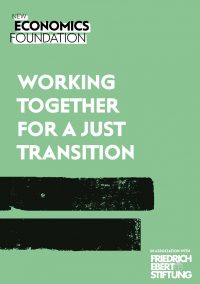
Working Together for a Just Transition

By David Powell, Alfie Stirling and Sara Mahmoud - New Economics Foundation, November 2018

This short pamphlet has been produced to launch the New Economics Foundation’s new programme of work on the 'just transition'. Our interest is in the practicality of change: the policies, processes, narrative and investment needed to accelerate the UK’s progress on 'just transition', here and now. Over the coming months and years we will be working at local and national levels to explore what is needed to build common cause and provide the right mixture of incentives and critical challenge to all parties to help unlock a new momentum for a 'just transition' for the UK.

It has been produced in association with the Friedrich-Ebert-Stiftung’s London Office, part of the international network of FES. The London office was established in 1988 to promote better understanding of British- German relations. FES's work in the United Kingdom focuses in particular on the exchange of ideas and discussion on the following topics: common challenges facing Germany, the United Kingdom and the European Union; economic and social policy; experiences gained from differing regional and local policies and practices; and a continuing dialogue between politicians as well as between the trade unions in both countries.

Read the report (PDF).

Pages

The Fine Print I:

Disclaimer: The views expressed on this site are not the official position of the IWW (or even the IWW’s EUC) unless otherwise indicated and do not necessarily represent the views of anyone but the author’s, nor should it be assumed that any of these authors automatically support the IWW or endorse any of its positions.

Further: the inclusion of a link on our site (other than the link to the main IWW site) does not imply endorsement by or an alliance with the IWW. These sites have been chosen by our members due to their perceived relevance to the IWW EUC and are included here for informational purposes only. If you have any suggestions or comments on any of the links included (or not included) above, please contact us.

The Fine Print II:

Fair Use Notice: The material on this site is provided for educational and informational purposes. It may contain copyrighted material the use of which has not always been specifically authorized by the copyright owner. It is being made available in an effort to advance the understanding of scientific, environmental, economic, social justice and human rights issues etc.

It is believed that this constitutes a 'fair use' of any such copyrighted material as provided for in section 107 of the US Copyright Law. In accordance with Title 17 U.S.C. Section 107, the material on this site is distributed without profit to those who have an interest in using the included information for research and educational purposes. If you wish to use copyrighted material from this site for purposes of your own that go beyond 'fair use', you must obtain permission from the copyright owner. The information on this site does not constitute legal or technical advice.
