

You are here

United Kingdom (UK)

Offshore: Oil and gas workers’ views on industry conditions and the energy transition

By Gabrielle Jeliazkov, Platform, Ryan Morrison, and Mel Evans - Platform, Friends of the Earth Scotland (FoES), Greenpeace, September 29, 2020

‘Offshore’ reveals the results of a survey of 1,383 oil and gas workers in the UK Continental Shelf. Amidst Covid-19, oil market volatility and a looming energy transition, the results and eight case studies demonstrate the dissatisfaction with precarity of work, an appetite to move into alternative industries and the policy proposals to make it happen.

Key survey results include:

  • 43% have been furloughed or made redundant since March
  • 91% of respondents had never heard of the term ‘just transition’
  • 81% would consider leaving the oil and gas industry to work in another sector
  • Given the option of retraining to work elsewhere in the energy sector, more than half would be interested in renewables and offshore wind

Based on the findings of the survey, the authors make recommendations to improve working conditions in the oil and gas sector, address barriers to entry and conditions within the renewables industry and ensure workers are able to help determine policy for the energy transition,

A well-managed energy transformation can meet UK climate commitments while protecting livelihoods and economic wellbeing – provided that the right environmental and social policies are adopted and that the affected workers, trade unions and communities are able to guide policies.

Energy systems help to shape our economic and political structures. As we inevitably change our energy system in the face of climate change, our economic and politics system must change too. An energy future grounded in democracy can create the potential for more just outcomes across society.

Read the text (PDF).

North Sea workers ready to switch to renewables, survey shows

By Gabriel Levy - People and Nature, September 29, 2020

Most UK oil workers would consider switching to another industry – and, if given the option to retrain, more than half would choose to work on renewable energy, a survey published today shows.

The survey blasts a hole in the argument by trade union leaders that every last drop of oil must be produced, supposedly to preserve jobs. Actually, workers are ready to move away from fossil fuel production – as long as they can work and their families don’t suffer.

The 1383 offshore workers who responded to the survey crave job security, above all. Nearly half of them had been laid off or furloughed since oil prices crashed in March.

Many complained about precarious employment and the contract labour now rife on the North Sea.

The survey, Offshore: oil and gas workers’ views on industry conditions and the energy transition, was put together by Platform London, Friends of the Earth Scotland and Greenpeace.

The survey’s authors seem to be the first people who have actually asked workers what they think.

The Scottish government has a comfortably-funded Just Transition Commission, including trade union chiefs, that recently ran a consultation on its interim report.

But it was campaign groups, working with activists on the ground, who bothered to talk to offshore workers.

The survey, distributed via social media and targeted advertising, garnered 1546 responses. The results excluded replies by 163 people who work in midstream or downstream industries, and are focused on the 1383 respondents who work upstream. That’s a representative sample: about 4.5% of the workforce.

One of the survey’s most sobering results is that, when asked if they had heard of a “just transition”, a staggering 91% of survey respondents said no. (The term “just transition”, nowadays used and misused by politicians, was coined by trade union militants in the 1990s to define the need to fight for social justice during the switch away from fossil fuel burning and other ecologically ruinous practices.)

Does working from home weaken the working class?

By Blue Bird Beta - New Syndicalist, September 16, 2020

This piece came about from conversations within IWW Cymru, and we hope that it kicks off discussion in the wider labour movement. A quick note, while many forms of labour take place at home, such as unemployed and unpaid caring, in this piece “work from home” is used to refer to employed and “self-employed” workers who carry out computer-based work, or former office work.

For many years, workers have been told that flexible hours and working from home are impossible demands. But as companies have been forced to adapt to lock-down this perceived common sense has been shattered. This presents a range of possibilities and opportunities for workers who seek more autonomy in how and where they work.

However, trade unions have yet to examine the enormous challenges that arise when people work from home. Despite surface appearances, it is not quite as liberating as we might think. If not organised by and for the workers, working from home could actually make our conditions worse. This mode of work challenges our typical methods of workplace organising, and it could weaken the working class in some fundamental ways.

UCU's Green New Deal

A Better Recovery: Learning the lessons of the corona crisis to create a stronger, fairer economy

By staff - Trades Union Congress - May 20, 2020

A plan to get Britain growing out of the crisis – and stop mass unemployment

The pandemic alone did not cause this economic crisis. It was made worse by a decade of austerity and the government’s failure to strengthen the UK’s economy. Choosing the wrong approach to recovery now risks embedding low growth, long-term unemployment and all the social ills that go alongside.

An investment for growth approach means taking action on six key areas:

  • Decent work and a new way of doing business: New business models based on fairer employment relationships. A fairer share for workers of the wealth they create, with a higher minimum wage and new collective bargaining rights.
  • Sustainable industry: Economic stimulus for a just transition to net zero carbon. Rebuilding the UK’s industrial capacity with modern tech and training in new skills.
  • A real safety net: Reforms to social security to provide help faster and prevent poverty. A job guarantee scheme so everyone can work and long-term unemployment does not take hold.
  • Rebuilding public services: Bringing our public services back to full strength, with decent pay for those who looked after us in the crisis, and a new focus on good jobs and direct employment in social care.
  • Equality at work: Specific actions to make sure women, disabled people and BME groups do not suffer disproportionately from the impact of the coronavirus recession.
  • Rebuilding internationalism: New international rules must prioritise decent jobs and public services for all.

The evidence from the post-war recovery is that this investment for growth recovery plan can pay for itself. Millions of working families with higher disposable income create the economic demand needed for strong growth and healthy public finances. Stronger public services and an effective safety net will support people to start and grow businesses, and will better protect against a future pandemic.

Read the report (PDF).

(Working Paper #13) Transition in Trouble?: The Rise and Fall of "Community Energy" in Europe

By Sean Sweeney, John Treat and Irene HongPing Shen - Trade Unions for Energy Democracy, March 2020

This TUED Working Paper explores the current crisis of local, community, and cooperative energy. Our focus is Europe where these types of initiatives have made the most progress but now find themselves facing an uncertain future. In this paper we will explain what happened, and why. The goals of this paper are twofold.

The first goal is to draw a clear line of demarcation between the bold claims being made in the name of local and community energy, “energy citizenship,” and similar concepts on the one hand, and the cur-rent reality on the other—a reality that largely confines local energy initiatives to the margins of energy systems. In the case of Europe, the distance between the claims and the reality is vast, and it is widening.

Local and community energy has attracted a lot of support and enthusiasm from activists, and it is not hard to understand why this is the case. Efforts to advance community energy are frequently carried out in the name of a commitment to social justice, advancing equality, and empowering ordinary people to take a more active role in the transition to a low carbon future. Additionally, the activists and organizations undertaking such initiatives nearly always identify with a “values-driven” mission and aim to rise above considerations of personal gain or private profit.

For a period, it seemed that such initiatives were emerging everywhere across Europe. The growth of renewable energy and the proliferation of citizen and community ownership seemed to be in-separable from each other. Spurred on by falling costs of wind and solar technologies, a radical transition in energy ownership—and a shift in control away from large energy companies to small producers and consumers—seemed not only possible, but perhaps even imminent.

But recent policy changes in Europe have placed community energy into a pattern of decline. The removal of subsidies, particularly the Feed-in Tariff, and other incentives has led to a dramatic slow-down in local energy initiatives and cooperatives. The number of households installing solar photovoltaic panels (solar PV) has slowed to a crawl as onshore wind projects have also declined. While offshore wind installations are increasing, the total level of investment and deployment of renew-able energy in Europe has fallen dramatically.

Read the report (PDF).

Fighting the wrong battles: how obsession with military power diverts resources from the climate crisis

By Sam Perlo-Freeman - Campaign Against Arms Trade, February 15, 2020

The first duty of government, it is often said, is to provide for the security of its people. But what is security? For whom, and from what? UK governments typically view security through a military lens; but the real threats affecting the security of people in the UK and worldwide, most urgently the climate crisis, are not susceptible to military force, and indeed military interventions by the UK and its allies this century have had an overwhelmingly disastrous impact on peace and security.

The central role of the military in the government’s understanding of security is reflected in budgetary allocations. There is thus a widespread consensus on maintaining military spending at a minimum of 2% of GDP, the NATO target, with many politicians calling for far higher levels. Meanwhile, the climate crisis, the most urgent threat to human security worldwide, receives far less funding.

Military security or sustainable security

This report argues for a shift of focus both in understanding of security and in resources away from military security and towards a concept of sustainable security that prioritises the security of people over that of states and addresses the underlying causes of conflict and insecurity. In particular, the climate crisis needs to be treated as the urgent, devastating and present threat to human security that it is, with resources allocated accordingly.

Arguments for higher military spending typically start from the premise that the world is an ever more dangerous place. While this contains an element of truth, such arguments are based on a narrow and fundamentally flawed understanding of security centred on military power. The conclusion that what is needed is greater military force from the west is fallacious. Indeed, it has often been the actions of the UK and its allies that have made the world more dangerous, as in Iraq.

Non-military security challenges are minimised or ignored. Climate change, for example, is barely mentioned in the Government’s most recent Strategic Defence and Security Review. When mentioned, they are often framed in terms of the impact on national security, and approached with ‘hard’ security responses, such as militarised borders to deal with mass migration. Meanwhile, ambitions for the UK to retain or regain status as a ‘great military power’, able to project military force around the world, are presented as essential requirements for security, on a par with ensuring the survival and sovereignty of the nation.

Read the text (PDF).

Scotland's Just Transition Commission Interim Report

By Jim Skea, et. al. - Scottish Just Transition Commission, February 2020

1.1 The Just Transition Commission was established by Scottish Ministers to advise on how just transition principles can be applied to climate change action in Scotland. Our remit is to prepare practical recommendations within two years of our first meeting, meaning our final report is due to be shared with Ministers by January 2021. We have been asked for recommendations that will help support action to:

  • maximise the economic and social opportunities that the move to a net-zero economy by 2045 offers
  • build on Scotland’s existing strengths and assets
  • understand and mitigate risks that could arise in relation to regional cohesion, equalities, poverty (including fuel poverty), and a sustainable and inclusive labour market

1.2 This report has been prepared as a result of a request from the Cabinet Secretary for Environment, Climate Change, and Land Reform asking for interim advice to inform the updated Climate Change Plan. We hope this document can be helpful in this regard.

1.3 We held our inception meeting at the start of last year, when we agreed a work plan and an approach to collecting evidence. Since that initial meeting, we have travelled the country speaking to a range of stakeholders regarding the challenges and opportunities of transitioning to a net-zero economy. This has included a variety of activities, such as consideration of written evidence, discussions with experts, engagement events and site visits.

1.4 While we have been carrying out this programme of work, we are very aware that public concern over the impact and response to climate change has never been higher. There have also been important changes on the policy front. With this in mind, there are a number of developments that we can point to as being broadly positive in terms of delivering a just transition to a net-zero economy in Scotland.

Read the report (Link).

A Just Transition to a Greener, Fairer Economy

By Sean Sweeney and John Treat - Trades Union Congress, July 2019

The trade union movement recognises that there is overwhelming scientific evidence of the need to decarbonise our economy. Energy-intensive industries, including the energy, transport, manufacturing and construction sectors, will be key to achieving this transition, but this is a project that will require change right across our economy, and trade union members have the expertise to deliver it. The voices of workers who are at the forefront of dealing with the challenge of climate change must be at the centre of achieving a successful transition to the economy we will need.
Such a change, if left to solely to the market, could have massive economic and social consequences, in terms of jobs, skills and knowledge lost and communities destroyed. We need a different approach to the failed neoliberal approach of the 1980s, which left workers behind, and communities devastated.

The international trade union movement has called for a ‘just transition’ to a greener economy, where new jobs that are just as good in terms of pay, skills, pensions and trade union recognition replace those that are lost. Following union pressure, the concept of a just transition was included in the preamble to the 2015 Paris Agreement and in the Silesia Declaration at the climate talks in 2018.

The move to a low-carbon economy has implications and potential opportunities for industrial policy and the quality of employment. However, the opportunities will not be realised unless the workers most affected have a seat at the table where key decisions are taken. They should be able to contribute to solutions, not be told after decisions have been made.

Read the report (PDF).

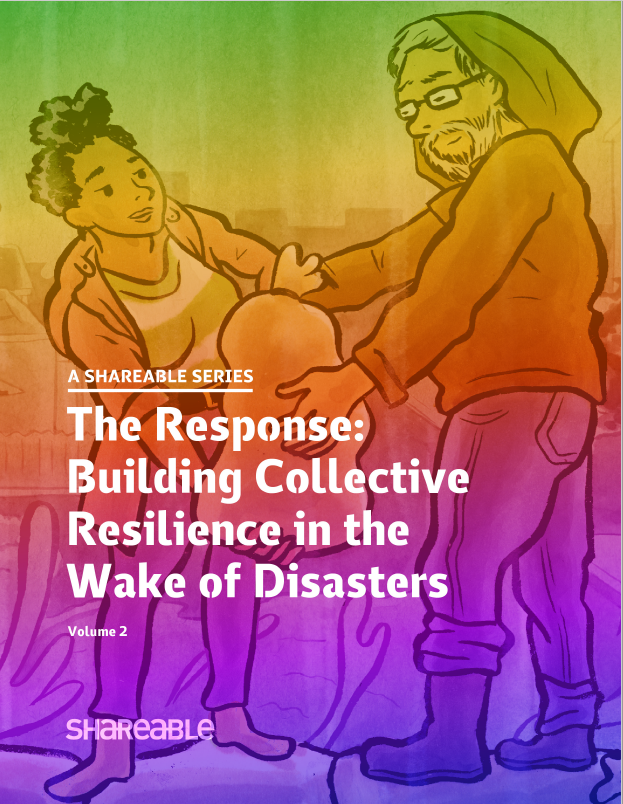
The Response: Building Cllective Resilience in the Wake of Disasters (Shareable)

By various - Sharable, 2019

When disasters occur, the majority of news coverage teeters on the edge of “disaster porn” at best, emphasizing the sheer mass of destruction in the affected area while celebrating a few token “heroes.” At its worst, the media perpetuates harmful stereotypes, casting survivors as looters and justifying the extrajudicial murder of people of color by the police and mostly white vigilantes, like what occurred during Hurricane Katrina.

But in both scenarios, news reporting routinely underplays how local communities come together to recover from the immediate devastation and collectively rebuild the community, often on a new foundation of sustainability and justice. It’s a good thing that people collaborate instead of competing during a crisis because all signs point towards an increase in climate change-fueled disasters in the coming years.

This kind of collective response is worth celebrating, but there’s no better way to respond to disasters than to anticipate them happening and prepare before they strike. And there’s no better time than right now to build resilience together. While a little preparation today can save a lot of trouble tomorrow, it can also create immediate benefits like stronger community ties, increased civic capacity, and the joy that comes from accomplishing things together.

Read the report (PDF).

Pages

The Fine Print I:

Disclaimer: The views expressed on this site are not the official position of the IWW (or even the IWW’s EUC) unless otherwise indicated and do not necessarily represent the views of anyone but the author’s, nor should it be assumed that any of these authors automatically support the IWW or endorse any of its positions.

Further: the inclusion of a link on our site (other than the link to the main IWW site) does not imply endorsement by or an alliance with the IWW. These sites have been chosen by our members due to their perceived relevance to the IWW EUC and are included here for informational purposes only. If you have any suggestions or comments on any of the links included (or not included) above, please contact us.

The Fine Print II:

Fair Use Notice: The material on this site is provided for educational and informational purposes. It may contain copyrighted material the use of which has not always been specifically authorized by the copyright owner. It is being made available in an effort to advance the understanding of scientific, environmental, economic, social justice and human rights issues etc.

It is believed that this constitutes a 'fair use' of any such copyrighted material as provided for in section 107 of the US Copyright Law. In accordance with Title 17 U.S.C. Section 107, the material on this site is distributed without profit to those who have an interest in using the included information for research and educational purposes. If you wish to use copyrighted material from this site for purposes of your own that go beyond 'fair use', you must obtain permission from the copyright owner. The information on this site does not constitute legal or technical advice.
