

You are here

International Association of Sheet Metal, Air, Rail and Transportation Workers (SMART)
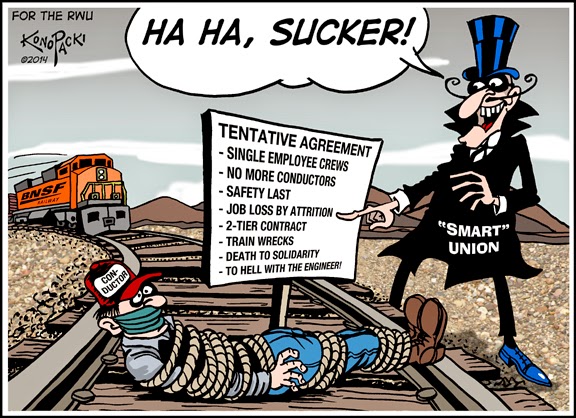
The BNSF Single Crew Initiative Defeated!

By J.P. Wright - Railroad Workers United Blog, September 11, 2014

Disclaimer: The views expressed here are not the official position of the IWW (or even the IWW’s EUC) and do not necessarily represent the views of anyone but the author’s.

The members of the International Association of Sheet Metal, Air, Rail & Transportation Workers (SMART) General Committee GO—001 have spoken. In a loud and clear mandate, they have told the BNSF railway, their union leaders, and the world, that they do not support single employee train crews. By 2-to-1, the rank and file voted down a tentative agreement, that – had it been ratified – would have resulted in conductorless train operations over more than half of the Burlington Northern Santa Fe Railway (BNSF), the second largest rail carrier in the U.S.

The major rail carriers have been seeking to run trains with a single employee for nearly a decade now. This latest attempt was by far the most blatant and confrontational effort to date. Railroad workers know that there are grave dangers and inefficiencies should such practice be implemented. According to Railroad Workers United General Secretary Ron Kaminkow, “Single employee train operations – with or without Positive Train Control (PTC) – would compromise the safety and security of train crews, motorists, pedestrians, trackside communities, the environment and the general public. Railroad workers are ready, willing and able to fight this concept with everything we have.”

In voting down this contract, the SMART GO-001 rank and file have won a decisive victory, not just for the trainmen and engineers on the BNSF, but for every railroad worker in North America. While the victory belongs to them, it is of course shared by all those who assisted – engineers (both UTU and BLET); union brothers and sisters from other crafts and carriers who rose to the occasion and helped out; family members who took part in pickets, rallies and demonstrations; fellow unionists and citizens who grasped the importance of the struggle and pitched in to help.

An Arresting Experience: Doing direct action at BNSF Delta Yard

By Patrick Mazza - Cascadia Planet, September 8, 2014

Disclaimer: The views expressed here are not the official position of the IWW (or even the IWW’s EUC) and do not necessarily represent the views of anyone but the author’s.

Following is the story of why I and four others engaged in an act of civil resistance at BNSF Delta Yard in Everett, Washington September 2.  The act was intended to draw attention to a Petition for Redress of Grievances Inflicted by Fossil Fuels.  Please sign our petition here

I am a veteran climate activist.  I have written about the climate crisis for over 25 years and for most of the last 15 worked full-time to advance climate solutions.  I have spent a lot of time trying to stop global warming sitting in front of a computer.  On September 2, 2014 it was time to sit in front of a train. 

Five of us attached ourselves to a tripod made of three 18-foot steel poles erected across a train track at Delta Junction, the north end of BNSF’s Everett Delta staging yard.  I locked myself at the foot of one of the poles.  School teachers Liz Spoerri and Jackie Minshew and coffee shop owner Mike Lapointe fastened themselves to the others. Abby Brockway, a house painter and artist, ascended to perch at the top.

Our banner, “Cut Oil Trains, Not Conductors,” expressed solidarity with railroad workers fighting against dangerous, single-person train crews.  During the day the action drew numerous supporting honks from truckers driving across the bridge above.

Around 150 yards to the south an orange BNSF engine was linked at the head of a black mile-long snake of tanker cars filled with North Dakota Bakken shale oil.  This is the same extraordinarily unstable crude that on July 6, 2013 leveled several city blocks and incinerated 47 people at Lac-Megantic on the Quebec-Maine border.  That exploded in fireballs after derailments October 19, 2013 in Edmonton, Alberta and November 8, 2013 in Aliceville, Alabama. A derailment and fire December 30, 2013 in Casselton, North Dakota erupted in a toxic plume that forced evacuations in a five-mile radius.  Another Bakken train derailed and was engulfed in flames January 7, 2014 in Plaster Rock, New Brunswick.

Every week oil trains each carrying up to three million gallons of volatile Bakken crude trundle through Seattle 8 to 13 times and Washington up to 19 times, according to BNSF’s own figures. Sightline's Eric de Place reports that oil unit train traffic through Washington has risen from essentially zero in August 2012 to an average of 2.6 trains a day. They run past stadiums and heavily populated neighborhoods, and through tunnels underneath Seattle and Everett.  Just this July 24 a nearly 100-tanker train derailed beneath the Magnolia Bridge in Seattle.  Fortunately no toxic fireball . . . this time.

Rail-union Agreement Raises Concerns Over Safety

By Sarah Case - Gilette News Record, August 26, 2014

Disclaimer: The views expressed here are not the official position of the IWW (or even the IWW’s EUC) and do not necessarily represent the views of anyone but the author’s.

If things go the way BNSF and some union leaders hope, the trains that haul coal out of the Powder River Basin soon could be driven by a lone engineer, instead of an engineer working with a conductor.

A pending contract would mandate single-person crews on trains equipped with a technology called Positive Train Control. Conductors, in a new role called a master conductor, would work off site and would oversee an unknown number of trains at any given time.

It’s a cost-saving maneuver that embraces technology mandated by a 2008 law. Many rail employees say it’s too risky to slash crews that help each other out and keep each other awake during long hauls across isolated stretches of territory.

Those opposed to the deal point to the remains of a small Canadian town as evidence that single-person crews are a deadly mistake.

Rail Workers Revolt against Driving Solo

By Alexandra Bradbury - Labor Notes, August 12, 2014

Disclaimer: The views expressed here are not the official position of the IWW (or even the IWW’s EUC) and do not necessarily represent the views of anyone but the author’s.

“There’s a real rank-and-file rebellion going on right now,” says Jen Wallis, a Seattle switchman-conductor for Burlington Northern Santa Fe (BNSF) Railway. “People who’ve never been involved in the union, never went to a union meeting, they are showing up and they’re joining Railroad Workers United in droves.
“People are saying, ‘We have to take action now to stop it. We can’t let our union officers do this to us.’”

What’s all the fuss? On July 16, thousands of railroaders abruptly learned their union officers had held secret negotiations with BNSF, one of the country’s biggest freight carriers, and reached a deal to allow single-person train crews: a safety disaster.

Ballots on the tentative agreement went out in early August, and are due back in early September. If the vote goes up, huge freight trains could rumble through towns across the western U.S. with just an engineer onboard, no conductor.

This would be a first on a major railway, and a foot in the door for the whole industry. BNSF is owned by Warren Buffett, one of the world’s richest people.

“Members had no clue this was even coming,” said John Paul Wright, a locomotive engineer working out of Louisville, Kentucky. “The membership is basically saying, “What in the hell is going on? We never thought our own union would sell us out.’”

Wright is co-chair of the cross-union, rank-and-file group Railroad Workers United, which has been campaigning against the looming threat of single-person crews for a decade. With just weeks to go, its members are suddenly busy sending out “vote no” stickers and appealing to local labor councils to pass resolutions backing two-person crews.

“We weren’t expecting it this soon,” says Robert Hill, a BNSF engineer in Spokane, Washington. “We were expecting it.”

Railroaders are seeking out RWU and a new Facebook group, “Spouses & Families Against One-Man Crews,” to get information and coordinate the push for a “No” vote. Much of the opposition is being led by railroaders’ family members.

Engineers and conductors are represented by separate unions. The conductors, members of SMART, are the ones voting on this contract.

“This vote will affect far more people than just the ones that vote on it,” said James Wallace, a BNSF conductor in Lincoln, Nebraska, and RWU co-chair, “because it is going to set a precedent for all freight railroads in the U.S., and potentially endanger the job of every conductor in this country.”

Bay Area IWW General Membership Branch Resolution in Opposition to Single Employee Train Crews

Passed Unanimously on Thursday, August 7, 2014

Whereas, the BLET and the SMART have joined forces and have been working hand in hand to outlaw Single Employee Train Crews; and

Whereas, railroad workers universally support a minimum of two crew members on every train, an engineer and a conductor; and

Whereas, in the wake of the Lac Megantic tragedy and numerous other train wrecks in the last year, we have an historic opportunity to build alliances with community and environmental groups to outlaw single employee train crews;

Whereas, a rogue general committee of the SMART TD has recently announced an tentative agreement, that would, if implemented, eliminate the road conductor on through freight and allow single employee crews;

Therefore, be it resolved, that the Bay Area General Membership Branch of the IWW affirms our opposition to single employee train operations and that we support an engineer and a conductor on every train; and

Be it further resolved, that we condemn the backroom deal recently made between the SMART TD and the BNSF as it would undermine the national union strategy to outlaw single employee operations; and

Be it further resolved, that the Bay Area General Membership Branch of the IWW urge all rail, transportation, and other union members to actively oppose contracts that would allow single employee operations of trains; and

Be it finally resolved, that Local the Bay Area General Membership Branch of the IWW urge trainmen on the BNSF GC-001 in the strongest possible terms to stand up and fight back standing shoulder to shoulder with the rest of labor and to vote NO on this tentativeagreement. 

Adopted by the members of the Bay Area General Membership Branch of the IWW on August 7, 2014

Jim M. Garrett, Iowa State Legislative Director SMART-Transportation Division (UTU), Speaks Out AGAINST Single Employee Train Crews

By Jim M Garrett - August 10th, 2014

Disclaimer: The views expressed here are not the official position of the IWW (or even the IWW’s EUC) and do not necessarily represent the views of anyone but the author’s.

Brothers and Sisters,

I would like to share with you my many concerns surrounding the proposed conductor elimination agreement between BNSF and GO-001. I encourage you to share this with anyone who works for a railroad. These thoughts are in no particular order of importance.

Whether a curse or a benefit, I have been here 35 year and I have seen this type of push down, fear promotion before. What I have never seen is the level of secrecy involved and the lack of member participation seen here.

I first would ask that everyone read the proposed TA as if you were a railroad manager. View it in the light of how you would exploit it. Trust me, if you perceive a hole somewhere, BNSF has seen it and is already making preparations to use it. But even without the holes, how would you use it?

The TA should also be considered for what is NOT in it as much as for what is.

If you attend an informational session or have heard of its content, you will hear and see via the PowerPoint the usual 'fear' issues: crew consist is expiring, we probably can't do better in the future, laws and regulations can change, we lost past battles on crew consist, etc. First, there is no expiration date on crew consist. There is a moratorium that protects us from having to negotiate it while a protected person still falls under it. So consider this: If we will be in a weaker position in the future, why is BNSF settling now and locking themselves in for 40 plus years? I submit it is because they have got a sweetheart deal. While laws and regulations can change, it is very unlikely any two person mandate will. We have public support on our side. 83% + of our community neighbors support mandating two person crews. This is huge support in the political world. And finally, the fear propagated by noting past crew consist losses. Lets put some perspective on that. In those battles we could not with a straight face argue that having two or even one brakeman riding behind the conductor (or in a trailing locomotive) was a necessity and required for safety. But we do have that argument now, it is valid, and we have political and public support. Further more, those crew consists were written under duress account of PEB mandates and "featherbedding" claims. Brother Knutson has voiced that the legal remedy is weak and yet HE approached the BNSF with the proposal to eliminate conductors some 8 or 10 years before the issue needs to be discussed and feels HE is in a stronger position. Again I ask you, if BNSF felt they are in a weaker position now, why would they seemingly be give up so much? It is a serious question and one you should reflect on when reading the agreement as a corporate railroad officer. I submit to you that since Brother Knutson initiate the talks, that BNSF though, "What the hell, lets see what we can get and if it isn't enough we'll just wait 8 years". I mean, wouldn't you?

Brother Knutson says laws and regulations are resendable and that any two person law or regulation can be revoked and yet later said PTC is here to stay. Please pick a side and stick to it.

Look at the clause regarding elimination of brakemen and yard helpers. What does that have to do with PTC protected trains and how is safety enhanced for the remaining sole conductor or switchman? And with no additional pay. Brother Knutson said, with an incredible lack of sarcasm, that he doubts BNSF will exploit that right because of the drop in productivity. Say what?!! BNSF uses two man remotes everywhere they can without concern for productivity. CSX has one man remotes across their system with the resulting drop in productivity but it doesn't stop them. Expect them to remove those jobs.

Brother Knutson has opened his monologue by parroting the carriers lines in their support for one man operations. First, he has used the AAR's line that "there is no proof that a second person leads to safer operations".

Well, um...since all operations except for a few shortline, assigned trains are already two person, can you disprove it? That should be the question.

Worker Safety Questioned as Trains and Accidents Multiply

By Blake Sobczak - Energywire [Paywall Site], August 4, 2014

Disclaimer: The views expressed here are not the official position of the IWW (or even the IWW’s EUC) and do not necessarily represent the views of anyone but the author’s.

The recent surge in oil train traffic along North America’s freight network has been a boon for railroads struggling to cope with falling coal shipments.

But though the crude-by-rail boom has kept workers busy, it has also raised questions about their safety and preparedness following a series of oil train derailments and explosions.

A tentative agreement between BNSF Railway Co. and a major transportation union last month would allow certain trains to operate with just one engineer on board, provided they were outfitted with Positive Train Control. PTC technology allows for the train to be stopped or slowed automatically if it exceeds a speed limit or is on track for an unseen collision.

BNSF spokeswoman Roxanne Butler pointed out that the PTC labor deal would not apply to any trains hauling hazardous materials such as crude oil. The agreement is now being considered by members of the International Association of Sheet Metal, Air, Rail and Transportation Workers’ Transportation Division (SMART TD).

But union representatives have worried that the agreement could clear the way to phase out oil train conductors in the future, setting what they consider a dangerous precedent.

“You can’t talk about this issue without mentioning the terrible lessons that we learned at Lac-Mégantic,” said SMART TD National Legislative Director James Stem, referring to a fiery oil train derailment and explosion in Quebec last year that killed 47 people.

The train was not manned when it jumped the tracks in downtown Lac-Mégantic, but it had been operated by a lone engineer the previous night. The worker is now facing charges of criminal negligence for allegedly failing to apply enough hand brakes that could have prevented the train from breaking free from its parking place and hurtling toward town.

In that case, Stem explained, safety “had nothing to do with the size of the tank car — it had to do with management decisions that were made based around the fact that they had a crew of one.”

“Based on our experience and multiple fatalities, a crew of at least two certified employees is necessary for the safe operation of the train,” he said.

The Federal Railroad Administration, part of the U.S. Department of Transportation, is now crafting regulations that will likely require oil trains to be staffed by at least one conductor and one engineer. An FRA spokesman said the regulator expects to issue a notice of proposed rulemaking on the topic by the end of the year.

The U.S. rail industry already uses at least two employees on oil or ethanol trains as standard practice.

But in a statement supporting the FRA’s two-person crew proposal in April, Edward Wytkind, president of the Transportation Trades Department at the union confederation AFL-CIO, noted that railroads’ “previous collective bargaining pursuits have included attempts to employ one-person crews.”

Railroads have sought to use smaller crews in recent decades to cut down on labor costs, arguing that technologies such as PTC and improved operating practices preclude the need for many workers. But regulators and labor groups have maintained that larger crews boost safety.

BNSF Nears Shift To One-Member Crews, Possibly Even on Dangerous Oil Trains

By Cole Stangler - DeSmog Blog, July 19, 2014

Disclaimer: The views expressed here are not the official position of the IWW (or even the IWW’s EUC) and do not necessarily represent the views of anyone but the author’s.

For decades, the U.S. railroad industry has successfully shed labor costs by shifting to smaller and smaller operating crews. Now, it’s on the verge of what was once an unthinkable victory: single-member crews, even on dangerous oil trains.

A tentative agreement reached by BNSF Railway and the Transportation Division of the Sheet Metal, Air, Rail and Transportation (SMART) union would allow a single engineer to operate most of the company’s routes. It would mark a dramatic change to a labor contract that covers about 3,000 workers, or 60 percent of the BNSF system.  

It’s not just bad news for workers. The contract has major safety implications—especially amid North America’s dangerous, and sometimes deadly, crude-by-rail boom. Last year’s Bakken shale oil train derailment and explosion in Lac Mégantic, Quebec, which killed 47 people, brought increased scrutiny to oil trains. 

Pages

The Fine Print I:

Disclaimer: The views expressed on this site are not the official position of the IWW (or even the IWW’s EUC) unless otherwise indicated and do not necessarily represent the views of anyone but the author’s, nor should it be assumed that any of these authors automatically support the IWW or endorse any of its positions.

Further: the inclusion of a link on our site (other than the link to the main IWW site) does not imply endorsement by or an alliance with the IWW. These sites have been chosen by our members due to their perceived relevance to the IWW EUC and are included here for informational purposes only. If you have any suggestions or comments on any of the links included (or not included) above, please contact us.

The Fine Print II:

Fair Use Notice: The material on this site is provided for educational and informational purposes. It may contain copyrighted material the use of which has not always been specifically authorized by the copyright owner. It is being made available in an effort to advance the understanding of scientific, environmental, economic, social justice and human rights issues etc.

It is believed that this constitutes a 'fair use' of any such copyrighted material as provided for in section 107 of the US Copyright Law. In accordance with Title 17 U.S.C. Section 107, the material on this site is distributed without profit to those who have an interest in using the included information for research and educational purposes. If you wish to use copyrighted material from this site for purposes of your own that go beyond 'fair use', you must obtain permission from the copyright owner. The information on this site does not constitute legal or technical advice.
