You are here

International Association of Sheet Metal, Air, Rail and Transportation Workers (SMART)

Rail workers score big safety win in California

By Mark Gruenberg - People's World, August 26, 2015

Disclaimer: The views expressed here are not the official position of the IWW (or even the IWW’s EUC) and do not necessarily represent the views of anyone but the author’s.

Rail workers scored a big safety win in California on August 21 as state lawmakers gave final approval to a bill mandating two-person crews on all freight trains.

The measure, pushed by the Teamsters and their California affiliates, the Rail Division of SMART - the former United Transportation Union - and the state labor federation, now goes to Gov. Jerry Brown, D-Calif., who is expected to sign it.

Rail unions nationwide have been pushing for the two-person crews while the rail carriers have been pushing for just one, an engineer. Several months ago, the head of one carrier, the Burlington Northern, advocated crewless freights.

The unionists told lawmakers presence of a second crew member would cut down on horrific crashes such as the one that obliterated downtown Lac-Megantic, Quebec, two years ago. Then, a runaway oil train crashed and exploded, killing 47 people. That train had only an engineer. There has been a string of similar U.S. accidents since, especially of oil-carrying trains. Recent oil train accidents were near Galena, Ill., Lynchburg, Va., and in West Virginia.

The proposed California statute requires trains and light engines carrying freight within the nation's largest state - home to one of every eight Americans - to be operated with "an adequate crew size," reported Railroad Workers United, a coalition of rank-and-file rail workers from SMART, the Teamsters and other unions.

The minimum adequate crew size, the bill says, is two. Railroads that break the law would face fines and other penalties from the state Public Utilities Commission. The commission supported the bill, SB730.

EcoUnionist News #16

Compiled by x344543 - IWW Environmental Unionism Caucus, December 31, 2014

Disclaimer: The views expressed here are not the official position of the IWW (or even the IWW’s EUC) and do not necessarily represent the views of anyone but the author’s.

The following news items feature issues, discussions, campaigns, or information potentially relevant to green unionists:

Lead Stories:

Railroad Workers, Safety, and the Environment:

Other News of Interest:

For more green news, please visit our news feeds section on ecology.iww.org; Twitter #IWWEUC

EcoUnionist News #15

Compiled by x344543 - IWW Environmental Unionism Caucus, December 30, 2014

Disclaimer: The views expressed here are not the official position of the IWW (or even the IWW’s EUC) and do not necessarily represent the views of anyone but the author’s.

The following news items feature issues, discussions, campaigns, or information potentially relevant to green unionists:

Lead Stories:

Other News of Interest:

For more green news, please visit our news feeds section on ecology.iww.org; Twitter #IWWEUC

Oil on the Tracks: Pacific Northwest Rises for Rail Safety

By Nartha Baskin - Truthout, November 6, 2014

Disclaimer: The views expressed here are not the official position of the IWW (or even the IWW’s EUC) and do not necessarily represent the views of anyone but the author’s.

If there were ever any question about how the public feels about "moving time bombs," or oil trains carrying volatile crude through the state's coastal estuaries, aquifers, population centers and tribal lands, the answers began at the crack of dawn and ricocheted into the night. At a five-hour-plus hearing, the public weighed in on a draft report on oil train safety and spill response issued by the Washington State Department of Ecology.

Raging Grannies, chained together in rocking chairs, started the day by blocking the entrance to Ecology offices. The Department of Ecology, said the Grannies, was closed for a workshop on "How to Say No to Oil." By evening, the stand-off was over, but the public hearing had just begun. Longshoreman, railroad workers, and first responders expressed concerns about safety, crew capacity, and training. Tribes spoke of threats to drinking water and fishing rights. Millennials and boomers demanded fossil fuels stay in the ground. Mayors and county commissioners, including some who had passed resolutions against any oil trains moving through their communities, demanded clean energy alternatives.

Oil train safety: A whole lot of worry among Washingtonians

By John Stang - CrossCut, October 31, 2014

Disclaimer: The views expressed here are not the official position of the IWW (or even the IWW’s EUC) and do not necessarily represent the views of anyone but the author’s.

The subject was oil train traffic, and most of a roughly 750-person crowd Thursday night opposed the increasing transportation of crude oil by rail across Washington.

And if more oil trains do surface, the crowd at an Olympia hearing on draft oil spill prevention and response plan wanted dramatically stricter rules that what the state plan proposes. 

"We must stop these trains and the tankers they feed," said Nathaniel Jones, mayor pro tempore of Olympia. Vancouver small business owner Don Orange, representing the Main Street Business Alliance, said oil trains are "great for Big Oil. It stinks for us."

"We shouldn't be moving this stuff through our populated area," Orange said.

The draft state report says, "There has been an unprecedented increase in the transportation of crude oil by rail from virtually none in 2011 to 714 million gallons in 2013. The amount may reach 2.87 billion gallons by the end 2014 or during 2015."

Even that amount could increase with construction of proposed new rail facilities and the potential lifting of a federal ban on exporting U.S. crude oil, the report says.

Railroad Workers United Steve Klak speaks to Pullman, IL Labor Day 2014

By Steve Klak - Railroad Workers United Blog, October 8, 2014

Disclaimer: The views expressed here are not the official position of the IWW (or even the IWW’s EUC) and do not necessarily represent the views of anyone but the author’s.

120 years ago Eugene Victor Debs stood six blocks from here at Langley Park and pledged the support of his brand new union, the American Railway Union to the struggle of the Pullman car builders. The ARU had just decisively defeated the Great Northern Railway in 18 days preventing a 10% wage cut. Now, this same company the Burlington Northern Santa Fe, is demanding concessions just as drastic. I came here today to ask you to help these present day rail workers in this fight.

Blood on the Tracks: Saying No to Warren Buffett

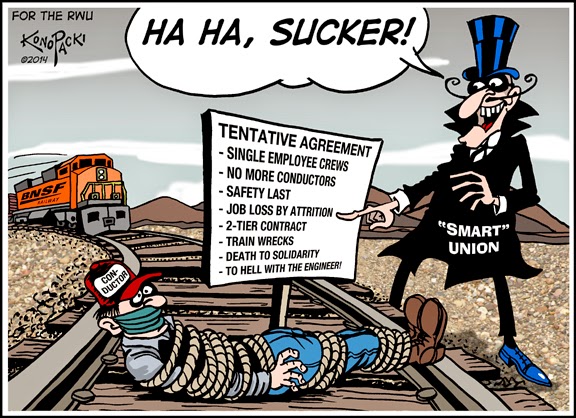
By Guy Miller; image by Mike Konopacki - CounterPunch, September 26, 2014

Disclaimer: The views expressed here are not the official position of the IWW (or even the IWW’s EUC) and do not necessarily represent the views of anyone but the author’s.

The City of New Orleans by Steve Goodman is a loving tribute to an era gone-by. Steve mourned what he perceived to be ”the disappearing railroad blues.” He takes a nostalgic look back at an America that looks better through the sepia tones of memory than it actually was. Steve Goodman was unquestionably a great song writer, but for all that, he was a lousy economist. America’s railroads are anything but disappearing. Rather than a relic from another time, they are at the forefront of American capital’s plan for the 21st century. If you don’t live along the major corridors of rail traffic, it is easy to miss this vital aspect of the US economy.

For people that live in, or near, one of the cities that stretch from Boston to Washington, when they think about railroads at all, they generally think first about Amtrak. Everyone who uses Amtrak has a horror story to tell. Even the premium Acela train is seen as not measuring up to the trains of Europe or China. The primary reason high speed passenger trains aren’t a priority in the US is simple: freight traffic makes too damn much money. Wherever in the world there are fast and efficient passenger trains, freight traffic is secondary, or non existent. There was a time in the United States when freight traffic was shunted to the side to make room for passenger trains. To the major railroads that was a waste of time and money.

If high speed passenger service were to be successful two essential things would be needed: 1. Government subsidies (or better yet total nationalization) and 2. A huge upgrade in infrastructure. File the first requirement under the category of “come the revolution,” and the second under unlikely. The infrastructure is just fine for what the major carriers want to accomplish. They do not want, or need tracks, or roadbeds, that can safely move 15,000 tons of freight at 100 miles per hour, sixty MPH will do nicely, thank you. Building and maintaining the right-of-way is an expensive and labor intensive proposition. Even with cost-cutting machinery it is viewed by railroads as something to be kept to a minimum.

In the decade before the crash of 2008 railroad freight traffic exploded. From 1996 to 2006 railroad and truck traffic both grew, but railroad traffic grew faster. Using the metric of ton miles, the industry’s standard measurement, that decade saw rail traffic grow 25.1% and truck traffic grow 21.8%. This boom is still being fueled by the growth of “unit trains.” Unit trains, as opposed to manifest trains, are a one trick pony. For example a train consisting solely of crude oil, or grain or coal are of unit trains. Such trains go from point A to point B with no stops in between. No setting out a cut of cars in Podunk, Iowa or picking up cars of lumber in Rochester, Minnesota. Much of America has become not only flyover country, but also roll-by country as well. This contrasts with the once more common manifest train. Such trains required switching at various points along the route. This change brought with it the loss of thousands of switching jobs, those jobs did indeed go the way of Steve Goodman’s disappearing railroad.

After years of consolidation American railroad evolved into five large carriers. With the aid of this monopoly the railroads were on track for bigger and bigger payoffs. My old boss, the Union Pacific has over 32,000 miles of tracks resulting from mergers and takeovers. In the second quarter of 2014 the Union Pacific saw its profits jump 17%.  This in the midst of an economy that is, at best, sputtering along.

Rank-and-File Rail Workers Rebel Against Single-Person Crews

By Kari Lyderson - In These Times, September 15, 2014

Disclaimer: The views expressed here are not the official position of the IWW (or even the IWW’s EUC) and do not necessarily represent the views of anyone but the author’s.

Railroad workers scored a victory last week in a years-long battle over the introduction of single-person crews on freight trains, a move that railroad workers say is a recipe for disaster. On September 10, a unit of the International Association of Sheet Metal, Air and Rail Transportation Workers (SMART) union announced that members had voted down a proposed contract which would have allowed the railroad company BNSF to run more than half its trains with just one worker on board.

BNSF and other railroad companies assert that automation and modern controls on tracks mean freight trains can be safely and efficiently operated by only one engineer, a change that would essentially eliminate the position of the conductor.

Railroad workers, however, say that having only one person on trains that are often more than a mile long is a safety risk for workers and communities alike, especially as more and more trains are involved in carrying explosive crude oil cross-country. The introduction of single-person crews would further a longstanding push by industry to reduce the number of workers needed to operate trains; currently most freight trains have a conductor and an engineer, but in decades past crews of three to five people were common. An industry shift to single-person crews would likely mean significant job losses, and significant savings for railroads on labor costs.

Currently the major railroads like BNSF are not using single-person crews, but smaller railroads are. The July 2013 Lac-Megantic disaster in Quebec, in which a train derailed and caused a deadly explosion, brought increased scrutiny of single-person crews. 

The contract between the union and BNSF had been negotiated by a union leadership body known as the district committee, SMART GO-001, representing about 3,000 conductors, brakemen and switchmen in multiple states. Leaders of Railroad Workers United (RWU), a national organization that includes members from the country’s 13 different railroad labor unions, said that SMART GO-001 leadership had pushed for approval of the single-person crew provision, apparently as a way to gain other concessions from BNSF.

SMART’s national leadership opposes single-person crews, and supports proposed federal legislation on the issue. The Rail Safety Improvement Act (S. 2784) just introduced in the Senate on September 10, and the Safe Freight Act (HR 3040), introduced in August 2013 in the House, would require two workers on any freight train.

In a statement on SMART’s website, SMART Transportation Division President John Previsich says: “No one would permit an airliner to fly with just one pilot, even though they can fly themselves. Trains, which cannot operate themselves, should be no different.”

In an email notifying union members that the proposed contract had been voted down, SMART GO-001 committee general chairperson Randall Knutson said, “Moving forward, this office will notify BNSF Labor Relations that we remain open to informal conversation regarding these matters, but will oppose any formal attempt by BNSF to serve notice to change our existing crew consist agreements prior to the attrition of all protected employees.”

In other words, the leadership indicated that it would not cooperate with the company in pushing single-person crews any longer. Knutson’s email also said the leadership would be in touch with more details about the contract fight in coming weeks.

SMART GO-001 district committee leaders did not return a phone message or emails for this story.

The Battle has Just Begun!

By J.P Wright - Railroad Workers United Blog, September 13, 2014

Disclaimer: The views expressed here are not the official position of the IWW (or even the IWW’s EUC) and do not necessarily represent the views of anyone but the author’s.

I have been numb for a couple of days about "our" and "their" victory on the BNSF against a contract that would have allowed for one person trains. I feel like David has hit Goliath squarely on the face and yes... he is hit, and.... Railroad Workers United played a very serious roll in this campaign, but I am reluctant for our organization to take credit for the "action." While I do know that many of our activist, some who put their jobs on the line, were seriously helping to fan a flame that has long been smoldering, analysis and strategy is needed.

Who is Goliath?

Is it Warren Buffet, the Berkshire-Hathaway hedge fund owner of the BNSF railroad? Is it the "Business" union structure that created the environment that allowed this contract to come about? Is it a membership that has become very apathetic and reluctant to "get involved." Is it a Federal Railroad Administration that has historically been very reluctant to make strong regulations. Is it a "robber barron" industry that has long controlled Washington?

All of the above and more, is Goliath. Who is David? that is the question!

The motive of the railroad industry for decades has been a reduction of crew size. You can bet that the strategy sessions are going on at the labor relations level. There is a union political environment that is also at work here. This is a "war on workers" and there will be a "last man standing." The wheel of history is turning and there will be massive changes to work rules. There will be more battles to wage. There is a fire burning and we must keep it lit.

I am inspired, and i can feel it in my blood. There is a power that comes from a victory, but the forces we are up against are very,very powerful. The BNSF conceded, and said they will respect the workers mandate. But fellow railroaders don't be fooled. Remember from where this attack came. The union and the company, think about that.

It would be SMART to remember that the Brotherhood is at an impasse on the W&LE out in Ohio. Goliath has been on a rampage against 100 Teamster represented fellow railroad workers there for may years now. Now that the front has quieted in the west, shouldn't we turn our slingshots in that direction? If an arbi "traitor" settles that fight.. We are in serious trouble. The W&LE has not conceded.

Brothers and Sisters, Fellow Railroaders.. the fight ain't over.. it has just begun. In our hands is placed a power and there is no greater power than the union. Are you ready David? Goliath will be back.

Solidarity!

SMART Railroad Workers Rejection of Single Employee Crews is a Victory for Workers AND the Environment

By x344543 - IWW Environmental Unionism Caucus, September 14, 2014

Disclaimer: The views expressed here are not the official position of the IWW (or even the IWW’s EUC) and do not necessarily represent the views of anyone but the author’s.

On Tuesday, September 10, 2014, the rank and file union members of the International Association of Sheet Metal, Air, Rail & Transportation Workers (SMART) General Committee GO—001 overwhelmingly voted down a concessionary proposal to reduce train crew size from 2 to 1 by a margin of 2 to 1 against the proposal.

The proposed change would have resulted in conductorless train operations over more than half of the Burlington Northern Santa Fe Railway (BNSF), the second largest rail carrier in the U.S. According to Railroad Workers United, a coalition of rank and file union members from various railroad workers' unions, this was part of a campaign by the major rail carriers to weaken the already weak and divided rail unions further. Over the past half-century, the railroad bosses have taken advantage of the craft divisions among their workers to reduce crew sizes from a standard of 5 to 2. Now they're pushing to reduce that number to 1. The fact that BNSF was able to convince the leadership of one local to go along shows just how beaten down these unions are.

Fortunately, rank and file militants--some of them dues paying members of the IWW--formed RWU to beat back just such an offensive by the bosses, and--perhaps--turn the tide in what has hitherto been a one-sided class war waged against the workers by the bosses.

The RWU strategy mixed a whole variety of tactics, both old (including "silent agitators" and graffiti) and new (social media), many of them pioneered by the IWW:

Upon learning of the BNSF TA, RWU convened an “emergency meeting” of the Steering Committee and instantly mobilized the network. Thousands of buttons and sticker, flyers and leaflets, “Talking Points” and more were disseminated to BNSF railroad workers in the following weeks. A press release was issued that was picked up by a number of newspapers. RWU members spoke out on radio and TV stations, and organized rallies, pickets and demonstrations at numerous terminals, from large cities like Chicago and Seattle to small towns like Creston, Iowa. RWU members intervened in the debate at the SMART Convention in August, and held a series of telephone conference calls open to all railroad workers to voice their concerns, ask questions, and devise strategies and tactics. A regular e-newsletter with the latest flyers, leaflets, stickers, articles, songs, graffiti and cartoons were issued weekly.

In the end, the workers beat back the bosses attack, and this campaign should provide (the beginnings, at least, of) a model for rank and file workers in business unions to overcome entrenched bureaucratic interests that serve the bosses and not the workers. It can also serve as a model for the IWW's "dual card" strategy.

The vote was also a small victory for the environment and efforts to build bridges between environmental activists and workers. As has been widely reported, the accident that blew up Lac Magentic was the result of a single employee train, and while derailments involving two employee crude-by-rail trains have occurred, the chances of them happening are substantially greater if the crew size were to be reduced to one. Further, the push to reduce crew sizes is part of the ongoing efforts by the rail carriers to maximize their profits by cutting corners on labor costs, safety procedures, and best practices. The workers' victory will likely embolden them to take stronger stands against other initiatives by the bosses that would increase the risk of accident or derailment, and should the workers gain sufficient momentum, they can actually go on the offensive and force the carriers to increase safety, which will reduce environmental impacts significantly.

Pages

The Fine Print I:

Disclaimer: The views expressed on this site are not the official position of the IWW (or even the IWW’s EUC) unless otherwise indicated and do not necessarily represent the views of anyone but the author’s, nor should it be assumed that any of these authors automatically support the IWW or endorse any of its positions.

Further: the inclusion of a link on our site (other than the link to the main IWW site) does not imply endorsement by or an alliance with the IWW. These sites have been chosen by our members due to their perceived relevance to the IWW EUC and are included here for informational purposes only. If you have any suggestions or comments on any of the links included (or not included) above, please contact us.

The Fine Print II:

Fair Use Notice: The material on this site is provided for educational and informational purposes. It may contain copyrighted material the use of which has not always been specifically authorized by the copyright owner. It is being made available in an effort to advance the understanding of scientific, environmental, economic, social justice and human rights issues etc.

It is believed that this constitutes a 'fair use' of any such copyrighted material as provided for in section 107 of the US Copyright Law. In accordance with Title 17 U.S.C. Section 107, the material on this site is distributed without profit to those who have an interest in using the included information for research and educational purposes. If you wish to use copyrighted material from this site for purposes of your own that go beyond 'fair use', you must obtain permission from the copyright owner. The information on this site does not constitute legal or technical advice.