You are here

Green New Deal (GND)

An Ecosocialist Green New Deal: Guiding Principles

By the DSA Ecosocialist Working Group - Democratic Socialists of America - February 28, 2019

The IWW has not endorsed this document; however, individual members of the IWW EUC have helped shape it.

Humankind has reached a moment of existential crisis. Human activity is causing disastrous climate disruption and Earth’s sixth mass extinction event, triggering critical losses of biodiversity. We are already locked in for global warming that will have catastrophic effects, and we are on a slippery path to our own extinction. The 2018 Special Report from the Intergovernmental Panel on Climate Change (IPCC) warns unequivocally that “without societal transformation and rapid implementation of ambitious greenhouse gas reduction measures, pathways to limiting warming to 1.5°C and achieving sustainable development will be exceedingly difficult, if not impossible, to achieve.”

Yet, the crisis we face exceeds ecological breakdown. Deepening inequality, suppressed democracy, precarious jobs, racial and gendered violence, border hostility, and endless wars make up the terrain on which climate destabilization will be unleashed. The most vulnerable members of society will be hit hardest, first, and suffer most.

We must solve the climate crisis and the inequality crisis together. Climate remedies in the context of austerity will produce a popular backlash, as we see in the yellow vest protests against a fuel tax. Corporations profiting from fossil extraction have long worked to turn workers against environmentalists, claiming that clean energy would be a job killer. But working class and poor people’s quality of life, gravely threatened by climate disruption, would greatly improve in a just transition. Because corporate capitalism rewards extraction to concentrate wealth, it must be replaced by a sustainable economy. A Green New Deal can begin the transition from exploitative capitalism to democratic ecological socialism.

The urgency and scale of the crisis we face demand solutions that meet the magnitude of this moment. The ineffectual gradualism and corporate obedience demonstrated by the U.S. government’s climate response has proven to be a dead-end for humanity. We need rapid, systemic transformation that heals the stratification of wealth and power while putting decarbonization and justice at the forefront.

We need a Green New Deal. We demand a Green New Deal, and we demand that it serve people and planet—not profit.

Read the report (PDF).

The Green New Deal and Labour

By Elizabeth Perry - Work and Climate Change Report, February 27, 2019

The Labor Network for Sustainability in the U.S.  published a new Discussion Paper written by Jeremy Brecher in late February.   18  Strategies for a Green New Deal: How to Make the Climate Mobilization Work  states that initial discussion of the Green New Deal resolution was rightly focussed on values and goals, but this Discussion paper moves on to the “how”- in 18 specific proposals which are itemized individually, but are intended to work together. The paper explains and consolidates many of the goals and strategies which have been proposed before by  LNS, including: protect low-income energy consumers and empower communities; mobilize labour and leave no worker behind; ensure worker rights and good union jobs, and yes, provide a “job guarantee.”  The 18 Strategies Discussion paper is summarized as “The Green New Deal can work: Here’s How”, which appeared in Commons Dreams on February 25  and was re-posted in  Resilience on Feb. 26.  In the article, Jermey Brecher states: “A GND will not pit workers against workers and discourage the growth of climate-protecting industries and jobs abroad. It will oppose both escalating trade wars and the free trade utopia of neoliberalism.”

The Labor Network for Sustainability has worked to build solidarity behind the Green New Deal, and on February 26,  published a Special  Issue of their newsletter, which profiles the GND endorsements and initiatives of the San Diego and Imperial Counties Labor Council in California, SEIU Locals 32BJ in New York, SIEU Local  1021 in San Francisco, and the Business Manager of IBEW Local 103 in Dorchester, Massachusetts, along with other examples and resources.  The LNS  website also hosts a new blog by Todd Vachon,  Green New Deal is a Good Deal for New Jersey workers , in which he argues for the GND and cites some of his research  which shows that union members are more likely than the general population to support environmental action.

The Green New Deal Isn’t Just Affordable, It’s Necessary Now

By Ryan Smith - Broke Ass Stuart, February 27, 2019

Editor's Note: the IWW has not taken a position on the Green New Deal; the author is a cofounder of the IWW EUC; the image is from the Intercept.

The Green New Deal resolution Rep. Alexandra Ocasio-Cortez (D-NY) and Senator Ed Markey (D-MA) have proposed has captured the attention of the American public like nothing else. The deal presents a sweeping vision for meeting the challenge of climate change by creating a more just, equitable and equal society — in the weeks since its introduction, the Green New Deal has stirred up enormous controversy. It’s been co-sponsored by five Democratic presidential candidates and panned by others like Senator Diane Feinstein (D-CA) and former Rep. John Delaney (D-MD) as unrealistic with Delaney going so far as to say:

The Green New Deal as it has been proposed is about as realistic as Trump saying that Mexico is going to pay for the wall. Let’s focus on what’s possible, not what’s impossible.

Donald Trump easily takes the cake when he said, “I really don’t like their policy of taking away your car, of taking away your airplane rights, of ‘let’s hop a train to California,’ of you’re not allowed to own cows anymore!”  In fairness, you have to be impressed by Trump topping former President George HW Bush’s ranting that environmental regulations would leave everyone jobless, “and up to our necks in owls!”

Regardless of the criticism, some of which is couched in more reasonable language than others, there’s strong evidence that the Green New Deal is not only desirable but actually very feasible.

One, Two, … Many Green New Deals: An Ecosocialist Roundtable

By Carol Dansereau, John Foran, Ted Franklin, Brad Hornick, Sandra Lindberg, Jennifer Scarlott - Resilience, February 26, 2019

Introduction by John Foran

There was a saying in the Green Party – perhaps I made it up: “Two Greens, three opinions.” Ecosocialists, perhaps, tend to be slightly more in agreement with a few basic principles, or “Points of Unity.”  Yet there are a number of ecosocialist responses to the Green New Deal, converging for the most part around the recognition that though it is not the Green New Deal most of us would prefer, it is the opportunity to move the paralysis of the climate change movement very far in the right – left – direction that our times so desperately need.

This is an essay in six voices, from long-time activists who participate in the North American ecosocialist network System Change Not Climate Change.  Each challenged to make their point in 500 words or less, we intend this as a constructive contribution to the wonderful storm of discussion that the Green New Deal has opened up, and we welcome your comments on the essay below, as well as in the discussion space of SCNCC!

It's EcoSocialism or Death

An interview with Kali Akuno - Black Agenda Report, February 20, 2019

Cooperation Jackson leader Kali Akuno on the Green New Deal, the need for mass civil disobedience, and the necessity of building an internationalist movement for eco-socialism.

We have to articulate a program that concretely addresses the class’s immediate and medium-term need for jobs and stable income around the expansion of existing “green” industries and the development of new ones.”

The Green New Deal (GND) is now part of the national conversation. But for decades, social movements have been doing the on-the-ground work to resist fossil capitalism and envision a different future. Such grassroots social mobilization — but at a massive scale — is vital to ensuring the GND catalyzes transformative social change.

Cooperation Jackson is at the forefront of eco-socialist organizing to create a new society and economy from the bottom up. Cooperation Jackson encompasses a network of worker cooperatives and supporting institutions fighting to build a solidarity economy in Mississippi and beyond. Jacobin’s Green New Deal editorial team spoke with Kali Akuno, the cofounder and executive director of Cooperation Jackson, and coeditor of Jackson Rising: The Struggle for Economic Democracy and Black Self-Determination in Jackson, MS .

In this wide-ranging interview, we discussed the links between local eco-socialist action, national movement-building, and an internationalist orientation; tactics and strategies for interacting with electoral politics to radicalize the GND — and much more. Throughout, Akuno draws on a long history of environmental justice activism in the United States and around the world, providing key lessons about how to move forward — and quickly — to generate a militant, mass movement for a just planet.

A Green New Deal for American Labor?

By Saurav Sarkar - Labor Notes, February 15, 2019

The simple yellow protest signs were stenciled “Green Jobs for All.” Speaker after speaker stepped into the middle of the office floor, marked with a U.S. House of Representatives seal. Representative-Elect Alexandria Ocasio-Cortez, fresh off her election win, gave the protesters high fives.

That was the scene in November when the youth climate justice organization Sunrise Movement held a sit-in at the office of Rep. Nancy Pelosi, who was soon to be the Speaker of the House.

Most Americans had never heard of the “Green New Deal” at the time.

Now, it’s on the mainstream radar. The New York Times and the Washington Post ran multiple stories when Ocasio-Cortez introduced a resolution on February 7 to reduce carbon emissions through a massive good jobs program. The resolution has 67 House co-sponsors, while the Senate version has 12.

Even stronger than the original New Deal in the ’30s, her version of a Green New Deal would include a federal guarantee of living-wage employment—that is, anyone who wanted a job could get one at a salary that could support a family, with an emphasis on union jobs and protecting the right to organize.

The plan would also include public investments in clean energy infrastructure. But “there are millions of good, high-wage jobs that will be available through the Green New Deal, and they’re not just jobs that are in the manufacture of clean energy,” said security officer Judith Howell, a Service Employees 32BJ shop steward. For instance, she said, it will take work to clean up the environment where it’s already been damaged.

Howell has been an environmental activist since hearing Ray Charles sing “America the Beautiful” on Earth Day. Last year she helped push through a carbon tax in her hometown of Washington, D.C.

Activists like her are responding to the acute necessity to deal with climate change before the earth is drastically damaged.

It’s not too soon. Scientists now estimate that humanity has 12 years to cut carbon pollution by 45 percent to avert dramatic increases in droughts, flooding, heat, and poverty. Among the costs will be exposure to deadly heat illnesses for 350 million more people around the world by 2050 and $500 billion lost annually to the U.S. economy by 2100.

Why we need a European Green New Deal

By Srećko Horvat - ROARMag, February 14, 2019

The damage caused by air pollution is now being compared to the effects of tobacco use. According to the World Health Organization (WHO), air pollution poses the greatest environmental threat to global health in 2019, killing seven million people prematurely every year, which is around the number of deaths caused by cigarettes.

No wonder a common joke about air pollution in contemporary India says that “living in Delhi is just like smoking 50 cigarettes in a day.”

Or that a joke in China even suggests ways of dealing with the air pollution in the best Graucho Marx manner: “Individual therapy: put a mask on. Family therapy: buy health insurance. If you have money and the time: go on holiday. If you’ve no class: emigrate. National therapy: wait for the wind.”

Unfortunately, as usually with dark humor, the joke is reality. When in January 2017 China announced the first ever nationwide red level fog alarm, haze-avoidance soon became a trend and hundreds of thousands of Chinese would start traveling abroad during winter months — when pollution is critical — specifically to escape air pollution. At the same time, those who do not have the means to escape have to stay with masks and literally wait for… air.

When we hear or read about air pollution, we immediately think of India or China. Yet the death rate from air pollution in Hungary happens to be the second highest in the world, coming just behind China. As many as 10,000 people die prematurely in the country each year because of diseases linked to air pollution.

In 2018, the European Environment Agency (EEA) published a report showing that air pollution causes almost 500,000 premature deaths in Europe every year. The report warned that the toll on health was worse in Eastern European countries than China and India.

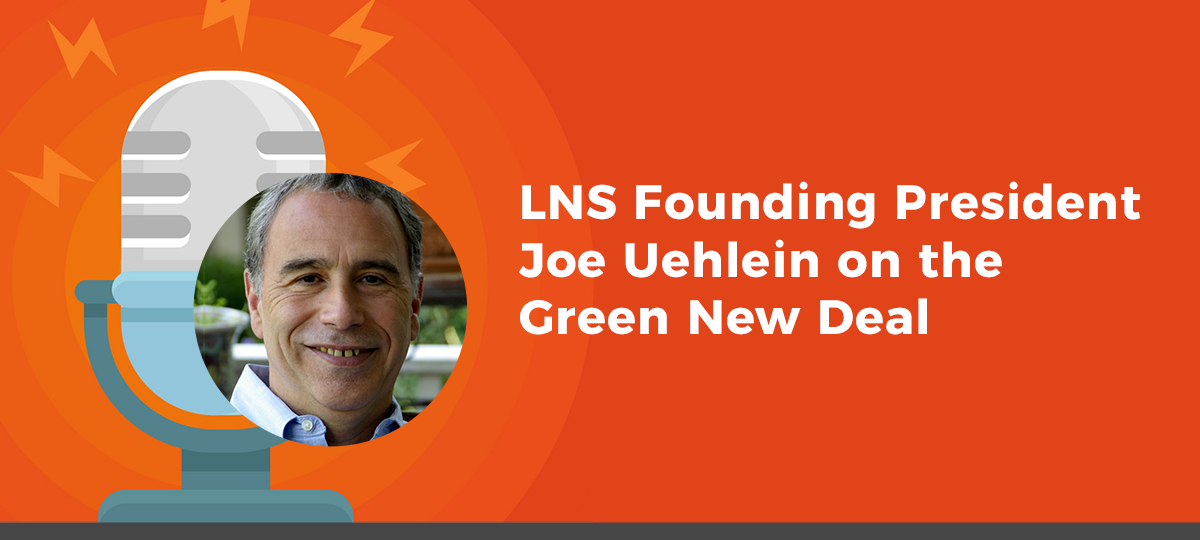
Joe Uehlein on the Green New Deal

By staff - Labor Network for Sustainability, February 2019

On Monday, February 18, 2019, Chris Bangert-Drowns, a senior reporter with WPFW, the Pacifica Radio affiliate in Washington, D.C. spoke with LNS founding president Joe Uehlein about the Green New Deal and the tepid response from some unions. Listen below.

Audio Player

Listen here.

What Do Eco-Socialists Have to Say About the Climate Movement?

By Nancy Romer - New Politics, Winter 2019

To me the role of eco-socialists is to raise transitional demands, demands that bring a broader understanding of the role of capital in creating climate change and the ways that capitalism can be challenged by working people and people most affected by the vast inequality it has created.

Two criteria seem pertinent to me:

1) How do we articulate what it will actually take to save our planet for the humans and other species? That will require a deep transformation that will include locking out at least the fossil fuel and auxiliary corporations and economy, ending wars and militarization of society, taking up a race- and gender-based liberation politics, and creating a thoroughly transforming social-service safety net that expands human development and allows people to look at the whole of society and our planet and make responsible decisions. Without that transformation, certain sectors—by job, by race, by gender, by class, by region—will continue to exert uneven and inadequate pressure on climate-based decisions.

2) How do we create mass movements, often united fronts of a wide range of people and social-political sectors, that can join together to exert power to make real change? How do we articulate demands that can bring the movements together while keeping those demands just a bit beyond the consensus, prodding the movement forward? How do we engage people in a mass-based struggle so that we begin the process of gaining the kind of power needed for the transformation described above?

I have spent much of my political life working in united fronts, organizational expressions of movements, coalitions, and so on, that put forward mass demands that raise consciousness, build power through the movements, and actually create some of the changes we need, not-quite-adequate as they may often be due to movements’ weakness. I have also been a leftist without too much of a “brand” or group of socialists that I have formally joined. Right now I am in Democratic Socialists of America and feel the broad politics of the organization is what keeps it active, muscular, and pushing. They are good comrades to the rest of the climate movement—willing to show up, picket, petition, study, strategize, and to be kind and generous comrades. They are well-respected as a relatively new activist organization in New York. DSA existed for many years before Trump, but after Trump was elected the numbers have exploded—presently up to 50,000 nationally and 5,000 in New York City. Yes, DSA pushes for publically owned and operated, 100 percent renewable, energy now or as soon as possible. Yes, they call for an end to the fossil fuel regime and for a polluters tax. Outside of the “publically owned and operated” part of the demand, these are the demands that our local climate movement has adopted. It is our job as eco-socialists to support the demands of the united front—in this case the Peoples Climate Movement and New York Renews—and push the demands further, specifically toward public power or public ownership of the new renewable energy grid. We need to articulate a fuller politics than can the united front coalitions due to their organizational support and membership, especially in the unions. That “prod” is essential for direction of the coalitions and movement.

A Green New Deal vs. Revolutionary Ecosocialism

By Wayne Price - Anarkismo, January 2, 2019

Ecosocialism: reformist or revolutionary, statist or libertarian?

The idea of a "Green New Deal" has been raised in response to the threat of climate and ecological catastrophe. Two such proposals are analyzed here and counterposed to the program of revolutionary libertarian ecosocialism.

According to the climate scientists, industrial civilization has at most a dozen years until global warming is irreversible. This will cause (and is already causing) extremes of weather, accelerating extermination of species, droughts and floods, loss of useable water, vast storms, rising sea levels which will destroy islands and coastal cities, raging wildfires, loss of crops, and, overall, environmental conditions in which neither humans nor other organisms evolved to exist. The economic, political, and social results will be horrifying.

The scientists write that humans have the technological knowledge to avoid the worst results. But this would take enormous efforts to drastically reduce the output of heat-trapping greenhouse gasses. The recent UN Intergovernmental Panel on Climate Change writes that this “would require rapid and far-reaching transitions in energy, land, urban, and infrastructure (including transport and buildings) and industrial systems…unprecedented in terms of scale.” (quoted in Smith 2018) At the least this means a rapid transition to shutting down fossil-fuel producing industries, leaving most oil, coal, and natural gas in the ground and rationing what is currently available. It means replacing them with conservation and renewable energy sources. It means drastic changes in the carbon-based-fuel using industries, from construction to manufacturing. It means providing alternate jobs and services for all those put out of work by these changes.

To the scientists’ warnings, there have been rumblings of concern from some financial investors, businesspeople (in non-oil-producing industries), and local politicians. But overall, the response of conventional politicians has been business-as-usual. The main proposals for limiting climate change has been to place some sort of taxes on carbon emissions. From liberals to conservatives, this has been lauded as a”pro-market” reform. But, as Richard Smith (2018) has explained, these are inadequate, and even fraudulent, proposals. “If the tax is too light, it fails to suppress fossil fuels enough to help the climate. But…no government will set a price high enough to spur truly deep reductions in carbon emissions because they all understand that this would force companies out of business, throw workers out of work, and possibly precipitate recession or worse.

In the U.S., one of the two major parties outright denies the scientific evidence as a “hoax.” As if declaring, “After us, the deluge,” its policies have been to increase as much as possible the production of greenhouse-gas emissions and other attacks on the environment. The other party accepts in words the reality of global warming but only advocates inadequate and limited steps to deal with it. It too has promoted increased drilling, fracking, and carbon-fuels burning. These Republicans, Democrats, and their corporate sponsors are enemies of humanity and nature, worse than war criminals.

On the Left, there have been serious efforts to take up the scientists’ challenge. Various ecosocialists and other radicals have advocated a massive effort to change the path of industrial society. This is sometimes called a “Green New Deal.” This approach is modeled on the U.S.’s New Deal of F. D. Roosevelt in the Great Depression. Its advocates also usually model their programs on the World War II industrial mobilization which followed the New Deal. (For examples, see Aronoff 2018; Ocasio-Cortez 2018; Rugh 2018; Simpson 2018; Smith 2018; Wikipedia.)

There does need to be a massive social effort to change our current technological course. A drastic transformation of industrial civilization is needed if we are (in Richard Smith’s phrase) to “save the humans,” as well as our fellow animals and plants. Nothing less than a revolution is needed. Yet I think that there are serious weaknesses in this specific approach, not least in modeling itself on the New Deal and the World War II mobilization—which were not revolutions, however romanticized. The proponents of a Green New Deal are almost all reformists—by which I do not mean advocates of reforms, but those who think that a series of reforms will be enough. They are state-socialists who primarily rely on the state to intervene in the economy and even take it over; in practice this program creates not socialism but state capitalism.

Pages

The Fine Print I:

Disclaimer: The views expressed on this site are not the official position of the IWW (or even the IWW’s EUC) unless otherwise indicated and do not necessarily represent the views of anyone but the author’s, nor should it be assumed that any of these authors automatically support the IWW or endorse any of its positions.

Further: the inclusion of a link on our site (other than the link to the main IWW site) does not imply endorsement by or an alliance with the IWW. These sites have been chosen by our members due to their perceived relevance to the IWW EUC and are included here for informational purposes only. If you have any suggestions or comments on any of the links included (or not included) above, please contact us.

The Fine Print II:

Fair Use Notice: The material on this site is provided for educational and informational purposes. It may contain copyrighted material the use of which has not always been specifically authorized by the copyright owner. It is being made available in an effort to advance the understanding of scientific, environmental, economic, social justice and human rights issues etc.

It is believed that this constitutes a 'fair use' of any such copyrighted material as provided for in section 107 of the US Copyright Law. In accordance with Title 17 U.S.C. Section 107, the material on this site is distributed without profit to those who have an interest in using the included information for research and educational purposes. If you wish to use copyrighted material from this site for purposes of your own that go beyond 'fair use', you must obtain permission from the copyright owner. The information on this site does not constitute legal or technical advice.