You are here

climate justice

Airport expansion is a racist policy

By Jo Ram - Red Pepper, November 2016

On 19 November, activists blockaded one of the key access roads to Heathrow airport with a banner saying ‘Climate Change is A Racist Crisis’. More groups had interventions planned but the police foiled their attempts. 15 arrests took place throughout the day. 100s also took part in a nearby demonstration despite heavy police presence. This action was coordinated by Rising Up! and comes a few weeks after Theresa May gave the green light to the building of a third runway at Heathrow.

For the climate and everyone who doesn’t belong to the global political elite, May’s decision doesn’t make sense. Thousands will see their home demolished to make way for the new runway. Only 15% are responsible for 70% of UK’s international flights - so airport expansion doesn’t really benefit the average person who goes on holiday once or twice a year. Plus, a large proportion of Heathrow flights are short haul, whose routes could be better serviced by improved rail infrastructure. More crucially, flying is the most emissions-intensive form of transport and the fastest growing cause of climate change. It is not possible for the UK government to expand airports and meet existing commitments on climate action.

The subtext of this decision is loud and clear: the government’s doesn’t care either about the local community, who are fiercely opposed to the expansion, or about the vast majority of the world’s population, for whom climate change is truly an existential threat.

Election of Trump clarifies the struggle for climate justice

By Nicolas Haeringer and Tadzio Müller - New Internationalist, November 11, 2016
Until Donald Trump’s electoral success, there was at least some reason to believe that the momentum was finally on the side of climate justice. After a cycle of failures and defeats, our mobilizations were finally proving to have an impact – from actions targeting infrastructures to the divestment movement, there were important successes, amplifying what seems to be the irresistible rise of a 100 per cent renewable future.

The climate summit in Paris was not Copenhagen. COP21 enabled the climate movement to enter a new stage with clearer strategic perspectives building stronger alliances among very diverse actors. COP21 (and the momentum it created) has not only changed the political landscape from a movement’s perspective. It has had an impact on the institutional sphere too. As such, this is no guarantee that world leaders will finally opt for bold climate action. But it enables us not only to demand actions but also to hold public actors accountable for decisions they’ve made. It makes our demands stronger: they’re not ‘only’ about climate anymore, but are demands for democracy, and leave us the space to defend the idea of a ‘climate state of necessity’.

Of course, these successes and progresses came with issues, doubts and debates within the movement. But we had this strong feeling that we were beginning to win: after an action this May in the East German lignite region of Lusatia, a thousand people in a circus tent shouted ‘we are unstoppable, another world is possible!’ – and meant it!

It is pretty easy, after Wednesday’s US presidential election result, to give up on hope – and consider Trump’s victory a serious setback. It is only going to be a setback if we let it be so. In that perspective, his victory ironically comes with a clarification, and a major simplification of the climate math. If Trump is to do what he said he was going to do (i.e. drill, drill and drill), it concretely means that the carbon budget for the rest of the world has in fact dropped to zero on election night.

That fact shouldn’t scare us. It is actually a very powerful and simple tool, which shows us what the next steps for the climate movement should be: if the UNFCCC process isn’t going to stop climate chaos, and if the US is being run by a madman – then the movements need to stop it themselves, and those outside of the US have to step up their game to impose fossil-fuel phase-outs everywhere. It also shows us what our solidarity with the communities at the frontline of the fight against climate change and fossil fuel extraction in the US should look like: the best way to build and show that solidarity is by freezing fossil fuel infrastructures everywhere.

To be sure: in a world where someone who claims that climate change is a ‘hoax cooked up by the Chinese’ has just been elected to what is perceived to be the most powerful office on the planet, it is not enough to simply claim that science, truth and reason now dictate how we step up our fight against the fossil fuel industry. After all, Trump’s success rested to a significant extent on the fact that he ignored established ‘truths’, and that his supporters frequently did not care that he was lying, or making utterly absurd statements about building walls and ‘making Mexico pay’ for them.

If Trump’s success is also the success of a ‘post-truth politics’, what does that mean for climate justice politics? It means that we need to leave the intellectually easy certainty of science and of ‘carbon budgets’ behind to a certain extent – science has played a huge role in shaping our movement and our successes, and there is no reason for it to cease. But the laws of physics don’t care about politics, and last night the former proved to be more powerful than the latter. In a trumped-down world, we might respond that the laws of politics don’t care about physics, that ‘truth’ as we traditionally understand it plays less and less of a role.

Trump won because his political discourse resonated with people on an affective level, that is to say: it made them feel understood and it made them feel powerful. Politics in the liberal/leftist tradition too often concerns itself with interests and truths (and then we often wonder why people vote ‘against their interests’, implying, rather arrogantly, that they have been duped by something we like to call a ‘hegemonic ideology’). But in the words of philosopher Baruch Spinoza, since people ‘are led more by passion than by reason, it naturally follows that a multitude will unite and consent to be guided as if by one mind not at reason’s prompting but through some common affect’.

If this is true – and we believe it is, all the more so in an age where neoliberal and centre-left elites have for decades used seemingly inescapable truths (‘There Is No Alternative’) as a battering ram against the historical achievements of working class movements, and where social media are producing multiple-truth-echo-chambers – then climate (justice) politics has to leave the high ground of science.

It has to recreate itself as a politics that makes people feel empowered, that starts not from carbon budgets per se, but from the struggles of those frontline communities most negatively affected, and that, quite simply put, is appealing enough to fight the racist, sexist, nativist juggernaut currently remaking the global North.

In short: we need less COP23, and more Ende Gelände; less potentially doomed fights for carbon taxes in Congress, and more effective, powerful and inclusive struggles like those against the Keystone XL or the Dakota Access pipelines – or rather, we need to embrace them and build them into one movement. Which means more organizing, more peaceful civil disobedience and less time in the political halls of the UN.

Not because the latter are wrong or bad or necessarily ineffective (though unfortunately they often are) – but because in a world where Trump is president of the US, if climate politics remain tied to reason and truth, and to global elite jamborees, it will necessarily fail.

Only a climate justice politics that exceeds the affective attractiveness of the jargon of the other side can win the fights we need to win. This is what many groups are already doing – those who are on the frontline.

The Politics of Hosting

By Daniel Voskoboynik - The Verb, November 6, 2016; Image by Hasna Lahmini

Climate summits let host governments publicise their environmental credentials, but we cannot be blind to their injustices.

This year the United Nations climate negotiations descends upon Marrakech. The stage is set for negotiators to continue their granular discussions, but also for the Moroccan government to showcase its own environmental ambition.

Praise has surrounded the Moroccan government’s audacious plans for renewable energy, which aim to generate over half of the country’s energy from wind, water and solar by 2030. In February, King Mohamed VI unveiled the first part of the world’s biggest solar energy complex in the city of Ouarzazate.

While the Moroccan government has welcomed the spotlight, the conference has also drawn attention to its more authoritarian and repressive elements.

Morocco has just experienced its most intense public protests since the Arab Spring. On 28 October, fisherman Mouhcine Fikri was crushed to death by a garbage truck compactor in the port town of Hoceima, as he tried to recover goods confiscated by the police. Activists accused police officers of ordering Fikri’s death, and civil rights associations denounced the illegality of the confiscation. Fikri’s individual case has been seen as emblematic of what is known as hogra: arbitrary abuses at the hands of the authorities.

These abuses occur in a wider context of human rights violations, corruption and impunity, in which the makhzen (the King and the royal establishment) exert decisive political control. Abuse of the rule of law by security forces is widespread.

Moroccan activists and journalists are routinely harassed or arrested. During the conference, negotiators and observers will likely be communicating through platforms such as Whatsapp, Skype and Viber. These VoIP (voice over international protocol) applications however were only recently unblocked in Morocco, and citizens fear they will be restricted once the summit concludes.

Unions Prepare for UN Climate Talks in Marrakesh

(Original PDF) The times when climate action was raised as a job killer are behind us. Ambitious emissions reduction and adaptation policies are now recognised as vital to protect jobs, people and communities from the impacts of climate change, and investment is creating jobs in renewable energy, public transit, energy efficiency in buildings, sustainable agriculture, forestry, water and more.

We are living in a time of contradictions. A minority of corporate interests intends to benefit until the last minute from a socially unfair, environmentally-damaging and undemocratic system by obstructing change. Many governments bow to these interests while austerity policies, attacks on regulation and public services remain on the same governments’ tables, even when those policies have proven to be disastrous and their countries face climate aggravated crises.

For the past years, the international trade union movement has stood strong in calling for ambition from our political leaders on climate because we all know: “there are no jobs on a dead planet”.

In 2015 government leaders from all over the world signed the Paris Agreement, which will regulate international climate action from 2020 onwards. For unions, every step that contributes to global governance in favour of rights, justice and solidarity – every investment in climate action is a welcome one. However, we are conscious that the long-term objective governments have set for themselves and our societies of “staying well below 2°C in average temperature increase, and aiming at 1.5°C”, will only be reached if concrete measures are taken to dramatically change our production and consumption patterns and if national emissions reduction objectives, in particular in developed countries, are reviewed with greater ambition, before 2018.

Reaching the agreed goals will also require governments to deliver on their climate finance commitments and agree to provide more support so that everyone can contribute to the global effort. The Paris Agreement is one step in a long journey for protecting our climate.

This is not only a matter of principle – it is a matter of need: we need ambition to trigger sustainable investments and decent jobs at a time when we face historic levels of unemployment with half of the world’s workers either unemployed or in vulnerable employment, with two in five young people in this situation.

We know millions of workers and families still depend on a fossil-fuel-based economy for their jobs and livelihoods. They have generated the energy required for today’s prosperity. Governments and employers, with workers and their unions must sit together and commit to protect our future through a just transition strategy

– a plan which guarantees decent work for all. The inclusion of a just transition in the Paris Agreement is an important first step.

Corporations who refuse to diversify their energy base instead set out to frighten workers. But fear will not deliver for working families in communities dependent on fossil fuels. Fear will just increase the costs of action and make the prospects for organising the transition we need to build together more difficult. A difficult set of challenges confront us. The imperative to make our societies compatible with all forms of life and with the restrictions of limited planetary resources must be met with national and international plans that must deliver

on social justice and prosperity for all. The decisions by global leaders to meet the sustainable development goals by 2030 with the Paris agreement chart a course to a zero poverty, zero carbon world but this journey will only be realised when people act to make it happen.

Our Poisonous Economic System Needs A Grassroots Intervention

By Taj James - The Leap, November 2, 2016

Last month, nearly two hundred nations signed on to a legally-binding global climate deal seeking to phase out the greenhouse gases known as HFCs. And this Friday, the non-binding Paris Agreement will officially enter into force for seventy-six nations, which have made voluntary pledges to keep global temperature rise below 2 degrees Celsius and if possible, below 1.5°C.

These agreements are important, but they are not enough to save us. That is because admitting a problem is only the first step. To move forward, we must also properly diagnose and get to the root of the problem.

Right now, the problem that the Earth and the people on it are facing is a potentially terminal case of fossil fuel poisoning. We have a very short time window to stop the injection of the poison into our collective body and repair the harm done over previous decades. If we do not seize this moment, the future for humanity will be relatively short and extremely painful.

While national governments are finally admitting there is a problem, they have failed to diagnose the disease accurately. As a result, they are proposing solutions that will be fatal for the patient.

Their approach is like going to tobacco companies and asking them to handle the problem of lung cancer by coming up with a new tobacco product to cure it.

Our governments are opting for false solutions: they are looking to oil companies and market-based approaches to fix a problem that oil companies and market-based approaches created. They seem to believe that banks and the fossil fuel industry are the only players powerful enough and smart enough to address this crisis.

Thankfully, people all over the world are rising up to release their governments from the grip of corporations and demand that politicians serve the future of the people and the planet. Most importantly, communities are not waiting for national governments to act. They know what the real solutions are, and they are coming together to implement them in their towns, cities, and states. We’ve seen grassroots movements stop the Keystone pipeline and bring international pressure to bear on the Dakota Access pipeline, end fracking in New York State, and put Hawaii and other states on the path to 100% clean energy.

The fight for democracy, peace, and climate justice is accelerating. It is time to join the chorus of voices insisting that national governments do their part.

We have the power to divest from climate chaos and reinvest in local democracy and flourishing. We can build the next regenerative economy and repair the harm of the current system by restoring wealth back to the communities and countries that produced it. Such efforts include The Reinvest Network, which is moving money into a democratically-governed cooperative that invests in projects owned and operated by frontline communities, in order to build economic democracy rooted in ecological integrity; the Black Land and Liberation Initiative, a trans-local, Black-led land reclamation and reparations leadership network; and support for internally displaced climate refugees that recognizes present and historical structures of racial injustice. Projects such as these are crucial for eliminating the inequality on which our extractive economy thrives.

This is not a climate movement—it’s a movement for the future of humanity.

It will take all of us to accelerate the solutions already in our hands.

The Chevron Way: Polluting California and Degrading California

By various - International Transport Federation, et. al., November 2016

In the recent election, Chevron-backed campaigns lost bigtime, despite the $61 million the company has spent to influence California elections since 2009. That’s far more than any other oil company spend in state elections. The report, by the International Transport Workers Federation, was released Nov. 17 at the Chevron gates by a coalition including the Richmond Progressive Alliance (RPA), Alliance of Californians for Community Empowerment (ACCE), Communities for a Better Environment (CBE), and more.

Members of the coalition said the report, The Chevron Way: Polluting California and Degrading Democracy, will educate the public about the corrupting influence of corporate money and alert politicians that they will be judged on whether they act in the public interest or in Chevron’s interest.

In this election, in State Assembly and State Senate races, candidates heavily backed by Chevron lost. In Monterey County, Chevron spent $1.5 to oppose a ballot measure to ban fracking and expanded oil drilling. Despite being outspent 33 to 1, the measure passed.

In Richmond, Chevron sat out this election, having spent $3 million in the last election, when its candidates lost anyway. This year, two additional progressive candidates won seats on the city council and a longstanding Chevron candidate was voted out.

Chevron makes billions in profits from its huge retail and refining business in California, but has aggressively cut tax payments to federal, state and local governments. In 2015, the company paid no net income tax in the US, but instead banked nearly $1.7 billion in tax credits.

In 2015, Chevron had over $45 billion stashed in offshore accounts, including the company’s 211 active Bermuda subsidiaries, and the company’s global effective tax rate fell to below 3%.

Read the report (PDF).

Protesters blockade mock runway outside Parliament to oppose airport expansion

By staff - Plane Stupid and Reclaim the Power, October 25, 2016

Activists have blockaded a mock runway outside Parliament to oppose airport expansion and highlight  the inequality of catastrophic climate impacts on the day a government announcement is expected.
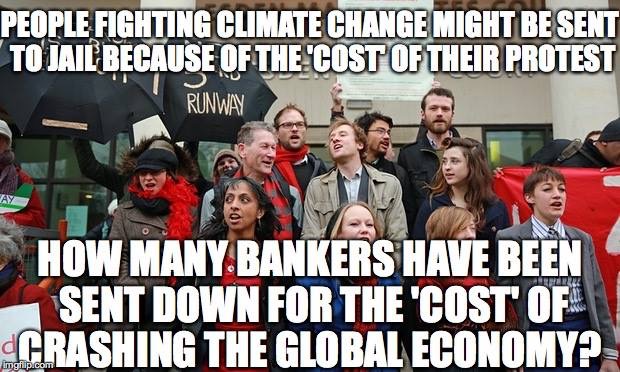
This morning, 40 Activists locked together using ‘arm tubes’ on a mock runway outside Parliament to signal their intent to continue fighting airport expansion. Air traffic controllers with “STOP” paddles lined the runway highlighting the need to stop climate change as well as noise and air pollution. Other campaigners and local residents held a banner reading “Climate Change Kills, No New Runways.”

Shona Kealey spokesperson for Plane Stupid, said,

“Two weeks ago, enough countries agreed to ratify the Paris Agreement for it to come into force. Last week, the government’s climate advisers issued a report saying reducing aviation emissions should be a priority if we’re going to honour the Climate Change Act. And now, with today’s announcement, our government proclaims to the world that we’re a dishonest and unreliable nation who can’t be trusted to keep to our international agreements or even follow our own laws, just as we’re about to renegotiate trade agreements with the whole world.

“Obedience to this government is suicide. If they think we’re going to quietly follow them over the cliff, they’re dreaming.

Speaking for Reclaim the Power, Stephanie Nicholls said,

“We can honour our commitments to tackle climate change, or we can build new runways – we can’t do both. Aviation expansion anywhere is irresponsible, and globally will impact the most on the people who’ve done least to cause the problem. Climate change is already hitting poorer communities in the global south, who are the least likely to ever set foot on a plane.

“When the government won’t follow its own rules, it’s time for normal people to step up and take action. Following today’s announcement climate activists, council leaders and local residents will be standing together to make any new runways undeliverable. If the government thinks they can override local opinion, climate science and their own commitments they’ve got another thing coming.”

Throughout the day, local residents and environmental campaigners will be in the Five Bells Pub in Harmondsworth (Harmondsworth High Street, UB7 0AQ) to demonstrate continuing opposition to airport expansion and will be available for interview. Contact: Rob Barnstone, 07806 947050.

Local residents from Gatwick CAGNE (Communities Against Gatwick Noise Emissions) will be meeting at the Plough Inn, Ifield from midday to watch the decision. Contact: Sally Pavey, cagnegatwick@gmail.com, 07831 632537.

We are expecting new direct action network Rising Up to announce escalating direct action against airport expansion following the government announcement. Contact: Simon Bramwell, 07760 556177, lawgoch2008@hotmail.co.uk.

Hundreds at Heathrow ‘die-in’ protest against airport expansion

By staff - Reclaim the Power, October 1, 2016

Hundreds of activists stage ‘die-in’ and disruptive ‘critical mass’ bike ride at Heathrow to protest aviation expansion and highlight injustice of climate change impacts.

ecology.iww.org editor's note: IWW members particopated in organizing this action.

This afternoon, over 100 people took part in a ‘die-in’ flashmob inside Heathrow terminal 2. Protesters wearing gas masks lay on the floor, as testimonies from communities already affected by climate change were read [1].

Simultaneously, a ‘critical mass’ bike ride with 150 riders wearing red [2] circled the area, visiting Harmondsworth Detention Centre to highlight the link between climate impacts and migration, and obstructing traffic by circling the main roundabout on Bath Road and dropping banners.

The action was part of a global wave of actions opposing airport expansion (including Austria, France, Mexico, Turkey), timed to coincide with a major UN conference aiming to address the emissions impact of aviation. The process has received criticism for not attempting to reduce emissions, instead focussing on controversial ‘carbon offsets’.

A ‘flash-mob’ picnic protest also happened at Gatwick this morning.

The decision on airport expansion is expected on the 11th or 18th October; with recent reports suggesting there is parliamentary support for Heathrow.

Privatization of Public Education: This Changes Everything

By Morna McDermott - Educational Alchemy, January 16, 2016

“The process of taking on the corporate-state power nexus that underpins the extractive economy is leading a great many people to face up to the underlying democratic crisis that has allowed multinationals to be the authors of the laws under which they operate …. What is a democracy if it doesn’t encompass the capacity to decide, collectively, to protect something that no one can live without” (Naomi Klein, This Changes Everything, p. 361)

I recently read Naomi Klein’s new book This Changes Everything: Capitalism vs The Climate. I was struck by how many similarities there were between the struggle to abate massive climate disaster and the current fight for public education. I think this is a good analogy because like climate change, education “reform” (aka privatization) is everywhere and nowhere. While the issues are clearly related to human and civil rights, there are no lunch counters to sit at, no visible or tangible signs of du-jure segregation. Rather … like the emissions, fracking and melting of ice caps, the erosion of public education is slow, insidious, and difficult to pin point by location or single origin. The problem feels just “too big” to tackle on some days.

I noted many marked parallels in both the nature/cause of the problem (between Klein’s book and education reform), as well as visions for a solution to both. They (ed reform and the capitalist/big oil co’s) are both “extrationist” in nature: We are mining the earth for coal, oil, natural gas, and other resources just as we are mining children’s data for profit, mining our children’s bodies as “human capital,” and mining schools of our tax dollars to line the pockets of corporations. They share an ideology of money, and the money to fund the ideology.

Fast forward to the conclusion: In order to 1) wrest public education from the hands of privatizers/corporate control ….and 2) to create PUBLIC schools that are sustainable, equitable and meaningful for all children (something we have never done before), we must be willing to completely revolutionize the way in which we think about, and act, in the world. Simple. But a tall order.

Naomi Klein says as much; that in order to truly address climate change, we must critically re-examine the entirety of the socio political and economic values embedded within a deregulated, global free- market paradigm. Ecological justice is social justice, just as education justice is tied to ecological and economic and cultural justice.

Think … lead in water in Flint MI and the effects on educational opportunities for those children.

IT’S ALL CONNECTED: The corporate interests that are driving privatization and global control of health services, access to food and water, and management of other public institutions (i.e. prisons) are the SAME corporations, using the same playbook, to dismantle public education.  And this issue is GLOBAL.

Capital Blight News #122

Compiled by x344543 - IWW Environmental Unionism Caucus, September 20, 2016

A supplement to Eco Unionist News:

Lead Stories:

The Man Behind the Curtain:

Green is the New Red:

Pages

The Fine Print I:

Disclaimer: The views expressed on this site are not the official position of the IWW (or even the IWW’s EUC) unless otherwise indicated and do not necessarily represent the views of anyone but the author’s, nor should it be assumed that any of these authors automatically support the IWW or endorse any of its positions.

Further: the inclusion of a link on our site (other than the link to the main IWW site) does not imply endorsement by or an alliance with the IWW. These sites have been chosen by our members due to their perceived relevance to the IWW EUC and are included here for informational purposes only. If you have any suggestions or comments on any of the links included (or not included) above, please contact us.

The Fine Print II:

Fair Use Notice: The material on this site is provided for educational and informational purposes. It may contain copyrighted material the use of which has not always been specifically authorized by the copyright owner. It is being made available in an effort to advance the understanding of scientific, environmental, economic, social justice and human rights issues etc.

It is believed that this constitutes a 'fair use' of any such copyrighted material as provided for in section 107 of the US Copyright Law. In accordance with Title 17 U.S.C. Section 107, the material on this site is distributed without profit to those who have an interest in using the included information for research and educational purposes. If you wish to use copyrighted material from this site for purposes of your own that go beyond 'fair use', you must obtain permission from the copyright owner. The information on this site does not constitute legal or technical advice.