You are here

climate justice

It’s heating up: ‘Unions can play a vital role in the battle for climate justice’

Anabella Rosemberg interviewed by Danny Chivers - New Internationalist, August 2016

Image: a coalition of union members oppose coal exports at an Oakland City Council meeting in July 2016; photograph by Brooke Anderson.

The climate discussion in the union movement has not been easy. We have so many more immediate struggles, from austerity crises to trade unionists being murdered. But about 10 years ago, in the ITUC Congress, we started bringing unions from the Global South to engage on climate with unions from industrialized countries. Those Southern unions described how everything they were fighting for – social protection, health, education – was being undermined by the terrible public costs of climate disasters. This put the discussion on climate in a different perspective. It wasn’t about the union movement ‘going green’, it was a basic issue of international solidarity.

Meanwhile, many root causes of climate change – greed from an unregulated corporate sector, politicians responding to lobbyists rather than citizens, energy privatization – are strongly linked to other social-inequality issues that we are struggling against. So it made sense to bring this issue into our agenda.

A third, more pragmatic reason: this is a discussion about the transformation of key industries such as energy and forestry. If we aren’t part of that discussion, we cannot expect the needs of workers to be taken into account. There’s a slogan: ‘If you’re not at the table, you’re on the menu.’

From Copenhagen to Paris: the union movement raises its voice

The Copenhagen climate talks in 2009 saw the mass international involvement of unions on climate issues for the first time. So – unlike for much of the climate movement, for whom Copenhagen was a low point – for us, those talks marked a beginning. We had a very typical union response: sometimes you lose, sometimes you win, but you keep fighting.

We went to the 2015 Paris climate talks with three key things that we wanted in the deal. One was ambition, because the impact on the majority of workers on the planet is going to be huge if we go beyond two degrees [Celsius of global warming]. The second priority was finance, with the industrialized nations providing funds for energy transition, adaptation and the cost of climate damage in the South. The third was seeing a ‘just transition’ commitment in the Paris agreement.

The Paris deal is clearly insufficient. Politicians have committed to 1.5 degrees but not to any concrete measures to make it happen. On climate finance, the Paris agreement does not contain any figures or targets. On just transition, at least there is recognition, for the first time, of the connection between environmental justice and the need to secure workers’ livelihoods, although only in the preamble, not the main text.

Breaking free from ‘jobs versus climate’

In general, the union movement acknowledges the urgency of the climate issue and salutes the courage of the activists who took part in the May 2016 ‘Break Free’ direct actions at fossil-fuel sites. However, there are also sensitivities. Many of the workers at the sites that were targeted don’t have a choice but to work in that sector; the alternatives aren’t yet there.

Companies and workers are not the same; they don’t have the same interests. If we treat them as if they are, then we are pushing them together and strengthening the companies’ position.

Actions like Break Free have a theoretical commitment to the idea of just transition, but there has not yet been real engagement with workers or unions on most of the occupied sites. No-one came and asked, ‘What do you, the fossil-fuel workers, want as an alternative for you and your communities?’ But that’s a matter of tactics; it’s normal for these kinds of actions, and it does not mean it will not happen later.

Unified in climate action

We are not expecting a massive global mobilization from unions on climate, but we’re seeing local unions taking action, for example in Canada, as part of the climate justice movement, or in Argentina against fracking. In the Philippines, after Typhoon Haiyan, we saw a huge mobilization by trade unions around climate justice and they have participated in actions, including Break Free. In Tunisia, unions are part of the movement asking for environmental justice issues to be enshrined in the constitution.

This doesn’t mean that the whole labour movement is in consensus – there are other unions, generally those that depend on short-term jobs such as construction, which may support fracking or mining if no alternative job proposals are put forward.

Because of the lack of preparation by governments for the transition to clean energy, I think we will see, sadly, an increase in conflict between environmentalists and unions. Not because our objectives are not aligned, but because there is a huge political gap in the commitment made by governments to workers, and, instead of addressing that, they are letting us fight with each other.

A good way to build dialogue is to find common ground on other issues. For example, Greenpeace US is working on electoral reform with unions, NGOs, faith groups and many others. In Europe and Latin America, unions are working with environmental groups to challenge free-trade deals. These kinds of campaigns create a space to build trust, and make it easier then to discuss difficult topics like the climate transition because you are talking to partners, not adversaries.

The landscape is moving, and on climate justice we need to be on the right side of history. In the end, it’s a question of our credibility into the future. Some unions aren’t yet on the right side for understandable reasons, such as fear, or the lack of preparation by governments, or terrible labour rights situations that prevent them from engaging. For others, it’s just self-interest. It’s basically a lack of wisdom and a lack of awareness of where our societies are going.

My hope is that the general trend in the labour movement is going strongly in the right direction. There are a lot of contradictions and difficulties – internal and external – that come with that. But I think the trend is there.

How to Stop Capitalism’s Deadly War With Nature

By Paul Street - TruthDig, September 14, 2016

So far, 2016 is the hottest year on record. So was 2015. So was 2014. (John McColgan / U.S. Department of Agriculture)

Earth scientists now know that the history of our planet has been set for some time in our current geological age, the Anthropocene. According to leading experts Will Steffen, Paul Crutzen and John McNeill, in this era, “human activities have become so pervasive and profound that they rival the great forces of Nature and are pushing the earth into planetary terra incognita. The Earth is rapidly moving into a less biologically diverse, less forested, much warmer, and probably wetter and stormier era.” We are living in a “no-analogue state” in which “the Earth system has recently moved well outside the range of natural variability.”

The new earth epoch bearing its species’ mark and name is nothing for Homo sapiens to hold up with pride. The unprecedented changes introduced by humanity are ecologically unsustainable for decent life on the planet. Thanks to the Anthropocene, the world is now in the middle of “its sixth great extinction event, with rates of species loss growing rapidly for both terrestrial and marine ecosystems. The atmospheric concentrations of several important greenhouse gases have increased substantially, and the Earth is warming rapidly,” according to Steffen et al., bringing us ever closer to the precipice of ecosystem collapse and putting prospects for a decent future at grave risk. The signs are clear to those willing to look: the melting of polar ice and Arctic permafrost, the acid bleaching of global coral reefs, the pronounced warming of the oceans, the drying out of the Amazonian rain forests. All this and more are moving at an unexpectedly rapid pace. Marked by now-predictable epic forest fires and floods, 2016 is the hottest year on record. So was 2015. So was 2014.

The terrible trends and data have led the venerable progressive political scientist and social-justice advocate Susan George to introduce what she calls “a new phenomenon in the history of humankind.” In a recent lecture to the International Centre for the Promotion of Human Rights in Buenos Aires, she names it “geocide,” meaning “the collective action of a single species among millions of other species which is changing planet Earth to the point that it can become unrecognisable and unfit for life.” Humanity, George says, “is committing geocide against all components of nature, whether microscopic organisms, plants, animals or against itself, homo sapiens, humankind.” George is unstinting in her denunciation of the human species: “Homo sapiens has only existed for roughly 200,000 years. The time we’ve spent on this planet compared to its total age is infinitesimally short, just the tiniest sliver of geological time. It amounts to a mere 0.00004 percent of Earth’s existence. And although any given species of plant or animal—vertebrate or invertebrate—tends to last on average about 10 million years, our species seems determined to cause its own extinction, along with the rest of creation, long before its allotted time.”

It’s a hard to imagine a more terrible crime. Geocide is bigger than genocide.

The Climate Crisis is a racist crisis!

By Staff - Plane Stupid, September 9, 2016

Plane Stupid supports the Black Lives Matter UK invention at City Airport earlier this week.  Developing a dialogue with, and demonstrating solidarity with communities impacted by aviation and climate change locally and internationally, has been part of the work of Plane Stupid for some time. Globally, climate change disproportionately affects people of colour.

In addition, in the case of City Airport, it is the predominantly non-white and low income community of Newham who will suffer the worst local environmental impacts from airport expansion – including noise and air pollution, leading to health problems such as heart disease, sleep disturbance, asthma, and depression - all of which can lead to early death, and compound existing health problems. By contrast, the people flying from City Airport are predominantly white, and typically have an annual salary of over £90,000.

City Airport has recently been granted permission to expand, despite the obvious contribution of this expansion to climate change, and the aggravating impact expansion will have on existing inequalities in the Newham area.

Plane Stupid believes in a just and sustainable transition to a peaceful, low carbon future. Plane Stupid is against all airport expansion, and will continue to take direct action in pursuit of this aim. Plane Stupid supports all other actions targeted against aviation where these are not inconsistent with our ethos.

Capital Blight News #121

Compiled by x344543 - IWW Environmental Unionism Caucus, September 13, 2016

A supplement to Eco Unionist News:

Lead Stories:

The Man Behind the Curtain:

Trade unions and the climate change fight

By Julie Douglas and Peter McGhee - Briefing Papers, July 5, 2016

We [unions] have to stop running away from the climate crisis, stop leaving it to the environmentalist, and look at it. Let ourselves absorb the fact that the industrial revolution that led to our society’s prosperity is now destabilizing the natural systems on which all of life dependsNaomi Klein

Climate change is perhaps the greatest existential threat humanity has ever faced. Indeed, this year is predicted to be the hottest on record since pre-industrial levels. The signing of the Paris COP21 agreement in March in 2016 behoves all countries to take urgent action to reduce carbon emissions. New Zealand is a signatory to the agreement, which clearly accepts that climate action is not the responsibility of governments alone and that all affected parties have a role in developing a response to climate change. Aside from environmental impacts from climate change there will be significant social, economic and political impacts as well. Work and workplaces, at the centre of the economy and social life, are important sites for responding to climate change. Employment is core to providing a livelihood and prospects on an individual level, and contributing to society as a whole.

There needs to be a tripartite approach to climate action in the workplace. Of the key direct stakeholders (state, employers and unions), unions represent around 18.6 percent of all workers (359,782 members) in New Zealand and therefore also constitutes our largest democratic body. A body of this size which has the structure in place to educate and organise through both the peak union body, the New Zealand Council of Trade Unions (NZCTU), and individual unions, must logically become an important partner in strategic discussions at both a government, industry and firm level.

The union movement in New Zealand has a long history of leading debate and resistance around issues of social justice, from taking a stand against Spain’s fascist Franco to refusing to assist in the loading of ships carrying New Zealand police officers to Samoa in 1929 who went on to kill many Samoans in the Mau movement. With this pedigree of social conscience and history of taking action it should follow that the union movement and its members would again rise and offer leadership to the latest challenge to social order and justice, and indeed potential catastrophic change to the planet.

Not only will jobs, occupations and industries disappear or change but the health and safety of workers will be threatened and more broadly, food and water security compromised. The initial challenge to unions then, is to see these threats as core to union work and why action is imperative to ensure their unions are ready to respond, educate members, and also to work with firms to develop strategies which allow for a just transition to a more sustainable workplace and world.  Unfortunately, such transformation does not appear to be forthcoming.

A recent study we conducted interviewed leaders from eleven of the affiliated unions to the NZCTU (representing 75 percent of all members in affiliated unions). These interviews sought information on what actions, if any, the unions had put in place to respond to climate change, and also the role they saw unions having in climate action and just transition. All of the interviewees articulated a strong personal position of concern about impending climate change and need for action. They all saw the union movement and the NZCTU as important stakeholders and leaders in the action required. However, when looking at the unions themselves the results were sobering. None were in a well-prepared position to face the future regarding climate change. Two had begun to develop some basic policies and plans but did not consider themselves in anyway ready; seven respondents indicated that they personally saw the issue as important but that their unions had done nothing in this area yet and that there were no conversations within the formal structure of their organisation about this issue; and the remaining two union respondents clearly articulated that climate change was not on their union’s radar and there was no indication this was likely to change. Across these unions only two respondents indicated that there had been interest raised by their membership.

This is a fairly bleak outlook for society especially if it places its hope of action on the largest democratic body in the country. Why are unions so unprepared? There are some identifiable reasons, but not excuses, for this. Firstly, we must look at the current socio-political environment unions operate under in New Zealand. As a result of the neo liberal paradigm shift in the 1980s and consequent legislation changes (such as the Employment Contracts Act 1991), union membership dramatically fell, and since 2008 unions have sustained a consistent undermining of rights such as workplace access. The role that unions play in the lives of workers – including their members – has narrowed as a result.

Secondly, unions’ core work is the preservation and enhancement of workers’ wages and conditions. It is for this reason that workers join unions and many of the union leaders we interviewed indicated they were concerned that a shift towards long-term social issues such as climate change could affect membership numbers. The irony being that the continued focus on the short gains of wages and conditions will be pointless if in the middle to long term members’ jobs ceased to exist. That said though, research from the US indicated that union members were more likely to be concerned with environment issues and therefore may well embrace their union engaging with climate change strategies[1]. Despite this finding, it is perhaps unsurprising that none of the unions interviewed had actively surveyed or begun widespread conversations about climate change within their unions and therefore were unaware of their members’ position or wishes on the issue. While it was true that some unions had improved sustainability measures in specific firms and, in one instance, got an organisation to divest in fossil fuel investment, this still stopped well short of a unified approach.

System justification theory postulates that human’s tend to view the wider systems on which they depend in a favourable light. As Johnson notes, upholding the status quo encourages feelings of security, purpose and relatedness through a shared reality. Unions, and their members are no different. They advocate for improved employment outcomes within a capitalist system that rewards self-interest and promotes economic growth as central to human well-being (usually at the expense of the environment). Unfortunately, climate change is a consequence of that same system. Perhaps this explains unions’ reluctance to engage in any meaningful way. To embrace climate change shifts the focus from short-term economic benefits for workers to that of uniting ‘all labouring men and women for a truly different order of things’.[2] Such a move could help unions become truly social democratic movements contributing to the flourishing of all.

[1] Vachon, T., & Brecher, J. (2016). Are union members more or less likely to be environmentalists? Labor Studies Journal. Doi:10.1177/0160449×16643323

[2] Leeson, R. (1971). United We Stand: British Trade Union Emblems (p. 32). London: Adams and Dart.

Capital Blight News #120

Compiled by x344543 - IWW Environmental Unionism Caucus, September 7, 2016

A supplement to Eco Unionist News:

Lead Stories:

The Man Behind the Curtain:

Green is the New Red:

Greenwashers:

Disaster Capitalism:

An Energy Revolution is possible: Tax havens and financing climate action

By Patrick Hearps and Sam Cossar-Gilbert - Friends of the Earth, September 2016

This report is the technical report that supports Friend of the Earth International’s summary report with recommendations and general analysis, also entitled ‘An energy revolution is possible’.

The aim of this analysis is purely to calculate an investment cost of providing several regions of the developing world with 100% renewable electricity, and to compare those amounts with government revenue lost through tax havens globally, in order to highlight the need for economic and climate justice.

Read the report (PDF).

Breathing in the benefits: How an accelerated coal phase-out can reduce health impacts and costs for Albertans

By Benjamin Israël, Kim Perrotta, Joe Vipond, Leigh Allard, and Vanessa Foran - Pembina Institute, September 2016

With the phase-out of coal power announced by the provincein November 2015, Albertans stand to avoid significant health impacts caused by coal pollution. By extension, afurtheraccelerated phase out of coal power facilities would both hastenand amplify those avoided health impacts.The health benefits and costs savings in avoided health outcomes would be significant, and should be consideredin the government’s planning of the coal phase-out from now to 2030.
While the provincial government has announced a coal phase-out, they have not yet released a transition schedule. This analysis assesses the relative benefits of an accelerated stepwise transition away from coal, as proposed by the Pembina Institute,versus the back-loaded phase-out that otheranalyses haveposited.

In 2012, when the federal government finalized its coal regulations that —in effect —reduce electricity generation from coal plants, Environment Canada(as it was called at that time)estimated considerable health impacts would be avoided, usinghighly regarded modelling techniques. Logically, thesesignificantbenefits from reducing coal necessarily mean that the use of coal for power generation causesconsiderablehealth impacts in the first place.

By extrapolating the health benefit results from Environment Canada’s analysis, this report highlights the full impact of coal-fired generation in Albertaand indicates attainable benefits associated with the province’s coal phase- out.When the federal government weakened its proposed coal regulations back in 2012 in response to lobbying from some coal generators, allowing coal plants to continue unabated longer than first proposed,it left health savings on the table. Alberta can now grasp these savings byaccelerating our transition away from coal-fired electricity.

Read the report (PDF).

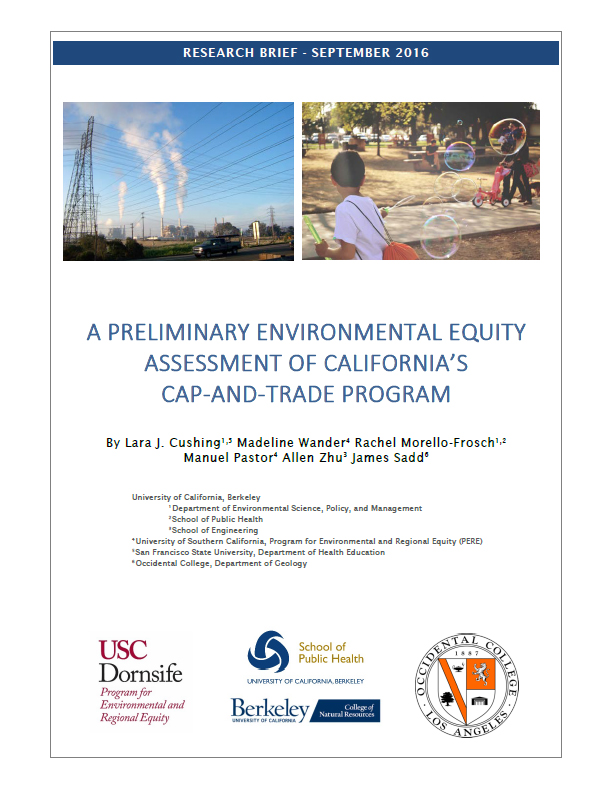
“A Preliminary Environmental Equity Assessment of California’s Cap-And-Trade Program

By Rachel Morello-Frosch, Manuel Pastor, James Sadd, Lara Cushing, Madeline Wander, and Allen Zhu - California Environmental Justice Alliance, September 2016

California’s cap-and-trade program is a key strategy for achieving reductions in greenhouse gas (GHG) emissions under AB32, the California Global Warming Solutions Act. For residents living near large industrial facilities, AB32 offered the possibility that along with reductions in GHGs, emissions of other harmful pollutants would also be decreased in their neighborhoods. Carbon dioxide (CO2), the primary GHG, indirectly impacts health by causing climate change but is not directly harmful to health in the communities where it is emitted. However, GHG emissions are usually accompanied by releases of other pollutants such as particulate matter (PM10) and air toxics that can directly harm the health of nearby residents.

In this brief, we assess inequalities in the location of GHG-emitting facilities and in the amount of GHGs and PM10 emitted by facilities regulated under cap-and-trade. We also provide a preliminary evaluation of changes in localized GHG emissions from large point sources since the advent of the program in 2013. To do this, we combined pollutant emissions data from California’s mandatory GHG and criteria pollutant reporting systems, data on neighborhood demographics from the American Community Survey, cumulative environmental health impacts from the California Environmental Protection Agency’s CalEnviroScreen tool, and information from the California Air Resources Board (CARB) about how regulated companies fulfilled their obligations under the first compliance period (2013-14) of the cap-and-trade program. Our methodology is described in greater detail in the appendix to this report.

In this analysis, we focus primarily on what are called “emitter covered emissions,” which correspond to localized, in-state emissions (derived mostly from fossil fuels) from industries that are subject to regulation under cap-and-trade. The cap-and-trade program also regulates out-of-state emissions associated with electricity imported into the state and, beginning in 2015, began regulating distributed emissions that result from the burning of fuels such as gasoline and natural gas in off-site locations (e.g., in the engines of vehicles and in homes).

We found that regulated GHG-emitting facilities are located in neighborhoods with higher proportions of residents of color and residents living in poverty. In addition, facilities that emit the highest levels of both GHGs and PM10 are also more likely to be located in communities with higher proportions of residents of color and residents living in poverty. This suggests that the public health and environmental equity co-benefits of California’s cap-and-trade program could be enhanced if there were more emissions reductions among the larger emitting facilities that are located in disadvantaged communities. In terms of GHG emission trends, in-state emissions have increased on average for several industry sectors since the advent of the cap-and-trade program, with many high emitting companies using offset projects located outside of California to meet their compliance obligations. Enhanced data collection and availability can strengthen efforts to track future changes in GHG and co-pollutant emissions and inform decision making in ways that incentivize deeper in-state reductions in GHGs and better maximize public health benefits and environmental equity goals.

Read the report (PDF).

Capital Blight News #119

Compiled by x344543 - IWW Environmental Unionism Caucus, August 31, 2016

A supplement to Eco Unionist News:

Lead Stories:

The Man Behind the Curtain:

Greenwashers:

Disaster Capitalism:

Other News:

For more green news, please visit our news feeds section on ecology.iww.org; Twitter #IWWEUC; Hashtags: #greenunionism #greensyndicalism #IWW. Please send suggested news items to include in this series to euc [at] iww.org.

Pages

The Fine Print I:

Disclaimer: The views expressed on this site are not the official position of the IWW (or even the IWW’s EUC) unless otherwise indicated and do not necessarily represent the views of anyone but the author’s, nor should it be assumed that any of these authors automatically support the IWW or endorse any of its positions.

Further: the inclusion of a link on our site (other than the link to the main IWW site) does not imply endorsement by or an alliance with the IWW. These sites have been chosen by our members due to their perceived relevance to the IWW EUC and are included here for informational purposes only. If you have any suggestions or comments on any of the links included (or not included) above, please contact us.

The Fine Print II:

Fair Use Notice: The material on this site is provided for educational and informational purposes. It may contain copyrighted material the use of which has not always been specifically authorized by the copyright owner. It is being made available in an effort to advance the understanding of scientific, environmental, economic, social justice and human rights issues etc.

It is believed that this constitutes a 'fair use' of any such copyrighted material as provided for in section 107 of the US Copyright Law. In accordance with Title 17 U.S.C. Section 107, the material on this site is distributed without profit to those who have an interest in using the included information for research and educational purposes. If you wish to use copyrighted material from this site for purposes of your own that go beyond 'fair use', you must obtain permission from the copyright owner. The information on this site does not constitute legal or technical advice.

