You are here

green unionism

Declaration of the Launching Congress of the South African Federation of Trade Unions (SAFTU)

By staff - Trade Unions For Energy Democracy, April 23, 2017

The South African Federation of Trade Unions (SAFTU) has been born. We have passed a milestone in the history of the South African trade union movement at this Launching Congress held in Boksburg from 21-23 April 2017.

700,000 workers represented by 1,384 voting delegates from 24 unions and other non-voting unions have taken the first decisive step to building a new, vibrant, independent, and democratic workers’ federation, leading the struggle against exploitation, mass unemployment, poverty, inequality and corruption and taking up the struggle for the total emancipation of the working class from the chains of its capitalist oppressors.

Delegates formally adopted the name, logo and colours of red, black and gold. A constitution was adopted and a Report from the Steering Committee which  spelt out the way forward for the coming period, and endorsed the principles adopted by the Workers Summit on 30 April 2016.

We are building a fundamentally different type of workers’ organisation – independent of political parties and employers but not apolitical, democratic, worker-controlled, militant, socialist-orientated, internationalist, Pan Africanist from a Marxist perspective and inspired by the principles of Marxism-Leninism. 

Our historic mission is to rapidly build a united mass force of workers, which will transform their lives and pave the way for the transformation of society as a whole from one based on the greed of a rapacious capitalist elite to one run for the benefit of the working class and all the people of South Africa and the world.

But time is not on our side. Unless we urgently mobilize our forces to confront the quadruple challenge of unemployment, poverty, inequality and corruption and revive the trade union movement, turn the tide and fight back against their appalling conditions of life, we shall slide into a new age of barbarism, and even worse exploitation of the working class and the poor. 

Towards a Progressive Labor Vision for Climate Justice and Energy Transition

By Sean Sweeney and John Treat - Trade Unions for Energy Democracy, June 2, 2017

Discussion document submitted to Labor for Our Revolution (LFOR):

This memorandum proposes an analysis and provisional framework around which to construct an ambitious and effective agenda for progressive labor to respond to the converging environmental crises, and to pursue a rapid, inclusive approach to energy transition and social justice.

Such an agenda could serve to bring a much-needed independent union voice to policy and programmatic debates on climate change and energy within Our Revolution spaces and processes. Labor’s voice in these debates frequently echoes the large energy companies on one side, or the large mainstream environmental NGOs on the other.

Unions that supported Bernie, alongside other union locals and individual leaders and activists who participate in Labor for Our Revolution (LFOR), understand that we cannot afford to regard environmental issues and climate change as peripheral concerns situated outside of labor’s “core agenda.” This is not the place to review the science, but recent assessments from climate scientists, already sobering, have become increasingly grave. The health impacts of rising airborne pollution and warming temperatures already cut short the lives of millions on an annual basis, and will increasingly do so without a major change in direction.

Importantly, a global movement has emerged that today challenges the destructive trajectory of “business as usual.” This is a movement that progressive labor in the US can work with and should support.

Progressive labor can and should articulate a clear alternative to the anti-scientific, “energy superpower” agenda being advanced by Trump—an alternative that can help build and strengthen alliances with the climate and environmental justice movements. Progressive unions are already involved in Labor Network for Sustainability (LNS) and / or Trade Unions for Energy Democracy (TUED); both LNS and TUED bring significant experience and capacity, and can serve as platforms for expanded and accelerated collaboration and programmatic work.

Many would agree that progressive labor’s approach must be science-based and internationalist. It must aspire to be socially and economically transformative, and must be able simultaneously to inspire and mobilize union members, and provide a basis for durable, effective alliances with other social movements. This, then, is our starting point.

At the same time, progressive labor’s approach must recognize that incremental efforts to “move the needle” are no longer sufficient. For this reason, such an approach must also be built around clear programmatic commitments that are evidence-based, grounded in a realistic assessment of the urgency, and commensurate to the task.

Capitalism Is Killing the Earth: An Anarchist Guide to Ecology

By JohnWarwick, et. al. - Anarchist Federation, 2018

We are in a period of crisis that we in MEDCs cannot yet see. The signs are there if you look hard enough but at the moment the water is still flowing, the crops are still reliable the ski lifts are still running. The first wave of climate refugees are trying to make their way into Europe but they are being dismissed as "economic migrants" or those displaced by war. In all likelihood, MEDCs will not feel the effects of climate change for some time; our relative wealth will push the impacts onto those who haven't the means to adapt or whose local climates were less temperate to begin with. The longer we wait to act, however, the bigger the coming crunch will be.

Collectively, MEDCs are responsible for the overwhelming majority of cumulative carbon emissions and will have to radically change their energy and transport systems if an ecological disaster is to be avoided. Who will bear the brunt of the costs and who will get rich from this process is sadly predictable. The working class in MEDCs and most people in LEDCs will pay for the fossil fuel addiction and growth-at-all-costs model of the capitalist system. We have already begun to see this happen in the black, working-class communities devastated by natural disasters in the USA and flooding killing thousands in Bangladesh.

Capitalism relies on constantly increasing accumulation of profits. This has been achieved historically by appropriations (a polite term for thefts) both internal and external to the nation state. Internally, in Europe from the fifteenth century onwards, this has followed the model of stealing common land from the people to create a proletarian class dependent on wage labour to support itself. Externally, this expansion was tied to a move outside Europe's borders to exploit natural resources and labour in other locations. Thus colonialism and capitalism were, from the beginning, linked to processes of resource extraction and accumulation.

Capitalism is now in crisis; with so few areas beyond its reach, there are no easy sources of growth to appropriate, and the ability of the earth's ecosystems to accommodate further growth is being seriously questioned. How then to continue growth and profit? In MEDCs, we are seeing a fresh attack on workers? rights, with more precarious jobs, lower pay and poorer social care. In LEDCs, the neoliberal development model is pushed with privatisation and financial deregulation extracting the most profit for the capitalists.

We write this pamphlet to discuss the environmental problems that capitalism has created, with a focus on climate change and the false solutions offered up to us. There has been wider understanding of environmental issues since mainstream publications such as Silent Spring, Gaia and An Inconvenient Truth; however, an anti-capitalist critique has been lacking.

Read the report (PDF).

The Plan (Documenatary)

By Steve Sprung - The Plan, May 2018

Full Length Version:

THE PLAN is a two-part film essay - Part 1 (120mins) Part 2 (90mins). It tells the story of the Lucas workers alternative plan in the context of its time and in relation to the challenges we face today.

The two parts are suitable for screening together, with an intermission, or on consecutive occasions.

Richmond IWW May Day Platform

By Joe Sabo - Richmond IWW, April 25, 2018
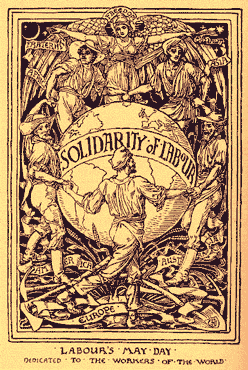
May Day in Richmond this year has been organized as a celebration of working people and worker’s power. We will meet at Abner Clay park in Richmond at 5pm for a people’s banquet, music, comradery and other awesome events! This celebration has been collectively organized by the Richmond chapters or Organizing for a Free Society, Democratic Socialists of America, and the Richmond IWW General membership branch.

The following platform was penned collectively by the various representatives of each of the aforementioned groups and has been approved via consensus:

May 1st is International Workers’ Day. Unlike other holidays, it is not a day to commemorate bloody wars for empire. It is not a day for shopping. May Day is a day for the vast majority of us who must labor for the profit of a tiny minority. May Day is a day without borders, where workers of all countries unite in celebration of our collective potential and power, recognizing the capitalist bosses and their state as our common enemy, and liberation as our common goal. May Day is a day to reconnect with a more sustainable form of existence, for workers to share in the abundant harvest that is the product of our collective social labor.

May Day is widely celebrated throughout the world with protests, boycotts, sabotage, and strikes against a system of exploitation: it is a day without work. May Day is not recognized as a holiday by the rulers of the USA, though it originates in our country. However, despite this lack of “official” recognition, working people have always celebrated May Day. Before the capitalists kicked the peasantry off the land and privatized every aspect of our lives, May Day was a day to celebrate the fertility and abundance of the earth with communal singing, dancing, loving, eating, and drinking.

After capitalism began to spread its reach throughout the world, May Day became a day of working class resistance: on May 4, 1886, immigrant workers in Chicago went on strike for the eight-hour day, better working conditions, and higher pay. In response, the government arrested and executed 7 working class activists – the Haymarket Martyrs – in 1887. Since then, anti-capitalist workers have chosen the 1st of May to commemorate and continue their struggle for liberation. On May Day 2006, when millions of immigrant workers went on strike against workplace injustice and racist immigration policies in the USA, we were once again reminded of the real spirit of May Day.

May Day 2018 is a day of struggle against fascism and imperialism, and a day of celebration to affirm the value of life against the killers of the earth. We mobilize on May Day against white supremacy and in defense of Black Lives, Muslims, immigrants, and all indigenous people and people of color. We mobilize on May Day against mass incarceration and in defense of prison abolition. We mobilize on May Day against heteropatriarchy and in defense of queer and trans lives and reproductive freedom. We mobilize on May Day against the capitalist exploitation of the working class, against slavery and unpaid labor, and against the destruction of our environment. We mobilize on May Day because another world is possible.

Our goal is to foster collaboration among the multiple autonomous organizations and projects operating in the city of Richmond, Virginia. We hope that May Day can be an opportunity for horizontal exchange of diverse ideas and experiences, and to form bonds based on common affinities and commitment to revolutionary struggle.

Unions in the Americas call for “Energy Sovereignty and Democratization”

By Sean Sweeney - Trade Unions for Energy Democracy, June 3, 2014

Disclaimer: The views expressed here are not the official position of the IWW (or even the IWW’s EUC) and do not necessarily represent the views of anyone but the author’s.

The Trade Union Confederation of the Americas (TUCA)  has released a major policy instrument, the Development Platform for the Americas (English version here) or Plataforma de Desarrollo de las Americas (PLADA).  Spanish original is here. The report was released in Santiago, Chile, at a meeting with Chilean president Michelle Bachelet on May 6 in the presence of more than 5,000 trade unionists and friends.

The year-long process of discussion and debate leading to the launch of PLADA reflects growing support among unions and social movements for democratic control of energy and other strategic sectors as well as the need for governments to halt the for-profit exploitation of the commons.

TUCA is the largest regional workers´ organization in the Americas.  It represents more than 50 million workers belonging to 53 national trade union organizations based in 23 countries. TUCA is the regional structure of the International Trade Union Confederation. A number of TUCA affiliates participate in TUED, from Argentina, Canada and the United States.

PLADA calls on the region’s various social and political forces to “work together to build alternatives in the battle for a new hegemony.” The document is structured around four pillars or dimensions – political, economic, social and environmental – which will be geared towards achieving sustainable development.

Why Unions Need to Join the Climate Fight

By Naomi Klein, September 3, 2013. Source: Naomi Klein

Disclaimer: The views expressed here are not the official position of the IWW (or even the IWW’s EUC) and do not necessarily represent the views of anyone but the author’s.

Naomi delivered the following speech on September 1, 2013 at the founding convention of UNIFOR, a new mega union created by the Canadian Autoworkers and the Canadian Energy and Paper Workers Union.

I’m so very happy and honoured to be able to share this historic day with you.

The energy in this room – and the hope the founding of this new union has inspired across the country – is contagious.

It feels like this could be the beginning of the fight back we have all been waiting for, the one that will chase Harper from power and restore the power of working people in Canada.

So welcome to the world UNIFOR.

A lot of your media coverage so far has focused on how big UNIFOR is – the biggest private sector union in Canada. And when you are facing as many attacks as workers are in this country, being big can be very helpful. But big is not a victory in itself.

The victory comes when this giant platform you have just created becomes a place to think big, to dream big, to make big demands and take big actions. The kind of actions that will shift the public imagination and change our sense of what is possible.

And it’s that kind of “big” that I want to talk to you about today.

A Green New Deal for Agriculture

Raj Patel and Jim Goodman - Jacobin, April 4, 2019

The food system is breaking the planet. Nearly a quarter of anthropogenic greenhouse gases are driven by how we eat, and it’s impossible to tackle climate change without transforming agriculture. So the Green New Deal is wise to call for “a more sustainable food system that ensures universal access to healthy food.” Better yet, Alexandria Ocasio-Cortez and Ed Markey’s proposal includes a call to work “collaboratively with farmers and ranchers in the United States to remove pollution and greenhouse gas emissions from the agricultural sector.”

This has the makings of a bonanza for rural America. Healthy food costs more and is harder to access than processed food. Under a Green New Deal that helped Americans eat better, more cash might flow back to the land. And if the federal government were paying more for better food, and understood that well-managed soil can sequester carbon, sustainable farming might be a way to end America’s rural poverty.

Yet almost as soon as the Green New Deal was released, members of the American Farm Bureau criticized the proposal as misguided and uninformed. Early in March, the National Farmers Union, one of the more left-leaning of the large farm organizations, snubbed the Green New Deal for not recognizing “the essential contribution of rural America.” And the recent Senate vote united fifty-seven members of the chamber in opposition. So, why the haters in farm country?

Of course, not all farmers are conservative. Nor is everyone living in rural America a farmer. Farmers carried Jimmy Carter to the White House in 1976. Farmers and others active in America’s rural social movements have written enthusiastically about the Green New Deal and its possibilities for family farms, about how it might spur things like rural repopulation, new farm pricing models, and climate-friendly agriculture. But those ideas are written against what the Italian thinker Antonio Gramsci called “hegemony.

A key idea in Gramsci’s work on hegemony is that of a historic bloc, a coalition that licenses and polices a dominant social order. The power within that bloc extends beyond brute force — it tries to establish dominance at the level of “common sense,” styling ideas of what’s socially acceptable and what’s unthinkable. The dominant historic bloc in the United States today is an assembly of property owners, fossil fuel corporations, war-makers, tech giants, media outlets, health care management firms, industrialists, monopolists, and financiers, but involves cultural leadership from some workers and farmers. The reflexive criticism of the Green New Deal, before its details have even been hashed out, is an indicator of the bloc’s hegemony.

The Green New Deal’s success depends on refashioning this common sense. To rewrite common sense is to unpick the alliances that the current bloc works to maintain, to find the fault lines that can pry that bloc apart, and to develop the organizational links that can build a counter-hegemonic bloc. To do that, it’s worth understanding the source of some of the most important alliances in the current configuration of forces in America’s food system: the first New Deal.

The original New Deal today appears as a miracle, an incredible moment in which the nation stood united behind Keynesian policy to accomplish big things. Yet they were achieved not because the nation united behind them, but because the nation was profoundly divided. The New Deal was a project precipitated by class struggle, and is best understood as a series of victories and defeats in the management of that struggle by an anxious bourgeoisie, across rural and urban America.

Pages

The Fine Print I:

Disclaimer: The views expressed on this site are not the official position of the IWW (or even the IWW’s EUC) unless otherwise indicated and do not necessarily represent the views of anyone but the author’s, nor should it be assumed that any of these authors automatically support the IWW or endorse any of its positions.

Further: the inclusion of a link on our site (other than the link to the main IWW site) does not imply endorsement by or an alliance with the IWW. These sites have been chosen by our members due to their perceived relevance to the IWW EUC and are included here for informational purposes only. If you have any suggestions or comments on any of the links included (or not included) above, please contact us.

The Fine Print II:

Fair Use Notice: The material on this site is provided for educational and informational purposes. It may contain copyrighted material the use of which has not always been specifically authorized by the copyright owner. It is being made available in an effort to advance the understanding of scientific, environmental, economic, social justice and human rights issues etc.

It is believed that this constitutes a 'fair use' of any such copyrighted material as provided for in section 107 of the US Copyright Law. In accordance with Title 17 U.S.C. Section 107, the material on this site is distributed without profit to those who have an interest in using the included information for research and educational purposes. If you wish to use copyrighted material from this site for purposes of your own that go beyond 'fair use', you must obtain permission from the copyright owner. The information on this site does not constitute legal or technical advice.