You are here

green unionism

An Open Letter to Developer Phil Tagami

By Ted Franklin - No Coal in Oakland, April 7, 2017; image by Brooke Anderson

On Saturday, April 8, the Alameda Labor Council will sponsor a Labor, Climate & Jobs Forum with plenary and workshop sessions devoted to how Unions are addressing climate and environmental challenges by organizing workers and communities.  Speakers will include Josie Camacho, executive secretary-treasurer, Alameda Labor Council; Kathyrn Lybarger, president, California State Federation of Labor; Cesar Diaz, State Building and Construction Trades Council; and Carol Zabin, UC Berkeley Labor Center Green Economy Program.

The Forum follows the Labor Council’s pathbreaking support for the No Coal in Oakland campaign.  In September 2015, in one of the first actions by any labor council in the United States to oppose a developer’s plans on environmental grounds, the Alameda Labor Council passed a resolution calling on Mayor Libby Schaaf, the Oakland City Council, and the project developers “to reject the export of coal through the Oakland Global project, to not take funds from Utah to secure use of the terminals for coal, and to execute a binding agreement or adopt an ordinance that will bar export of coal from this public land.”

With strong support from Labor, faith, environmental, and community organizations, the Oakland City Council banned the storage and handling of coal in the City of Oakland by adopting an ordinance prohibiting bulk storage and handling of coal within Oakland’s city limits.

The City supported its decision by reviewing extensive evidence of serious local health and safety impacts that would result from locating a large coal export facility in West Oakland as well as disastrous effects on global climate that would result from burning the vast quantities of coal that would be shipped overseas.

Building Trades Activists Stand Up to Trump

By Dan DiMaggio - Labor Notes, April 05, 2017

When they heard President Donald Trump would address the Building Trades national legislative conference, activists from Electrical Workers (IBEW) Local 569 knew they had to do something.

“We couldn’t let him come and speak to us and just sit there,” said William Stedham, a “workaday Joe” and executive board member of the San Diego-based local. “If we hadn’t, everyone would think that the Building Trades was on board with him 100 percent, and we’re not.”

So a few minutes into his speech, six of them stood up with signs that said “Resist” and turned their backs on the billionaire-in-chief. The gesture flew in the face of a directive from Building Trades leadership that attendees should “be on their best behavior.”

Demonstrators included the political director and business manager of Local 569 as well as the president and political director of the San Diego Building Trades.

San Diego activists are hot about Trump’s decision to appoint a top lobbyist from the anti-union Association of Building Contractors to a key role on his incoming Department of Labor team.

They’re also furious that former Heritage Foundation staffer James Sherk is now the White House Domestic Policy Council’s labor and employment adviser. Sherk has written a seemingly infinite number of articles attacking union workers. A sample: frequent pieces attacking minimum wage increases, an argument in favor of requiring unions to be re-certified every two to four years a la Scott Walker’s Wisconsin, and a report titled “Right to Work Increases Jobs and Choices.”

“The things we’ve been fighting hard for—more project labor agreements, more local-hire agreements, and better training and workplace safety—none of them are being supported by the Trump administration,” says Gretchen Newsom, political director of Local 569.

'No Is Not Enough': Naomi Klein Writing Anti-Trump Blueprint for 'Shock Resistance'

By Andrea Germanos - Common Dreams, April 05, 2017
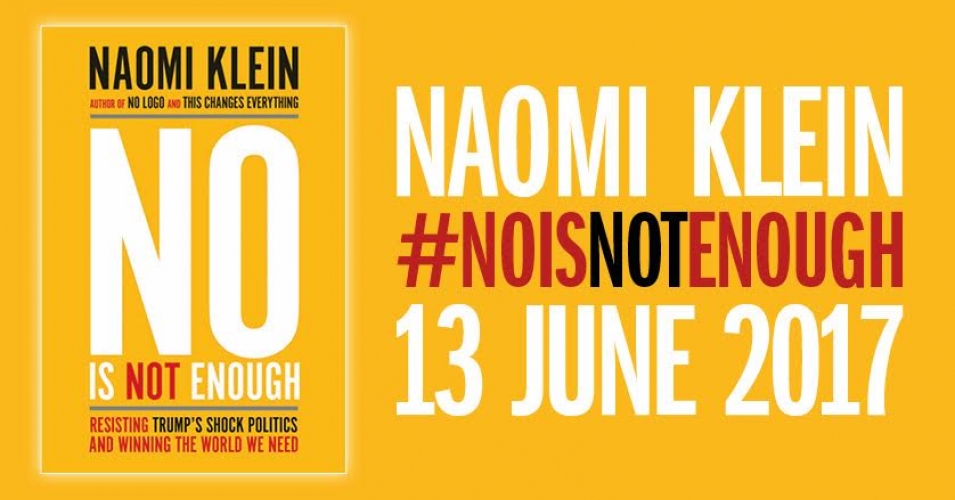
How did a man like Donald J. Trump get to be president? And how on earth can his dangerous agenda be fought?

For those burning questions, a forthcoming book described as "the toolkit for shock resistance" could well be an indispensable resource.

Authored by award-winning author and investigative journalist Naomi Klein, the book, No Is Not Enough: Resisting Trump's Shock Politics and Winning the World We Need, will publish in the U.S. on June 13, 2017.

"Trump is extreme, but he's not a Martian," writes Klein. "On the contrary, he is the logical conclusion to many of the most dangerous trends of the past half century. He is the personification of the merger of humans and corporations—a one-man megabrand, with wife and children as spin-off brands."

A website for No Is Not Enough says the book

reveals, among other things, how Trump's election was not a peaceful transition, but a corporate takeover, one using deliberate shock tactics to generate wave after wave of crises and force through radical policies that will destroy people, the environment, the economy, and national security. This book is the toolkit for shock resistance, showing all of us how we can break Trump's spell and win the world we need.

In the wake of Trump's election, Klein, while accepting the 2016 Sydney Peace Prize, also offered her thoughts on the factors that paved the way for the real estate mogul's rise to power and the strategies needed for a movement to rise against Trump (as well as other Trump-esque figures).

"If there is a single overarching lesson in the Trump victory, perhaps it is this: Never, ever underestimate the power of hate, of direct appeals to power over the 'other'...especially during times of economic hardship," she said.

Another takeaway, she continued, is that "four decades of corporate, neoliberal policies and privatization, deregulation, free trade, and austerity" have ensured ongoing economic pain and in turn, enabled the rise of faux-populists like Trump.

An additional lesson is that "only a bold and genuinely re-distributive agenda has a hope of speaking to that pain and directing it where it belongs—the politician-purchasing elites who benefited so extravagantly from the auctioning off of public wealth, the looting of our land, water, and air, and the deregulation of our financial system."

"If we want to defend against the likes of Donald Trump—and every country has their own Trump—we must urgently confront and battle racism and misogyny in our culture, in our movements, and in ourselves. This cannot be an afterthought, it cannot be an add-on. It is central to how someone like Trump can rise to power."

Klein, whose other works include No Logo, This Changes Everything, and The Shock Doctrine, also recently joined The Intercept as a senior correspondent. There, she is tasked with monitoring the "shocks of the Trump era." Days after Trump's inauguration, she wrote that his administration

can be counted on to generate a tsunami of crises and shocks: economic shocks, as market bubbles burst; security shocks, as blowback from foreign belligerence comes home; weather shocks, as our climate is further destabilized; and industrial shocks, as oil pipelines spill and rigs collapse, which they tend to do, especially when enjoying light-touch regulation.

All this is dangerous enough. What's even worse is the way the Trump administration can be counted on to exploit these shocks politically and economically.

This is the first time one of Klein's books will be published by the independent, Chicago-based Haymarket Books, which has delivered works by esteemed authors including Noam Chomksy, Howard Zinn, Keeanga-Yamahtta Taylor, and Winona LaDuke.

How the Democrats Lost West Virginia and the Coal Miners To Trump

By Les Leopold - Common Dreams, April 7, 2017

“C’mon, fellas. You know what this is? You know what this says? You’re going back to work.” ― Donald Trump on signing an executive order to reverse the Obama Administration’s rules on coal, March 28, 2017.

Lyndon Baines Johnson in 1964 buried Barry Goldwater in West Virginia, 67.9 percent to 32.1 percent. By 2016, Trump completely reversed that landslide by defeating Hillary Clinton 67.9 percent to 26.2 percent. What happened to turn such a deep blue state into flaming red?

The Democratic Party establishment has a simple explanation: West Virginians are so hung up on cultural issues like guns, gays, abortion and their mythical self-image as “coal country” that they vote against their own material interests. They seem impervious to the fact that they are major beneficiaries of Obamacare and Medicaid. They don’t seem to notice that health care jobs far exceed coal-related jobs which have been decimated by new technologies, and market competition from natural gas and renewables.

As New York Times columnist Paul Krugman recently writes, “So West Virginia voted overwhelmingly against its own interests. ....Coal country residents.... were voting on behalf of a story their region tells about itself, a story that hasn’t been true for a generation or more.”

The Wrong Way to Debunk Trump’s Pipeline Jobs Claims

By Kate Aronoff - In These Times, March 29, 2017

There’s a right and a wrong way to debunk the right-wing myth about jobs and the environment. As a refresher, here are the basics of that myth: Jobs in the extractive industry are an invaluable engine of job creation and a key driver of economic growth. People concerned about the environment want to kill projects, like the Keystone XL and Dakota Access pipelines, that would provide jobs and help stimulate the economy.

If you’re reading this, you probably already know that argument is wrong. Jobs in the U.S. clean energy industry—itself a very small sector—outnumber jobs in the fossil fuel industry 5 to 1, according to a recent report from the Department of Energy. What’s more, renewable energy has the potential to create millions of jobs in the future, which would make that type of employment dwarf even the bloated jobs figures the White House cites in defense of fossil fuels.

But here’s how not to dispel fossil fuel industry talking points: noting the disparity between part-time and full-time construction jobs. Since the Keystone XL’s permit was approved by the State Department last Friday, a number of outlets—including those with a specifically environmentalist bent—re-upped a statistic that made the rounds before the project was squashed back in 2015, stating that the project will create just 35 permanent jobs. The State Department estimates that the Keystone XL pipeline will create some 42,000 direct and indirect jobs, 50 of which will be permanent. Fifteen of the 50 jobs are temporary contracts, leaving just 35 people with ongoing jobs maintaining the pipeline. This line of argument contends the fact that so few of these positions are permanent means that Trump’s jobs argument is an elaborate rouse.

Here’s the problem: All construction jobs are temporary. When you construct something, it is eventually built. Workers in the building trades might work on several projects in a given year, and part of what building trades unions do is set up the people they represent with projects.

Talking points about permanent versus temporary jobs aren’t just bad because they stand to make the people spouting them sound grossly out of touch with working people. Jobs building wind turbines and sea walls and installing solar panels are also often temporary jobs. And that’s okay!

Making sure they’re good ones is another matter. Because of long-standing and union-negotiated norms in the building trades, the unionized workers who build pipelines tend to bring home good money and benefits, sometimes making as much as six figures in a year. Building trades and their workers, then, aren’t being somehow duped by Trump about these figures. The pipeline will create new jobs for their members, who, by and large, will be happy to work them.

But as Bryce Covert points out in The Nation, mining, manufacturing and construction jobs together account for less than 13 percent of jobs in the United States. More than 80 percent of workers are housed in the service sector. The clean energy sector is creating jobs at a remarkable rate, and there’s plenty of other work that is just as low carbon—and happens to be in some of the fastest growing parts of the economy. Teachers and nurses don’t emit massive amounts of carbon into the atmosphere. Their professions are (relatively) heavily unionized, but wages in other, non-unionized parts of the service sector remain pitifully low—an industry standard being fought tooth and nail by the Fight for $15 campaign.

So don’t fact-check the Keystone jobs line on the basis that the jobs aren’t permanent. Ask why Trump isn’t fueling high-paying, union job growth in the sectors where most Americans work and that are already creating jobs.

Green Jobs and Intergenerational Justice: Trump’s Climate Order Undermines Both

By Dana Drugmand - Common Dreams, March 30, 2017

With the stroke of a pen, President Trump has written off both the biggest economic development opportunity of the twenty-first century, and the security of today’s young people, future generations and the other species inhabiting this planet. Or so it seems.
The White House’s “Energy Independence Executive Order” is clearly a blow to the progress made under the Obama Administration to fight climate change and transition from fossil fuels to a clean energy economy. The new Order aims to rescind the Clean Power Plan, lift a moratorium on coal mining on federal land and roll back regulations on methane emissions from oil and gas fields. It comes on the heels of Trump’s official approval of the controversial Keystone XL pipeline. These actions are supposedly meant to boost jobs, but the only thing they actually boost is the already enormous share of fossil fuel profits.

A review of the numbers indicates that this is indeed not about jobs. Keystone XL, for example, would result in only 35 long-term jobs post-construction, according to State Department analysis. By contrast, the wind power industry employed 88,000 Americans at the start of 2016, and wind power technician is now the fastest growing profession in the nation. In electric power generation, solar provides more jobs than coal, oil and natural gas combined. According to an Environmental Defense Fund report, both solar and wind jobs are growing at a rate 12 times faster than the rest of the U.S. economy. In almost every state, there are now more jobs in the clean energy sector than in fossil fuels. For a president that claims to be so intent on creating jobs, ignoring renewables and energy efficiency in favor of fossil fuel exploitation is simply irrational.

It is also completely irresponsible and immoral. Intergenerational equity tends to be overlooked in the climate change conversation, yet it is an important dimension of the issue. Decision-makers have spent decades expanding the fossil fuel economy and running up a huge carbon debt – and their children and grandchildren will be forced to foot the bill. According to a 2016 report by Demos and NextGen Climate, failing to make steep cuts in emissions will cost the Millennial generation nearly $8.8 trillion in lost lifetime income. Beyond this financial implication, exacerbating climate change threatens the very survival of future generations and most other life on Earth. According to famed climate scientist Dr. James Hansen, the climate crisis implies “young people and future generations inheriting a situation in which grave consequences are assured,” and it “requires urgent change to our energy and carbon pathway to avoid dangerous consequences for young people and other life on Earth.” But instead of changing course, the Trump Administration’s fossil fuel frenzy in effect mortgages the future of my generation and those to follow.

Of course this all-out assault on clean air, clean water, and a stable climate will not go unchallenged. Citizens and activists are already gearing up to fight back in the streets and in the courts. One lawsuit in particular pits the federal government and fossil fuel industry against a group of youth plaintiffs, with a trial expected later this year that observers are billing as “the trial of the century.” And following in the spirit and scope of the Women’s March, tens of thousands of people will gather in Washington DC and other cities on April 29th to take part in the People’s Climate March.

State and local governments are also taking action to move forward on addressing the climate crisis. Maryland lawmakers just passed a bill to ban fracking, which the state’s Republican governor is slated to sign. A handful of states in the northeast and on the West Coast currently have pending legislation to implement a fee on carbon pollution. Hawaii has a mandate for 100 percent clean energy electricity by 2045. Municipalities all across the country are taking steps to slash carbon and transition quickly to entirely renewable energy. These and other initiatives become ever more important in this alarming age of science skepticism and “alternative facts.”

What this all comes down to is a power struggle between the ruling elite class of billionaires and the greater populace. Ultimately the authority to govern is derived from the people. We can and must use our collective people power to counter the greed of the fossil fuel industry and the big money polluting our politics. Most importantly, we must continue to fight and refuse to give up.

Climate Change and Just Transition: What Will Workers Need

By staff - Adapting Canadian Work and Workplaces to Respond to Climate Change and United Steelworkers, April 2017

The United Steelworkers Union (USW) in Canada has produced a new workshop guide to educate workers about the impact of climate change on jobs, and to better prepare them to ensure that government policies promoting a just transition are put in place. The workshop and guide were piloted at the United Steelworkers National Health, Safety, Environment and Human Rights Conference that was held in Vancouver in 2017.

The workshop guide leads union members through discussion topics and activities, such as asking participants to answer the question, “What can your workplace do to combat climate change?”

Topics covered include:

  • How Climate Change Connects Us
  • How Climate Change Contributes to the World of Work
    • Employment
    • Forestry
    • Mining
    • Transportation
  • Just Transition
  • What Does a Green Job Mean in Relation to the Environment?
    • Collective Agreements
    • Political Lobbying
    • Green Procurement
    • Training
    • Employment Insurance
  • National Concern for the Economic Growth of Canada

Read the text (PDF).

Trump’s Energy Plan: A “Brighter Future” for American Workers?

By staff - Labor Network for Sustainability, March 28, 2017

Full PDF of the White Paper can be found HERE

The day he was inaugurated, President Donald Trump issued his “America First Energy Plan.”[1] It presented policies it said would “stimulate our economy, ensure our security, and protect our health” and thereby provide “a brighter future.” Trump has promised that his energy policy will create “many millions of high-paying jobs.”[2]

What do American workers need in an energy policy? Does President Trump’s energy plan provide it? Or does it threaten our future? Is it credible or deceptive? Does it put us on the road to good jobs in an affordable, reliable energy future? Or does it threaten to reverse a massive shift to a more secure, climate-safe, fossil-free energy system — a clean energy revolution that will benefit American workers, and that is already under way?

Some in organized labor have been attracted by President Trump’s energy plan, even echoing the claim that it will provide “a brighter future.” But one thing you learn when you negotiate a contract for a union is to take a hard look at proposals you are offered— however attractive they may appear, it is best to unwrap the package and see what’s really in it before you agree. Labor should conduct similar “due diligence” for Trump’s America First Energy Plan. Was it designed to meet the needs of American workers, or of the global oil, gas, and coal companies whose executives have been appointed to so many top positions in the Trump administration? Will it encourage or hold up the energy revolution that is making renewable energy and energy efficiency the way of the future?

Climate Activists Pledge Huge Response to Trump’s Executive Order

By Dani Heffernan - Common Dreams, March 28, 2017

Climate activists are joining with labor, social justice, faith, and other organizations to plan a massive march in Washington, D.C. this April 29th that will offer up resistance to Trump’s new executive orders and put forward the vision of a clean energy economy that works for all.

The “Peoples Climate March” aims to bring upwards of 100,000 people to Washington, D.C. and turn out tens of thousands more across the country to push back on Trump’s agenda and stand up for climate, jobs and justice.

350.org is one of the organizations on the steering committee for the mobilization and is working on turning out members to D.C. and actions across the country.

350.org Executive Director May Boeve said:

“The best way to fight against these executive orders is to take to the streets. Even as Trump dismantles environmental protections to shore up the fossil fuel industry, support for action to stop global warming is at an all-time high. Now it’s up to communities to bring our vision of a healthy climate and a just transition to renewable energy to life. From the upcoming congressional recess through the Peoples Climate March and beyond, we’ll be putting pressure on lawmakers to defend the climate and building power to stop the fossil fuel industry for good.”

The wide-ranging coalition behind the Peoples Climate March includes major labor unions and environmental, climate justice, faith, youth, social justice, peace groups, and more (the “Peoples” in the title is a direct reference to the role of Indigenous peoples in helping lead the effort). In 2014, the same coalition brought over 400,000 people to the streets of New York City to call for climate action ahead of the Paris Climate Summit.

Beyond Protest in the Age of Trump

By Black Rose Anarchist Federation - It's Going Down, March 25, 2017

In the early days of the Trump administration, we are seeing Trump’s utilization of executive orders to initiate and/or implement a wide array of right-wing policies.  He is starting to make troubling organizational moves, such as the appointment of Steve Bannon- the former executive chairman for Breitbart News, a platform for the Alt-Right- to his National Security Council.  We are seeing the emboldenment of the far right and the rising possibility of international warfare with nuclear capable countries such as China.  Many are feeling overwhelmed and questioning the best way to resist.  None of us has the power to resist these attacks individually; but we do have the power to resist collectively.

We have been engaged in protest actions across the nation mobilizing large numbers of people; but this is not enough. Now is the time to build and strengthen groups in our schools, communities and workplaces to not only resist the far right agenda, but to move on the offensive while building bottom-up popular power in the process.  There are three ways we can do this and all of them are necessary: 1) maintain the protest mobilizations, 2) engage in efforts to criticize the right and put forward alternative ideas, and 3) build collective sites of popular power for resistance, as well as going on the offensive towards a more free and egalitarian society.

Pages

The Fine Print I:

Disclaimer: The views expressed on this site are not the official position of the IWW (or even the IWW’s EUC) unless otherwise indicated and do not necessarily represent the views of anyone but the author’s, nor should it be assumed that any of these authors automatically support the IWW or endorse any of its positions.

Further: the inclusion of a link on our site (other than the link to the main IWW site) does not imply endorsement by or an alliance with the IWW. These sites have been chosen by our members due to their perceived relevance to the IWW EUC and are included here for informational purposes only. If you have any suggestions or comments on any of the links included (or not included) above, please contact us.

The Fine Print II:

Fair Use Notice: The material on this site is provided for educational and informational purposes. It may contain copyrighted material the use of which has not always been specifically authorized by the copyright owner. It is being made available in an effort to advance the understanding of scientific, environmental, economic, social justice and human rights issues etc.

It is believed that this constitutes a 'fair use' of any such copyrighted material as provided for in section 107 of the US Copyright Law. In accordance with Title 17 U.S.C. Section 107, the material on this site is distributed without profit to those who have an interest in using the included information for research and educational purposes. If you wish to use copyrighted material from this site for purposes of your own that go beyond 'fair use', you must obtain permission from the copyright owner. The information on this site does not constitute legal or technical advice.

