You are here

green unionism

How to Win a Green New Deal in Your State

By Ashley Dawson - The Nation, May 11, 2023

New York passed a publicly funded renewable energy program. This is how DSA did it—and how you can too.

New York just became the first US state to pass a major Green New Deal policy. After four years of organizing, the Build Public Renewables Act (BPRA) is now in the New York state budget. Passage of the act is a massive challenge to fossil fuel hegemony and a major victory for public power.

The BPRA authorizes and directs the state’s public power provider—the New York Power Authority (NYPA)—to plan, build, and operate renewable energy projects across the state to meet the ambitious timetable to decarbonize the grid mandated by the Climate Act of 2019. The NYPA, the largest public utility in the country, provides the most affordable energy in the state, but until now, it has been prohibited from building and owning new utility-scale renewable generation projects because of lobbying by profit-seeking private energy companies.

How did we win passage of this plan to start a publicly funded renewable energy program?

The Public Power NY movement began in late 2019 with a campaign organized by the eco-socialist working group of the NYC Democratic Socialists of America (DSA) against a rate hike request from the private utility ConEd. According to a 2018 report from the US Energy Information Administration, ConEd was already charging the second-highest residential rates of any major utility in the country (nearly double the national average), and now they wanted to raise electricity rates an additional 6 percent and gas rates by 11 percent.

To thwart this request, the Public Power campaign did intensive research into the for-profit utility’s recent history and found that though ConEd was making a billion dollars per year in profits, it had threatened to shut off power for 2 million low-income New Yorkers in 2018. Moreover, ConEd had failed to carry out grid upgrades that it had received $350 million to perform, a failure that left the power grid in an increasingly unstable state.

ASLEF: Bang Goes the Government’s Green Agenda!

By Keith Richmond - Associated Society of Locomotive Engineers and Firemen, May 10, 2023

ASLEF, the train drivers’ union, has slammed the government’s decision to approve the use of longer lorries on Britain’s roads.

Mick Whelan, ASLEF’s general secretary, said: ‘There goes this government’s green agenda! We need to move more goods – as well as more people – off Britain’s roads and onto electrified rail if we are to have any hope of hitting our CO2 targets.

‘To encourage the use of longer, heavier, lorries will only mean more emissions, more deadly particles in the air that we breathe, and more danger – with the six extra feet, deadly tail swing, and a bigger area at the rear end when the truck is turning – for pedestrians, cyclists, and people in cars. It will mean more accidents, more injuries, and more deaths on our roads.

‘The government – which always bends its knee to the road lobby – claims it will mean more goods can be transported by fewer vehicles. In fact it will mean the same number of heavy goods vehicles on our roads – just longer, heavier, and more dangerous HGVs.’

Mick added: ‘This is, I’m afraid, a regressive, rather than progressive, measure. A retrograde step. Rather than permitting longer, and more dangerous, lorries, the government should be encouraging more freight to move to rail which we all know is a more efficient, safer, cleaner, and more environmentally friendly alternative.

‘Each freight train removes 129 lorries from our roads. We need more freight hubs right across the country so we let the train take the strain for the long haul, and then switch the goods to shorter, and more modern, electric vehicles for the last few miles. That’s the sort of forward-thinking, integrated, green transport system we need for the 21st century.’

RMT slams government plans for longer lorries

By staff - National Union of Rail, Maritime and Transport Workers, May 10, 2023

LOGISTICS UNION RMT slammed the government over plans to permit longer lorries to travel on UK roads despite the climate emergency and the managed decline of rail. There have also been widespread warnings that the move will increase the number of fatal road accidents.

Under government plans the lorries will be a maximum of 2.05 metres longer than the current standard sized trailer meaning lorries over 18.5 metres in length. 

The longer lorries have been trialled since 2011 and there are about 3,000 already on the roads, but from May 31 any business in England, Scotland or Wales will be able to use them.

RMT general secretary Mick Lynch said that it was completely baffling that the government had made the announcement on longer lorries despite the fact that the climate emergency was accelerating and the increasingly obvious managed decline of the rail including the freight sector. 

“Rail freight is the most sustainable and environmentally friendly way to move freight but instead over recent years what we are seeing on our railways is cutting investment, slashing services and staff numbers, scrapping and downgrading vital infrastructure projects and rewarding failed private train operators with lucrative contract extensions. 

“If this government was serious about tackling the climate emergency, they would recognise the critical importance of rail freight to reducing carbon emissions and commit to a historic mass investment in this sector to ensure the UK meets its legally binding climate targets,” he said.

Daniel Randall RMT at the XRTU Hub, The Big One

Finlay Asher from Unite and Safe Landing at The Big One Trade Union hub

Clara Paillard from Unite Grassroot Climate Justice Caucus at the Big One Trade Union hub

Equity for a Green New Deal at The Big One Trade Union hub

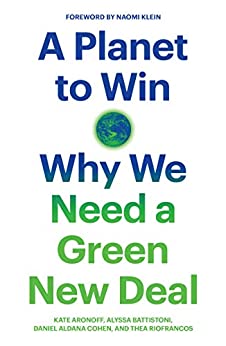
Review - A Planet to Win: Why We Need a Green New Deal

By That Green Union Guy - IWW Environmental Union Caucus, May 11, 2023

In spite of this book's straightforward sounding title, A Planet to Win, Why We Need a Green New Deal (Verso, 2019), by Kate Aronoff, Alyssa Battistoni, Daniel Aldana Cohen, and The Riofrancos, this relatively short and concise book would be much more accurately titled, "Why we think our version of the Green New Deal is the best one of the lot," because there isn't a single "Green New Deal", but several, as we have noted here on ecology.iww.org. This, however, is not necessarily a negative aspect of this book.

The authors, all of them ecosocialists with a transformative approach, are quick to explain that the particular Green New Deal they seek is one that addresses most critiques of the Green New Deal in general. 

  • Would the Green New Deal repeat the mistakes of the original New Deal and exclude BIPOC people? Not the authors' version.
  • Would the Green New Deal rely heavily on social democratic Keynesian state intervention? Not the author's version!
  • Would the Green New Deal perpetuate endless growth in hubristic ignorance of the natural limits to growth, not if these authors have any say in the matter;
  • Would the Green New Deal further the continued exploitation by the Global North of the Global South? Not if the authors have anything to do with it!
  • Would the Green New Deal merely be a case of the capitalists saving themselves, with a putatively green branding? Absolutely not, the authors say.

Certainly, if given the choice, that sounds quite good to me. Clearly these authors aren't content with a naive faith that just because something is called a "Green New Deal" it will actually be a good deal.

Bulletin 133: Chilean Labour Voices on the National Lithium Strategy

By Staff - Trade Unions for Energy Democracy, May 9, 2023

Last week, we looked at the Boric administration’s launch of the National Lithium Strategy, the creation of a National Lithium Company, and some initial responses by trade unions. In this bulletin, we’ll highlight clips of interviews from diverse trade union perspectives on the role of the labour movement in the lithium sector. 

May Day 2023 Port Kembla

Pages

The Fine Print I:

Disclaimer: The views expressed on this site are not the official position of the IWW (or even the IWW’s EUC) unless otherwise indicated and do not necessarily represent the views of anyone but the author’s, nor should it be assumed that any of these authors automatically support the IWW or endorse any of its positions.

Further: the inclusion of a link on our site (other than the link to the main IWW site) does not imply endorsement by or an alliance with the IWW. These sites have been chosen by our members due to their perceived relevance to the IWW EUC and are included here for informational purposes only. If you have any suggestions or comments on any of the links included (or not included) above, please contact us.

The Fine Print II:

Fair Use Notice: The material on this site is provided for educational and informational purposes. It may contain copyrighted material the use of which has not always been specifically authorized by the copyright owner. It is being made available in an effort to advance the understanding of scientific, environmental, economic, social justice and human rights issues etc.

It is believed that this constitutes a 'fair use' of any such copyrighted material as provided for in section 107 of the US Copyright Law. In accordance with Title 17 U.S.C. Section 107, the material on this site is distributed without profit to those who have an interest in using the included information for research and educational purposes. If you wish to use copyrighted material from this site for purposes of your own that go beyond 'fair use', you must obtain permission from the copyright owner. The information on this site does not constitute legal or technical advice.