You are here

just transition

Ecological Politics for the Working Class

By Matt T Huber - Catalyst, Spring 2019

The climate and ecological crisis is dire and there’s little time to address it. In just over a generation (since 1988), we have emitted half of all historic emissions.1 In this same period the carbon load in the atmosphere has risen from around 350 parts per million to over 410 — the highest level in 800,000 years (the historic preindustrial average was around 278).2 Human civilization only emerged in a rare 12,000 year period of climate stability — this period of stability is ending fast. The recent Intergovernmental Panel on Climate Change (IPCC) report suggests we have a mere twelve years to drastically lower emissions to avoid 1.5 C warming — a level that will only dramatically increase the spikes in extreme superstorms, droughts, wildfires, and deadly heat waves (to say nothing of sea-level rise).3 New studies show changing rainfall patterns will threaten grain production like wheat, corn, and rice within twenty years.4 A series of three studies suggest as early as 2070, half a billion people will, “experience humid heat waves that will kill even healthy people in the shade within 6 hours.”5

You don’t have to be a socialist to believe the time frame of the required changes will necessitate a revolution of sorts. The IPCC flatly said we must immediately institute “rapid, far-reaching and unprecedented changes in all aspects of society.”6 The noted climate scientist Kevin Anderson said, “… when you really look at the numbers behind the report, look at the numbers the science comes out with, then we’re talking about a complete revolution in our energy system. And that is going to beg very fundamental questions about how we run our economies.”7

The radical climate movement has long coalesced around the slogan “system change, not climate change.” The movement has a good understanding that capitalism is the main barrier to solving the climate crisis. Yet sometimes the notion of “system change” is vague on how systems change. The dilemma of the climate crisis is not as simple as just replacing one system with another — it requires a confrontation with some of the wealthiest and most powerful sectors of capital in world history. This includes a mere 100 companies responsible for 71 percent of the emissions since 1988.8 The fossil fuel industry and other carbon-intensive sectors of capital (steel, chemicals, cement, etc.) will not sit by and allow the revolutionary changes that make their business models obsolete.

Like all other such battles, this confrontation will take a highly organized social movement with a mass base behind it to force capital and the state to bend to the changes needed. Yet, as Naomi Klein argues, this is really “bad timing” because over the last several decades it is capital who has built formidable power to neutralize their main challenges like a regulatory state, progressive tax structures, and viable trade unions.9 The history of the nineteenth and twentieth century shows that the largest challenge to the rule of capital has come from organized working-class movements grounded in what Adaner Usmani calls “disruptive capacity” — particularly strikes and union organizing. 10 It is the working class that not only constitutes the vast majority of society, but also has the strategic leverage to shut down capital’s profits from the inside.11

Why Unions Must Bargain Over Climate Change

By Nato Green - In These Times, March 12, 2019

Union contract negotiations include mandatory and permissive subjects of bargaining. Employers are required by law to negotiate over mandatory subjects—wages, benefits and working conditions. Permissive subjects, such as decisions about which public services will be provided and how, have historically been the purview of management. We only negotiate over how managerial decisions affect members’ jobs. Employers may voluntarily agree to negotiate permissive subjects, but unions can’t legally strike over them.

In recent years, some unions have embraced “bargaining for the common good,” which use the union campaign to win broad, righteous public benefits. The best current example of this is the Los Angeles teachers’ strike, which opposed the underfunding, privatization and overcrowding of schools—all of which hurt students. Common good goals often bump against the constraints of what is legally bargainable. For instance, does a demand from teachers' unions that school districts use district-owned property to fund and build affordable housing for teachers affect working conditions? While shortages of affordable housing affect teachers very directly, how school districts use their land and invest their money is normally considered a managerial prerogative.

But last fall’s report from the Intergovernmental Panel on Climate Change is a game-changer. It concludes that humanity has 12 years to cut greenhouse gas emissions enough to hold global warming to 1.5 degrees Celsius—and avoid civilization-threatening consequences of climate change. There is a lot of space between projected best- and worst-case future scenarios. It’s the difference between bad and apocalyptic. That space represents hundreds of millions of people dying. Avoiding worst-case scenarios, in strictly scientific terms, requires everyone to do everything, immediately.

The looming timeline of the IPCC report means unions must have a right to bargain over climate change, especially in the public sector. What good is it to negotiate the assignment of overtime when the sky is on fire? Does a public employer really want to claim that its direct complicity in the potential collapse of civilization has no bearing on working conditions? Can government claim that abandoning its workforce to die or flee their homes doesn’t affect working conditions? If employers don’t accept that every choice made today affects the near future, they’re denying science. Local and state governments in Democratic strongholds may find it politically challenging to posture about resisting Republicanism nationally while denying the local implications of that stance.

Thanks to the Sunrise Movement and Rep. Alexandria Ocasio-Cortez (D-N.Y.), the Green New Deal provides a framework for us to declare our part in everyone doing everything immediately. The Green New Deal calls for a government-funded jobs program to carry out a just transition to a carbon-free economy at the rates called for by the IPCC report. This is a perfect common good framework for unions to respond to the most urgent challenge of our time, while simultaneously promoting a high-functioning public sector as antidote to neoliberalism’s degradation of public services.

LNS Videoconference: The Green New Deal – What Does It Mean for Labor?

By staff - Labor Network for Sustainability, March 2019

Sunrise Movement founders Varshini Prakash and William Lawrence speak and answer questions at a special LNS videoconference on labor and the Green New Deal. View it here »

An Ecosocialist Green New Deal: Guiding Principles

By the DSA Ecosocialist Working Group - Democratic Socialists of America - February 28, 2019

The IWW has not endorsed this document; however, individual members of the IWW EUC have helped shape it.

Humankind has reached a moment of existential crisis. Human activity is causing disastrous climate disruption and Earth’s sixth mass extinction event, triggering critical losses of biodiversity. We are already locked in for global warming that will have catastrophic effects, and we are on a slippery path to our own extinction. The 2018 Special Report from the Intergovernmental Panel on Climate Change (IPCC) warns unequivocally that “without societal transformation and rapid implementation of ambitious greenhouse gas reduction measures, pathways to limiting warming to 1.5°C and achieving sustainable development will be exceedingly difficult, if not impossible, to achieve.”

Yet, the crisis we face exceeds ecological breakdown. Deepening inequality, suppressed democracy, precarious jobs, racial and gendered violence, border hostility, and endless wars make up the terrain on which climate destabilization will be unleashed. The most vulnerable members of society will be hit hardest, first, and suffer most.

We must solve the climate crisis and the inequality crisis together. Climate remedies in the context of austerity will produce a popular backlash, as we see in the yellow vest protests against a fuel tax. Corporations profiting from fossil extraction have long worked to turn workers against environmentalists, claiming that clean energy would be a job killer. But working class and poor people’s quality of life, gravely threatened by climate disruption, would greatly improve in a just transition. Because corporate capitalism rewards extraction to concentrate wealth, it must be replaced by a sustainable economy. A Green New Deal can begin the transition from exploitative capitalism to democratic ecological socialism.

The urgency and scale of the crisis we face demand solutions that meet the magnitude of this moment. The ineffectual gradualism and corporate obedience demonstrated by the U.S. government’s climate response has proven to be a dead-end for humanity. We need rapid, systemic transformation that heals the stratification of wealth and power while putting decarbonization and justice at the forefront.

We need a Green New Deal. We demand a Green New Deal, and we demand that it serve people and planet—not profit.

Read the report (PDF).

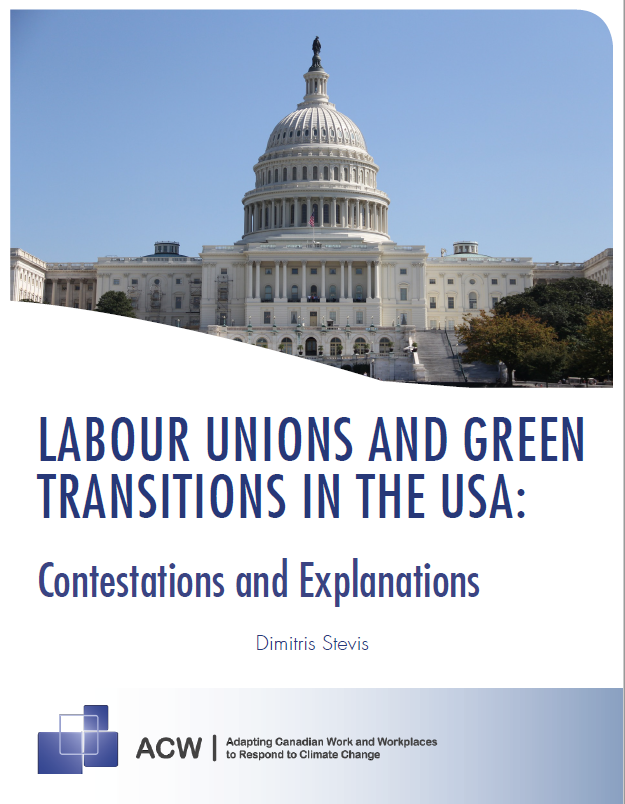
Labor Unions and Green Transitions in the USA

By Dimitris Stevis - Adapting Canadian Work and Workplaces to Respond to Climate Change, February 27, 2019

“In broad terms there are now two camps amongst US labour unions with respect to climate change and renewables (the two not always related). On one side, are those unions that believe that something needs to be done about climate change and that renewables are a good strategy. On the other side are those that are opposed to meaningful climate policy –even as they claim that climate change is a problem.”

This report outlines the deep cleavages with respect to climate policy but also argues that the views of unions are more complex and contradictory than the opposition-support dichotomy. Additionally, it seeks to understand what explains the variability in union responses to climate change and policy. What can account for the contradictions evident amongst and within unions?

Read the report (PDF).

The Huntley Experiment

By Richard Lipsitz and Rebecca Newberry, Labor Network for Sustainability, May 9, 2017

As the Huntley coal-fired power plant in Tonawanda, NY, a working class suburb of Buffalo, NY, began cutting back on its production, the company began cutting back on its payments to the town; as a result, three schools were closed and 135 school employees lost their jobs. The workforce at the plant was slashed from 125 to 75. In response to the likely closing of the plant, the Kenmore-Tonawanda Teachers Association, the IBEW, the Western New York Area Labor Federation, and the Clean Air Coalition formed the Huntley Alliance.

They won funding from the new state Fossil Fuel Plant Closure Fund to offset lost tax revenue. And they are continuing to campaign for jobs and/or retraining for those employed at the plant and reuse of the plant for activities that will enhance the economic and cultural life of the community. Richard Lipsitz, President of the Western New York Labor Federation, and Rebecca Newberry, Executive Director of the Clean Air Coalition of Western New York, tell the inside story of this successful effort in “Huntley, a Case Study: Building Strategic Alliances for Real Change.”

[Full Text] of the case study

International Trade Union Confederation unveils a Just Transition Centre at COP22

By Elizabeth Perry - Work and Climate Change Report, November 16, 2016

The 22nd meeting of the United Nations Conference of the Parties (COP22) in Marrakesh Morrocco concluded on November 18, having made dogged progress despite the looming spectre of President Donald Trump . (see “7 things you missed at COP22 while Trump hogged the headlines“). 150 trade union members from 50 countries comprised a delegation led by the International Trade Union Confederation (ITUC). On November 18, the ITUC released their assessment of COP22: “ Marrakech Climate Conference: Real Progress on economic diversification, transformation and just transition, but more ambition and more finance needed”.

The three “top line” ITUC demands going in to the meetings can be summed up as: greater ambition and urgency for action; commitments on climate finance, especially for vulnerable countries, and commitment to just transition for workers and communities. The summary of demands is reproduced at the Trade Unions for Energy Democracy website and described in detail in the ITUC Frontlines Briefing: Climate Justice COP 22 Special Edition. (Note that one of the case studies in the Special Edition highlights the president of Unifor Local 707A in Fort McMurray, Alberta, who describes the union’s efforts to lobby government, to bargain for just transition provisions, and to sponsor job fairs for displaced workers.) The union demands are consistent with the issues raised in Setting the Path Toward 1.5 C – A Civil Society Equity Review of Pre-2020 Ambition. The ITUC is a signatory to the Setting the Path document – along with dozens of other civil society groups, including Canada Action Network, David Suzuki Foundation, and Friends of the Earth Canada.

The ITUC Special Edition statement announced “…the ITUC and its partners are establishing a Just Transition Centre . The Centre will facilitate government, business, trade unions, communities, investors and civil society groups to collaborate in the national, industrial, workplace and community planning, agreements, technologies, investments and the necessary public policies.” The “partners” mentioned include the United Nations Environment Programme (UNEP), the B Team , an international network of business executives who believe that “the purpose of business is to become a driving force for social, environmental and economic benefit” and We Mean Business, a coalition of business, NGO and government policy organizations promoting the transition to a low-carbon economy.

As an aside: The CEO of We Mean Business wrote A Just Transition to defeat the populist politicians (Nov. 5), summing up the business point of view about Just Transition. See excerpts here.

The European Trade Union Congress, a member of ITUC, promoted five demands in its own Position Statement , adopted by the Executive Committee on the 26-27 October. The ETUC demands largely mirror those of ITUC but also call for concrete action to move the issue of Just Transition from the Preamble of the Paris Agreement, ( where it landed by compromise ) . “The COP 22 must now urge Parties to integrate just transition elements into their national contributions, notably by mandating the Subsidiary Bodies Implementation (SBI) and for Scientific and Technological Advice (SBSTA), for they define the terms of this integration.” The ETUC urges that the ILO Principles for a just transition to environmentally sustainable economies and societies for all provide an internationally recognized reference for governments and social partners concerning just transition.

The Canadian Labour Congress, Confederation des Syndicats Nationaux and Centrale des Syndicats Democratiques in Canada, and the American Federation of Labor (AFL-CIO) are ITUC affiliates. Details, pictures, videos are posted on Twitter at #unions4climate.

International action on Just Transition: what’s been accomplished, and proposals for the future

By Elizabeth Perry - Work and Climate Change Report, September 27, 2017

Just Transition – Where are we now and what’s next? A Guide to National Policies and International Climate Governance  was released on September 19 by the International Trade Union Confederation, summarizing what has been done to date by the ITUC and through  international agencies such as the  ILO, UNFCCC, and the  Paris Agreement.  It also provides short summaries of some transition situations, including the Ruhr Valley in Germany, Hazelwood workers in the LaTrobe Valley, Australia, U.S. Appalachian coal miners and the coal mining pension plan, Argentinian construction workers, and Chinese coal workers.  Finally, the report calls for concrete steps to advance Just Transition and workers’ interests.

The report defines Just Transition on a national or regional scale, as  “an economy-wide process that produces the plans, policies and investments that lead to a future where all jobs are green and decent, emissions are at net zero, poverty is eradicated, and communities are thriving and resilient.” But the report also argues that Just Transition is important for companies, with social dialogue and collective bargaining as key tools to manage the necessary industrial transformation at the organizational level.  To that end, the ITUC is launching “A Workers Right To Know” as an ITUC campaign priority for 2018, stating, “Workers have a right to know what their governments are planning to meet the climate challenge and what the Just Transition measures are. Equally, workers have a right to know what their employers are planning, what the impact of the transition is and what the Just Transition guarantees will be. And workers have a right to know where their pension funds are invested with the demand that they are not funding climate or job destruction.”

The ITUC report makes new proposals. It calls on the ILO to take a more ambitious role and to negotiate a Standard for Just Transition by 2021, carrying on from the Guidelines for a just transition towards environmentally sustainable economies and societies forAll  (2015).   The ITUC also states “expectations” of how Just Transition should be given greater priority in the international negotiation process of the United Nations Framework Convention on Climate Change (UNFCC), so that:  Just Transition commitments are incorporated into the Nationally Determined Contributions (NDCs) of countries; Just Transition for workers becomes a permanent theme within the forum on response measures under the Paris Agreement, and Just Transition is included in the 2018 UNFCCC Facilitative Dialogue. It also calls for the launch of a “Katowice initiative for a Just Transition” at the COP23 meetings to take place in Katowice, Poland in 2018, “to provide a high-level political space”.  Finally, the ITUC calls for expansion of the eligibility criteria of the Green Climate Fund to allow  the funding of Just Transition projects.

Just Transition – Where are we now and what’s next? is a Climate Justice Frontline Briefing from the International Trade Union Confederation, with support from the Friedrich Ebert Stiftung and is based upon Strengthening Just Transition Policies in International Climate Governance by Anabella Rosemberg, published as a Policy Analysis Brief by the Stanley Foundation in 2017.

Canada, the World Bank and International Confederation of Trade Unions announce a partnership to promote Just Transition in the phase-out of coal-fired electricity

By Elizabeth Perry - Work and Climate Change Report, December 13, 2017

Canada’s Environment and Climate Change Minister is back on the  international stage at the One Planet Summit in Paris, which is focusing on climate change financing – notably phasing out  fossil fuel subsidies, and aid to developing countries.  In a press release on December 12,  Canada announced a partnership with the World Bank Group to accelerate the transition from coal-fired electricity to clean sources in developing countries, stating: “This work also includes sharing best practices on how to ensure a just transition for displaced workers and their communities to minimize hardships and help workers and communities benefit from new clean growth opportunities. The transition to a low-carbon economy should be inclusive, progressive and good for business. We will work together with the International Trade Union Confederation in this regard.”   The World Bank Group announcement was briefer : “Canada and the World Bank will work together to accelerate the energy transition in developing countries and, together with the International Trade Union Confederation, will provide analysis to support efforts towards a just transition away from coal.”  The ITUC Just Transition Centre hadn’t posted any announcement as of December 13.

Other Canadian partnerships announced in a general press release: a Canada-France Climate Partnership to promote the implementation of the Paris Agreement through  carbon pricing, coal phase-out, sustainable development and emission reductions in the marine and aviation sectors; Canada was selected as one of five countries for a new partnership with the Breakthrough Energy Coalition led by Bill Gates; and Canada , along with five Canadian provinces, two U.S. states, and Mexico, Costa Rica and Chile, signed on to the Declaration on Carbon Markets in the Americas, to strengthen  international and regional cooperation on carbon pricing.

The World Bank, one of the organizers of the One Planet Summit, made numerous other announcements – including that it will no longer finance upstream oil and gas developments after 2019, and as of 2018, it  will report greenhouse gas emissions from the investment projects it finances in key emissions-producing sectors, such as energy. Such moves may be seen as a response to the demands of the Big Shift Global campaign of Oil Change International, which  released a new briefing called “The Dirty Dozen: How Public Finance Drives the Climate Crisis through Oil, Gas, and Coal Expansion  on the eve of the One Planet Summit.  Over 200 civil society groups also issued an Open Letter   calling on G20 governments and multilateral development banks to phase out fossil fuel subsidies and public finance for fossil fuels as soon as possible, and no later than 2020.  Signatories include Oil Change International, Les Amis de la Terre – Friends of the Earth France, Christian Aid, Greenpeace, Reseau Action Climat – Climate Action Network France, WWF International, BankTrack, Climate Action Network International, Global Witness, 350.org, Germanwatch, Natural Resources Defense Council, CIDSE, and the Asian Peoples Movement on Debt and Development.

In Canada, Environmental Defence is collecting signatures in a campaign to stop fossil fuel subsidies , stating  “ Together, federal and provincial governments hand out $3.3 billion in subsidies every year for oil and gas exploration and development. In 2016, Export Development Canada, a crown corporation, spent an additional $12 billion in public money to finance fossil fuel projects.”

California’s progressive policies yield better job growth and wage growth than Republican comparators

By Elizabeth Perry - Work and Climate Change Report, January 15, 2018

A November 2017 report from the Labor Center at University of California Berkeley  examined the “California Policy Model” –  defined as a collection of 51 pieces of legislation and policy implementations enacted in California between 2011 and 2016 – and found that with progressive policies such as minimum wage increases, increased access to health insurance, reduction of carbon emissions and higher taxes on the wealthy, the state showed  superior economic  performance  in comparison to Republican-controlled states and to a simulated version of California without such policies.  According to  “California is Working: The Effects of California’s Public Policy on Jobs and the Economy since 2011,  the suite of progressive policies resulted in superior total employment growth , superior private sector employment growth, and higher wage growth for low-wage workers from 2014 to 2016. All the while, keeping the state on track to meet its 2020 GHG emissions targets.  The  environmental policies included in the analysis were: starting in 2006, AB 32, which committed the state to lowering its greenhouse gas emissions to 1990 levels by 2020;  regulations under AB 32 in 2012 and 2013, which introduced the state cap and trade program;  SB 350 in 2015 and 2016,  committing the state to greater use of renewable energy and further improvements in energy efficiency ; and SB 32, which raised the emissions reduction goal to 40 percent below 1990 levels by 2030.  The report warns that  enforcement of labour standards and a lack of affordable housing remain as challenges facing the state, and also admits to possible weakness  regarding the second of its two methods of analysis, the synthetic control statistical method.

Pages

The Fine Print I:

Disclaimer: The views expressed on this site are not the official position of the IWW (or even the IWW’s EUC) unless otherwise indicated and do not necessarily represent the views of anyone but the author’s, nor should it be assumed that any of these authors automatically support the IWW or endorse any of its positions.

Further: the inclusion of a link on our site (other than the link to the main IWW site) does not imply endorsement by or an alliance with the IWW. These sites have been chosen by our members due to their perceived relevance to the IWW EUC and are included here for informational purposes only. If you have any suggestions or comments on any of the links included (or not included) above, please contact us.

The Fine Print II:

Fair Use Notice: The material on this site is provided for educational and informational purposes. It may contain copyrighted material the use of which has not always been specifically authorized by the copyright owner. It is being made available in an effort to advance the understanding of scientific, environmental, economic, social justice and human rights issues etc.

It is believed that this constitutes a 'fair use' of any such copyrighted material as provided for in section 107 of the US Copyright Law. In accordance with Title 17 U.S.C. Section 107, the material on this site is distributed without profit to those who have an interest in using the included information for research and educational purposes. If you wish to use copyrighted material from this site for purposes of your own that go beyond 'fair use', you must obtain permission from the copyright owner. The information on this site does not constitute legal or technical advice.