You are here

just transition

A Green New Deal Must Be Rooted in a Just Transition for Workers and Communities Most Impacted by Climate Change

By various - Climate Justice Alliance, December 11, 2018

A Call for Special Attention to Highly Impacted Communities Leading a Just Transition

What is the Climate Justice Alliance?

The Climate Justice Alliance (CJA) is a growing alliance, currently linking 68 community organizations, movement networks, and support organizations throughout the U.S. and Puerto Rico to unite under Just Transition strategies. CJA’s inter-generational constituencies are rooted in Indigenous, African American, Latinx, Asian Pacific Islander, and poor white communities on the frontlines of the climate crisis. They share legacies of colonialism, racial and economic oppression, along with rich histories of environmental, economic and social justice organizing.

CJA believes that in order to effectively confront the climate crisis, we must transition our priorities from global systems of production and consumption that are energy intensive and fossil fuel dependent to more localized systems that are sustainable, resilient, and regenerative.

The transition itself, however, must be just.

What is the Green New Deal (GND)?

The GND is a proposal recently put forth by Congressional Representative Alexandria Ocasio-Cortez (D-NY) and currently supported by 18 members of the U.S. House of Representatives. It comes on the heels of the midterm election where Democrats won the majority in the House as well as the election of a number of self-proclaimed Democratic Socialists. Building off of energy from the demonstrations in Nancy Pelosi’s office by the youth of the Sunrise Movement, the GND, at this stage, has been presented as a call for the establishment of a House Select Committee that would be charged with “developing a detailed national, industrial, economic mobilization plan for the transition of the United States economy to become carbon neutral.”  It also aims to “significantly draw down and capture greenhouse gases from the atmosphere and oceans and … promote economic and environmental justice and equality.”(1)

The GND is the first time in many years that a proposal of this type has been presented by a number of members of a major U.S. political party. It proposes to tackle climate change and inequality simultaneously, while revolutionizing conditions for workers.  It is a much needed aggressive national pivot away from climate denialism to climate action with large scale federal legislative and budgetary implications.

Let Them Drown: The Violence of Othering in a Warming World

By Naomi Klein - London Review of Books, June 2, 2016

Edward Said was no tree-hugger. Descended from traders, artisans and professionals, he once described himself as ‘an extreme case of an urban Palestinian whose relationship to the land is basically metaphorical’. In After the Last Sky, his meditation on the photographs of Jean Mohr, he explored the most intimate aspects of Palestinian lives, from hospitality to sports to home décor. The tiniest detail – the placing of a picture frame, the defiant posture of a child – provoked a torrent of insight from Said. Yet when confronted with images of Palestinian farmers – tending their flocks, working the fields – the specificity suddenly evaporated. Which crops were being cultivated? What was the state of the soil? The availability of water? Nothing was forthcoming. ‘I continue to perceive a population of poor, suffering, occasionally colourful peasants, unchanging and collective,’ Said confessed. This perception was ‘mythic’, he acknowledged – yet it remained.

If farming was another world for Said, those who devoted their lives to matters like air and water pollution appear to have inhabited another planet. Speaking to his colleague Rob Nixon, he once described environmentalism as ‘the indulgence of spoiled tree-huggers who lack a proper cause’. But the environmental challenges of the Middle East are impossible to ignore for anyone immersed, as Said was, in its geopolitics. This is a region intensely vulnerable to heat and water stress, to sea-level rise and to desertification. A recent paper in Nature Climate Change predicts that, unless we radically lower emissions and lower them fast, large parts of the Middle East will likely ‘experience temperature levels that are intolerable to humans’ by the end of this century. And that’s about as blunt as climate scientists get. Yet environmental issues in the region still tend to be treated as afterthoughts, or luxury causes. The reason is not ignorance, or indifference. It’s just bandwidth. Climate change is a grave threat but the most frightening impacts are in the medium term. And in the short term, there are always far more pressing threats to contend with: military occupation, air assault, systemic discrimination, embargo. Nothing can compete with that – nor should it attempt to try.

There are other reasons why environmentalism might have looked like a bourgeois playground to Said. The Israeli state has long coated its nation-building project in a green veneer – it was a key part of the Zionist ‘back to the land’ pioneer ethos. And in this context trees, specifically, have been among the most potent weapons of land grabbing and occupation. It’s not only the countless olive and pistachio trees that have been uprooted to make way for settlements and Israeli-only roads. It’s also the sprawling pine and eucalyptus forests that have been planted over those orchards, as well as over Palestinian villages, most notoriously by the Jewish National Fund, which, under its slogan ‘Turning the Desert Green’, boasts of having planted 250 million trees in Israel since 1901, many of them non-native to the region. In publicity materials, the JNF bills itself as just another green NGO, concerned with forest and water management, parks and recreation. It also happens to be the largest private landowner in the state of Israel, and despite a number of complicated legal challenges, it still refuses to lease or sell land to non-Jews.

I grew up in a Jewish community where every occasion – births and deaths, Mother’s Day, bar mitzvahs – was marked with the proud purchase of a JNF tree in the person’s honour. It wasn’t until adulthood that I began to understand that those feel-good faraway conifers, certificates for which papered the walls of my Montreal elementary school, were not benign – not just something to plant and later hug. In fact these trees are among the most glaring symbols of Israel’s system of official discrimination – the one that must be dismantled if peaceful co-existence is to become possible.

The JNF is an extreme and recent example of what some call ‘green colonialism’. But the phenomenon is hardly new, nor is it unique to Israel. There is a long and painful history in the Americas of beautiful pieces of wilderness being turned into conservation parks – and then that designation being used to prevent Indigenous people from accessing their ancestral territories to hunt and fish, or simply to live. It has happened again and again. A contemporary version of this phenomenon is the carbon offset. Indigenous people from Brazil to Uganda are finding that some of the most aggressive land grabbing is being done by conservation organisations. A forest is suddenly rebranded a carbon offset and is put off-limits to its traditional inhabitants. As a result, the carbon offset market has created a whole new class of ‘green’ human rights abuses, with farmers and Indigenous people being physically attacked by park rangers or private security when they try to access these lands. Said’s comment about tree-huggers should be seen in this context.

And there is more. In the last year of Said’s life, Israel’s so-called ‘separation barrier’ was going up, seizing huge swathes of the West Bank, cutting Palestinian workers off from their jobs, farmers from their fields, patients from hospitals – and brutally dividing families. There was no shortage of reasons to oppose the wall on human rights grounds. Yet at the time, some of the loudest dissenting voices among Israeli Jews were not focused on any of that. Yehudit Naot, Israel’s then environment minister, was more worried about a report informing her that ‘The separation fence … is harmful to the landscape, the flora and fauna, the ecological corridors and the drainage of the creeks.’ ‘I certainly don’t want to stop or delay the building of the fence,’ she said, but ‘I am disturbed by the environmental damage involved.’ As the Palestinian activist Omar Barghouti later observed, Naot’s ‘ministry and the National Parks Protection Authority mounted diligent rescue efforts to save an affected reserve of irises by moving it to an alternative reserve. They’ve also created tiny passages [through the wall] for animals.’

Perhaps this puts the cynicism about the green movement in context. People do tend to get cynical when their lives are treated as less important than flowers and reptiles. And yet there is so much of Said’s intellectual legacy that both illuminates and clarifies the underlying causes of the global ecological crisis, so much that points to ways we might respond that are far more inclusive than current campaign models: ways that don’t ask suffering people to shelve their concerns about war, poverty and systemic racism and first ‘save the world’ – but instead demonstrate how all these crises are interconnected, and how the solutions could be too. In short, Said may have had no time for tree-huggers, but tree-huggers must urgently make time for Said – and for a great many other anti-imperialist, postcolonial thinkers – because without that knowledge, there is no way to understand how we ended up in this dangerous place, or to grasp the transformations required to get us out. So what follows are some thoughts – by no means complete – about what we can learn from reading Said in a warming world.

Unions Congratulate the Standing Rock Sioux Tribe on Denial of Authorization for the Dakota Access Pipeline (DAPL)

Statement from 1199 SEIU; Amalgamated Transit Union; Brotherhood of Maintenance and Way Employees Division, Pennsylvania Federation–Teamsters; National Domestic Workers Alliance; National Nurses United; New York State Nurses Association; United Electrical Workers - Trade Unions for Energy Democracy, December 9, 2016

We are unions representing members in health care, domestic work, public transit, railroads, manufacturing and other sectors.

We congratulate leaders of the Standing Rock Sioux Tribe and thousands of supporters for the news that the federal government will deny authorization for the Dakota Access Pipeline to go through tribal lands posing a threat to water sources and sacred sites.

The Obama Administration’s decision respects the sacred grounds of the Standing Rock Sioux and takes into consideration the potential of a hazardous pipeline leak that would harm the community’s life and livelihood.

This is a historic victory, and an organizing victory that every union member can identify with, against one of the most powerful economic and political forces in the world: the fossil fuel industry and its many allies inside and outside government. These forces have used private police that have not hesitated in using violence to intimidate those participating in peaceful protest.

Mindful of our own history in facing private police and vigilantes in the fight to establish workers’ rights, trade unionists have stood shoulder to shoulder with the First Nation water protectors, environmental and community supporters, and many allies who have mobilized and rallied for months against huge odds.

Our unions will continue to join with opponents of the Dakota Pipeline along other routes and fight to halt similar projects that transport dirty crude oil that jeopardize public health and contribute to the climate crisis.

We also stand in solidarity with the construction workers who build our country’s infrastructure, and also with the workers in coal, oil and gas, many of whom have lost their jobs due to the collapse in global prices. In accordance with the Paris Climate Agreement, we call for a “just transition” for workers whose jobs and livelihoods may be threatened by the move away from fossil fuels.

But there is much work to be done in modernizing and repairing bridges, roads, tunnels, public transit systems, etc., many of which have become dilapidated and dangerous to workers and the public.  But jobs based on expanding (and exporting) fossil fuels will simply lead to more environmental destruction, worsening health, climate instability and social upheaval at home and abroad.  Business as usual is not an option.

Together we can demand the development of sustainable energy production and resource initiatives that unequivocally provide good, safe union jobs while salvaging the health and well-being of the earth’s population.

Our future depends on our willingness to engage and organize among progressive forces and social movements in order to effectively meet the challenges ahead.

5.7-Million-Member TUC Supports Labour Party’s Manifesto Commitments on Public Ownership of Energy and Climate Change

By staff - Trade Unions for Energy Democracy, September 25, 2017

The annual congress of the UK Trades Union Congress (TUC) has passed a historic composite resolution (also below) on climate change that supports the energy sector being returned to public ownership and democratic control.

The resolution—carried unanimously by hundreds of delegates—calls upon the national center to work with the Labour Party to achieve this goal, as well as to: implement a mass program for energy conservation and efficiency; lobby for the establishment of a “just transition” strategy for affected workers; and, investigate the long-term risks to pension funds from investments in fossil fuels.

The Labour Party’s 2017 election manifesto, For the Many, Not the Few,pointed to the failures of electricity privatization, energy poverty, the need the honor the UK’s climate commitments, and to put the UK on course for 60% of its energy to be met by zero carbon or renewable sources by 2030.

The Manifesto also committed to “take energy back into public ownership to deliver renewable energy, affordability for consumers, and democratic control.” It calls for the creation of “publicly owned, locally accountable energy companies and co-operatives to rival existing private energy suppliers.”

Moved by Sarah Woolley, Organising Regional Secretary for the Bakers, Food and Allied Workers Union (BFAWU), the resolution refers to the “irrefutable evidence that dangerous climate change is driving unprecedented changes to our environment,” as well as the risks to meeting the climate challenge posed by Trump’s announced withdrawal from the Paris Agreement, and by the chaotic approach to both Brexit and broader policy by the current Conservative government.

The resolution affirmed that combating climate change and moving towards a low-carbon economy cannot be left to markets, but requires a strong role for the public sector in driving the transition. In supporting the resolution, several speakers referred to the devastation unleashed across the Caribbean over the previous several days by Hurricane Irma—the most powerful Atlantic Ocean storm in recorded history—and across southern Texas only days before that by Hurricane Harvey.

Report on TUED Strategy Meeting at COP23

By staff - Trade Unions for Energy Democracy, November 28, 2017

On November 10th, during COP23, Trade Unions for Energy Democracy (TUED) convened a “Strategy Roundtable” in Bonn, Germany. The meeting was attended by more than 40 representatives of roughly 25 unions from 14 countries as well as several allies from the environmental movement, media and research bodies.

Union participants came from Argentina, Australia, Belgium, Brazil, Canada, Dominican Republic, Germany, Italy, Netherlands, Norway, Philippines, UK and USA. The meeting was organized with support from the New York office of Rosa Luxemburg Stiftung (RLS–New York). Participants were welcomed by Stefanie Ehmsen of RLS-NYC, and TUED Coordinator Sean Sweeney of the Joseph S. Murphy Institute, City University of New York.

The meeting provided a rare opportunity for unions that are not yet part of the network to be exposed to TUED’s analysis and to participate in a lively debate about the struggle for the future of global energy systems. Copies of TUED’s most recent working paper, “Preparing a Public Pathway: Confronting the Investment Crisis in Renewable Energy,” were circulated.

Setting the context for the meeting, Sweeney provided a brief overview of the 5-year history of the 60-union network, and the political origins of the “Resist, Reclaim, Restructure” framework. There was broad consensus among participants that the current, market-driven approach, focused on “mobilizing the private sector,” is failing to produce a just energy transition and that, given the Paris targets, there is an urgent need to pursue public alternatives that advance social ownership and democratic control of the power sector and the broader energy economy, including energy options, management, and research and development.

Participants also provided updates on recent developments in their regions, including reports on: the Philippines and the challenges facing trade unions under Duterte’s government; the September meeting in Buenos Aires on “The Energy Grid and the Commons”; the UK Trades Union Congress resolution to support public ownership of energy; developments and next steps to follow the June 2017 meeting in Geneva of TUED unions in Europe; why “Public Renewable Power” is gaining support among unions in Australia; latest developments in Canada, particularly Alberta and Quebec; and the recent sharp debate around the AFL-CIO resolution on climate change in the US. Participants also heard about ITF’s campaigning work on public transportation.

Identifying points of agreement and shared analysis, representatives of Friends of the Earth International (FOE-I) and Friends of the Earth Europe (FOE-E) also participated in the discussion.

(TUED Bulletin #62) Changes at TUED, new unions, report from Asia-Pacific Region

By staff - Trade Unions for Energy Democracy, August 31, 2017

Dear TUED unions and movement allies:

Please welcome John Mark Mwanika to the TUED global advisory group. He will represent the Amalgamated Transport & General Workers Union of Uganda(ATGWU – Uganda)  The ATGWU is affiliated to two Global Union Federations, namely ITF and UNI, and joined TUED last week.

Please also welcome Alex White, representing UnionsACT, the Trades and Labour Council of the Australian Capital Territory, the peak body representing all unions in Canberra. UnionsACT is now part of TUED and working with the growing TUED community in the region.

SEIU Local 1021, representing 54,000 workers in Northern California, has also joined TUED.  The local will for now be represented by Martha Hawthorne (Martha attended COP 21 in Paris in late 2015)

Click here for an updated list of unions participating in TUED

TUED Asia-Pacific 

Meanwhile, here are the minutes of the TUED Asia-Pacific discussion that took place on August 10. The coordinator of this meeting was Tom Reddington, formerly of Earthworker Cooperative. Tom is now working on climate and energy democracy for Union Aid Abroad-APHEDA. Tom is also new to the TUED community, but he’ll be very involved in the Asia-Pacific work alongside Kate Lee

Global Advisory Group

The Electrical Trades Union (ETU) of Australia will be represented by Trevor Gauld. Trevor is the ETU’s National Policy Officer.  Lance McCallum is now the National Campaign Coordinator at the Australian Council of Trade Unions. Lance is still very involved in the work of TUED and chaired the August 10th meeting.

Due to staff changes, Alison Arron will now represent the Public Services Association – New Zealand and Michael Seville will represent District Council 57, AFSCME, based in California. Cheryl Brown is now with SEIU Local 521 (thanks for everything Cheryl!)

Thank you James Hare! 
Everyone at TUED would like to express our appreciation to James Hare of the Rosa Luxemburg Stiftung NYC Office, who will be moving on from RLS-NYC at the end of summer. Thank you, James, for your role in strengthening and guiding the growth of TUED for five full years. We wish you the best in all things to come!

Korean Unions Call for a “Just Energy Transition” to Move Away From Coal and Nuclear

By Staff - Trade Unions for Energy Democracy, August 4, 2017

In a series of landmark statements following the May 2017 election of the pro-reform President Moon Jae-in, Korean energy, transport and public service workers have called for “a just energy transition” allowing the sector to “function as a public asset under public control.”  Unions support the new government’s decision to close the country’s aging coal-fired and nuclear power stations, and its planned reconsideration of two new nuclear facilities, Kori 5 and Kori 6. In a statement issued in late July, the Korean Public Service and Transport Workers’ Union (KPTU) and the Korean Labour and Social Network on Energy (KLSNE), a coalition of unions and civil society organization, said, “We actively support the policy of phasing out coal and nuclear and expanding clean renewable energy.” The statement urged the development of, “A roadmap for energy transition that ensures public accountability and strengthens democratic control of the energy industry.” KPTU and KLSNE also committed  “to work together with the public and civil society to achieve a just transition.”

The Korean Labour and Social Network on Energy (KLSNE) and the Korean Public Service and Transport Workers’ Union (KPTU) Support the Government’s Policy of a Transition towards a Coal-free, Nuclear-free Energy System

The Moon Jae-in government, which was elected on a pledge to phase out coal and nuclear generation and scale up clean renewables, is now moving quickly to enact these promises. Following a temporary shutdown of old coal-fired power plants, the Kori 1 nuclear reactor was permanently closed down on June 19. The government is now reconsidering plans to build new nuclear reactors Kori 5 and 6. The KLSNE and KPTU declare our support for these policies and our intentions to play a leading role in bring about a just energy transition.

The government’s establishment of a commission to assess public opinion on the plans to build Kori reactors 5 and 6 on July 24 sparked immediate outcry from nuclear power business interests and pro-nuclear power scholars. The press has exacerbated this conflict with sensational reporting. It is deeply regrettable that those who oppose the government’s policies are speaking only from their individual self-interest without putting forth viable alternatives.

It is even more regrettable that the voices of workers at the Korean Hyro & Nuclear Power Corporation and other nuclear-power related companies who support a just transition are being stifled in the process. We stress the importance of recognising the difference between nuclear power business interests and the nuclear power workers. These workers are the people most easily exposed to radiation and at the most risk in the case of accidents. Electricity and gas workers, who have been discussing paths for a just transition for many years now, are sure that nuclear power workers will soon join us in this effort.

During the last nine years of conservative rule, South Korea’s energy policy has been focused on restructuring aimed only at meeting the interest of corporations (i.e. privatisation). The result has been the expansion of nuclear power and private coal and LNG generation and massive profits for corporations. Energy policy has been consistently undemocratic and anti-climate.

With South Korea now facing the threat of earthquakes and air contaminated with fine dust it is only natural that we energy workers, who have fought for almost two decades to stop privatisation and protect our public energy system, would take a leading role in the fight for a just energy transition.

TUED energy and climate retreat, Cutchogue, Long Island, April 3-4, 2017, hosted by Local 3, IBEW

By Staff - Trade Unions for Energy Democracy, February 25, 2017

A Discussion on Union Strategy and Policy in a Time of Resistance

April 3rd & 4th at Local 3 IBEW’s Education and Cultural Center in Cutchogue, Long Island, New York. Dinner and reception to follow (check out morning of April 5th).

See below for information about the purpose of the retreat and discussion topics.

Confirmed international participants:

Daniel Angelim (Trade Union Confederation of the Americas)
David Boys (Public Services International)
Daniel Chavez (Transnational Institute, Netherlands)
Hector de la Cueva (CILAC-Mexico)
Bruno Dobrusin (CTA, Argentina)
Simona Fabiani (CGIL, Italy)
Luz Gonzalez (CUT, Brazil)
Kate Lee (Union Aid Abroad /APHEDA, Australia)
Wol-san Liem (KPTU, Korea)
Maite Llanos (TUED, Geneva)
Sam Mason (PCS, UK)
Josua Mata (Sentro, Philippines)
Lance McCallum (Electrical Trades Union, Australia)
Philip Pearson (TUED, UK)
Allison Roche (UNISON, UK)
Ashim Roy (NTUI, India)
Asbjorn Wahl (NUMGE, Norway)

We are all energy unions now.

The retreat is being convened at a time when President Trump has made clear his enthusiastic support for more fracking of shale gas and shale oil, and his desire to remove regulations on fossil fuels. Executive Orders have indicated President Trump’s support for the Keystone XL and Dakota Access pipelines. A number of key US unions have endorsed these actions. Meanwhile, The White House has removed all references to climate change from its website, and the President has vowed to pull out of the Paris Climate Agreement and reign in the EPA.

Jobs and Climate Justice

We share a common atmosphere and all rely on the ecosystems that sustain life. All over the world unions and social movements are being drawn into struggles over the future of energy. Therefore a clear, compelling, and effective strategy for a transformative transition for energy is needed in order to meet the political challenges in the US and elsewhere.

Likely discussion questions:

  • The Trump Agenda: How can progressive labor in the US respond to the “energy superpower” argument?
  • What is the record of “labor-environmental” alliances and coalitions in the US and internationally?
  • Should we defend the Paris climate agreement?
  • Centers of resistance: What role for cities and states?
  • What is happening in key “carbon battlegrounds” countries like Australia, India, South Africa and the UK?
  • How can unions champion public renewable power and build union strength in the renewables sector?

A recent TUED Working Paper, Energy Transition: Are We Winning?, explains what is going on in the global energy system and the need for progressive and forward-looking unions internationally to work together to develop a more coherent and compelling approach to energy transition.

Energy Democracy and Just Transition Endorsed at Launch of South Africa’s New Trade Union Federation

By John Treat - Trade Unions for Energy Democracy, May 1, 2017

At a historic launch event held outside Johannesburg on April 21-23, 2017, almost 1,400 voting delegates from two-dozen unions representing 700,000 workers convened to launch the new “South African Federation of Trade Unions” (SAFTU).
In addition to adopting the name, logo and colors — red, black and gold — delegates also endorsed a range of principles adopted at a preparatory “Workers’ Summit” convened by the National Union of Metalworkers of South Africa (NUMSA) in April 2016, adopted a new constitution, and approved a report from the Steering Committee proposing a range of campaigning priorities for the next period.

In a recent article, then SAFTU convener Zwelinzima Vavi said:

We’ve got a mix of workers in the private sector, manufacturing, transport, mining and construction. And we’ve got unions in the public sector – the biggest ones are the South African Policing Union and the National Union of Public Servants and Allied Workers.[SAFTU] is independent but not apolitical. It is truly worker controlled and democratic and not ‘sloganising’ over the issues. SAFTU is truly fighting and militant.”

At a TUED strategy meeting in New York in early April, Karl Cloete, NUMSA’s Deputy General Secretary, told union representatives from 12 countries that while the new federation’s campaigning priorities will focus on the many grave and urgent challenges facing South Africa’s highly exploited workers and exceptionally vulnerable poor, SAFTU would also make energy democracy and just transition part of its core agenda.

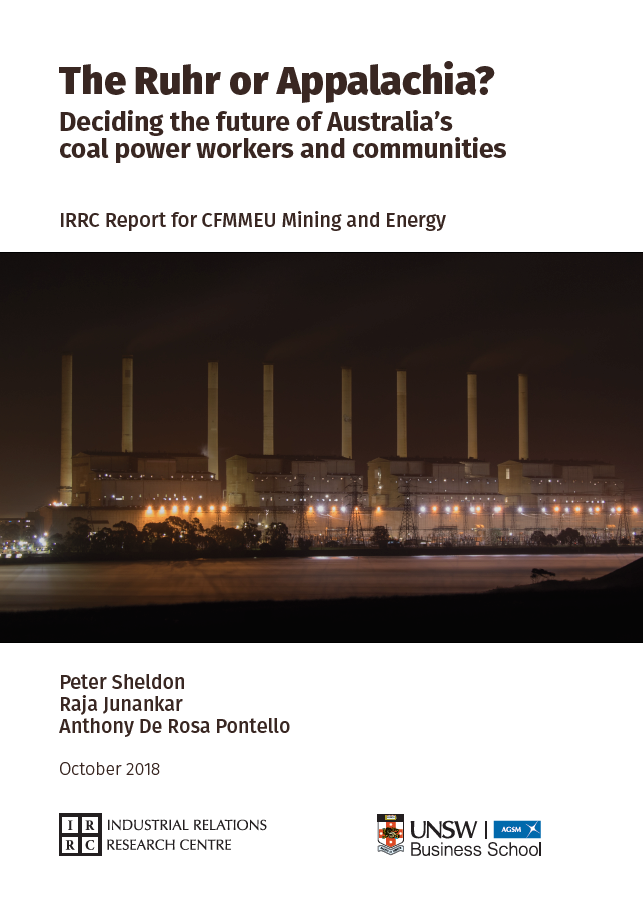
The Ruhr or Appalachia: Deciding the Future of Australia’s Coal Power Workers and Communities

By Peter Sheldon, Raja Junankar, and Anthony De Rosa Pontello - CFMMEU Mining and Energy, December 3, 2018

Australia’s coal-fired power stations will all close in the next two or three decades. We know this because the companies that operate the 23 power stations currently operating nation-wide have told us so.

Despite the empty rhetoric of some, it is unlikely that the economic case for investing in new coal-fired power stations in Australia will stack up. Those who currently own and operate coal power stations have no plans to build new ones.

The bad news is that the transition in how we produce power will bring great change to the workers and communities we have relied on to provide Australian homes and industry with reliable energy over many decades.

The good news is that we have the lead time to make smart decisions about what that change looks like—or at least, we now have the lead time after being caught unprepared by earlier closures, including Hazelwood in 2017.We have the choice to manage this structural economic change so that individuals, families and regions aren’t abandoned to unemployment, low-value jobs, poverty and associated health and social decline. Even better, we have the evidence about what works to deliver just transitions for coal power workers and communities, with skills, jobs, opportunities and hope for the future.

Communities grow around power stations and the mines that supply them. They are unique communities bonded in many cases by history, geography, difficult and dangerous working conditions and good unionised jobs. They are also uniquely vulnerable in their heavy dependence on the coal power industry.

This analysis of transitions in resource economies internationally and here in Australia provides valuable insights into the ingredients of success and the wide scope of outcomes.The Appalachian region in the United States is a heart-breaking story of industry transition characterised by short-term, reactive and fragmented responses to closures of coal mines, resulting in entrenched, intergenerational poverty and social dysfunction.

Compare this with the transition away from a heavy reliance on coal mining in Germany’s Ruhr region, where forward planning, investment in industry diversification, staggering of mine closures and a comprehensive package of just transition measures delivered a major reshaping of the regional economy with no forced job losses.

Central to these vastly different outcomes is the presence of a national, coordinated response. To this end, a major recommendation of this report is the establishment of a national, independent statutory authority to plan, coordinate and manage the transition.

In the energy debate to date, the impact of the transition on workers and communities has been almost completely ignored. This is an omission we can’t afford. After all, the costs of investing in a Just Transition need to be balanced against the costs of doing nothing and abandoning whole communities to a bleak future.

While global trends suggest that Australian export coal for steelmaking and energy production will be in demand for decades to come, coal-fired power generation in Australia is winding down. On the information available, there are no excuses for not taking action to protect the best interests of those affected.</p.

I thank Peter Sheldon and the team at UNSW Sydney’s Industrial Relations Research Centre for this important piece of work. I call on all power industry stakeholders to engage with its findings and consider how we can work together to deliver a Just Transition for coal power workers and communities.

Read the report (PDF).

Pages

The Fine Print I:

Disclaimer: The views expressed on this site are not the official position of the IWW (or even the IWW’s EUC) unless otherwise indicated and do not necessarily represent the views of anyone but the author’s, nor should it be assumed that any of these authors automatically support the IWW or endorse any of its positions.

Further: the inclusion of a link on our site (other than the link to the main IWW site) does not imply endorsement by or an alliance with the IWW. These sites have been chosen by our members due to their perceived relevance to the IWW EUC and are included here for informational purposes only. If you have any suggestions or comments on any of the links included (or not included) above, please contact us.

The Fine Print II:

Fair Use Notice: The material on this site is provided for educational and informational purposes. It may contain copyrighted material the use of which has not always been specifically authorized by the copyright owner. It is being made available in an effort to advance the understanding of scientific, environmental, economic, social justice and human rights issues etc.

It is believed that this constitutes a 'fair use' of any such copyrighted material as provided for in section 107 of the US Copyright Law. In accordance with Title 17 U.S.C. Section 107, the material on this site is distributed without profit to those who have an interest in using the included information for research and educational purposes. If you wish to use copyrighted material from this site for purposes of your own that go beyond 'fair use', you must obtain permission from the copyright owner. The information on this site does not constitute legal or technical advice.

