You are here

AFL-CIO

Brothers and Sisters, It’s Time to Fight

By Kevin Norton - Labor Notes, February 15, 2017

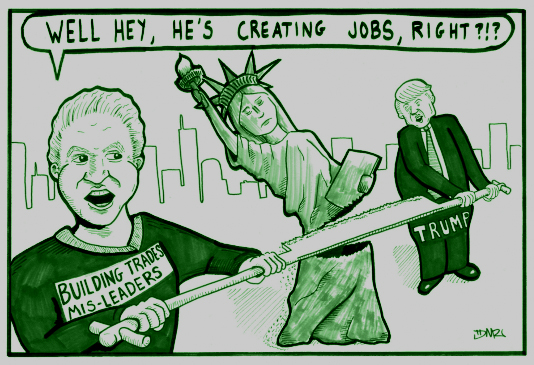
The speed of events since Trump’s inauguration has made my head spin. The administration’s absolute onslaught against women, environmentalists, Muslims, immigrants, and the government itself began on day one. So I was a little shocked to see some of the building trades union leadership meet so happily with our nation’s first orange president.

“We have a common bond with the president,” Building Trades President Sean McGarvey said. “We come from the same industry. He understands the value of driving development, moving people to the middle class.” McGarvey also commented that President Obama had never met with the trades.

Some enthusiastic Trump supporters have lit up my Facebook page with stories about how he is going to “Make America Great Again.” One wrote, “I was told Trump was anti-union... Being an informed voter, I knew it was hogwash... here’s the proof.” He left a link to an article about the new president’s meeting with the union leaders.

Fawning over Trump Shuts Out Our Movement’s Future

By Len Shindel - Labor Notes, February 15, 2017

Surrounded by key union leaders, Trump was relaxed and smooth. He thanked the Sheet Metal Workers for their work on his hotel down the street—even as an electrical contractor was suing his company after allegedly getting stiffed on the job.

Union leaders clapped when Trump announced he was trashing the Trans-Pacific Partnership. Trump said their members would soon be needed to complete a load of new projects as he terminated the “disastrous” trade policies that had sent jobs out of the country.

He assured them they would be building new Ford plants and pharmaceutical manufacturing facilities for companies like Johnson and Johnson. The union leaders said they also asked Trump to move ahead, despite widespread protests, on the Keystone XL Pipeline and the Dakota Access Pipeline.

Unions stand at Standing Rock

By staff - NW Labor Press, December 14, 2016

The standoff at North Dakota’s Standing Rock Sioux Reservation — with Indian tribes and supporters on one side, and police and private security for the Dakota Access Pipeline on the other – also finds labor union members on both sides.

North America’s Building Trades Unions and the AFL-CIO have come out in favor of the project moving forward, because it’s a big source of union jobs. But other labor organizations have declared support for pipeline protesters, and in Oregon and Washington, a number of union members have traveled to Standing Rock to take part in the massive protest encampment — a nonviolent uprising that has united Indian tribes nationwide.

Roben White — a retired union painter and former president of Painters Local 10 — is one of them. White is of mixed Lakota Sioux and Cheyenne ancestry on his father’s side, and he’s an enrolled member of the Oglala Lakota tribe at the Pine Ridge Indian Reservation in South Dakota. He’s also a staunch unionist who says he was pained to see unions take a stand he disagrees with.

The Standing Rock Sioux object to the pipeline chiefly because of the potential risk to their water supply. When complete, the Dakota Access Pipeline would pump 470,000 barrels a day of light crude oil through a 30-inch-wide, 1,172-mile-long pipeline from the Bakken Oil Fields of northwestern North Dakota through South Dakota and Iowa to refining facilities in Illinois. The pipeline’s route was originally supposed to cross the Missouri River just upstream from Bismarck, North Dakota, but because of concerns that an oil spill could wreck the city’s water supply, the route was changed to cross just upstream from the Standing Rock Sioux Reservation. The pipeline would cross half a mile north of the reservation, 92 feet underneath the Standing Rock Sioux water supply — Lake Oahe, a reservoir formed by a Missouri River dam.

To protest that course, in April, members of the tribe established a “spiritual camp” on Army Corps of Engineers land along the banks of the Missouri river. By August, it had become the largest gathering of Native American tribes in more than a century. With protesters attempting to stop construction, North Dakota Gov. Jack Dalrymple declared a state of emergency Aug. 19. Private security contractors, joined by police reinforcements from six states, deployed in armored personnel carriers, and used rubber bullets, tear gas grenades, pepper spray, and sound cannons against unarmed protesters. On Sept. 3, security guards attacked nonviolent protesters with pepper mace and dogs.

Then on Sept. 9, Department of Justice, Department of the Interior and Department of the Army asked that the pipeline company voluntarily halt construction within 20 miles of Lake Oahe, after a federal judge denied the Standing Rock Sioux Tribe’s request for a temporary injunction.

Shortly after that, national AFL-CIO President Richard Trumka weighed in with an official statement on the pipeline: “The AFL-CIO supports pipeline construction as part of a comprehensive energy policy,” he declared Sept. 15. “Pipeline construction and maintenance provides quality jobs to tens of thousands of skilled workers,” Trumka said. Community involvement is important, Trumka said, particularly in situations involving places of significance to Native Americans, but, he added, “once these processes have been completed, it is fundamentally unfair to hold union members’ livelihoods and their families’ financial security hostage to endless delay.… Furthermore, trying to make climate policy by attacking individual construction projects is neither effective nor fair to the workers involved.”

Reacting to Trumka’s statement, White, the former Painters Local 10 president, picketed with half a dozen other local unionists outside the Sept. 23 annual awards banquet of the AFL-CIO’s Southwest Washington Labor Roundtable.

“I’m all labor. I live and breathe it,” White said. “I’m not questioning the fact that they want those jobs. I made my living in the building trades too. But there is a point that we need to take responsibility. … How ‘bout fixing the pipelines that are busting all over the place? How ‘bout changing the infrastructure so we don’t have to use so much oil and gas?”

For the Standing Rock tribe, protest banners say, “water is life.” But for many union construction workers, pipelines are how they earn their living. After the federal agencies requested a halt to construction, five national union presidents wrote to President Obama. “The [Dakota Access pipeline] project is being built with an all-union workforce and workers are earning family-sustaining wages, with family health care and retirement contributions,” wrote the presidents of Operating Engineers, Electrical Workers, Teamsters, United Association and Laborers. “However, the project delays are already putting members out of work and causing hardships for thousands of families.”

The pipeline is providing work for an estimated 4,500 members of building trades unions.

But a number of labor organizations not directly involved with the project issued statements supportive of the protests, including Amalgamated Transit Union, American Postal Workers Union, Communications Workers of America, National Nurses United, and Service Employees International Union (SEIU).

‘An injury to one is an injury to all’

By Angela K. Evans - Boulder Weekly, December 1, 2016

Since July, thousands of people have joined the Standing Rock Sioux in North Dakota as they protest the Dakota Access Pipeline (DAPL), which is slated to carry up to 570,000 barrels of crude oil every day for 1,172 miles from North Dakota to Illinois. The protesters, who call themselves “water protecters,” have been joined by members of other Native American tribes, environmentalists, international sympathizers and members of several labor unions.

Liam Cain, a card-carrying member of Laborers International Union of North America (LIUNA) out of Cheyenne, Wyoming, first traveled to North Dakota after he heard that large trade unions such as LIUNA and AFL-CIO called on the governor of North Dakota to protect union members working on the pipeline by sending in the National Guard.

“If anyone knows anything about the labor movement or labor history, they know it’s a deeply hypocritical and soulless thing for them to do. It aligns them as the junior partners in capitalism and divorces them from whatever was good with the labor movement in terms of the working-class and fighting for the working-class population. …

“This is actually a union I’m a part of,” he continues. “I may have philosophical disagreements with people who are in this union but this isn’t a philosophical disagreement. This is a soulless, disgusting thing that the International [Union] signed off on and the rank and file is not all on board with.”

Originally from Humboldt County, California, Cain first joined LIUNA in 2008 to work on a major pipeline being built through Cheyenne, and he has worked on several mainline pipeline construction projects since. Lately, he’s spent more of his time fighting wildfires around the country but still picks up jobs on pipelines during the off season.

In North Dakota, Cain joined up with the Labor for Standing Rock delegation, a group of workers in a variety of unions who have traveled to Standing Rock to show their solidarity with the Native Americans and environmentalists protesting the pipeline.

San Diego Labor Opposes Dakota Access Pipeline

By Jim Miller - OB Rag, December 12, 2016

The Dakota Access Pipeline (DAPL) and the heroic struggle against it have ignited a big battle inside of American labor. Earlier this fall an excellent article in Common Dreams outlined the split over DAPL at the national level with key trades unions and AFL-CIO leader Richard Trumka backing the pipeline and criticizing the protests while other large national unions were issuing statements supporting the Standing Rock resistance.

Here in California and elsewhere, Trumka’s letter in support of the pipeline received strong condemnation.

For instance, a response to it that I penned as chair of the California Federation of Teachers Climate Justice Task Force challenges the AFL-CIO leader in the strongest possible terms:

“In sum, your statement is factually inaccurate, morally suspect, politically inept, and does not stand for the values that should guide a progressive union movement worth being a part of in an era of stark threats to the future of our children.”

I have yet to receive a response.

Trump, Sunk Cost Fallacies, and the Next Labor Movement

By David Rolf - On Labor, November 16, 2016

David Rolf has led some of the largest union organizing campaigns since the 1940s. He is President of SEIU 775, The Workers Lab, Working Washington, and the Fair Work Center; International Vice President of SEIU; and the author of “The Fight for Fifteen” (New Press, 2016). Views expressed here are his own.

This post is part of a series on Labor in the Trump Years.

If one were able to magically scrub the embedded racism, misogyny and xenophobia from Donald Trump’s slogan “Make America Great Again,” one might conjure up an image of unionized America circa 1946-1976: high wages, high employment, stable jobs, good benefits; expanding investments in infrastructure, education, and home ownership; a growing economy that lifted all boats and created more middle class wealth than in any era before or since. “Solidarity Forever,” we would sing, to the tune of the Battle Hymn of the Republic, “for the Union makes us strong.”

But although Donald Trump spent precious few words on labor law and labor policy during his campaign, it’s fair to expect that single-party Republican control of all three branches of the federal government will bring only bad news for America’s already-fading unions.

Between now and at least 2021, the best scenario that union leaders can reasonably hope for from the Federal government includes hostile appointments to the NLRB, the DOL, and the judiciary; a rolling-back of progressive Obama-era efforts to modernize both NLRB election procedure and DOL overtime rules; the use of regulation, budget-writing, procurement, and other government powers to chip away around the edges of prevailing wages, wage and hour protections, workplace safety, and nondiscrimination; total or partial repeal of Obamacare; and some short-term job creation if the President-elect is successful in passing an infrastructure package and renegotiating trade agreements on more favorable terms (and assuming he is simultaneously unsuccessful in deporting 11 million wage-earners and triggering a depression by doing so).

A worse but equally likely scenario is a continued and concerted national campaign to weaken and shrink unions themselves. More right to work laws. The return of Friedrichs and its ilk. Continued assaults on public employee unions in the two-thirds of state houses controlled by conservatives. And legal challenges to the notion of exclusive representation itself, brought by adherents of previously obscure and cultish legal theories.

A handful of union leaders in the construction, carbon emissions, and law enforcement sectors may choose to align themselves with the incoming administration in hopes of harvesting a few favors or a few jobs for union members.

A far greater number of union leaders will justifiably and eloquently rail against the new order and pledge renewed collaboration with progressive allies, but with increasingly small and besieged audiences of union members left to listen. Wagons will be circled. Drawbridges will be raised. Poorly thought out union mergers will be negotiated and inked, primarily to protect union staff and officers from declining budgets. We will once again be called to stand with mainly uninspiring Democrats (and a few inspiring ones) in the 2018 and 2020 elections, each of which we will call “the most important election of our lifetime.” Meanwhile our numbers will continue to shrink and our power continue to wane.

Rank-and-File Union Members Join Standing Rock Camp, As Crackdown on Opponents of Pipeline Escalates

By Micheal Letwin and Cliff Willmeng - Labor for Standing Rock, October 27, 2016

Editor's note: IWW Environmental Unionism Caucus cofounder, Steve Ongerth, is also a cofounder of Labor for Standing Rock.

On Saturday, October 29 at 10 AM, union members and supporters are assembling at Standing Rock Union Camp, north of Cannonball, North Dakota. Despite escalating police violence and AFL-CIO leadership support of the Dakota Access Pipeline, pipeline, a delegation of union members from around the U.S. are, at this moment, assembling with signs and banners for a labor procession at Standing Rock camp to join Sioux Water Protectors against Dakota Access Pipeline (DAPL.) The procession will be followed by a lunchtime organizing meeting, and by afternoon outreach to pipeline workers, by a delegation from Labor For Standing Rock, comprised of rank-and-file union members and working people.

This effort is being spearheaded by Labor for Standing Rock co-founders Michael Letwin and Cliff Willmeng. Letwin, a former President of the Association of Legal Aid Attorneys/UAW Local 2325 in New York City, and Co-Convener of Labor for Palestine, whose online petition in opposition to DAPL has garnered more than 12,000 signers and helped lay the basis for Labor for Standing Rock. In 1973, at age sixteen, he and others were by the Nixon-era FBI under the Rap Brown Act for participating in a relief caravan to the American Indian Movement occupation at Wounded Knee. Willmeng is a registered nurse with UFCW Local 7, and former member of United Brotherhood of Carpenters Local 1 in Chicago. He is a leader in Colorado fight against fracking, a rank-and-file labor activist and organizer for the Colorado Community Rights Amendment. Cliff’s work against the oil and gas industry made national headlines when Lafayette, Colorado banned fracking in 2013. He and his daughter Sasha delivered water tanks to Standing Rock Camp after authorities removed the water supply in August.

Labor For Standing Rock was created by rank-and-file workers and union members to mobilize growing labor support for the First Nation's fight against the Dakota Access Pipeline.

The response from working people around the country has been nothing short of staggering. It is clear that the labor movement is no longer content to sit aside while Native American sovereignty is violated, and while land and water are risked. No oil company profits are more important than our rights and environment.

"As a healthcare provider, as a father of two, and as a union member I will be heading up to Standing Rock, said Cliff Willmeng, union member and a co-founder of Labor for Standing Rock. "We will be supporting the First Nations fight against the Dakota access pipeline, to protect the environment for my kids, and as a rejection of the decision of the AFL-CIO support the pipeline."

"Workers' rights are inseparable from indigenous rights, said Michael Letwin, union member and a co-founder of Labor for Standing Rock. "We need decent union jobs that protect, rather than destroy, the Earth -- there are no jobs on a dead planet."

"We at Oceti Sakowin Camp welcome any and all support from our Union brothers and sisters," said Standing Rock Council in an October 13 message to Labor for Standing Rock. "This camp stands to protect our sacred water and support a new energy paradigm, jobs and work in green energy fields. We welcome your support in any ways you feel appropriate, join us in paving a new road to a sustainable future for many future generations."

Labor for Standing Rock and Union Camp are being hosted by Red Warrior Camp, which is made up of Dakota and Lakota people residing within the original Sacred Stone spirit camp on the Standing Rock Sioux Reservation.

The Standing Rock Split

By Trish Kahle - Jacobin, October 19, 2016

The leadership of the AFL-CIO seems determined to meet the indigenous rebellion at Standing Rock with the most parochial view of trade unionism it can muster.

After Sean McGarvey, president of the building trades, sent a letter declaring those protesting the Dakota Access Pipeline “environmental extremists” and “professional agitators,” AFL-CIO president Richard Trumka quickly followed up with a statement defending the pipeline and lashing out at protesters for “hold[ing] union members’ livelihoods and their families’ financial security hostage to endless delay.” Trying to block each new pipeline, he concluded, was neither an “effective” way to set climate policy nor fair to the workers caught in the middle.

In doing so, Trumka and his ilk have advanced a jobs-versus-planet trope that, however common, is a manufactured falsehood. Accepting his and the building trades’ argument that pipeline construction “provides quality jobs to tens of thousands of skilled workers” prevents us from asking key questions not just about climate change, but about the wellbeing of those skilled workers: how long will these workers be employed? How safe will their workplaces be? What kinds of communities will they live in? And how will their work impact their long-term health?

Construction work is, by its very nature, temporary. On this basis, LiUNA president Terry O’Sullivan has stridently criticized people who have questioned the sustainability of pipeline construction as an employment source. “In our business we go from one temporary job to another temporary job,” O’Sullivan explained last year at an American Petroleum Institute event, “and we string enough temporary jobs together and build proud structures as we do it to create a career.”

But oil pipeline work is its own kind of temporary. Even if we wanted to dredge up every drop of oil from the earth, even if we wanted to build every pipeline possible — and we can’t do either one — an unsustainable industry can’t produce sustainable, lasting careers. And in the meantime, each new method of extraction and transportation introduces new forms of accidents and new fatal risks. Heeding O’Sullivan’s call for unabated pipeline construction would mean continuing to sacrifice workers’ lives on the altar of the fossil-fuel industry.

You wouldn’t know it from O’Sullivan’s histrionic statements, but the volatile compounds workers dig up and ship are far more dangerous than any anti-pipeline protest. Workers in the building trades are nearly three times more likely to die on the job than the average American worker — and that figure is on the rise. In 2014, 874 construction workers were killed on the job — a 5.6 percent increase over the previous year, and the highest number since 2008. Extractive industries are even more lethal: workers in that sector die nearly five times more often than other workers.

Climate Emergency: Global Insurgency

By Jeremy Brecher - Common Dreams, October 14, 2016

Note: The new, updated 2016 edition of Jeremy Brecher’s Climate Insurgency: A Strategy for Survival, from which the following is drawn, can be now be downloaded for free at the author's website here.)

The Lilliputian defenders of the earth’s climate have been winning some unlikely battles lately. The Standing Rock Sioux, supported by nearly two hundred Native American tribes and a lot of other people around the globe, have put a halt, at least for now, to completion of the Dakota Access Pipeline, a project that threatens their sacred burial sites and the water supply for 17 million people—not to mention the world’s climate. Before that a seven-year struggle terminated the Keystone XL pipeline. Other fossil fuel extraction, transport, and burning facilities have been halted by actions around the world.

But as Bill McKibben has said, "Fighting one pipeline at a time, the industry will eventually prevail."[1] Is there a plausible strategy for escalating today’s campaigns against fossil fuel infrastructure to create an effective challenge to the escalating climate threat? How can we get the power we need to counter climate catastrophe? My book Climate Insurgency: A Strategy for Survival (download) grapples with that question and proposes a possible strategy: a global nonviolent constitutional insurgency. Now that strategy is being tried – and may even be overcoming some of the obstacles that have foiled climate protection heretofore.

Standing Rock Solid with the Frackers: Are the Trades Putting Labor’s Head in the Gas Oven?

By Sean Sweeney - Trade Unions for Energy Democracy, October 14, 2016

This article first appeared in New Labor Forum. It has been updated to reflect the rising level of union opposition to the Dakota Access Pipeline (DAPL).

If anyone were looking for further evidence that the AFL-CIO remains unprepared to accept the science of climate change, and unwilling to join with the effort being made by all of the major labor federations of the world to address the crisis, the fight over the Dakota Access Pipeline (DAPL) provides only the most recent case in point. Taking direction from the newly minted North American Building Trades Unions (NABTU) and the American Petroleum Institute (API), the federation stood against the Standing Rock Sioux and other tribal nations.

In a recent video interview, NABTU president Sean McGarvey dismissed those who oppose the expansion of fossil fuels infrastructure. “There is no way to satisfy them…no way for them to recognize that if we don’t want to lose our place in the world as the economic superpower, then we have to have this infrastructure and the ability to responsibly reap the benefits of what God has given this country in its natural resources.”[i] Although the leaders of NABTU no longer identify with the AFL-CIO and the letterhead does not mention the Federation, the Trades continue to determine the shape the AFL-CIO’s approach to energy and climate. This is despite the fact that a growing number of unions have opposed the DAPL, among them the Amalgamated Transit Union, Communication Workers of America, National Domestic Workers Alliance, National Nurses United, New York State Nurses Association, Service Employees International Union (SEIU); SEIU 1199, and the United Electrical Workers. Union locals (branches or chapters) have also opposed the DAPL, among them, GEU UAW Local 6950 and Steelworkers Local 8751.

These unions have been joined by the Labor Coalition for Community Action, which represents well established AFL-CIO constituency groups like LCLAA, APALA, Pride at Work, CBTU, CLUW and the A. Philip Randolph Institute.

Reacting to the progressive unions’ solidarity with Standing Rock Sioux, NABTU’s president Sean McGarvey wrote a scathing letter to AFL-CIO president Richard Trumka, copies of which were sent to the principal officers of all of the Federation’s affiliated unions. In a fashion reminiscent of the Keystone XL fight, McGarvey disparaged the unions that opposed DAPL. A day later, on September 15th, the AFL-CIO issued its own already infamous statement supporting DAPL. “Trying to make climate policy by attacking individual construction projects is neither effective nor fair to the workers involved” said the statement. “The AFL-CIO calls on the Obama Administration to allow construction of the Dakota Access Pipeline to continue.”[ii]

Pages

The Fine Print I:

Disclaimer: The views expressed on this site are not the official position of the IWW (or even the IWW’s EUC) unless otherwise indicated and do not necessarily represent the views of anyone but the author’s, nor should it be assumed that any of these authors automatically support the IWW or endorse any of its positions.

Further: the inclusion of a link on our site (other than the link to the main IWW site) does not imply endorsement by or an alliance with the IWW. These sites have been chosen by our members due to their perceived relevance to the IWW EUC and are included here for informational purposes only. If you have any suggestions or comments on any of the links included (or not included) above, please contact us.

The Fine Print II:

Fair Use Notice: The material on this site is provided for educational and informational purposes. It may contain copyrighted material the use of which has not always been specifically authorized by the copyright owner. It is being made available in an effort to advance the understanding of scientific, environmental, economic, social justice and human rights issues etc.

It is believed that this constitutes a 'fair use' of any such copyrighted material as provided for in section 107 of the US Copyright Law. In accordance with Title 17 U.S.C. Section 107, the material on this site is distributed without profit to those who have an interest in using the included information for research and educational purposes. If you wish to use copyrighted material from this site for purposes of your own that go beyond 'fair use', you must obtain permission from the copyright owner. The information on this site does not constitute legal or technical advice.