

You are here

reports

Apply the Brakes: Anti-Immigrant Co-Optation of the Environmental Movement

By Jenny Levison, Stephen Piggott, Rebecca Poswolsky, and Eric Ward - Center for New Community, 2010

From the Introduction: - This report is intended to explore how antiimmigrant forces have corrupted the dialogue on population and the environment, and will examine the anti-immigrant environmentalist network that has influenced the environmental movement for the last 14 years. In 2009, an article in the Population Special Issue of the Earth Island Journal1 mentioned a new organization and website named Apply the Brakes (ATB hereafter). A few months later, the Center for Immigration Studies2 — an anti-immigrant organization known to trade in racism — cited ATB in a memorandum denouncing Sierra Club leadership for not addressing the issue of immigration. At a time when more people of color, labor and human rights organizations are engaging in environmental concerns such as climate change and “green jobs,” ATB could very well threaten those fragile coalitions.

Read the entire report here (in PDF form).

Crisis in California: Everything Touched by Capital Turns Toxic

By Gifford Hartman - January 2010

In California toxic capitalist social relations demonstrated their full irrationality in May 2009 when banks bulldozed brand-new, but unsold, McMansions in the exurbs of Southern California.

Across the United States an eviction occurs every thirteen seconds and there are at the moment at least five empty homes for every homeless person. The newly homeless are finding beds unavailable as shelters are stretched well beyond capacity. Saint John’s Shelter for Women and Children in Sacramento regularly turns away 350 people a night. Many of these people end up in the burgeoning tent cities that are often located in the same places as the ‘Hoovervilles’—similar structures, named after then President Herbert Hoover—of the Great Depression of the 1930s.

Read More - Download the PDF version of this document.

Coal’s Assault on Human Health

By Alan H Lockwood, Kristen Welker-Hood, Molly Rauch, and Barbara Gottlieb - Physicians for Social Responsibility, November 2009

Coal pollutants affect all major body organ systems and contribute to four of the five leading causes of mortality in the U.S.: heart disease, cancer, stroke, and chronic lower respiratory diseases. This conclusion emerges from our reassessment of the widely recognized health threats from coal. Each step of the coal lifecycle—mining, transportation, washing, combustion, and disposing of postcombustion wastes—impacts human health. Coal combustion in particular contributes to diseases affecting large portions of the U.S. population, including asthma, lung cancer, heart disease, and stroke, compounding the major public health challenges of our time. It interferes with lung development, increases the risk of heart attacks, and compromises intellectual capacity.
Oxidative stress and inflammation are indicated as possible mechanisms in the exacerbation and development of many of the diseases under review. In addition, the report addresses another, less widely recognized health threat from coal: the contribution of coal combustion to global warming, and the current and predicted health effects of global warming.

Read the report (PDF).

Making the Transition: Helping Workers and Communities Retool for the Clean Energy Economy

By Elena Foshay, et. al. - Apollo Alliance and Cornell Global Labor Institute, August 11, 2020

We stand at a critical moment in American history. We face a choice: do we continue with business as usual, ignoring the climate implications of current energy, environmental, and economic policy? Or do we move forward with a new set of priorities aimed at promoting climate stability, energy security, and economic prosperity?

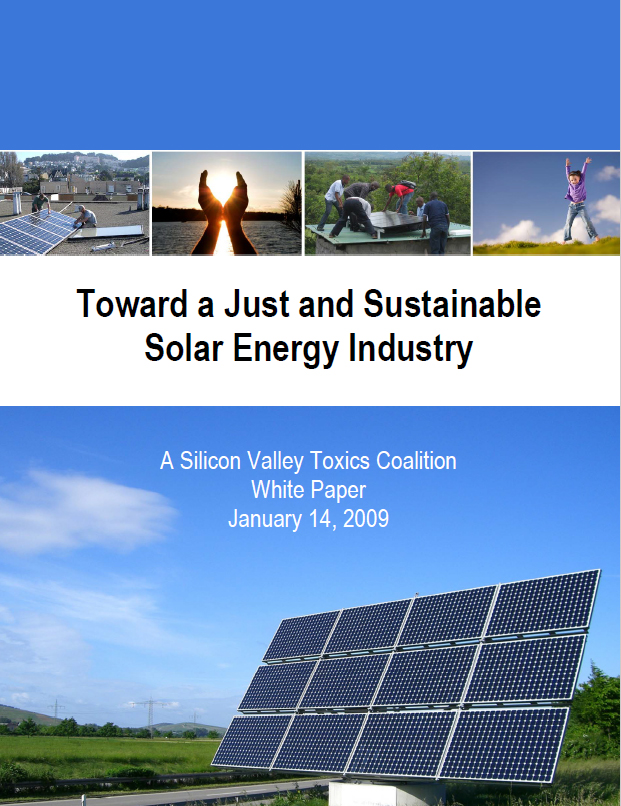
Towards a Just and Sustainable Solar Energy Industry

Towards a Just and Sustainable Solar Energy Industry - A Silicon Valley Toxics Coalition White Paper, January 14, 2009.

Every hour, enough solar energy reaches the Earth to meet human energy needs for an entire year. Solar photovoltaic (PV) technology is widely seen as a “win-win” solution that can harness this “free energy” to address global warming, reduce U.S. dependence on energy imports, create “green jobs,” and help revitalize the U.S. economy.

Solar energy will play an essential role in meeting these challenges, but as the solar PV sector expands, little attention is being paid to the potential environmental and health costs of that rapid expansion. The most widely used solar PV panels are based on materials and processes from the microelectronics industry and have the potential to create a huge new wave of electronic waste (e-waste) at the end of their useful lives, which is estimated to be 20 to 25 years. New solar PV technologies are increasing cell efficiency and lowering costs, but many of these use extremely toxic materials or materials with unknown health and environmental risks (including new nanomaterials and processes).

With the solar PV sector still emerging, we have a limited window of opportunity to ensure that this extremely important industry is truly “clean and green,” from its supply chains through product manufacturing, use, and end-of-life disposal. The solar industry has taken a leadership role in addressing the world’s pressing energy and environmental challenges and will serve as a model for how other innovative “green” industries address the lifecycle impacts of their products.

In this white paper, the Silicon Valley Toxics Coalition (SVTC) provides an overview of the health and safety issues faced by the solar PV industry, including the toxic materials used in manufacturing and the potential end-of-life disposal hazards of solar PV products. The report also lays out recommendations to immediately address these problems to build a safe, sustainable, and just solar energy industry. These recommendations include:

  • Reduce and eventually eliminate the use of toxic materials and develop environmentally sustainable practices.
  • Ensure that solar PV manufacturers are responsible for the lifecycle impacts of their products through Extended
    Producer Responsibility (EPR).
  • Ensure proper testing of new and emerging materials and processes based on a precautionary approach.
  • Expand recycling technology and design products for easy recycling.
  • Promote high-quality “green jobs” that protect worker health and safety and provide a living wage throughout the
    global PV industry, including supply chains and end-of-life recycling.
  • Protect community health and safety throughout the global PV industry, including supply chains and recycling.

Read the report (PDF)

Project Labor Agreements

By Dale Belman, Matthew M Bodah, and Peter Philips - ELECTRI International, January 15, 2007

Progressives believe in the labor movement. We support unions and believe that workers are entitled to a collective say in the terms and conditions of their employment, free from the arbitrary dictates of management.

But what if the management is you? When it comes to nonprofit (or “NGO”) social justice organizations—and the funders who help sustain the work—the response is often, “Yes, but…”

And what if you’re the union? When workers organize in a progressive nonprofit—even one that accepts unionizationthe approach is sometimes no different than it might be with a hostile or profit-making employer.

We, your authors, decided to undertake this guide because we were fielding a growing number of calls about organizations in crisis. Too often, groups we value were struggling to fulfill their important movement missions, while being shredded from within, often about issues of unionization. While we both have decades of experience in labor and NGOs--spanning a wide range of roles--we no longer serve as paid staff or leaders of any organization. Being without official portfolio, we thought we might be able to offer a resource to help move those conversations to a better place.

This guide is not meant as the final word on anything. Rather, consider it a rough, hand- drawn map to navigate some poorly-charted terrain. The perspectives and suggestions are offered in the spirit of strengthening the resilience and alliances of progressive forces-- and to get to a more definitive and satisfying “yes” on the issue of unionization.

Download a copy of this publication here (PDF).

The Ecological Challenge: Three Revolutions are Necessary

By Alternative Libertaire - 2006 [PDF File Available]

With a planetary ecological crisis on hand, it can no longer be denied that socialism will be incompatible with mass production and mass consumption. Indeed, even without returning to Malthusian catastrophe theories, we are forced to admit that the planet’s resources are not inexhaustible. These resources could provide for humanity’s needs, but only if they are used in a reasonable and rational way, i.e., in a manner directly opposed to capitalist logic, which in itself is a source of imbalance.

For decades, anti-capitalists have rightly raised the question of the “redistribution of wealth” between the Global North and Global South. This idea has commonly been imagined to mean an end to the pillage of the Third World by the advanced industrialized powers, so that the people of the Global South are able to attain an equivalent level of development. This demand, put simply, means that the South should catch up to the North’s “standard of living.”

But this old view is clumsy and over-simplified, since certain countries are already fully in the process of “taking their share” of the cake that is Planet Earth, and this is accelerating the destruction of the great ecological balances. The arrival of China and India as industrial, political and military powers obliges revolutionaries to rethink, from top to bottom, issues surrounding the model of development itself.

With a planetary ecological crisis on hand, it can no longer be denied that socialism will be incompatible with mass production and mass consumption. Indeed, even without returning to Malthusian catastrophe theories, we are forced to admit that the planet’s resources are not inexhaustible. These resources could provide for humanity’s needs, but only if they are used in a reasonable and rational way, i.e., in a manner directly opposed to capitalist logic, which in itself is a source of imbalance.

Your Nuclear Workplace: Know Your Risks, Know Your Rights

By staff - Nuclear Information and Resource Service, April 2006

A handy guide for workers in nuclear power plants, including information about PPE, and the (high) risks of employment in such facilities.

Read the report (PDF).

Radical Ecology and Class Struggle: A Re-Consideration

By Jeff Shantz (Toronto-NEFAC) - ca December 2002 [PDF File Available]

Introduction

In recent years a variety of social movement and environmental commentators have devoted a great deal of energy to efforts which argue the demise of class struggle as a viable force for social change (See Eckersley, 1990; Bowles and Gintis, 1987; Bookchin, 1993; 1997). These writers argue that analyses of class struggle are unable to account for the plurality of expressions which hierarchy, domination and oppression take in advanced capitalist or what they prefer to call "postindustrial" societies (See Bookchin, 1980; 1986). They charge that class analyses render a one-dimensional portrayal of social relations. The result of this has been a broad practical and theoretical turn away from questions of class and especially class struggle.

In my view, both orthodox Marxist constructions of class struggle and the arguments raised against that conceptualization have been constrained by conceptually narrow visions of class struggle. Commentators have either taken class to mean an undifferentiated monolith (Bookchin, 1986; 1987) which acts, or more often fails to act, as the instrumental agent in history or else as a fiction generated to obscure hopelessly divided and antagonistic relations within the working class (Laclau and Mouffe, 1985; Bourdieu, 1987). What is generally missing from these otherwise disparate accounts is a dynamic understanding of people as workers and workers as activists.

Indeed one might argue that much of the difficulty arises from arguments over the sociologically constructed working class (e.g. the Marxist "totality" which treats workers in a deterministic manner) rather than the working class in its variety of daily negotiated manifestations. While it is worthwhile to criticize the economistic construction of the working class as constituted by orthodox Marxism, the outcome of such critiques should not be a rejection of the central importance of class and the revolutionary implications of class struggle.

Will EVs Create Budget Potholes for States?: Economic Development Megadeals for Electric Vehicle and Battery Factories

By Greg LeRoy, with Kasia Tarczynska and Maja Ochojska - Good Jobs First, October 2022

In a megadeal spending spree like no other in U.S. history, states and localities have awarded more than $13.8 billion in economic development subsidies to at least 51 electric vehicle (EV) and EV battery factories. Many more dollars have certainly been committed to 53 more projects where incentives are not yet disclosed. Most of these deals have been approved since 2018, and many in just 2021 and 2022.

EVs are a necessary and vital climate-change solution, but these lavish new subsidies effectively amount to states taking credit for good news that is already unfolding. Decades of federal and state pro-EV investments and policies are paying off and the market is rapidly moving. Big factory-specific subsidies are wasting public dollars at a moment when states are flush with pandemic relief grants that should be used broadly, to make economies more resilient against future stressors.

Download a copy of this publication here (link).

Pages

The Fine Print I:

Disclaimer: The views expressed on this site are not the official position of the IWW (or even the IWW’s EUC) unless otherwise indicated and do not necessarily represent the views of anyone but the author’s, nor should it be assumed that any of these authors automatically support the IWW or endorse any of its positions.

Further: the inclusion of a link on our site (other than the link to the main IWW site) does not imply endorsement by or an alliance with the IWW. These sites have been chosen by our members due to their perceived relevance to the IWW EUC and are included here for informational purposes only. If you have any suggestions or comments on any of the links included (or not included) above, please contact us.

The Fine Print II:

Fair Use Notice: The material on this site is provided for educational and informational purposes. It may contain copyrighted material the use of which has not always been specifically authorized by the copyright owner. It is being made available in an effort to advance the understanding of scientific, environmental, economic, social justice and human rights issues etc.

It is believed that this constitutes a 'fair use' of any such copyrighted material as provided for in section 107 of the US Copyright Law. In accordance with Title 17 U.S.C. Section 107, the material on this site is distributed without profit to those who have an interest in using the included information for research and educational purposes. If you wish to use copyrighted material from this site for purposes of your own that go beyond 'fair use', you must obtain permission from the copyright owner. The information on this site does not constitute legal or technical advice.
