You are here

railroad workers

Capital Blight - Aristocracy Forever

That Green Union Guy - June 12, 2014

When the union leaders' payoffs by the bosses has begun,
There will be no labor trouble anywhere beneath the sun,
For the AFL trade unions and the management are one,
The union keeps us down.

Chorus
Aristocracy forever,

--lyrics excerpted from Aristocracy Forever, by Judi Bari

It happens far too often. Big corporate industrial polluters rape and pillage the Earth, whether by tar sands mining, fracking, mountaintop coal mining, offshore oil drilling, clearcut logging, and more. What's more, much of what they extract they export elsewhere, choosing to remove even the economic benefits of local production from the affected community. These corporations claim to be "good neighbors", but they suck up all the wealth (in the form of profits), and they outsource the costs to the community. And the workers who actually do the labor to produce all of this wealth? Not only are they not paid the full value of their labor, they're often the first to bear the brunt of the toxic pollution and chemical poisoning these companies create in their wake.

It's no wonder that time and time again we witness communities organizing and mobilizing opposition to this state of affairs, often assisted by environmental organizations of various types. What's curious, however, is how often the unions (if the workers in these facilities are fortunate enough to have union representation) defend the companies and even promote the companies' messages--even though it's ultimately not in the workers' interest to do so.

Casey Jones in #LacMegantic

Video and Song by J.P. Wright - Railroad Workers United, June 6, 2014

Disclaimer: The views expressed here are not the official position of the IWW (or even the IWW’s EUC) and do not necessarily represent the views of anyone but the author’s. J.P. Wright is a member of the IWW and Railroad Workers United.

Employees’ Complaints Against Canadian National Railway

By John Kristensen - Railroaded, May 20, 2014

Disclaimer: The views expressed here are not the official position of the IWW (or even the IWW’s EUC) and do not necessarily represent the views of anyone but the author’s.

On May 7, 2014, the U.S. Department of Labor and the Occupational Safety and Health Administration (OSHA) ruled Wayne Laidler had been wrongfully fired by Canadian National Railway (Times Herald). The case, considered a whistleblower lawsuit, stems from Laidler’s firing after he refused to exit his train to conduct an inspection of an oncoming train at a Flint, Michigan substation in December 2012.

Laidler argued, “But my train was stopped on a bridge. It was 3 a.m., it was dark, and it was foggy. It was not safe for me to climb out of my train, and onto the bridge to inspect the oncoming train. There was no safe place to stand.” The OSHA ruling agreed with Laidler’s claims. CN violated the Federal Railroad Safety Act, and has been ordered to reinstate Laidler with guaranteed pay and monetary compensation. He is to receive $92,916 in lost wages plus interest, $6,408 of lost vacation pay, $45,000 for the emotional stress of being wrongfully terminated, $100,000 from Canadian National Railway in order to discourage repetitive behaviour from CN, and an amount equal to his attorney’s fees.

Jessica Ballard, an African-American and former Canadian National Railway worker, is suing CN over alleged racial discrimination when she was fired in 2012 (Chicago Sun-Times). The lawsuit, filed May 15 in U.S. District Court, claims CN violated the Civil Rights Act and the Illinois Human Rights Act. Ballard alleges that a white female supervisor discriminated against her for about a year, manufactured examples of improper conduct, conducted “sham” investigations regarding minor infractions, and intentionally created a harassing and stressful work environment for Ballard. The lawsuit seeks an undisclosed amount in damages, reinstatement to her old job, or receipt of future wages she would have earned in her position before she was fired.

Mistrust, Disagreement Over Oil Terminal Plan Aired at Meeting

By Courtney Sherwood - Columbian, May 22, 2014

Disclaimer: The views expressed here are not the official position of the IWW (or even the IWW’s EUC) and do not necessarily represent the views of anyone but the author’s.

Controversial issue draws about 60 people

Mistrust and disagreement on the risks and benefits of a proposed Vancouver oil terminal were on display Wednesday night at a community meeting aimed at bringing all sides in the controversial issue together. And most of the mistrust seemed directed at Tesoro Corp. and Savage Companies, the two businesses that want to handle as much as 380,000 barrels at the Port of Vancouver.

Wednesdays event, convened by the East Old Evergreen Highway Neighborhood Association, brought representatives of those two companies together with BNSF Railway officials, property developers who oppose the Tesoro-Savage proposal, an environmental group representative, a longshore union leader, and emergency responders.

About 60 people attended. The Port of Vancouver, which instigated the Tesoro-Savage project by seeking out oil export proposals, originally said it would also participate but later backed out.

Barry Cain, CEO of Gramor Development, outlined details of the planned Columbia Waterfront LLC downtown Vancouver waterfront development and his concerns that oil exports could put that project at risk.

Cain estimated that plans for the former Boise Cascade mill site along the north bank of the Columbia River could ultimately generate $844 million per year in economic activity. After eight years spent developing the property, building roads and improving rail along the site, Columbia Waterfront proponents are in negotiations with restaurants, and could have plans for the first residential and office construction at the site soon, he said.

When we first heard about the oil trains, we thought, well, theyre probably not pretty, but we didnt think that was necessarily a problem, Cain said. Then in July, the accident happened at Lac-Megantic in Quebec. That killed 46 people.

CSX Train Carrying 8,000 Tons of Coal Derails in Company’s Second Wreck in 24 Hours

By Brandon Baker - EcoNews, May 1, 2014

Disclaimer: The views expressed here are not the official position of the IWW (or even the IWW’s EUC) and do not necessarily represent the views of anyone but the author’s.

A train derailed early Thursday morning in Bowie, MD marking the second derailment for CSX Corp. in 24 hours.

CSX spokeswoman Kristin Seay told the Associated Press that about 10 cars of the train traveling from Cumberland, MD to Bowie derailed Thursday. The train had three locomotives and 63 railcars, all of which were carrying coal. The train originated from a coal mine in Pennsylvania. 

The train was carrying about 8,000 tons of coal.

One of the train cars overturned, spilling its load of coal, but there were no injuries reported in the incident. CSX spokesman Gary Sease said the company would investigate the derailment. He said increased rain may have played a role, but it’s too early to say.

Federal Pipeline and Oil-by-Rail Regulator Making 9% Staff Cut, Confounding Experts

Federal Pipeline and Oil-by-Rail Regulator Staff Cut, Confounds Experts - Job cuts come at a time when PHMSA is struggling to regulate the nation’s aging pipeline network and new pipelines tied to the oil and gas boom.

By Elizabeth Douglass - Inside Climate News, April 24, 2014

Disclaimer: The views expressed here are not the official position of the IWW (or even the IWW’s EUC) and do not necessarily represent the views of anyone but the author’s.

If employees accept all of the available buyouts, PHMSA will shrink to a full-time staff of 386, putting it 112 jobs short of its approved payroll for the current fiscal year.
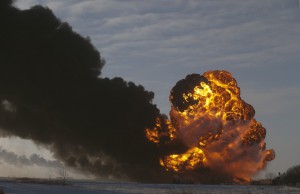
The federal regulator for petroleum pipelines and oil-toting railcars is offering employee buyouts that could shrink the agency’s staff by 9 percent by mid-June—a step that has confounded observers because the agency is widely regarded as being chronically understaffed.

Pipeline and Hazardous Materials Safety Administration (PHMSA) spokesman Damon Hill said the buyout offers are meant to “help the agency manage attrition in areas where a large and growing number of employees are eligible for retirement by offering an inducement for a limited number of employees to voluntarily retire or resign.”

Hill said PHMSA is continuing to hire in key areas at the same time. “I understand how some folks may be looking at [the buyout effort], but it’s part of an overall plan to retain expertise and plan for retention and things like that,” he said. “There is some good that comes out of this.”

Still, the job cuts come at a time when PHMSA is already under considerable duress. Politicians and the public have been pushing the agency to more rigorously regulate the nation’s aging pipeline network as well as the many new pipelines tied to surging domestic oil and natural gas production. A spate of damaging pipeline spills and oil-by-rail accidents is adding to the workload, exposing PHMSA’s shortcomings and intensifying scrutiny of the agency.

Official Tipped Off Hess Rail Yard About Oil-Carrier Inspection

By Cole Stangler - In These Times, April 29, 2014

Disclaimer: The views expressed here are not the official position of the IWW (or even the IWW’s EUC) and do not necessarily represent the views of anyone but the author’s.

Emails obtained by In These Times show a cozy relationship between North Dakota’s oil industry and a chief federal inspector charged with monitoring the safety of shipping crude oil by rail. The emails cast serious doubts on the integrity of the federal government’s supposed crackdown on the industry’s shoddy shipping practices—a subject of growing concern in the midst of a largely unregulated, and in some cases, deadly, transport boom.
Last August, the Pipeline and Hazardous Materials Safety Agency (PHMSA) and Federal Railroad Administration announced they were rolling out the “Bakken Blitz”—a crackdown on shippers and carriers that mislabel their cargo. Federal hazmat regulations require trains carrying oil to properly classify and identify their shipments with placards. These practices are supposed to ensure that oil is safely packaged before being shipped. They’re also aimed at informing railroad personnel and, in the event of a mishap, any emergency responders. Regulators introduced the Blitz just one month after the Lac Mégantic disaster, when a runaway freight train carrying oil exploded in the small Quebec town, killing 47 people. In that case, Canadian safety investigators found American shippers in North Dakota’s Bakken region had understated the volatility of the oil that ignited and destroyed much of Lac Mégantic’s downtown area. Improper classification caused the shipment to be transported in an improper package. Emergency responders, too, were caught by surprise at how quickly the fire spread and how long it burned.

As part of the Department of Transportation’s new enforcement effort, PHMSA officials show up unannounced at rail facilities to conduct classification inspections—at least that’s what an agency spokesperson told In These Times at first. An email obtained through a Freedom of Information Act request strongly suggests that Kipton Wills, Central Region Director of PHMSA's Office of Hazardous Materials Enforcement, pre-arranged at least one of his agency’s visits to a Hess Corp. rail yard in Tioga, North Dakota, last October.

“We will accommodate your request to inspect trucks at the Tioga Rail Terminal,” Jody Schroeder, the rail terminal supervisor, wrote in an email to Wills dated October 3, 2013—five days before the inspection took place. “At your convenience please let me know your schedule for this event.”

Schroeder later confirmed that Wills reached out to him about the visit.

Earlier this month, PHMSA spokesperson Gordon Delcambre told In These Times that such inspections are impromptu. “They’re unannounced,” he said. “[Inspectors] figure out who they’re going to visit ahead of time, make plans, go to the area and then start knocking on doors.”

Indeed, this is normal procedure. The agency’s handbook notes “the policy of the PHMSA hazardous materials enforcement program is to conduct unannounced inspections.” Exceptions can include cases of “apparent imminent danger to enable the company to correct the danger,” instances where special preparations, records and equipment are necessary, and cases where “giving advance notice would enhance the probability of an effective and thorough inspection.”

Read the entire article here.

How This U.S. Rail Safety Measure Has Been Delayed for 44 Years … And Counting

By Justin Mikulka - DeSmog Blog, April 30, 2014

Disclaimer: The views expressed here are not the official position of the IWW (or even the IWW’s EUC) and do not necessarily represent the views of anyone but the author’s.

On August 20, 1969, two Penn Central commuter trains collided head-on near Darien, Conn. Four people were killed and 43 were injured. The crash led the National Transportation Safety Board (NTSB) to recommend that railroads implement new safety technology called positive train control — a system for monitoring and controlling train movements to increase safety.

The NTSB first recommended positive train control in 1970. In 2008, after another fatal train collision that killed 25 people, Congress finally passed the Rail Safety Improvement Act, which mandated positive train control be implemented by the railroad industry by the end of 2015.

Fast-forward another six years to multiple congressional hearings in recent months, during which the railroads have informed Congress that positive train control simply won’t be implemented by the end of 2015. It’s been 44 years since the NTSB first recommended positive train control to improve rail safety in the U.S. and it is still not being used.

Looking at the way the positive train control scenario has played out for the past 44 years offers valuable lessons on how the U.S. is now dealing with safety regulations for shipping oil by rail.

Last week, the NTSB held a two-day forum on rail safety regarding the transportation of crude oil and ethanol. One of the main topics was how to improve rail tank car safety and what to do with the DOT-111 tank cars currently being used to ship crude oil and ethanol.

Much like positive train control, the NTSB has been recommending for decades that the DOT-111 tank cars not be used for ethanol and crude oil transportation due to the high risks they pose in derailments.

So why hasn’t anything been done? Mostly because of opposition by oil and gas industry groups, such as the American Petroleum Institute (API).

Arriving at May Day: Lockdowns, Throwdowns, and Direct Action

By the Earth First! Journal Staff - Earth First! Journal, May 1, 2014

Disclaimer: The views expressed here are not the official position of the IWW (or even the IWW’s EUC) and do not necessarily represent the views of anyone but the author’s.

When the Global Climate Convergence announced the Earth Day to May Day series of events and actions, it revealed a gap between daily reality and Hallmark posturing. More than 100 actions—such as the occupation of the DEQ in Portland, Oregon, by Rising Tide—have taken place in dozens of cities as part of the Climate Convergence.

Over the last few days, IWW fellow workers in California have protested the Koch Bros PetCoke Facility in Pittsburg, the Chevron Refinery in Richmond, and Crude by Rail at the Union Pacific’s Ozal Train Yard in Martinez.

One Wob organizer named Elliot Hughes U-locked himself to the gate of the Koch Brothers facility to halt business as usual. “Our goal is the liberation of the people on the planet that is our home. With the increasing amount of industrial disasters, we cannot wait any longer because the health and safety of all workers of the world is on the line.”

EF! shares numerous crucial membranes with the IWW and the labor movement, dating back to Judi Bari’s founding of the IWW timber workers local #1 in Northern California in the late 1980s. The goal of uniting loggers against Maxxam’s junk bond dealing, land grabbing, and clear cutting was to restore timber lands to the public interest. While some hardcore EF!ers were repulsed by the notion of chatting up loggers, let alone working to move timber lands into the hands of communities that would take part in “sustainable logging,” most agreed that the terms were vastly superior to clear cutting old growth.

Indeed, growth from the Redwood Summer movement at the turn of the 1990s fed the entire radical movement, developing critical understandings that would be cultivated and emerge in Seattle 1999 and again during Occupy. According to stories passed down to us over the years, activists being shot at in Northern California’s redwood forest by the same loggers they were trying to organize later on that night in the barroom would, ten years down the line, take part in the free states of Cascadia, and the No Borders Camp of the Sonoran desert five years later.

In the words of Buenaventura Durutti, “The bourgeoisie might blast and ruin its own world before it leaves the stage of history. We carry a new world here, in our hearts. That world is growing in this minute.” The inter-generational movement of Earth First! grows in the interstices of stories and ideologies, yet we often lag behind when it comes to social analysis.

Runaway Train: The Reckless Expansion of Crude-by-Rail in North America

By Lorne Stockman, et. al. - Oil Change International, May 2014

This report tracks the rise of crude-by-rail in North America, detailing where crude trains are being loaded and unloaded, how many trains carrying crude oil are crossing the North American continent, and who is involved in this burgeoning trade.

This reportis the first in a series covering North America’s booming crude-by-rail industry and is being published in conjunction with a unique interactive on line map of crude-by-rail terminals and potential routes.

Future reports in this series will look at the economics of crude-by-rail, safety, and climate change issues. Please see this site for the map and links to reports and data.

Read the report (English PDF).

Pages

The Fine Print I:

Disclaimer: The views expressed on this site are not the official position of the IWW (or even the IWW’s EUC) unless otherwise indicated and do not necessarily represent the views of anyone but the author’s, nor should it be assumed that any of these authors automatically support the IWW or endorse any of its positions.

Further: the inclusion of a link on our site (other than the link to the main IWW site) does not imply endorsement by or an alliance with the IWW. These sites have been chosen by our members due to their perceived relevance to the IWW EUC and are included here for informational purposes only. If you have any suggestions or comments on any of the links included (or not included) above, please contact us.

The Fine Print II:

Fair Use Notice: The material on this site is provided for educational and informational purposes. It may contain copyrighted material the use of which has not always been specifically authorized by the copyright owner. It is being made available in an effort to advance the understanding of scientific, environmental, economic, social justice and human rights issues etc.

It is believed that this constitutes a 'fair use' of any such copyrighted material as provided for in section 107 of the US Copyright Law. In accordance with Title 17 U.S.C. Section 107, the material on this site is distributed without profit to those who have an interest in using the included information for research and educational purposes. If you wish to use copyrighted material from this site for purposes of your own that go beyond 'fair use', you must obtain permission from the copyright owner. The information on this site does not constitute legal or technical advice.