You are here

railroad workers

Rail companies fight new rules to prevent crew fatigue: Leaked Transport Canada report details high levels of 'extreme fatigue' among freight train operators

By John Nicol and Dave Seglins - CBC News, October 8, 2014

Disclaimer: The views expressed here are not the official position of the IWW (or even the IWW’s EUC) and do not necessarily represent the views of anyone but the author’s.

Canada’s major freight rail companies are fighting moves by the federal transportation regulator to curb “extreme fatigue” among railway engineers, a CBC News investigation has found.

CN Rail, CP and the Railway Association of Canada went on the attack two weeks ago at a “tense and heated” meeting of industry, union and government representatives, according to a number of people present.

The conflict was over research by Transport Canada that found high levels of exhaustion among workers driving freight trains, and proposals by the regulator to impose new limits on scheduling to help reduce their fatigue.

"The body language from industry was, 'You're not going to push us around,'" said Rob Smith of the Teamsters Canada Rail Conference recalling a meeting two weeks ago of the Fatigue Management Working Group, part of the federal government’s Advisory Council on Railway Safety.

He said industry was determined to ​discredit Transport Canada's research and thwart the regulator's proposals.

CBC received internal documents

CBC News has obtained internal Transport Canada documents, including meeting minutes and the working group's draft report that details widespread fatigue among freight engineers and proposes mandatory restrictions — some of which are already law in the U.S. — on how workers are scheduled to prevent exhaustion.

The government report concludes that rail lags behind the airline and trucking industries in dealing with fatigue. Reviews over the last three decades have always left it to the railway industry and its unions to sort out the problem.

In 2009, the regulator established the fatigue working group to address this longstanding issue.

Transport Canada's own analysis of CN and CP’s employee scheduling records from six different rail terminals across Canada concluded that, based on the timing and length of each shift, assigned through an unpredictable on-call system, that “extreme fatigue” was rampant:

  • In four per cent of cases, employees were already “extremely fatigued” at the start of their shifts;
  • 45 per cent of employees became extremely exhausted during work;
  • and nearly all, or 99 per cent, were fatigued at least once during the month.

Combined with the results of a union survey, Transport Canada is now proposing enhanced safeguards and wants to harmonize Canada’s rail rules with requirements already in place in the U.S. that limit the hours and days railroaders can spend at work or on call.

Railroad Workers United Steve Klak speaks to Pullman, IL Labor Day 2014

By Steve Klak - Railroad Workers United Blog, October 8, 2014

Disclaimer: The views expressed here are not the official position of the IWW (or even the IWW’s EUC) and do not necessarily represent the views of anyone but the author’s.

120 years ago Eugene Victor Debs stood six blocks from here at Langley Park and pledged the support of his brand new union, the American Railway Union to the struggle of the Pullman car builders. The ARU had just decisively defeated the Great Northern Railway in 18 days preventing a 10% wage cut. Now, this same company the Burlington Northern Santa Fe, is demanding concessions just as drastic. I came here today to ask you to help these present day rail workers in this fight.

The Lac-Mégantic disaster: was it just the brakes? - The Big Problem with Letting Small Railroads Haul Oil

By Eric de Place and Rich Feldman - Sightline Daily, October 8, 2014

Disclaimer: The views expressed here are not the official position of the IWW (or even the IWW’s EUC) and do not necessarily represent the views of anyone but the author’s.

The disaster in Lac-Mégantic, Quebec—where 47 people were killed by a Bakken oil train derailment—is commonly understood to have resulted from a train slipping its brakes and then rolling downhill into town where it crashed disastrously. It was a tragedy, but it should not be considered just a mechanical accident.

In truth, it was a self-reinforcing chain of events and conditions caused by underinvestment, lack of maintenance, and staff cutbacks. And it’s a lesson the Northwest should heed because it illuminates the risks of allowing small regional and short line railroads to pick up unit trains of crude oil from bigger railroads like BNSF and transport them short distances to refineries and terminals. The Northwest is home to at least two small railroads with big oil-by-rail aspirations. One already hauls oil trains several times a week through Portland and small towns in northwest Oregon while the other, plagued by a string of recent derailments, aims to service no fewer than three terminals at the Port of Grays Harbor.

The story from Quebec—of what happened to the Montreal, Maine & Atlantic (MMA) railroad—is the story of a disaster waiting to happen. MMA was a regional railroad assembled in 2002 by a holding company from the assets of bankrupt Iron Road Railways, which owned four small railroads operating in Maine, Vermont, and Quebec. MMA had struggled financially from the start just as its major customers in the forestry industry also struggled. It went through a series of cutbacks to staff and maintenance.

Increased traffic from oil-by-rail was going to be MMA’s ticket to financial stability. Instead, following the Lac-Mégantic wreck, MMA was forced into bankruptcy, leaving billions of dollars of cleanup and damage costs uncovered by its minimal insurance.

What happened was this. MMA picked up the ill-fated oil train of Bakken crude from the Montreal yard of a big player in North American rail, Canadian Pacific (CP), and was transporting it to a refinery in New Brunswick. After passing through Lac-Mégantic, the engineer parked the train on a hill above town for the night. He is now accused of setting an insufficient number of hand brakes that were acting as a back-up to the train’s air-brake system and of not performing a brake test effectively. The hand brake issue only became a problem because locomotive 5017, which was powering the air-brake system for the entire oil train, was shut down.*

And the reason this locomotive was turned off? Because when it had caught on fire earlier in the night the responding firefighters had to turn it off.

And the reason this locomotive caught on fire? Chronic underinvestment by the railroad. According to court documents, MMA’s own employees point to underinvestment by the railway that led to the company using second-hand locomotives, operating rundown equipment, tolerating damaged tracks, and performing minimal maintenance. One worker testified that “he saw little maintenance done on locomotives and that locomotive 5017 was in particularly poor condition.”

Train Cars Carrying Undocumented Hazardous Materials Pose Risks

By Minnesota Public Radio News - Prarie Business, September 25, 2014

Disclaimer: The views expressed here are not the official position of the IWW (or even the IWW’s EUC) and do not necessarily represent the views of anyone but the author’s.

At least 18 times in the past three years BNSF Railway freight trains rolled west out of Minneapolis pulling cars filled with hazardous chemicals that were not on the trains’ official cargo list, according to train crew complaints.

That’s contrary to federal regulation because in case of an accident, local firefighters can be left in the dark, unable to take quick action to protect vulnerable residents.

In one case, a train traveled more than 20 miles through the western suburbs with six carloads of anhydrous ammonia, a toxic corrosive gas used as a farm fertilizer, before the train crew knew the chemical was on the train, a complaint said. In another, a complaint said a train traveled about 90 miles west to Willmar before its cargo list — called a manifest — was corrected to show an extra car of ammonia.

The complaints were filed with the Federal Railroad Administration, the federal agency that regulates railroads, and they provide a snapshot of one rail line across Minnesota, a BNSF Railway line from Minneapolis to Willmar. BNSF is the largest rail operator in Minnesota. Provided to MPR News by railroad union members, they are evidence of a problem the FRA said poses “unreasonable risks to health, safety and property.”

Hauling hazardous material without proper documentation is a problem federal officials have been aware of for years. When federal inspectors checked manifests of all rail haulers in Minnesota over a three-year period, one in five contained inaccurate information about cars hauling hazardous materials, according to FRA records obtained through a Freedom of Information Act request.

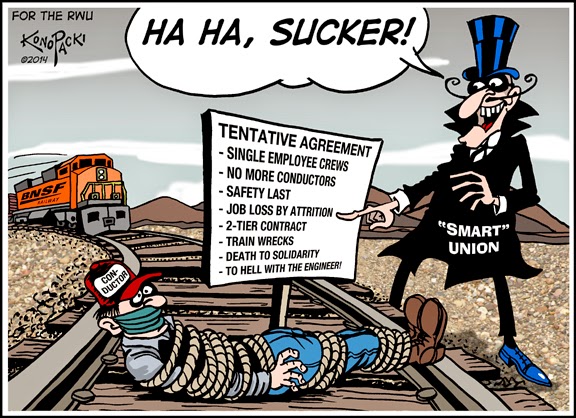
Blood on the Tracks: Saying No to Warren Buffett

By Guy Miller; image by Mike Konopacki - CounterPunch, September 26, 2014

Disclaimer: The views expressed here are not the official position of the IWW (or even the IWW’s EUC) and do not necessarily represent the views of anyone but the author’s.

The City of New Orleans by Steve Goodman is a loving tribute to an era gone-by. Steve mourned what he perceived to be ”the disappearing railroad blues.” He takes a nostalgic look back at an America that looks better through the sepia tones of memory than it actually was. Steve Goodman was unquestionably a great song writer, but for all that, he was a lousy economist. America’s railroads are anything but disappearing. Rather than a relic from another time, they are at the forefront of American capital’s plan for the 21st century. If you don’t live along the major corridors of rail traffic, it is easy to miss this vital aspect of the US economy.

For people that live in, or near, one of the cities that stretch from Boston to Washington, when they think about railroads at all, they generally think first about Amtrak. Everyone who uses Amtrak has a horror story to tell. Even the premium Acela train is seen as not measuring up to the trains of Europe or China. The primary reason high speed passenger trains aren’t a priority in the US is simple: freight traffic makes too damn much money. Wherever in the world there are fast and efficient passenger trains, freight traffic is secondary, or non existent. There was a time in the United States when freight traffic was shunted to the side to make room for passenger trains. To the major railroads that was a waste of time and money.

If high speed passenger service were to be successful two essential things would be needed: 1. Government subsidies (or better yet total nationalization) and 2. A huge upgrade in infrastructure. File the first requirement under the category of “come the revolution,” and the second under unlikely. The infrastructure is just fine for what the major carriers want to accomplish. They do not want, or need tracks, or roadbeds, that can safely move 15,000 tons of freight at 100 miles per hour, sixty MPH will do nicely, thank you. Building and maintaining the right-of-way is an expensive and labor intensive proposition. Even with cost-cutting machinery it is viewed by railroads as something to be kept to a minimum.

In the decade before the crash of 2008 railroad freight traffic exploded. From 1996 to 2006 railroad and truck traffic both grew, but railroad traffic grew faster. Using the metric of ton miles, the industry’s standard measurement, that decade saw rail traffic grow 25.1% and truck traffic grow 21.8%. This boom is still being fueled by the growth of “unit trains.” Unit trains, as opposed to manifest trains, are a one trick pony. For example a train consisting solely of crude oil, or grain or coal are of unit trains. Such trains go from point A to point B with no stops in between. No setting out a cut of cars in Podunk, Iowa or picking up cars of lumber in Rochester, Minnesota. Much of America has become not only flyover country, but also roll-by country as well. This contrasts with the once more common manifest train. Such trains required switching at various points along the route. This change brought with it the loss of thousands of switching jobs, those jobs did indeed go the way of Steve Goodman’s disappearing railroad.

After years of consolidation American railroad evolved into five large carriers. With the aid of this monopoly the railroads were on track for bigger and bigger payoffs. My old boss, the Union Pacific has over 32,000 miles of tracks resulting from mergers and takeovers. In the second quarter of 2014 the Union Pacific saw its profits jump 17%.  This in the midst of an economy that is, at best, sputtering along.

Railroad Worker Jen Wallis: "The Fence is Capitalism...It's Time to Take it Down!"

By Jen Wallis - exclusive, September 21, 2014

Disclaimer: The views expressed here are not the official position of the IWW (or even the IWW’s EUC) and do not necessarily represent the views of anyone but the author’s.

Editor's note: Jen Wallis meant to give the following speech at the People's Climate March in Seattle on Sunday, September 21, 2014, but had to abbreviate it due to time constraints. Here is the entire speech she would have given:

Hi my name is Jen Wallis, and I’m a founding member of Railroad Workers United. We are a rank-and-file caucus of the various national and international railroad unions. A few of us started this organization to respond to the decades of infighting created by the carriers to keep us divided.

I've been a conductor with BNSF Railway for over ten years. In 2008, I was injured on the job through no fault of my own. I was one of the first workers to file a whistleblower suit against a major railroad for retaliation for reporting a work-related injury. After 6 years of litigation, I won my case in Federal Court this past March, so I know a little bit about what it takes to fight corporations and what they will do to you and your family. I lost much of my support system, and I lost my house to foreclosure. And just as a side note, I first met Kshama Sawant when she showed up and got arrested for those of us fighting foreclosure. She is amazing!!! Over 1,000 railroaders who filed similar complaints have lost. I’m one of a handful to have won. The railroads have a lot of money to fight you, and they usually win.

I’ve taken it upon myself to use my victory to speak out for safety on the railroad because I’m one of the few people who can and not get fired for it, and I was actually in San Francisco speaking at a labor conference this past July when I got word that a group of unelected union officials from the conductor’s union had been meeting in secret with BNSF for 18 months, and unleashed a proposal that would have ended the job of the conductor on freight trains right here in my territory. My job. One person running trains at least a mile long through our communities where there have always been at least two, and engineer and a conductor. 140 years of railroading tradition gone with one contract. All the railroads would follow that precedent.

So we at Railroad Workers United went into what I can only call DEFCON 1 organizing. We had less than a month to mount a campaign to vote no before ballots were to be sent out. There were plenty of carrots in the agreement being dangled for the huge numbers of new hires we have, with things like “worker retention board” which claimed if you can’t hold a job, we’ll pay you to sit at home and not work, ending pay scale for new hires, and huge buy-outs for those getting close to retirement anyway. It was the standard concessionary agreement. Now those of us who have been in the game long enough knew these were only empty promises. We’ve seen enough of these broken in our careers, but the massive numbers of new hires did not, and we saw what scare tactics do at places like Boeing. Unions usually don’t defeat concessionary contracts, even when those companies are swimming in profits.

We knew we had to be bold, as bold as they were. I immediately started a FB group to protest the meeting in Sea-Tac where the officers would be to give us the hard-sell pitch. Now railroaders aren’t allowed to strike, and we haven’t done much in terms of organizing anything since 1894. You won’t find many of us who have ever so much as held a sign on a picket line. So I invited people who are more comfortable with holding signs - I invited my environmentalist friends I’d been trying to build alliances with these last couple of years - people from Backbone, from 350.org, Rising Tide, and members of the more radical unions like the Teamsters and Teachers and ILWU, and they showed up for us. Jess Spear showed up for us. The media we got in Seattle from that little picket inspired towns all across the country to follow suit. In places like Greybull, Wyoming and Creston Iowa, we got the spouses and families out there holding signs, (probably for the first times in their life), because they know our jobs and how terrifying it would be to have their loved ones out on these dangerous trains by themselves working under extreme fatigue in every kind of weather. We added over 2,000 new members to our facebook group in a month, distributed thousands of stickers and flyers and talking points. Many of us put our lives on hold and spent every waking moment organizing around this.

Finally, on September 10th, less than two months after we first got wind of it, the results were in. From the Gulf Coast to the Great Lakes to right here in the Pacific Northwest, our members voted that proposal down. It was one of the proudest moments of my life. But as sweet as that victory was, none of that means anything compared to this fight against climate change. I have a 9 year-old son. I read recently that by the time he is my age, at the rate we’re going, this planet will experience a mass extinction. Extinction! And I can’t help but wonder If I’ve really done enough to protect him from that future.

Now our recent victory was a huge inspiration to all of us. We now know what we have to do, and we know what it takes to do it. We understand completely now that we are fighting an industry that cares as much about us as they do the environment, which is not at all...It might seem a little scary for environmentalists to approach labor, and sometimes the feeling is mutual, but when my co-workers saw that tripod up in Everett with the sign that said “Cut Oil Trains, Not Conductors”, they were blown away. Nobody has stood up for us in a very long time. America has what I call an epidemic of fence-straddling. Most people like to be perched up there, listening to information from both sides and occasionally hopping down from one to the other based on the news we get or the friends we know or which side has the most money or slickest campaign. But my friends, the fence is an illusion. If we could all just step back for a minute and notice that big field we’ve been in together this entire time. The fence is capitalism and corporate plutocracy, and it’s time to take it down!!!

Rank-and-File Rail Workers Rebel Against Single-Person Crews

By Kari Lyderson - In These Times, September 15, 2014

Disclaimer: The views expressed here are not the official position of the IWW (or even the IWW’s EUC) and do not necessarily represent the views of anyone but the author’s.

Railroad workers scored a victory last week in a years-long battle over the introduction of single-person crews on freight trains, a move that railroad workers say is a recipe for disaster. On September 10, a unit of the International Association of Sheet Metal, Air and Rail Transportation Workers (SMART) union announced that members had voted down a proposed contract which would have allowed the railroad company BNSF to run more than half its trains with just one worker on board.

BNSF and other railroad companies assert that automation and modern controls on tracks mean freight trains can be safely and efficiently operated by only one engineer, a change that would essentially eliminate the position of the conductor.

Railroad workers, however, say that having only one person on trains that are often more than a mile long is a safety risk for workers and communities alike, especially as more and more trains are involved in carrying explosive crude oil cross-country. The introduction of single-person crews would further a longstanding push by industry to reduce the number of workers needed to operate trains; currently most freight trains have a conductor and an engineer, but in decades past crews of three to five people were common. An industry shift to single-person crews would likely mean significant job losses, and significant savings for railroads on labor costs.

Currently the major railroads like BNSF are not using single-person crews, but smaller railroads are. The July 2013 Lac-Megantic disaster in Quebec, in which a train derailed and caused a deadly explosion, brought increased scrutiny of single-person crews. 

The contract between the union and BNSF had been negotiated by a union leadership body known as the district committee, SMART GO-001, representing about 3,000 conductors, brakemen and switchmen in multiple states. Leaders of Railroad Workers United (RWU), a national organization that includes members from the country’s 13 different railroad labor unions, said that SMART GO-001 leadership had pushed for approval of the single-person crew provision, apparently as a way to gain other concessions from BNSF.

SMART’s national leadership opposes single-person crews, and supports proposed federal legislation on the issue. The Rail Safety Improvement Act (S. 2784) just introduced in the Senate on September 10, and the Safe Freight Act (HR 3040), introduced in August 2013 in the House, would require two workers on any freight train.

In a statement on SMART’s website, SMART Transportation Division President John Previsich says: “No one would permit an airliner to fly with just one pilot, even though they can fly themselves. Trains, which cannot operate themselves, should be no different.”

In an email notifying union members that the proposed contract had been voted down, SMART GO-001 committee general chairperson Randall Knutson said, “Moving forward, this office will notify BNSF Labor Relations that we remain open to informal conversation regarding these matters, but will oppose any formal attempt by BNSF to serve notice to change our existing crew consist agreements prior to the attrition of all protected employees.”

In other words, the leadership indicated that it would not cooperate with the company in pushing single-person crews any longer. Knutson’s email also said the leadership would be in touch with more details about the contract fight in coming weeks.

SMART GO-001 district committee leaders did not return a phone message or emails for this story.

The Battle has Just Begun!

By J.P Wright - Railroad Workers United Blog, September 13, 2014

Disclaimer: The views expressed here are not the official position of the IWW (or even the IWW’s EUC) and do not necessarily represent the views of anyone but the author’s.

I have been numb for a couple of days about "our" and "their" victory on the BNSF against a contract that would have allowed for one person trains. I feel like David has hit Goliath squarely on the face and yes... he is hit, and.... Railroad Workers United played a very serious roll in this campaign, but I am reluctant for our organization to take credit for the "action." While I do know that many of our activist, some who put their jobs on the line, were seriously helping to fan a flame that has long been smoldering, analysis and strategy is needed.

Who is Goliath?

Is it Warren Buffet, the Berkshire-Hathaway hedge fund owner of the BNSF railroad? Is it the "Business" union structure that created the environment that allowed this contract to come about? Is it a membership that has become very apathetic and reluctant to "get involved." Is it a Federal Railroad Administration that has historically been very reluctant to make strong regulations. Is it a "robber barron" industry that has long controlled Washington?

All of the above and more, is Goliath. Who is David? that is the question!

The motive of the railroad industry for decades has been a reduction of crew size. You can bet that the strategy sessions are going on at the labor relations level. There is a union political environment that is also at work here. This is a "war on workers" and there will be a "last man standing." The wheel of history is turning and there will be massive changes to work rules. There will be more battles to wage. There is a fire burning and we must keep it lit.

I am inspired, and i can feel it in my blood. There is a power that comes from a victory, but the forces we are up against are very,very powerful. The BNSF conceded, and said they will respect the workers mandate. But fellow railroaders don't be fooled. Remember from where this attack came. The union and the company, think about that.

It would be SMART to remember that the Brotherhood is at an impasse on the W&LE out in Ohio. Goliath has been on a rampage against 100 Teamster represented fellow railroad workers there for may years now. Now that the front has quieted in the west, shouldn't we turn our slingshots in that direction? If an arbi "traitor" settles that fight.. We are in serious trouble. The W&LE has not conceded.

Brothers and Sisters, Fellow Railroaders.. the fight ain't over.. it has just begun. In our hands is placed a power and there is no greater power than the union. Are you ready David? Goliath will be back.

Solidarity!

Bakken Bomb Trains: Hell on Rails

By x356039 - IWW Environmental Unionism Caucus, September 1, 2014

Disclaimer: The views expressed here are not the official position of the IWW (or even the IWW’s EUC) and do not necessarily represent the views of anyone but the author’s.

Over the past two years the volume of bakken crude oil, extracted from the tar sand fields of Alberta, Wyoming, Utah, North and South Dakota, has skyrocketed by an astonishing 900%. Thanks in part to the work of many brave communities in the line of fire and the logistical difficulties of building a continent-spanning pipeline the companies extracting this toxic material have sought out other methods for moving the volume of material they desire for export overseas to China and points beyond. The solution they have settled on is to move the bakken crude by oil trains, some stretching over a mile, owned by high-powered corporate captains of industry like Warren Buffett and Bill Gates from the point of extraction to the points of refinement and distribution.

They argue the materials being ripped from the Earth's crust are vitally necessary for energy independence and economic growth. What these self-interested short-sighted tycoons overlook is the truly massive cost in far more real terms than a mere bottom line such decisions are inflicting on people, communities, and the biosphere. In spite of the measured, massaged tones they use to assuage the fully-justified fears of the public there is little doubt the extraction, refinement, and movement of bakken crude by rail is a clear and present danger to all life in the path of these deadly horsemen.

The first and surest sign of the threat these bomb trains pose is the town of Lac-Megantic, Quebec. A small community located on Lake Megantic it is the sort of place, prior to the summer of 2013, one would never have expected to become associated with the worst rail disaster in Canadian history and one of the worst ever in North America. One fateful evening a bakken crude train was pulled off to a siding by its lone crew member so they could take a break from an extremely long shift and catch up on much needed sleep. During the night the brakes securing the train came loose and the train rolled off the track, tipping over and rupturing the tanks containing the highly volatile bakken crude. Thanks to the incredibly low flash point of bakken crude, due to the nature of the refining process, the entire train load went up in a flash obliterating a huge swath of Lac-Megantic. In the rushing inferno that followed 47 people's lives were mercilessly snuffed out, from young children to the elderly, without warning or any possibility of escape.

In the immediate wake firefighters from across Quebec and neighboring Maine were called in to bring the fires under control, do whatever they could for the survivors, and bury the dead. So great was the ferocity of the blaze following the disaster that nothing less than such a massive mobilization of emergency personnel would stand a chance. All were left stunned, shocked, and wondering how such a catastrophe could be visited on their homes with no warning of any kind. In the words of Tim Pellerin, fire chief for Rangeley, Maine, “It was like a World War II bombing zone. There was just block after block of everything incinerated. All that was left were foundations and chimneys. Everything burned. The buildings, the asphalt, the grass, the trees, the telephone poles. Just about everything was incinerated.” In the investigations following Lac-Megantic many facts came to light as to how so much harm could be caused, proving without question the devastation was no fluke but a very real, predictable possibility.

SMART Railroad Workers Rejection of Single Employee Crews is a Victory for Workers AND the Environment

By x344543 - IWW Environmental Unionism Caucus, September 14, 2014

Disclaimer: The views expressed here are not the official position of the IWW (or even the IWW’s EUC) and do not necessarily represent the views of anyone but the author’s.

On Tuesday, September 10, 2014, the rank and file union members of the International Association of Sheet Metal, Air, Rail & Transportation Workers (SMART) General Committee GO—001 overwhelmingly voted down a concessionary proposal to reduce train crew size from 2 to 1 by a margin of 2 to 1 against the proposal.

The proposed change would have resulted in conductorless train operations over more than half of the Burlington Northern Santa Fe Railway (BNSF), the second largest rail carrier in the U.S. According to Railroad Workers United, a coalition of rank and file union members from various railroad workers' unions, this was part of a campaign by the major rail carriers to weaken the already weak and divided rail unions further. Over the past half-century, the railroad bosses have taken advantage of the craft divisions among their workers to reduce crew sizes from a standard of 5 to 2. Now they're pushing to reduce that number to 1. The fact that BNSF was able to convince the leadership of one local to go along shows just how beaten down these unions are.

Fortunately, rank and file militants--some of them dues paying members of the IWW--formed RWU to beat back just such an offensive by the bosses, and--perhaps--turn the tide in what has hitherto been a one-sided class war waged against the workers by the bosses.

The RWU strategy mixed a whole variety of tactics, both old (including "silent agitators" and graffiti) and new (social media), many of them pioneered by the IWW:

Upon learning of the BNSF TA, RWU convened an “emergency meeting” of the Steering Committee and instantly mobilized the network. Thousands of buttons and sticker, flyers and leaflets, “Talking Points” and more were disseminated to BNSF railroad workers in the following weeks. A press release was issued that was picked up by a number of newspapers. RWU members spoke out on radio and TV stations, and organized rallies, pickets and demonstrations at numerous terminals, from large cities like Chicago and Seattle to small towns like Creston, Iowa. RWU members intervened in the debate at the SMART Convention in August, and held a series of telephone conference calls open to all railroad workers to voice their concerns, ask questions, and devise strategies and tactics. A regular e-newsletter with the latest flyers, leaflets, stickers, articles, songs, graffiti and cartoons were issued weekly.

In the end, the workers beat back the bosses attack, and this campaign should provide (the beginnings, at least, of) a model for rank and file workers in business unions to overcome entrenched bureaucratic interests that serve the bosses and not the workers. It can also serve as a model for the IWW's "dual card" strategy.

The vote was also a small victory for the environment and efforts to build bridges between environmental activists and workers. As has been widely reported, the accident that blew up Lac Magentic was the result of a single employee train, and while derailments involving two employee crude-by-rail trains have occurred, the chances of them happening are substantially greater if the crew size were to be reduced to one. Further, the push to reduce crew sizes is part of the ongoing efforts by the rail carriers to maximize their profits by cutting corners on labor costs, safety procedures, and best practices. The workers' victory will likely embolden them to take stronger stands against other initiatives by the bosses that would increase the risk of accident or derailment, and should the workers gain sufficient momentum, they can actually go on the offensive and force the carriers to increase safety, which will reduce environmental impacts significantly.

Pages

The Fine Print I:

Disclaimer: The views expressed on this site are not the official position of the IWW (or even the IWW’s EUC) unless otherwise indicated and do not necessarily represent the views of anyone but the author’s, nor should it be assumed that any of these authors automatically support the IWW or endorse any of its positions.

Further: the inclusion of a link on our site (other than the link to the main IWW site) does not imply endorsement by or an alliance with the IWW. These sites have been chosen by our members due to their perceived relevance to the IWW EUC and are included here for informational purposes only. If you have any suggestions or comments on any of the links included (or not included) above, please contact us.

The Fine Print II:

Fair Use Notice: The material on this site is provided for educational and informational purposes. It may contain copyrighted material the use of which has not always been specifically authorized by the copyright owner. It is being made available in an effort to advance the understanding of scientific, environmental, economic, social justice and human rights issues etc.

It is believed that this constitutes a 'fair use' of any such copyrighted material as provided for in section 107 of the US Copyright Law. In accordance with Title 17 U.S.C. Section 107, the material on this site is distributed without profit to those who have an interest in using the included information for research and educational purposes. If you wish to use copyrighted material from this site for purposes of your own that go beyond 'fair use', you must obtain permission from the copyright owner. The information on this site does not constitute legal or technical advice.