You are here

class struggle

The Irish water insurgency: no more blood from these stones

By Andrea Muehlebach - ROARmag, February 6, 2017

Cobh, the “Great Island” located just off Ireland’s Southern Coast, can be reached only via Belvelly Bridge, which was of strategic importance in 2014 when it became central to some of the most coordinated mass mobilizations that the island had seen in a long time.

When it became clear that the semi-state water company Irish Water was going to install household water meters in Cobh as it had done elsewhere already — meaning that Irish Water would come in with trucks, dig up sidewalks, hook up individual households with water meters and begin charging people for water — people revolted.

Standing guard on the mainland side of Belvelly Bridge, activists would text others standing guard at the other end of the bridge, alerting them to the approaching trucks and tracking the direction the trucks were taking. Many of the organizers were women, the elderly, and the unemployed — those who were at home during the day.

By the time the trucks arrived at their locations, people were often already waiting for them in groups, blocking the trucks’ entry into the estates, or crowding around them and imprisoning the workers. People simply would not budge. Women, men and children locked arms and sang. Blockages lasted for hours, sometimes even days, which meant getting organized into shifts and holding nightly meetings about everything from what to wear to who would collect the children from school and make food.

People set up tents and the estates started to compete with each other about who could make the best stews and sandwiches to feed the protesters. Striking red and white posters were stuck in windows that said “No Consent. No Contract. No to Water Privatization. No Water Meters Here.” As one water activist put it to me:

People had each others’ backs. Many of the working-class estates, not just in Cobh but all over the country, were in complete lockdown. We simply wouldn’t let Irish Water in. Communities, so alienated from each other and broken by poverty, evictions, unemployment, came together. It was magic.

Rebel Cities, Urban Resistance and Capitalism: a Conversation with David Harvey

By Vincent Emanuele - CounterPunch, February 1, 2017

Emanuele: You begin your book Rebel Cities: From the Right to the City to the Urban Revolution, by describing your experience in Paris during the 1970s: “Tall building-giants, highways, soulless public housing and monopolized commodification on the streets threatening to engulf the old-Paris… Paris from the 1960s on was plainly in the midst of an existential crisis.” In 1967, Henry Lefebvre wrote his seminal essay “On the Right to the City.” Can you talk about this period and the impetus for writing Rebel Cities? 

Harvey: Worldwide, the 1960s is often looked at, historically, as a period of urban crisis. In the United States, for example, the 1960s was a time when many central cities went up in flames. There were riots and near revolutions in cities like Los Angeles, Detroit and of course after the assassination of Dr. Martin Luther King in 1968 — over 120 American cities were inflicted with minor and massive social unrest and rebellious action. I mention this in the United States, because what was in-effect happening was that the city was being modernized. It was being modernized around the automobile; it was being modernized around the suburbs. Now, the Old City, or what had been the political, economic and cultural center of city throughout the 1940s and 50s, was now being left behind. Remember, these trends were taking place throughout the advanced capitalist world. So it wasn’t just in the United States. There were serious problems in Britain and France where an older way of life was being dismantled — a way a life that I don’t think anyone should be nostalgic about, but this old way of life was being pushed away and replaced by a new way of life based on commercialization, property, property speculation, building highways, the automobile, suburbanization, and with all these changes we saw increased inequality and social unrest.

Depending on where you were at the time, these were strictly class-inequalities, or they were class-inequalities focused on specific minority groups. For example, obviously in the United States it was the African American community based in the inner cities who had very little in terms of employment opportunities or resources. So, the 1960s was referred to as an urban crisis. If you go back and look at all the commissions from the 1960s that were inquiring what to do about the urban crisis, there were government programs being implemented from Britain to France, and also in the Untied States. Similarly, they were all trying to address this ‘urban crisis.’

I found this a fascinating topic to study and a traumatic experience to live through. You know, these countries that were becoming more and more affluent were leaving people behind who were being secluded in urbanized-ghettos and treated as non-existent human beings. The crisis of the 1960s was a crucial one, and one I think Lefebvre understood quite well. He believed that people in urban areas should have a voice to decide what those areas should look like, and what kind of urbanization process should take place. At the same time, those who resisted wished to roll back the wave of property speculation that was beginning to engulf urban areas throughout the industrialized capitalist countries.

Creating a Socialism that Meets Needs

By Sam Friedman - Against the Current, January 2017

THERE IS A growing suspicion among many people involved in movements against war, for social justice, and for an ecologically sustainable society that capitalism can only create a world of war, injustice and environmental destruction. There is widespread and growing understanding that the current social order cannot continue without catastrophe occurring —yet we lack a vision of what might replace it.

Karl Marx wrote relatively little about what he saw as a viable post-capitalist society. What he did write, however, has considerable value (Hudis 2012). Since Marx wrote his Critique of the Gotha Programme (1938) in 1875, we have had 140 years of additional experience, including watching the transformation of both the Russian Revolution and social democracy into the opposite of what was hoped for.

In addition, capitalism has had an equal number of years both to develop new technologies and to bring humanity and other species to the brink of many environmental disasters including global warming, acidification and overfishing of the seas, widespread degradation of soil and water quality and the threats from nuclear waste, nuclear accidents and nuclear war.

This article proposes a vision in which socially validated needs form the basis of production and in which democratic bodies resolve conflicts over whether a need is socially validated or harmful. This contrasts with ”market socialist” visions in which production continues on a commodity basis.

A model based on socially-validated needs should also provide a framework for coping with the emerging environmental crisis, which requires creating social solidarity and forms of politically-coordinated decision making in a system that does not require perpetual growth.

A number of authors have attempted to produce such a vision, including Alperovitz (2013), Alpert (2000), Schweickart (in Ollman 1998) and Wolff (2012). All of them suggest one or another form of worker self-directed enterprises that compete with each other, and some form of socially-directed investment, as the core for a new society. Explicit or implicit in what they propose is that production continues to be on the basis of workers of various sorts being hired to produce tangible or intangible commodities in order to sell them.

These authors argue that their model is fundamentally different from commodity capitalism and its needs to destroy the environment, create social injustice and create conditions that lead to global warfare. I am not going to attempt to argue against this claim of theirs here. (But see Friedman 2008; Hudis 2012; and Ollman 1998 for further discussion.) Instead, I want to offer a different view of what kind of new world we might aim for.

This article addresses these questions from a socialist perspective. It discusses the kind of world we might produce and how we might do it when and if the world working class(1) (which is the vast majority of the population) is able to take control over the world away from capital and its states.(2)

Let me add a disclaimer here: This paper does not attempt to resolve the question of how the working class (or “the 95%”) might oust capitalism from power.(3) This would require a book, not an article. Instead, in this paper, to provoke discussion and debate as widely as possible, I focus on what kind of society we might produce. Such discussion is needed to help the various movements of workers, communities, and others who are currently fighting the consequences of capital’s power to devise a clearer picture of what we are for.

Black Awakening, Class Rebellion

Keeanga-Yamahtta Taylor interviewed by George Ciccariello-Maher - ROAR Mag, December 2016

Keeanga-Yamahtta Taylor has written the most important book of 2016. Published by Haymarket, From #BlackLivesMatter to Black Liberation has struck a chord nationwide, garnering major awards but more importantly sparking necessary debates. Like all militant texts, it walks the fine line between Marx’s “ruthless critique of everything existing” — in this case, not only the white supremacist power structure, but also the abject failure of Black elites and the Obama “illusion” — and the revolutionary optimism coalescing in the streets from Ferguson to Baltimore and beyond. By showing us how we got here, to a society in which “colorblind” rhetoric provides cover for not only racist continuity but also the dispossession of the poor as a whole, Taylor’s book is a compass for charting a different course altogether. George Ciccariello-Maher interviews her for ROAR Magazine.

Justice in the Fields: A Report on the Role of Farmworker Justice Certification and an Evaluation of the Effectiveness of Seven Labels

By Kerstin Lindgren - Fair World Project, October 2016

A growing number of eco-social certifications are available on food products at a variety of retail locations. These certifications cover a range of environmental and social values and include claims like fair trade, humane, and environmentally friendly. As the historically invisible contribution of farmworkers in the agriculture system gains more attention, so too do the dangerous, often unsanitary conditions and low pay of farm labor. In recent years, eco- social certifications claiming to benefit farmworkers have emerged in response to this growing recognition. This has coincided with the decreasing prominence of and membership in labor unions, the traditional tool for addressing labor issues. The emergence of farmworker labels has also coincided, especially in the U.S., with the surge of wage victoriesat the state and local level, led by the Fight for $15 labor activists. Political advocacy, collective bargaining through worker associations, and social certifications can serve to reinforce each other to achieve the broad goals of fair pay and decent working conditions. This report looks at the role that certification can play and compares seven certification schemes.

Read the report (PDF).

While There Is A Soul In Prison

By Colin Bossen - Colin Bossen: Writer, Preacher, Organizer, August 28, 2016

Note: I recently have become involved with the Industrial Workers of the World's Incarcerated Workers Organizing Committee. I am serving as their contact person for faith-based organizing. It is a volunteer role and one of things that I am doing as part of it is preaching some in support of the September 9, 2016 National Prisoner Strike. The following sermon was the first I preached in support of the movement. I presented it at the First Parish in Needham, Unitarian Universalist, on August 28, 2016. 

It is a pleasure to be with you this morning. Your congregation features prominently in one of my favorite books of contemporary Unitarian Universalist theology, A House for Hope. John Buehrens, your former minister and the co-author of that book, has something to do with me being here today. He was a strong advocate for youth ministry when he was the President of the Unitarian Universalist Association. I had the good fortune to meet him when I was sixteen. He encouraged me both along my path to the ministry and my path to the academy. I also have fond memories of the worship services your present minister Catie Scudera led during her time at Harvard. And I congratulate in calling someone who will no doubt be one of the guiding lights of the next generation of Unitarian Universalists. So, there is a strange way in which even though I have never spent a Sunday with you before I feel as if I already know you a little.

Such familiarity, I suspect, is rather one sided. Most, of maybe all, just know me as the guest preacher. The last in the long line of summer preachers trying to bring a little spirit to Sunday morning before your regular worship services resume next month.

Now me, I am something of circuit rider. Right now I preach at more than a dozen congregations a year while I am finishing up my PhD at Harvard. As I travel around I have the privilege of getting something of the breadth of our Unitarian Universalist tradition. I think since I started in the ministry more than a decade ago I have lead worship at close to a hundred Unitarian Universalist congregations in the United States, Canada and the United Kingdom. Those congregations include the some of the largest and some of the smallest in our tradition.

My peripatetic career causes me to divide Unitarian Universalism crudely into two wings: the liberal and the abolitionist. Unitarian Universalism is occasionally called a liberal religion. This label refers to our understanding of human nature. Historically we have understood human beings to contain within them, in the words of William Ellery Channing, “the likeness to God.” As contemporary Unitarian Universalist theologian Rebecca Parker has explained, this does not mean that we think human beings are necessarily godlike. Instead, it suggests that rather than being born innately flawed or depraved, as orthodox Christianity has long taught, we are born with the capacity to choose and to become. Reflecting upon the suffering that we inflict upon each other Parker writes, “We are the cause and we can be the cure.” In this sense liberal religion means a recognition that much of what is wrong in the world was wrought by human hands. By joining our hands and hearts together we can, and we do, heal much of that harm.

I am not thinking of the liberal religion of Channing when I say that Unitarian Universalism can be crudely divided into two wings. I suspect that if you are here this Sunday morning your view of human nature is at somewhat similar to Channing’s and Rebecca Parker’s. Whether politically you are a Democrat or a Republican, an anarchist or a socialist, a liberal, libertarian or a conservative, if you are a Unitarian Universalist are a liberal religionist.

My division of our community into the abolitionists and the liberals focuses on our attitudes towards social reform. The majority liberal tradition believes in incremental and pragmatic social change. The social institutions and practices that exist, exist. When confronted with the intractable problems of America’s justice system liberals think the key question is: how can we make this system work better for everyone? How can we ensure that police are not racist? That everyone gets a fair trial and that prisons are humane?

Abolitionists demand the impossible. Rather than seeking to reform existing institutions they dream of creating new ones. Instead of asking how existing social institutions and practices can be reshaped they ask: what are those social institutions and practices for? In the face of a justice system that appears patently unjust they ask: Why we do have the system in the first place? What is its essential social function? Is it meeting this social function? Is this social function something we want met?

I place myself in the abolitionist camp. The essential difference between the two wings is that abolitionists see social institutions and practices as historically constituted while liberals take them as more permanent. A less fancy way to put that is that abolitionists think that the things we do and the institutions we create come from somewhere, will only last for so long, and will eventually be replaced by something else. Liberals focus on fixing what is now. Abolitionists imagine what might be.

Smoke and Mirrors: Lonmin’s failure to address housing conditions at Marikana, South Africa

By staff - Amnesty International, August 16, 2016

Since 2012 Amnesty International has commented and campaigned on the serious policing failures that led to the deaths at Marikana, calling for full accountability and reparations for the victims and their families. That work continues.

This report examines abuses of the right to adequate housing of mine workers at Lonmin’s Marikana mine operation. Its primary focus is an examination of Lonmin’s response to the findings of the Farlam Commission.

In this regard it looks both at what Lonmin has done and what the company has said about the situation.

Read the text (PDF).

What makes me tired when organising with middle class comrades

By Nicole Vosper - The Guardian, June 8, 2016

have many middle class friends and comrades whom I adore, this post certainly isn’t directed at everyone. But after years and years of organising, coming up against similar frustrations, and after lots of conversations between working class mates, I want to write about what is draining about working with some middle class activists.

It’s important to flag up that I’m writing this as a white, cis woman in England and I’m aware of the privilege that carries. I’m worried this piece will ignite a backlash, so I’m asking middle class folks that are triggered by this to perhaps talk to other middle class people and not email me about it. For once, please, just listen and reflect.

Also, because I want to be as constructive as possible, at the end of the post I’ve listed some of the character traits of middle class friends and organisers who don’t drive me up the wall.

Anyhow, here goes …

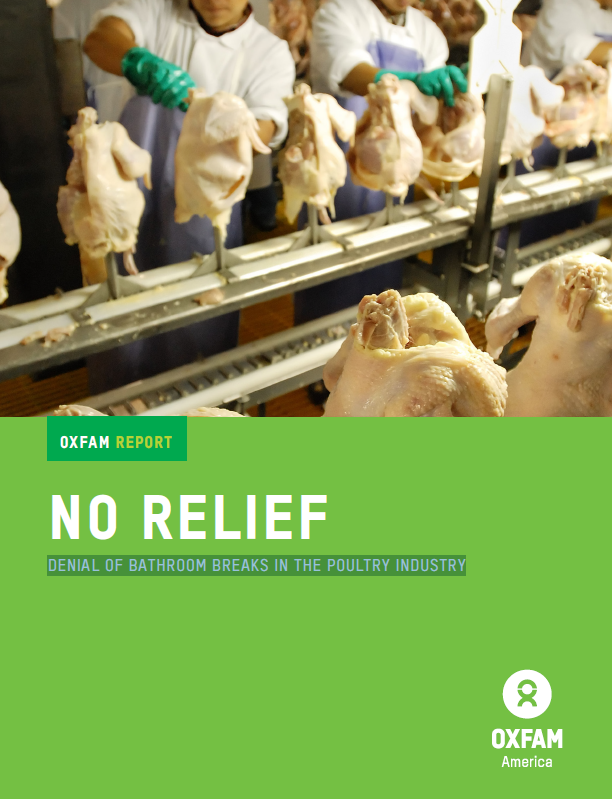
No relief: Denial of bathroom breaks in the poultry industry

By staff - OxFam, 2016

As poultry workers are routinely denied adequate bathroom breaks, they face dangers to their health and blows to their dignity.

While the poultry industry today enjoys record profits and pumps out billions of chickens, the reality of life inside the processing plant remains grim and dangerous. Workers earn low wages, suffer elevated rates of injury and illness, toil in difficult conditions, and have little voice in the workplace.

Despite all that, though, workers say the thing that offends their dignity most is simple: lack of adequate bathroom breaks, and the suffering that entails, especially for women.

Routinely, poultry workers say, they are denied breaks to use the bathroom. Supervisors mock their needs and ignore their requests; they threaten punishment or firing. Workers wait inordinately long times (an hour or more), then race to accomplish the task within a certain timeframe (e.g., ten minutes) or risk discipline.

Workers struggle to cope with this denial of a basic human need. They urinate and defecate while standing on the line; they wear diapers to work; they restrict intake of liquids and fluids to dangerous degrees; they endure pain and discomfort while they worry about their health and job security. And it’s not just their dignity that suffers: they are in danger of serious health problems.

The situation strikes women particularly hard. They face biological realities such as menstruation, pregnancy, and higher vulnerability to infections; and they struggle to maintain their dignity and privacy when requesting breaks.

Supervisors deny requests to use the bathroom because they are under pressure to maintain the speed of the processing line, and to keep up production. Once a poultry plant roars to a start at the beginning of the day, it doesn’t stop until all the chickens are processed. Workers are reduced to pieces of the machine, little more than the body parts that hang, cut, trim, and load—rapidly and relentlessly.By its nature, it is demanding and exhausting work.

But it does not have to be dehumanizing, and it does not have to rob people of their dignity and health.

Read the report (Link).

Pitch Black: The Journey of Coal from Colombia to Italy; the Curse of Extractivism

By various - Re:Common, April 2016

By presenting the horrors suffered under the domination of multinational companies, this work by Re:Common will dispel any lingering doubt that the current economic system based on extractivism is a war against the poor (what subcommander Marcos called the “Fourth World War”).

If someone who trusts the mainstream media and academic analyses thinks that at some point colonialism disappeared from the face of the Earth, this work, based on documents and testimonies, demonstrates otherwise.

For those who believe that progress is the most striking characteristic of our times, starting with the post-World War II period, the voices of the missing that populate these pages will convince you that present-day capitalism is a just a revamped version of the Spanish conquest of five centuries ago.

Throughout this work, all the variables of extractivism can be seen: from occupation of the territory and displacement of people to the role of the offshore banking and financial system, as two complementary and inseparable parts of accumulation by theft/dispossession. In the occupied territories, the displacement occurs in the form of war, with the participation of military, paramilitary, guerrilla and the greatest variety of imaginable armed actors.

The victims are always the weak: poor women and their children, elderly men and women, peasants, Indians, blacks, mestizos, the “wretched of the Earth,” as Frantz Fanon calls them. I want to emphasize, though it may seem anachronistic, and without reference to academic sources, how the extractive model coincides with colonialism, despite the different eras. This is not only due to the violent occupation of territories and the displacement of populations, but also to the salient features of the model.

Economically, extractivism has generated enclave economies, as it did in the colonies, where the walled port and plantations with slaves were its masterworks. This colonial/extractive model held populations 6 hostage in both 1500 and 2000.

Extractivism produces powerful political interventions by multinational enterprises, often allied with States, which manage to modify legislation, co-opting municipalities and their governors. It is an asymmetrical relationship between powerful multinationals and weak states, or better, states weakened by their own local elite who benefit from the model.

Like colonialism, the extractive model promotes the militarization of the territories, because it is the only way to eradicate the population, which, recalling Subcommander Marcos, is the real enemy in this fourth world war. Militarization, violence, and systematic rape of women and girls are not excesses or errors; they are part of the model because the population is the military objective.

To understand extractivism, we must consider it not as an economic model, but as a system. Like capitalism. Certainly there is a capitalist economy, but capitalism is not just the economic aspect. Extractivism (as stated by Re:Common) is capitalism in its financial phase and cannot be understood only as an economic variable. It implies a culture that promotes not work but consumption, which has (systemic) corruption as one of its central features. Put in another way, corruption is the extraction mode of governing.

Therefore, extractivism is not an economic actor; it is a political, social, cultural, and of course also economic actor. At this point, it’s crucial that the central part of this work describes human beings and the Earth as the subjects for looting, which is much more than the theft of the commons. Understanding dispossession only as robbery places property ownership at the center of the matter, in the place of people and land; e.g., life.

Read the text (PDF).

Pages

The Fine Print I:

Disclaimer: The views expressed on this site are not the official position of the IWW (or even the IWW’s EUC) unless otherwise indicated and do not necessarily represent the views of anyone but the author’s, nor should it be assumed that any of these authors automatically support the IWW or endorse any of its positions.

Further: the inclusion of a link on our site (other than the link to the main IWW site) does not imply endorsement by or an alliance with the IWW. These sites have been chosen by our members due to their perceived relevance to the IWW EUC and are included here for informational purposes only. If you have any suggestions or comments on any of the links included (or not included) above, please contact us.

The Fine Print II:

Fair Use Notice: The material on this site is provided for educational and informational purposes. It may contain copyrighted material the use of which has not always been specifically authorized by the copyright owner. It is being made available in an effort to advance the understanding of scientific, environmental, economic, social justice and human rights issues etc.

It is believed that this constitutes a 'fair use' of any such copyrighted material as provided for in section 107 of the US Copyright Law. In accordance with Title 17 U.S.C. Section 107, the material on this site is distributed without profit to those who have an interest in using the included information for research and educational purposes. If you wish to use copyrighted material from this site for purposes of your own that go beyond 'fair use', you must obtain permission from the copyright owner. The information on this site does not constitute legal or technical advice.