You are here

extractivism

Launch of the Ecosocial Energy Manifesto from the Peoples of the South

‘Transition is inevitable, but justice is not.’ A challenge to social movements in the rich countries

By staff - People and Nature, February 13, 2023

“Clean energy transitions” by rich countries of the global north are producing “a new phase of environmental despoliation of the Global South”, states a manifesto published last week by an alliance of social and environmental organisations.

“This decarbonisation of the rich, which is market-based and export-oriented, depends on a new phase of environmental despoliation of the Global South, which affects the lives of millions of women, men and children, not to mention non-human life”, the Manifesto for an Ecosocial Energy Transition says.

Women, especially from agrarian societies, are among the most impacted. In this way, “the Global South has once again become a zone of sacrifice, a basket of purportedly inexhaustible resources for the countries of the North.”

As the rich countries secure supply chains for these “clean” transitions, the web of debt and trade agreements in which countries outside the rich world are caught is tightened.

I hope that social movements and the labour movement in the rich countries will not only sign the manifesto (which you can do here), but also – probably more to the point – think about and discuss what it means for us.

Manifesto for an Ecosocial Energy Transition from the Peoples of the South

By Peoples of the Global South - Foreign Policy in Practice, February 9, 2023

An appeal to leaders, institutions, and our brothers and sisters

More than two years after the outbreak of the COVID-19 pandemic—and now alongside the catastrophic consequences of Russia’s invasion of Ukraine—a “new normal” has emerged. This new global status quo reflects a worsening of various crises: social, economic, political, ecological, bio-medical, and geopolitical.

Environmental collapse approaches. Everyday life has become ever more militarized. Access to good food, clean water, and affordable health care has become even more restricted. More governments have turned autocratic. The wealthy have become wealthier, the powerful more powerful, and unregulated technology has only accelerated these trends.

The engines of this unjust status quo—capitalism, patriarchy, colonialism, and various fundamentalisms—are making a bad situation worse. Therefore, we must urgently debate and implement new visions of ecosocial transition and transformation that are gender-just, regenerative, and popular, that are at once local and international.

In this Manifesto for an Ecosocial Energy Transition from the Peoples of the South, we hold that the problems of the Global – geopolitical – South are different from those of the Global North and rising powers such as China. An imbalance of power between these two realms not only persists because of a colonial legacy but has deepened because of a neocolonial energy model. In the context of climate change, ever rising energy needs, and biodiversity loss, the capitalist centers have stepped up the pressure to extract natural wealth and rely on cheap labor from the countries on the periphery. Not only is the well-known extractive paradigm still in place but the North’s ecological debt to the South is rising.

What’s new about this current moment are the “clean energy transitions” of the North that have put even more pressure on the Global South to yield up cobalt and lithium for the production of high-tech batteries, balsa wood for wind turbines, land for large solar arrays, and new infrastructure for hydrogen megaprojects. This decarbonization of the rich, which is market-based and export-oriented, depends on a new phase of environmental despoliation of the Global South, which affects the lives of millions of women, men, and children, not to mention non-human life. Women, especially from agrarian societies, are amongst the most impacted. In this way, the Global South has once again become a zone of sacrifice, a basket of purportedly inexhaustible resources for the countries of the North.

How To Combat The Cumbria Coalmine and Other Retrograde Energy Projects

An EV in Every Driveway Is an Environmental Disaster

By Alissa Walker - Curbed, January 25, 2023

“There is always a huge climate benefit — and, I would argue, a safety benefit — to ensuring people have access to excellent public transit,” Transportation Secretary Pete Buttigieg said earlier this month at the Transportation Research Board’s annual meeting. “Even if we weren’t aggressively working to decarbonize existing modes of transportation, that alone is one of the biggest and the best things we can do from a climate perspective.” This is the closest thing to a mic drop that exists at such an event, so the assembled transportation academics, urban planners, and civil engineers erupted into applause. Buttigieg had to pause, letting the hoots fade out before he could finish his remarks. He was onstage with Energy Secretary Jennifer Granholm to announce the first blueprint to decarbonize U.S. transportation by 2050, an unprecedented collaboration between the Departments of Transportation, Energy, and Housing and Urban Development and the Environmental Protection Agency to move the country away from using fossil fuels when, well, moving around.

Despite its many strengths, the blueprint is largely built around two things that have very little to do with what got Buttigieg the most applause from transit professionals: It’s heavily reliant on developing technologies that don’t exist yet and the Biden administration’s goal to have half of the new vehicles sold in 2030 to be electric (a figure closely negotiated with automakers). The latter point is perhaps why the slow but steadily growing number of electric vehicles, or EVs, sold in this country each year has become its own kind of shorthand for the decarbonization revolution. (“Electric Vehicles Keep Defying Almost Everyone’s Predictions,” “Electric Vehicle Sales Hit a Tipping Point in 2022,” “Electric Vehicles = 10% Of New Vehicle Sales Globally!”) A green future, the story goes, looks a lot like today — it’s just that the cars on the road make pit stops at charging stations instead of gas stations. But a one-for-one swap like that — an EV to take the place of your gas guzzler — is a disaster of its own making: a resource-intensive, slow crawl toward a future of sustained high traffic deaths, fractured neighborhoods, and infrastructural choices that prioritize roads over virtually everything else. And considering what it would take to produce that many cars, the vision being sold by the Biden administration about an EV in every driveway is more than just a fantasy — it’s an environmental nightmare.

A zero emissions future without the mining boom: A new report finds that the U.S. can reduce lithium demand by up to 90 percent

By Blanca Begert and Lylla Younes - Grist, January 24, 2023

The effort to shift the U.S. economy off fossil fuels and avoid the most disastrous impacts of climate change hinges on the third element of the periodic table. Lithium, the soft, silvery-white metal used in electric car batteries, was endowed by nature with miraculous properties. At around half a gram per cubic centimeter, it’s the lightest metal on Earth and is extremely energy-dense, making it ideal for manufacturing batteries with a long life. 

The problem is, lithium comes with its own set of troubles: Mining the metal is often devastating for the environment and the people who live nearby, since it’s water intensive and risks permanently damaging the land. The industry also has an outsized impact on Native Americans, with three-quarters of all known U.S. deposits located near tribal land. 

Demand for lithium is expected to skyrocket in the coming decades (up to 4,000 percent according to one estimate), which will require many new mines to meet it (more than 70 by 2025). These estimates assume the number of cars on the road will remain constant, so lithium demand will rise as gas guzzlers get replaced by electric vehicles. But what if the United States could design a policy that eliminates carbon emissions from the transportation sector without as much mining? 

A new report from the Climate and Community Project, a progressive climate policy think tank, offers a fix. In a paper out on Tuesday, the researchers estimated that the U.S. could decrease lithium demand up to 90 percent by 2050 by expanding public transportation infrastructure, shrinking the size of electric vehicle batteries and maximizing lithium recycling. They claim that this report is the first to consider multiple pathways for getting the country’s cars and buses running on electricity and suppressing U.S. lithium demand at the same time. 

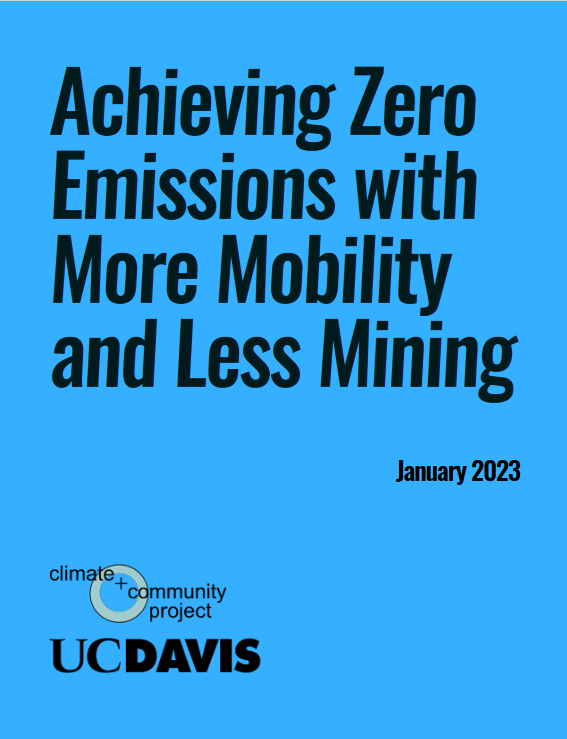
Achieving Zero Emissions with More Mobility and Less Mining

By Thea Riofrancos, Alissa Kendall, Kristi K. Dayemo, Matthew Haugen, Kira McDonald, Batul Hassan, and Margaret Slattery in partnership with the University of California, Davis - Climate and Community Project, January 2023

Transportation is the number one source of carbon emissions in the United States– making the sector crucial to decarbonize quickly to limit the climate crisis. States like New York and California banned the sale of gas cars by 2035 and the 2022 Inflation Reduction Act made major federal investments in electrifying transportation. As a result, US consumers are embracing electric vehicles (EVs), with over half of the nation’s car sales predicted to be electric by 2030. This is a critical juncture. Decisions made now will affect the speed of decarbonization and the mobility of millions. Zero emissions transportation will also see the transformation of global supply chains, with implications for climate, environmental, and Indigenous justice beyond US borders.

A crucial aspect of electrified transportation is new demand for metals, and specifically the most non-replaceable metal for EV batteries– lithium. If today's demand for EVs is projected to 2050, the lithium requirements of the US EV market alone in 2050 would require triple the amount of lithium currently produced for the entire global market. This boom in demand would be met by the expansion of mining. 

Large-scale mining entails social and environmental harm, in many cases irreversibly damaging landscapes without the consent of affected communities. As societies undertake the urgent and transformative task of building new, zero-emissions energy systems, some level of mining is necessary. But the volume of extraction is not a given. Neither is where mining takes place, who bears the social and environmental burdens, or how mining is governed. 

This report finds that the United States can achieve zero emissions transportation while limiting the amount of lithium mining necessary by reducing the car dependence of the transportation system, decreasing the size of electric vehicle batteries, and maximizing lithium recycling. Reordering the US transportation system through policy and spending shifts to prioritize public and active transit while reducing car dependency can also ensure transit equity, protect ecosystems, respect Indigenous rights, and meet the demands of global justice. 

Read the rest of the summary here.

Read the report (Link).

Carbon Removal Is Coming to Fossil Fuel Country. Can It Bring Jobs and Climate Action?

By Nicholas Kusnetz - Inside Climate News, December 4, 2022

Scientists have debated whether a new technology is a critical climate solution or would carry unacceptable risks. A project in Wyoming’s coal region could begin to provide answers.

ROCK SPRINGS, Wyo.—In early fall, residents of this desolate corner of southwestern Wyoming opened their mailboxes to find a glossy flyer. On the front, a truck barreled down a four-lane desert highway with a solar farm on one side and what looked like rows of shipping containers on the other. On the back was an invitation.

“CarbonCapture Inc. is launching Project Bison,” it read, announcing a “direct air capture facility” set to begin operations here next year. “Join us at our town hall event to learn more.”

Few had heard about the proposal before receiving the flyer, let alone had any idea what a direct air capture facility was. So the following week, about 150 people packed into a large classroom at Western Wyoming Community College in Rock Springs to find out.

“We are a company that takes CO2 out of the air and stores it underground,” said Patricia Loria, CarbonCapture’s vice president of business development, in opening the meeting.

Loria described a plan to deploy a series of units—the shipping container-like boxes pictured on the flyer—that would filter carbon dioxide from the air and then compress the greenhouse gas for injection underground, where it would remain permanently.

2022 Oil Change International Supporter Briefing

Understanding the Impacts of Hydrogen Hubs on EJ with The Equity Fund

Pages

The Fine Print I:

Disclaimer: The views expressed on this site are not the official position of the IWW (or even the IWW’s EUC) unless otherwise indicated and do not necessarily represent the views of anyone but the author’s, nor should it be assumed that any of these authors automatically support the IWW or endorse any of its positions.

Further: the inclusion of a link on our site (other than the link to the main IWW site) does not imply endorsement by or an alliance with the IWW. These sites have been chosen by our members due to their perceived relevance to the IWW EUC and are included here for informational purposes only. If you have any suggestions or comments on any of the links included (or not included) above, please contact us.

The Fine Print II:

Fair Use Notice: The material on this site is provided for educational and informational purposes. It may contain copyrighted material the use of which has not always been specifically authorized by the copyright owner. It is being made available in an effort to advance the understanding of scientific, environmental, economic, social justice and human rights issues etc.

It is believed that this constitutes a 'fair use' of any such copyrighted material as provided for in section 107 of the US Copyright Law. In accordance with Title 17 U.S.C. Section 107, the material on this site is distributed without profit to those who have an interest in using the included information for research and educational purposes. If you wish to use copyrighted material from this site for purposes of your own that go beyond 'fair use', you must obtain permission from the copyright owner. The information on this site does not constitute legal or technical advice.