You are here

green unionism

Mill Workers Exposed

By Daniel A. Faulk – Hard Times, February 1983

Michael Welch lived in Humboldt County for the past eleven years. Since 1975, Welch worked in local lumber mills as a laborer, chipper tender, and apprentice millwright.

While working at McNamara and Peepe’s Arcata mill last year, Welch was asked to work with lumber being dipped into Pentachlorophenol—an anti-fungicidal agent used to prevent discoloration of milled fir.

According to Welch, the lumber to be treated is secured to a forklift using fabric straps which absorb pentachlorophenol when dipped into a treatment tank. After dipping, the workers unstrap the soaked wood and attach another load. Welch states, “It is impossible to unstrap or strap on a load of lumber without coming into contact with this chemical.” Indeed, gloves and aprons are usually provided to workers performing this function, but these, Welch states, “are generally inadequate protections.”

On the night Welch was requested to perform the strapping task, no gloves were available. And, when Welch questioned the safety of working on the dipping process without gloves, the manager told him that “this stuff is completely safe, you could take a bath in it.”

It is interesting to note that OSHA requires signs to be posted around dip tanks using this chemical, warning workers to be very careful in handling this poison. These signs were posted at McNamara and Peepe until a few months before Welch was asked to help with the dipping process—but Welch says the signs were removed “some months back, without explanation”.

Welch ended up refusing to do dip tank work, but other workers are not so cautious or assertive. Noting the high unemployment rate in the area, many workers feel such a refusal could cost them their jobs.

The workers who do work on the dip tank rou-tinely get the chemical on their clothes, breathe the fumes from the uncovered dip tank and work with gloves that are drenched and leak.

An increasing amount of evidence, moreover, suggests that taking a bath in pentachlorophenol, or even breathing the fumes regularly, may be very ha-zardous to a mill worker’s health.

The U.S. Labor Department has found that pentachloro-phenol dust and vapors, even in very small doses, causes head-aches, dizziness, nausea, vomiting, and respiratory dysfunction.

Studies also indicate that the chemical is a muta-gen (causes birth defects) and may cause cancer as well. One of the most dangerous parts of pentachlo-rophenol is dioxin, TCDD, which has been directly linked to numerous health hazards. Many Vietnam veterans are still suffering from their exposure to “Agent Orange” which was also polluted with TCDD.

Pentachlorophenol is not isolated in one Arcata mill. It is in widespread use throughout the timber industry.

Workers are exposed daily to the chemical’s dangers and many are developing sub-fatal, short-term reactions. These people may become long-term fatalities.

Mike Welch observed at least one case of what he believes represented chronic, if not acute, exposure at McNamara and Peepe’s. One of Welch’s fellow workers who had been working at the dip tank for over a year complained to Welch of losing the feeling in his fingers.

Later, other complaints followed, which Welch recalls included “constantly irritates eyes, reoccurring feelings of dizziness and nausea. Despite these not so subtle indicators of potential poisoning, when Welch left the mill to move south, the dip tank worker was still working at the same job.

Needless to say, workers in Humboldt County are not the only timber workers exposed to anti-fun-gicides like pentachlorophenol. Surveys in both the U.S. and Canada indicate a significant incidence of toxic and even fatal reactions to these chemicals. In Canada, labor unions and labor organizers are lob-bying to enclose the pentachlorophenol process and to ban the chemical completely. Here in Humboldt County, we should do the same.

Log Export History: Mill Jobs Exported

By Edie Butler - Hard Times, Vol. 3, #1, February 1983

Observing the frequent loading of logs on ships, during daily drives past Fields Landing several years ago, aroused in me a strong curiosity about the exporting of logs. At the same time as I was so frequently driving past this docking facility, the expansion of Redwood National Park, and its potential impact on the local lumber mills, was a very big news item and the controversy was evident everywhere in the community. Why, I asked, are these logs being exported, in their raw resource form, from an area where steady employment is already a problem and, if the dire forecasts about the (Redwood) Park expansion are to be believed, there will be a much greater problem in the future? As I raised this question with a wide variety of people over the ensuing months and years, I concluded that the average citizens of Humboldt County has very little understanding of the log exporting matter.

Local Self-Sufficiency

This matter takes on added historical significance when viewed against the backdrop of the economy of this area from the last 1800’s on to the present day. At one time Humboldt County was largely self sufficient and the resources available here were, to a large extent used and manufactured here. Some examples of the diversity of Humboldt County industry are the following businesses which are listed in a 1895-96 Business Directory: Arcata Tannery, Eureka Brewery (with the slogan of “Patronize Home Industry and Call for Eureka Beer”), Eureka Bicycle Factory, Humboldt Mineral Water, Bendixin Shipbuilders, twenty-two creameries, three dairies, twelve milliners and fancy goods, and fifteen shoemakers. [1] A 1902 map of Eureka has a border of pictures of prominent buildings, among which are Jackson’s shirt Factory, Eureka Foundry, and Humboldt Bay Woolen Mills.

Bit by bit these industries have withered and a pattern of exporting of resources and importing of products can be seen. There is no longer a woolen mill to process the wool produced locally. While most fish is processed locally, shrimp is sent to an automated picking plant in Santa Rosa and foreign processing ships buy hake directly from fishing boats.

Hides from local cattle are sent out of the area for tanning. These are but a few examples of this trend. (At this point mention should be made of the many industrious and sincere people who are currently working to reverse this trend and reestablish a broad economic base of small industries. They have had some impact and show promise for the future.)

IWA Demands Safe Jobs and Clean Water

By Tim Skaggs, Business Agent, IWA Local 3-98 - reprinted in Hard Times, February 1983

This speech was given at a hearing of the North Coast Regional Water Quality Control Board in December of 1982.

My name is Tim Skaggs. I am Past President and now Business Agent of the International Woodworkers of America, Local 3-98.

In March of this year, the governing body of International Woodworkers of America resolved that the continued use of Phenoxy herbicides in place of manual conifer release has an adverse effect upon employment opportunities in the Pacific Northwest.

If we look at the historical record, we find that the practices of timber companies have been extremely poor and irresponsible. Outrageous forest practices led to the adoption of regulations to protect the water, wildlife, and the multiple uses of public and private lands.

Massive clear cutting caused substantial erosion and stream siltation, resulting in a loss of water quality. Indeed the use of herbicides is directly related to the reliance upon clear cutting as the primary method for timber harvesting.

Most importantly, and least understood, is the acquisition of additional lands from timber interests to expand Redwood National Park. This move has cost us all dearly, with the exception of timber interests. The workers have suffered, but in a good cause. These lands were purchased to insure the continued existence of old growth redwood and to do the restoration work needed to prevent the eventual death of Redwood Creek from siltation. The park, a public project, was created to do what timber corporations refused to do: treat the land and water responsibly.

It is important to note that the industry refused to change their methods until they were forced to do so by public pressure and regulation. It appears that the major motivation for the timber industry is profit regardless of the expense to the community, workers, and the environment.

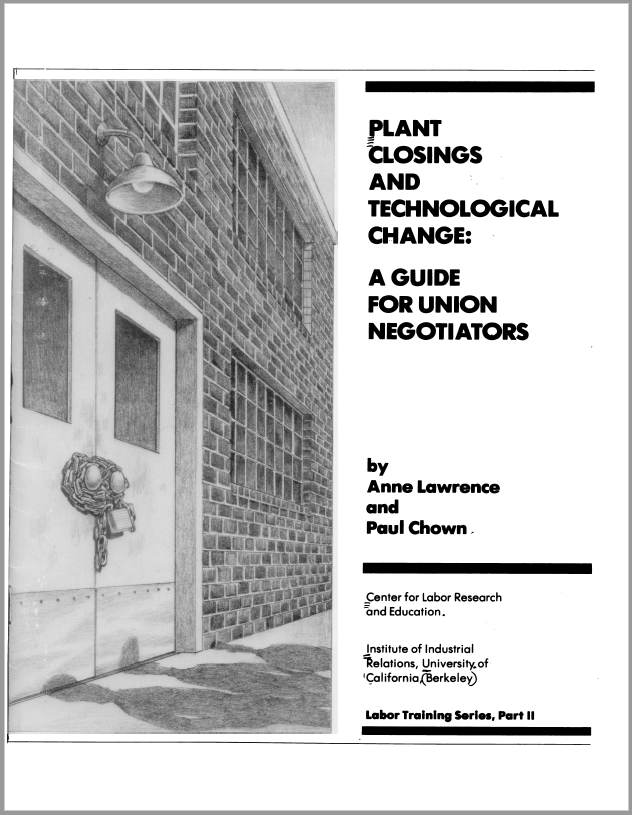
Plant Closings and Technological Change: A Guide for Union Negotiators

By Anne Lawrence and Paul Chown - Center for Labor Research and Education, Institute of Industrial Relations, University of California (Berkeley), Date Uncertain, likely early 1980s

American industry today is under going a massive transformation which gravely threatens the job security, wages, and benefits of union workers. Economic recession, the flight of capital overseas, and to low wage areas, the declining competitiveness of domestic industry, and the introduction of labor saving technologies are producing an epidemic of plant closings and layoffs.

The problem of plant closures is stunning. The federal government does not count shutdowns directly, but estimates based on private research data show that over four million jobs a year were lost in the early 1970s as a result of plant closings and migrations. For every ten large manufacturing plants open in 1969, three had closed by 1976. No single area of the country was spared. Since then, hundreds of thousands more workers -- from steelworkers in Lackawanna, New York, to insurance company data processors in San Francisco; from autoworkers in South Gate, California, to tire builders in Akron -- have joined the victims of plant closings.

Technological change also poses a major threat to workers' job security. The development of the microprocessor, or "computer on a chip," has made possible an unprecedented transformation of the workplace. Electronic scanning devices at the supermarket, word processors in the office, electronic transfer of mail at the post office, robots on the assembly line, and numerically controlled machine tools in the shop threaten the jobs of the checkout clerk, secretary, postal clerk, autoworker, and machinist. Business Week has estimated that within the next decade, new technology may transform as many as 45 million jobs, half of them now unionized. As many as 25 million of these jobs may be completely eliminated.

Faced with the major job losses caused by plant closings and technological change, many unions have sought through collective bargaining to check further layoffs and lessen the hardship for those who are already out of work. Job security has always been a major concern of union negotiators. But today, with the highest unemployment since the Great Depression, it has moved to the top of the bargaining agendas of many unions. Provisions such as advance notice of shutdowns and layoffs and restrictions on management's rights to close plants, transfer work, and displace or downgrade workers are increasingly being used by unions to prevent or postpone layoffs. For workers who lose their jobs, unions are seeking improved severance pay, extension of health care benefits, transfer rights, and retraining assistance.

This manual is designed as a practical guide for union negotiators responsible for bargaining contract language on issues related to plant closings, transfer of operations, and technological change. The manual is organized by contract clause, such as advance notice or severance pay. Each section contains an introduction to the major bargaining issues and a checklist of items negotiators may wish to cover. The manual then provides samples of actual contract clauses recently negotiated by unions in a variety of different industries. Model clauses, included for each topic, may be used by negotiators in framing their own proposals for contract bargaining.

Read the report (PDF).

Green Bans: Worker Control and the Urban Environment

By Mark Haskell - Industrial Relations, May 1977

Australian trade unions, have long made effective use of the “black ban,” that is, the tactic of boycotting employers and others in order to improve wages or working conditions or to implement political goals. During the Indonesian struggle for independence shortly after World War II, longshoremen placed bans on shipments to and from the Netherlands, More recently arms shipments to South Vietnam were boycotted and an Australian Council of Trade Unions (ACTU) black ban was imposed on French shipping to protest nuclear weapons testing in the South Pacific.

In 1971, the black ban was transposed into the “green ban” when the New South Wales branch of the Builder’s Labourers Federation (BLF) agreed to boycott a construction project in Hunter’s hill, an upper-middle class area on the Paramatta River, an arm of Sydney Harbor. In September 1970, residents of that area had organized to oppose the construction of 25 luxury homes in Kelly’s Bush, an eight-acre bushland tract which had been preserved in its natural state. The tract had been zoned as “residential” just one year earlier despite widespread community opposition. After unsuccessful attempts to interest the state in purchasing the land for recreational purposes, the newly organized group, the “Battlers for Kelly’s Bush,” approached the New South Wales BLF to request that they not work on the construction site. Construction was halted and, despite the subsequent demise of the New South Wales branch in 1975, this green ban remains in force.

Thus emerged an unlikely collaboration between community groups struggling against drastic neighborhood changes and traditionally job oriented trade unionists - a merger which has often been labeled “unique” and may, in fact, have been the product of a special set of circumstances. On the other hand, the green bans do have the possibility of becoming an example for others. This paper is an attempt to analyze this movement for the purpose of providing an explanation for its appearance at a particular time and place. Part of that explanation may lie in the nature of the union which was most heavily involved, i.e., in the characteristics of its leaders, its members, and the way in which the union’s affairs were managed. Hence, the line of questioning will focus on the New South Wales BLF-i.e. why this union adopted this unconventional tactic to achieve this unconventional goal.

Read the entire document (PDF File).

The Lucas Aerospace Combine Shop Stewards Committee Corporate Plan (The Lucas Plan)

By Lucas Aerospace Combine Shop Stewards Committee - 1976

This Corporate Plan was prepared by the Lucas Aerospace Combine Shop Stewards Committee for that section of Joseph Lucas Industries which is known as Lucas Aerospace.

If a brief description of Lucas Industries is provided this gives an economic, technical and company background against which the performance and potential of its wholly owned subsidiary, Lucas Aerospace, can be viewed. It was also felt desirable to do so as some of the alternative products proposed elsewhere in this report, although emanating from aerospace technology, could more appropriately be handled, at the manufacturing stage, by production techniques and facilities available elsewhere ln the Lucas organisations.

Our Lives Are at Stake: Workers Fight for Health and Safety (the Shell Strike of 1973)

By Berry Weisberg - OCAW 1-591, July 1973
Background Information by Douglas W. Erlandson - USW Local 12-591

On January 21st, OCAWIU President Bob Grospiron called over 4000 Shell OCAW members from 5 oil refineries and 3 chemical plants, out on strike. Then made a nationwide appeal to the public to boycott Shell Oil while the union continued its fight over the right to bargain health and safety issues.

The union was seeking:

  • 1) The establishment of a Joint Union-Management Health & Safety Committee
  • 2) Wanted the Union committee workers paid while performing official committee duties
  • 3) The right to call in independant Health & Safety inspectors
  • 4) Access to all Company information on both death and disease rates
  • 5) Annual Company medical examinations provided at Company expense

As a tactic for the 1973 strike, OCAW employed the first major "corporate campaign" in U.S. history. OCAW forged alliances with the scientific, academic, environmental and labor communities to fight Shell’s position that it would not bargain over health and safety. The union spent nearly half a million dollars to advertise a nationwide boycott of Shell and to educate the public about the need to protect the health of workers and the communities.

Even though 12 other major oil companies had already signed contracts that provided for the new joint union- management health and safety committees, they assisted Shell by buying their gasoline and blacklisting Shell's strikers. The oil industry's thinking was the new joint H&S committees would get in the way of production and profits.

Shell's corporate spokesman, J.H. Walter called the unions joint H&S committee 'another attempt at featherbedding since the workers could then decide how long they could safely work in the refineries and chemical plants.

Moreover, Shell stated that health & safety was none of the oil workers' business: "We are legally responsible for the health and safety of Shell employees in the workplace and this responsibility cannot be shared". The truth was the oil companies didn't want to give up control in this area.

From 1963-1969, Shell used caged canaries as 'safety devices' at their Houston chemical plant.(true story, no joke!) The canary's job was to detect the presence of carbon monoxide. If the canary died, it was time for the workers to leave. Shell went through a lot of canaries, OCAW was claiming by the time the canary died, the workers would already have been exposed.

The union was also seeking the right to inspect company records and financial reports of the pension funds Shell administered and to be able to grieve the company's arbitrary actions with regard to disability pensions. (The union suspected Shell's pension fund was under funded.) One Anacortes member who worked for Shell for 17 years, was certified by two doctors as being disabled, yet Shell wouldn't allow him disabled benefits even though he met the 15 year employment requirement. For the union, this was an item that needed to be addressed.

The International Representative assigned locally was Virgil Coragliotti, with Representative Tom Burkholder assisting on occasion. Don Yates was the Shell unit chairman and the committee members were Gil Nuessen, Wes Shull, F. D. Ferguson, Bob Melton Sr. Jerry Vrooman was the Local President and Jim Burgess was the financial secretary.

Picket pay was $25 a week. The 1-591 union brothers at General Chemical and Texaco assessed their monthly dues to help support the Shell members. Financial support was also received regularly from the Ferndale OCAW 1-590 local. Because Shell Oil’s daily production was unaffected and they didn’t lose any profits during the strike, the strikers received unemployment benefits under what was then known as the ‘dark plant rule’. Not surprising, Shell Oil later lobbied to get that section of the unemployment law changed.

About a week before the strike Snelsons’ had contracted with Shell to do maintenance work on a recently shutdown furnace. Their plan was to use the Boilermakers union, Local 104 out of Seattle. OCAW had gotten wind of it and a group of about 60 Shell brothers were on site waiting for the 14 building trades members when they attempted to cross the picket line, being led through by Bill Snelson. Several Shell picketers became so upset that they turned over both of Snelsons’ trucks and trailers. At the same time, someone smashed out Snelson's rear window. Out of fear, Snelson romped on the gas throwing John Garner, who was standing in front of him, onto the hood of his car. Garner was able to roll off as Snelson bolted on through. The Sheriff was immediately called.

Fred Nelson, Bob Melton and Charlie Pyburn were identified as the lead individuals involved and were fired. Later, after two days in court, Judge Deierlein had Melton and Pyburn jailed, then sharply criticized Shell management for not maintaining better communications with the union and local law enforcement officials in trying to prevent emotional blow-ups. Later Snelson took OCAW 1-591 to court and won $6700 for the damage done to his vehicles. Shell also fired Virgil Avey for breaking windsphrlds with his picket sign. While the other three were unable to get their jobs back, Fred Nelson was eventually rehired. Old time Union members refer to this incidence as the "Day of the Windstorm."

OCAW also had trouble with the Teamster's Union from Seattle. The same teamster leadership that was scabbing on the United Farm Workers, had ordered their drivers to disregard the picket line established by OCAW. And since there was an injunction limiting the number of pickets to two per gate, the union was unable to do much about the Teamsters pushing through with their trucks.

To keep in the health and safety issue in front of the public, OCAW had teams that traveled the northwest speaking to the news media and public about the need for work place safety. Shell later admitted the mobile speakers bureaus were very effective.

Finally, Shell, in the face of public pressure, bargained a compromised health and safety clause as well as meeting the union's demand allowing the pension fund to be reviewed and grieved if necessary. On June 1st the strike was officially ended.

Download (PDF).

50 Years After Memphis Sanitation Workers Went On Strike, Remembering MLK’s Words

By Marin Luther King - transcript, April 3, 1968

Thank you very kindly, my friends. As I listened to Ralph Abernathy in his eloquent and generous introduction and then thought about myself, I wondered who he was talking about. It's always good to have your closest friend and associate say something good about you. And Ralph is the best friend that I have in the world.

The Lumber Industry and Its Workers (James Kennedy)

This lengthy text was published by the Industrial Workers of the World in 1922. While by now some of the information is considerably dated, this study is still thoroughly exhaustive for its time. The breadth of knowledge possessed by the workers in the Lumber Industry is demonstrated here, and it shows that, even in 1922, control of the industry by the workers was entirely possible. So while technology and conditions have changed, the song remains the same. The working class and the employing class have nothing in common.

The IWW in the Lumber Industry (James Rowan)

By James Rowan, Lumber Workers Industrial Union #500 - IWW; Seattle, Washington - 1920

About the author:

James Rowan began organizing in the Lumber Industry for the IWW as early as 1916, witnessed the Everett Massacre, and became involved in the great IWW LWIU organizing campaigns from 1917-23. During this time he became to be known as the "Jesus of the Lumberjacks".

Unfortunately, post World War I defeats and factional disputes led to James Rowan leading a splinter faction called the "Emergency Program" (or "E.P.") which ultimately failed. The "E.P." died out around 1930. James Rowan was quite possibly its last remaining member.

Before this disastrous split, however, Fellow Worker Rowan's efforts contributed to and documented the success of the LWIU 120 (then known as LWIU 500).

The following represents the complete, unabridged edition of James Rowan's Sixty-One Page account of the (then) short but colorful history of the IWW in the Lumber Industry of the American Pacific Northwest from 1907-20. 

Pages

The Fine Print I:

Disclaimer: The views expressed on this site are not the official position of the IWW (or even the IWW’s EUC) unless otherwise indicated and do not necessarily represent the views of anyone but the author’s, nor should it be assumed that any of these authors automatically support the IWW or endorse any of its positions.

Further: the inclusion of a link on our site (other than the link to the main IWW site) does not imply endorsement by or an alliance with the IWW. These sites have been chosen by our members due to their perceived relevance to the IWW EUC and are included here for informational purposes only. If you have any suggestions or comments on any of the links included (or not included) above, please contact us.

The Fine Print II:

Fair Use Notice: The material on this site is provided for educational and informational purposes. It may contain copyrighted material the use of which has not always been specifically authorized by the copyright owner. It is being made available in an effort to advance the understanding of scientific, environmental, economic, social justice and human rights issues etc.

It is believed that this constitutes a 'fair use' of any such copyrighted material as provided for in section 107 of the US Copyright Law. In accordance with Title 17 U.S.C. Section 107, the material on this site is distributed without profit to those who have an interest in using the included information for research and educational purposes. If you wish to use copyrighted material from this site for purposes of your own that go beyond 'fair use', you must obtain permission from the copyright owner. The information on this site does not constitute legal or technical advice.