You are here

Donald Trump

Syndicalism for the Twenty-First Century: From Unionism to Class-Struggle Militancy

By Gabriel Kuhn and Torsten Bewernitz - CounterPunch, December 6, 2019

The capitalism we grew up in has collapsed. Its democratic mask has become transparent and its social pretensions hollow. In times of crisis, capitalism resembles a wounded predator and attacks indiscriminately. Crises also open up new possibilities for workers’ resistance, but this needs organizations that can sustain it. The last decade has painfully shown that such organizations do not exist. Capitalism’s current crisis is far from over, though. There is still a chance.

We are both active in syndicalist organizations. One of us in the German Free Workers’ Union, FAU, the other in the Central Organization of Workers in Sweden, SAC. In this text, we raise the question of where the future of syndicalist organizations lies. Our proposal might seem ironic: in order to save syndicalism’s mass orientation, the focus on unionism needs to be overcome.

Since the election of Donald Trump as president of the United States, the Brexit referendum, and the rise of the extreme right in various European and Latin American countries, there have been plenty of discussions about the left having lost touch with the working class. Oddly enough, syndicalists are largely absent from this debate, although the syndicalist tradition would predestine them to be an important voice in it and offer practical experience. When leftist pundits discuss what is often referred to as a “new class politics,” they regularly evoke inherent aspects of the syndicalist tradition, from direct action and self-management to horizontalism and internationalism.

Yet, syndicalists must blame themselves for their absence. “Real syndicalism” has largely become cliquish, paranoid, and self-marginalizing. The rejection and hostility that we experience from mainstream unions goes a certain way to explain this but not all of it.

One reason for the state of the syndicalist movement is that syndicalists dogmatically adhere to a particular form of organization that, with very few exceptions, hasn’t proven successful in almost a hundred years: the syndicalist mass union. Let’s be honest: if syndicalist unions that have existed for several decades struggle to have four-digit membership numbers, they have failed as aspiring mass unions. The Spanish CGT, with close to 100.000 members, is the only syndicalist union that can claim mass support today – and it is often accused of “reformism,” or even “traitorism,” by other syndicalist unions.

Syndicalist unions aren’t benefiting from the current crisis of mainstream unions, which organize no more than ten percent of the global proletariat. This although neoliberalism has given rise to a new army of “unorganizable” workers (today often called the “precariat”) who filled the ranks of the syndicalist mass unions a century ago. In short, revolutionary syndicalism as we know it might be a thing of the past. In order for it to survive, it needs to be reinvented.

Minuscule unions cannot be the answer. Militant workers’ organizations, however, might be. A union with a thousand members can only have limited impact; a class-struggle organization with a thousand members can have a huge impact if they are committed militants and organizers.

The dogmatic syndicalist attachment to the mass union is based on a false interpretation of history. Syndicalism’s ultimate goal was not to establish mass unions. Syndicalism’s ultimate goal was to establish a classless society, or, as many a syndicalist preamble declares, “libertarian socialism.” A hundred years ago, building mass unions appeared to be a viable means to reach this goal. Today, it does not. This doesn’t discredit the syndicalist idea of strengthening worker’s self-organization and solidarity in order to fight capital and the state. It only means that syndicalism has to express itself in other forms.

Take the Plant, Save the Planet (article)

By Russ Christianson - The Bullet, September 22, 2019.

It is a tragic irony that General Motors (GM) chose its hundredth anniversary in Oshawa to announce the December 2019 closure of its Oshawa assembly plant. This means the loss of over 15,000 jobs in Ontario: 2,200 GM assembly jobs, 300 salaried positions, 500 temporary contract positions, 1,000 inside and 1,000 outside supplier jobs, and a related 10,400 multiplier jobs. The closure of Oshawa’s assembly plant is estimated to decrease Ontario’s GDP by $4-billion per year until 2030, also reducing federal and provincial revenues by about $1-billion a year.1

Over the months following the November 26, 2018 plant closure announcement, GM and Unifor (formerly the Canadian Auto Workers’ union) negotiated the Oshawa Transformation Agreement (May 2019)2 that promises:

  • 300 stamping and parts assembly jobs and a $170-million investment.
  • Donating the 87-acre Mclaughlin Bay Reserve to the City of Oshawa.
  • A 55-acre test track for autonomous vehicles.

It has yet to be seen, whether GM will keep its promise. But even if they do, it will still mean losing over 13,000 jobs and a major hit to the economy.

This preliminary feasibility study offers an alternative. The Government of Canada can provide the leadership to acquire the GM Oshawa assembly plant and repurpose the production to building battery electric vehicles (BEVs). There is a strong business case for this alternative, based on a triple bottom line analysis that considers the economic, social and environmental benefits:

  • A public investment estimated at $1.4 to $1.9-billion to acquire and retool the Oshawa assembly plant for BEV production, and potentially manufacturing other products.
  • Manufacturing and selling an estimated 150,000 BEVs in the first five years of production, for total sales of $5.8-billion.
  • Estimated government procurement of one quarter of the BEVs produced in the first four years, representing about 23,000 vehicles with an estimated value of $900-million.
  • Reaching a breakeven point in year 4, and making a modest profit in year 5.
  • Creating over 13,000 jobs: up to 2,900 manufacturing-related (including 600 parts supplier jobs) and over 10,000 multiplier jobs.
  • Decreasing CO2 emissions by 400,000 metric tonnes by year 5.

8 Unions Have a Plan for Climate Action—But It Doesn’t Mention Fighting the Fossil Fuel Industry

By Rachel M. Cohen - In These Times, August 26, 2019

On June 24, the BlueGreen Alliance — a national coalition which includes eight large labor unions and six influential environmental groups—released an eight-page document laying out its vision to curb climate change and reduce inequality. The report, dubbed Solidarity for Climate Action, marks a significant development in the world of environmental politics. It argues the needs of working people must be front-and-center as the U.S. responds to climate change, and rejects the ​“false choice” between economic security and a healthy planet.

While the report’s focus on public investment, good jobs and justice shares much in common with the federal Green New Deal resolution introduced in February, it also stands in tension with environmentalists who demand the U.S. work to transition more quickly away from oil, coal and natural gas. ​“We’d really like them to be stronger and more concise about what it means to move away from fossil fuels and transition to renewables,” said José Bravo, executive director of the Just Transition Alliance and speaking on behalf of the Climate Justice Alliance. Members of the BlueGreen Alliance say the ultimate goal should be to decarbonize the economy — to reduce CO2 emissions, but not necessarily end the fossil fuel industry itself, with its tens of thousands of high-paying jobs. Other climate groups say that won’t be enough, and humanity cannot afford to preserve industries that have caused so much environmental harm. This difference in vision will stand as one of the most fundamental political questions facing progressives in the next decade.

The report spells out a series of principles, including limiting warming to 1.5°C, expanding union jobs, modernizing infrastructure, bolstering environmental protections and rebuilding the nation’s manufacturing sector with green technologies. It also elevates the issue of equity, calling to ​“inject justice into our nation’s economy by ensuring that economic and environmental benefits of climate change solutions support the hardest hit workers and communities.” The BlueGreen Alliance emphasizes the disproportionate impact low-income workers and communities of color will face, and says those affected by the energy transition must receive ​“a just and viable transition” to new, high-quality union jobs.

(Read the rest here)

A Look At the Miners’ Blockade Stopping Coal in its Tracks

By Earth First! Journal - It's Going Down, August 14, 2019

When I heard news of the coal miners’ railroad blockade in Harlan County, I knew it presented a real chance for growth, especially for movements like Earth First! who are at the intersection of various struggles, including eco-defense, anti-capitalism, climate justice, and prison abolition.

Though I spent most of my life in flat swampy Florida, stories of Harlan County, Kentucky, were burned into my head as a teenage anarchist in circles of Earth First!ers and IWW-types singing labor songs by fireside.

One of the most famous of union ballads, “Which Side Are You On?,” about miners’ resistance in the Kentucky coalfields, includes the line, “They say in Harlan County there are no neutrals there…” Even before the development of climate-focused mass movement, it has always been Big Coal vs. the rest of us.

Over the years, I must have heard dozens of knock-offs of that song for campaigns all across the country. We’d replace Harlan with whatever county we found ourselves in at the time, facing off with corporate raiders of all types.

And now the barricades have come full circle: back to Harlan, a locale of near-mythical significance for it’s legacy of resistance to corporate greed. The miners there have stopped a coal train operated by the company Blackjewel LLC, which filed for bankruptcy and secretly stopped paying the miners while they were still working.

Pandering to the Predator: Labor and Energy Under Trump

By Sean Sweeney - New Labor Forum, February 3, 2017

Donald Trump’s inauguration on January 20th 2017 saw unions and activist groups from numerous social movements take to the streets and declare an all-out war of resistance to both his presidency and his agenda.  

As is now clear, some union officials have not only dodged the draft, but have actually joined the opposition. Trump has made it clear that he intends to give full-on support for the further development of fossil fuels. He plans to revive coal, and get behind fracking for shale oil and shale gas. He also plans to approve major infrastructure projects like the Keystone XL and Dakota Access pipelines. This just happens to be a big part of labor’s agenda also, and agenda that has been largely shaped by the North American Building Trades Unions (NABTU).

A Trump-Trades Confederacy?

Leaders of NABTU have not only openly embraced Trump’s energy agenda, they  quickly warmed up to Trump himself—and some of his proposed appointees. In a pre-inauguration statement, NABTU praised Trump for nominating former Exxon Mobil CEO Rex Tillermen to be Secretary of State. NABTU said, “We believe he will be a tremendous success,” and praised Tillermen’s “resilient and dynamic grasp of both global and domestic policy issues, and a deep and unyielding sense of patriotism for our great nation.” Of this writing, even prominent Republicans are uncomfortable having someone with a pension plan worth $70 million and who owns $218 million’s worth of company stock become the country’s top diplomat.

In another sign of approval for Trump, the Laborer’s union (LiUNA) criticized the outgoing Administration’s decision to remove offshore areas for future leasing. In one of his final acts as president, Obama thwarted oil and gas industry plans to explore and drill in the Arctic and Atlantic Oceans. Attacking Obama, the union stated, “LIUNA looks forward to working with the Trump Administration to reverse this and other regressive energy policies enacted by the outgoing President.”  This from a union that just a few years ago was on the cutting edge of the “green jobs” agenda, an active partner in the Blue-Green Alliance, and one of the first US unions to call on the Obama administration to adopt the science-based emissions reductions targets proposed by the Intergovernmental Panel on Climate Change (IPCC).

Also significant was Trump’s post-inauguration White House meeting with labor leaders on Jan 23rd.  Participants included NABTU President Sean McGarvey, LiUNA President Terry O’Sullivan, Sheet Metal workers’ union President Joseph Sellers, Carpenters President Doug McCarron and Mark McManus, president of the Plumbers and Pipefitters. Progressive unions were, it seems, not invited. McGarvey told the New York Times “We have a common bond with the president…We come from the same industry. He understands the value of driving development, moving people to the middle class.”

Women of the World, Mobilise this #March8

By Rashmi Munikempanna, Iridiani Seibert, Mily Treviño-Sauceda - La Via Campesina, February 27, 2017

For the women of La Via Campesina from all over the world, 8th of March is a day of struggle, resistance and denunciation of the capitalist system, transnational corporations (TNCs), patriarchy and masochism. These oppress, exploit and violate women. It's also a day of solidarity with women’s struggles. 

As peasant women, we are fully committed to the struggle for food sovereignty as a solution for systemic change. This includes our struggle for access to land, water, health and seeds. We use agroecology as a political practice which envisions a world built on the principles of justice and equity.  

In recent times, we have seen an increase in violence against women. Our struggles and resistances are being criminalised in a context of growing conservatisms, dismantling of public policies and violations of long-fought-for women’s rights.

The recent grab of power by right-wing governments and heteropatriarchal forces around the world has further imposed an environment where women are violated, oppressed and in some cases assassinated with impunity. In this system, women suffer violence in different ways every day. There are patriarchal forces that confine and bind women in the private sphere, i.e. the home, to care for others. These forces constantly keep us, women, away from political sphere or the social and public life.  

Therefore, it is necessary for us, peasant women of the world, to take the street on this 8th of March, to mobilise, take action and defend our rights, lands, seeds, healthy food and to raise our voices to say Stop Violence Against Women, in ways that suit each organisation’s struggles, goals and local contexts.

We are committed to building alliances for the struggles of peasant women against capital and heteropatriarchal violence. Therefore, we also support and join the International Women Strike this 8th of March. 

Trump’s solar tariffs may impact solar jobs worldwide

By Elizabeth Perry - Work and Climate Change Report, February 4, 2018

Donald Trump’s decision to impose tariffs on solar panels and washing machines on January 23  was roundly criticized on many grounds – most frequently, the impact on jobs in the solar industry, as stated in the  New York Times Editorial on January 23 ,“Mr. Trump’s Tariffs will not bring back manufacturing jobs”.   The Times supported their opinion with several articles, including  “Trump’s Solar Tariffs are clouding the industry’s future” (Jan. 23) , which states: “Far more workers are employed in areas that underpin the use of solar technology, such as making steel racks that angle the panels toward the sun. And the bulk of workers in the solar industry install and maintain the projects, a process that is labor-intensive and hard to automate.” The Solar Energy Industries Association in the U.S. response is here, and their Fact Sheet (Feb. 2)  explains the terms and impact of the decision.  CleanTechnica summarized a  study by GTM Research, which forecasts that the utility-scale segment of the solar industry will be hardest hit, beginning in 2019.  For a thorough overview, see the Fact Checker article by the Washington Post,  “Trump says solar tariff will create ‘a lot of jobs.’ But it could wipe out many more” (Jan. 29).

For a deeper look at the possible implications for other countries, including Canada, consider the complexity of global trade:  From an excellent overview in  The Energy Mix: “Trump Solar Tariff may be opening salvo in trade war”: “Although China appeared to be Trump’s intended target, the tariff on solar cells and panels will mostly hit workers in other countries. Thanks to dispersed supply chains—and partly in response to previous U.S. tariffs—solar photovoltaic manufacturing is a global industry. Malaysia, South Korea, and Vietnam all hold a larger share of the U.S. market than China does directly. And all are entitled to seek remedies under various trade agreements.”   The Energy Mix item refers to “U.S. tariffs aimed at China and South Korea hit targets worldwide”    in the New York Times (Jan. 23), which adds:  “Suniva, one of the American solar companies that had sought the tariffs, filed for bankruptcy protection last year, citing the effects of Chinese imports. But the majority owner of Suniva is itself Chinese, and the company’s American bankruptcy trustee supported the trade litigation over the objections of the Chinese owners.” From Reuters,  “Why the US decision on solar panels could hit Europe and Asia hard”  states that Goldman Sachs estimated that the tariffs implied “a 3-7 percent cost increase for utility-scale and residential solar costs, respectively …. Two key exclusions with respect to technology and certain countries (Canada/Singapore, among others) were included as part of the (initial) recommendation.” Canadian Solar , founded in Canada but a multinational traded on NASDAQ,  is one the world’s biggest panel manufacturers.

For an overview of the current state of the U.S. renewable energy markets and labour force, including solar, see  In Demand: Clean Energy, Sustainability and the new American Workforce  (Jan. 2018) , co-authored by Environmental Defense Fund (EDF) and Meister Consultants Group.  Highlights:  there are  4 million clean energy jobs in the U.S., with wind and solar energy jobs outnumbering  coal and gas jobs in 30 states.  Quoting the IRENA Renewable Energy and Jobs Annual Review for 2017 ,  the In Demand report states that: “The solar industry grew 24.5 percent to employ 260,000 workers, adding jobs at nearly 17 times the rate of the overall economy in 2016.”  The coal industry employs 160,000 workers in the U.S.  In Demand  compiles statistics from the U.S. Department of Energy, International Energy Agency, International Renewable Energy Agency (IRENA) and many others, about current and projected clean energy markets and employment in the U.S.: renewable energy, energy efficiency, alternative vehicles, and energy storage and advanced grid sectors.

Progress at COP23 as Canada’s Minister pledges to include the CLC in a new Just Transition Task Force

By Elizabeth Perry - Work and Climate Change Report, November 21, 2017

An article in the Energy Mix reflects a widely-stated assessment of the recently concluded Conference of the Parties in Bonn: “COP23 Ends with solid progress on Paris Rules, Process to Push for Faster Climate Action” :  “It was an incremental, largely administrative conclusion for a conference that was never expected to deliver transformative results, but was still an essential step on the road to a more decisive “moment” at next year’s conference in Katowice, Poland.”  A concise summary of outcomes  was compiled by  the  International Institute for Environment and Development, including a link to the main outcome document of the COP23 meetings – the Fiji Momentum for Implementation .  The UNFCCC provides a comprehensive list of initiatives and documents in its closing press release on November 17. And from the only Canadian press outlet which attended COP23 in person, the National Observer: “Trump didn’t blow up the climate summit: what did happend in Bonn?” .

What was the union assessment of COP23? The International Trade Union Confederation expressed concern for the slow progress in Bonn, but stated: “The support for Just Transition policies is now visible and robust among all climate stakeholders: from environmental groups to businesses, from regional governments to national ones. The importance of a social pact as a driver to low-carbon economics means we can grow ambition faster, in line with what science tells us. ”  The European Trade Union Confederation (ETUC) also expressed disappointment, reiterating the demands in its October  ETUC Resolution and views on COP 23  , and calling for a “Katowice plan of action for Just Transition”  in advance of the COP24 meetings next year in Katowice, Poland.

The biggest winner on Just Transition was the Canadian Labour Congress, who pressed the Canadian Minister of Environment and Climate Change outside of formal negotiations at Bonn and received her pledge for federal support for the newly-announced Just Transition Plan for Alberta’s Coal Workers –  including flexibility on federal  Employment Insurance benefits,  and a pledge that  Western Economic Diversification Canada will  support coal communities.   Importantly, “Minister McKenna also announced her government’s intention to work directly with the Canadian Labour Congress to launch a task force that will develop a national framework on Just Transition for workers affected by the coal phase-out. The work of this task force is slated to begin early in the new year”, according to the CLC press release “  Unions applaud Canada’s commitment to a just transition for coal workers” .  The background story to this under-reported breakthrough  is in the National Observer coverage of the Canada-UK Powering Past Coal initiative, on November 15 and November 16.  Unifor’s take on the Task Force is here .

The Shutdown as Shock Doctrine

By Basav Sen - Truthout, February 15, 2019

As the dust settles from the last long government shutdown, it’s time to reflect on some fundamental truths about our political system.

First, during the last shutdown, the government forced 420,000 of its own employees to work without pay indefinitely, while another 380,000 were furloughed. A government that cares so little about the economic security of its own employees obviously cares even less about people experiencing poverty in the wider public.

Second, all this happened as a result of the president’s demonstrably false claims of a “crisis” of migration — and his demands to further militarize an already militarized border with a neighboring country that, the last time I checked, we aren’t at war with.

But there’s a third set of reasons we should be outraged and worried about the shutdown. The stories that form the nucleus of this narrative have all been in the news, but the common thread that ties these stories together is not widely understood or discussed, and it should be.

Consider this juxtaposition. During the last shutdown, the National Park Service, an agency of the Interior Department, couldn’t do its job looking after our national parks because its employees weren’t considered “essential” and were furloughed. This had some serious consequences, including permanent damage to the namesake trees in Joshua Tree National Park.

But while parks closed, other agencies of the Department of the Interior were busy leasing oil and gas drilling rights on public lands, including in the ecologically sensitive Arctic National Wildlife Refuge (ANWR). The department even recalled furloughed employees to process drilling permits, which is potentially illegal.

Meanwhile, at the Environmental Protection Agency (EPA), work on the US-Canada Great Lakes Water Quality Agreement, which deals with issues, such as toxic algae blooms on Lake Erie that affect water quality for hundreds of thousands of people, was stalled. (These blooms are a direct consequence of fertilizer runoff from our polluting food production system, exacerbated by climate change impacts, such as warmer water and heavier rains that increase runoff.)

And in North Carolina, communities devastated by Hurricane Florence — an event whose damaging impacts were amplified because of climate change — couldn’t access reconstruction funds from the Department of Housing and Urban Development because of the shutdown. Remember that the people hurt most by Hurricane Florence were disproportionately Black or Native, and low-income.

Labor Must Embrace the Anti-Trump Resistance to Fight for the Working Class

By Jeremy Brecher and Joe Uehlein - In These Times, March 2, 2017
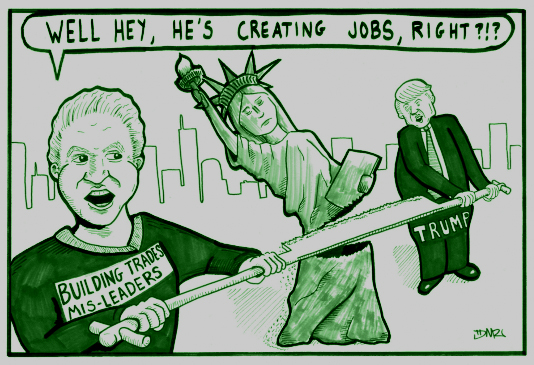
The Trump presidency presents organized labor with a dilemma.

On the one hand, Trump’s advocacy for fossil fuel, infrastructure and military expansion promises to provide jobs for some union workers. His proposals to end trade deals and put tariffs on manufacturing imports align with long-standing labor opposition to pro-corporate globalization.

On the other hand, Trump and his Republican allies in Congress propose tax, budget and social welfare policies that would impoverish most workers. His Cabinet nominees are proven enemies of organized labor and the rights of workers. And his executive policies, legislative priorities and likely Supreme Court appointments point towards catastrophic restrictions on organized labor.

A portent of the future: Vice-President Mike Pence recently discussed with Wisconsin Gov. Scott Walker how to go national with Wisconsin’s restrictions on collective bargaining and union rights. Union membership has dropped some 40 percent in the state since Walker’s collective bargaining law passed in 2011. Only 8 percent of Wisconsin’s workers were in unions last year.

Some in organized labor, especially in the buildings trades, have met with Trump, provided photo ops, and advocated that unions try to work with him, particularly on trade, energy and infrastructure. They know that many union members voted for him. Others have called for resistance to the entire Trump agenda.

The effort to embrace and work with Trump is short-sighted at best, and it may be short-lived. The survival of the labor movement depends on denying Trump the power to implement his agenda. The Trump presidency is likely to be catastrophic even for those unions that are currently seeking his favor. If the power of organized labor and its allies is further diminished, governments and corporations will be free to create a “union-free environment” for the building trades as for everybody else.

Trump’s infrastructure proposals are based on tax credits to private investors, private equity, and low-cost construction. The result is likely to be the banning of prevailing-wage rules and union security provisions for construction workers. Case in point: The Republican-led Kentucky legislature recently passed not only “right-to-work” and “paycheck protection” laws, but repealed the state’s prevailing wage law—a crucial support for building trades unions.

The attack by Trump and his Republican allies comes at a time when organized labor is already weakened. Less than 11 percent of all wage and salary workers are in unions, compared to some 20 percent in 1983. Less than 7 percent of private sector workers are in unions. Close to 35 percent of public sector workers are union members, but they are already under attack that will intensify under Trump.

While Trump’s actions will be devastating for organized labor, they may also have a silver lining. The Trump era is seeing the emergence of what has been called “social self-defense,” a massive self-organization of millions of Americans to resist Trump’s agenda. It has been manifested by the millions who participated in the Women’s March, the spontaneous actions against Trump’s Muslim ban, the mass demonstrations and community meetings in cities around the country, the millions of calls that have tied up politicians’ phone lines and myriad other forms of resistance.

The term “social self-defense” is borrowed from the struggle against the authoritarian regime in Poland 40 years ago. In the midst of harsh repression, Polish activists formed a loose network to provide financial, legal, medical and other help to people persecuted by police or unjustly dismissed from work. They organized free trade unions to defend the rights of workers and citizens, and nurtured many of the networks, strategies, and ideas that eventually helped topple the repressive regimes in Poland and other countries.

Pages

The Fine Print I:

Disclaimer: The views expressed on this site are not the official position of the IWW (or even the IWW’s EUC) unless otherwise indicated and do not necessarily represent the views of anyone but the author’s, nor should it be assumed that any of these authors automatically support the IWW or endorse any of its positions.

Further: the inclusion of a link on our site (other than the link to the main IWW site) does not imply endorsement by or an alliance with the IWW. These sites have been chosen by our members due to their perceived relevance to the IWW EUC and are included here for informational purposes only. If you have any suggestions or comments on any of the links included (or not included) above, please contact us.

The Fine Print II:

Fair Use Notice: The material on this site is provided for educational and informational purposes. It may contain copyrighted material the use of which has not always been specifically authorized by the copyright owner. It is being made available in an effort to advance the understanding of scientific, environmental, economic, social justice and human rights issues etc.

It is believed that this constitutes a 'fair use' of any such copyrighted material as provided for in section 107 of the US Copyright Law. In accordance with Title 17 U.S.C. Section 107, the material on this site is distributed without profit to those who have an interest in using the included information for research and educational purposes. If you wish to use copyrighted material from this site for purposes of your own that go beyond 'fair use', you must obtain permission from the copyright owner. The information on this site does not constitute legal or technical advice.


