You are here

movements, unions, and organizations

Ohio Valley Environmental Coalition Staff Joins the IWW

By Staff - Industrial Workers of the World, March 16, 2021

HUNTINGTON, West Virginia — The Industrial Workers of the World (IWW) is excited to announce that workers of the Ohio Valley Environmental Coalition (OVEC) have recently organized with majority support as the OVEC Union (OVECU) under the IWW. As of March 4, OVECU has submitted a request for voluntary recognition to the OVEC Board of Directors. OVECU is excited to begin the process of negotiating their contract. Their key demands include a standardized pay scale, an equitable discipline policy, and the right to union representation at any meeting wherein matters affecting staff pay, hours, benefits, advancement, or layoffs may be discussed or voted on.

The workers of OVEC decided to unionize to honor their organizational values of empowerment and justice. OVEC’s mission to organize for environmental justice is informed by the belief that Appalachians — and all workers, everywhere — benefit from the right to union representation in their place of employment regardless of current working conditions. OVECU believes it is particularly important for employees to have union support during times of transition with administration, board, and staff, and is eager to move forward collaboratively with members of the board and administration as the 34-year-old organization grows and changes.

“Having a union is a logical next step in supporting our organization as our organization continues to support our communities. Unionizing only strengthens our commitment to the vital work we do at the crossroads of environmental, social, and labor justice,” said OVEC Project Coordinator Dustin White.

OVECU is asking for you to endorse their unionization efforts by calling 304-522-0246 and leaving a message of congratulations and support, or dropping a note at info@ohvec.org.

The Ohio Valley Environmental Coalition Union is committed to protecting and preserving the quality of work conditions for employees of the Ohio Valley Environmental Coalition.

Socialist Rifle Association Staff Join the IWW

By Staff - Industrial Workers of the World, March 13, 2021

WICHITA, Kansas — The Industrial Workers of the World (IWW) is excited to announce that workers of the Socialist Rifle Association (SRA) have recently organized with majority support as the Socialist Rifle Association Workers United (SRAWU) under the IWW. As of March 13, SRAWU has submitted a request for voluntary recognition, which is guaranteed by the SRA’s bylaws. SRAWU is thrilled to begin the process of negotiating their contract. Their key demands include a Sexual Harassment/Assault Response and Prevention (SHARP) policy and the right of union representation at any Assembly meeting wherein matters affecting staff pay, hours, benefits, advancement, or layoffs may be discussed or voted on.

The reputation of the Socialist Rifle Association is that of radical democracy and a vigorous pro-labor attitude. The workers of the SRA have gone too long without workplace guarantees against harassment as well as a lack of representation in matters concerning their working conditions. This has too often led to wonderful, hard-working and talented individuals experiencing burnout and in some cases quitting. Given this, unionizing the SRA workspace is the next logical step in the existence of the organization.

“In 2018 when we started the Socialist Rifle Association, I could never have imagined it growing to the point that it has. So many amazing people have poured their sweat and tears into this organization, and unfortunately many of them have been burned in the process. It’s time for the staff and volunteers of the SRA to unite and organize for their own wellbeing while we continue to do everything we can to support our chapters and membership,” said Faye Ecklar, Director of Mutual Aid.

Socialist Rifle Association workers hold dear the belief that the best and most productive way to advance the goals of the SRA is to work collaboratively on making a productive, safe and healthy workplace.

Nikol Heathcock, Chapters Director, stated, “I am excited about the opportunity to be involved in building something like this for our staff, and personally I’m looking forward to being a union member!”

The Socialist Rifle Association Workers United is asking that you show your support for their unionization efforts by engaging on the union’s Twitter, as well as telling the SRA how excited you are that their workers are unionizing!

This Is What the Beginning of a Climate-Labor Alliance Looks Like: The PRO Act is emerging as the left’s answer to a classic political tension

By Kate Aronoff - New Republic, March 10, 2021

Tuesday night, the Protecting the Right to Organize Act passed the House by 225–205 votes. If it passes the Senate and becomes law, it will peel back over half a century of anti-union policies, including core provisions of the Taft-Hartley Act of 1947. It would override state-level right-to-work protections—the darlings of the Koch brothers machine—and create harsher penalties for employers who interfere with employees’ organizing efforts. But in myriad ways, the act might also do something unexpected: set the stage for sweeping climate policy.

A coalition led by the International Union of Painters and Allied Trades, or IUPAT, and the Communication Workers of America is mobilizing to push the PRO Act over the finish line in the Senate. The youth climate group Sunrise Movement was an early recruit, and the Democratic Socialists of America—including its ecosocialist working group, which is also pushing for a Green New Deal—will be deploying its members in key districts around the country to ensure it’s passed. After a kick-off call over the weekend featuring Congressman Jamaal Bowman, Association of Flight Attendants-CWA head Sara Nelson, and Naomi Klein, DSA is holding trainings for its members throughout March as well as events around the country pushing key senators to back the bill in the lead-up to May Day. Sunrise last week launched a Good Jobs for All campaign, which is urging on a federal job guarantee introduced recently by Representative Ayanna Pressley. Over the next several weeks, Sunrise hubs will be working alongside progressive legislators and holding in-district protests to advance five priorities for upcoming infrastructure legislation, including the PRO Act. After its passage through the House last night, a press release from the groups praised the measure as a “core pillar of the Green New Deal.”

The alliances forming around the PRO Act buck long-held wisdom in Washington about what it would take to get labor unions and environmentalists to work together. James Williams Jr., IUPAT’s vice president at large, has been frustrated by years of seeing the two talk past one another. Construction unions, in particular, have come to loggerheads with climate hawks over infrastructure projects like the Keystone XL and Dakota Access pipelines. “I would blame labor a lot of the time for this,” he says, “but there have to be deeper conversations about the fact that labor is going to lose jobs that have been really good jobs for a really long time.” 

Workers and the Green New Deal Today

Bows and Arrows: Indigenous Workers, IWW Local 526, and Syndicalism on the Vancouver Docks

By Jeff Shantz - LibCom.Org, February 17, 2021

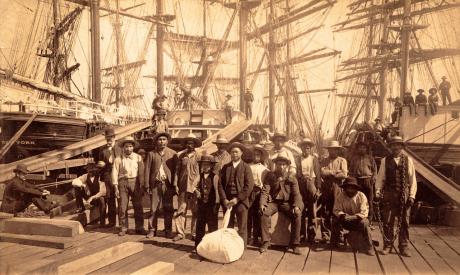
Few may be aware that the first union on the waterfront of Vancouver was organized by Indigenous workers, mostly Squamish and Tsleil-Waututh. And it was organized on an explicitly syndicalist basis as Local 526 of the Industrial Workers of the World (IWW). The IWW group would become known as the Bows and Arrows, a name that spoke to their active and more politically militant perspective and commitment to Indigenous solidarity. The Bows and Arrows organized on a multicultural/multiracial foundation of class solidarity.

While the lifespan of IWW Local 526 was brief (formally only a year while informally for about seven years) it had a lasting impact on working class organizing on the waterfront, anti-racism and racial solidarity on the docks, and on political organizing in Indigenous communities. It also showed the pivotal role of organizing within the logistical chains of global capitalism in sabotaging resource extractive industries, while providing a model of work organization that sustained community relevant work and work cycles rather than the single career monoculture of industrial capitalism at the time.

As historian Andrew Parnaby suggests, the Bows and Arrows:

"Join[ed] in the broader upsurge of support for the Wobblies that took place among loggers, miners, railroad workers, and seafarers prior to the Great War…Reformers, rebels, and revolutionaries: collectively, they were responsible for a level of militancy on the waterfront that was unmatched by most other occupations, provincially or nationally. Vancouver waterfront workers went on strike at least sixteen times between 1889 and 1923; the four largest and most dramatic strikes were in 1909, 1918, 1919, and 1923." (2008, 9)

While Local 526 would finally be broken through battles with waterfront employers that have been described as titanic, these workers provided important and lasting examples of working class militance, workplace organizing tactics, racial solidarity and anti-racism, and cultural defense. They offer a critical model of syndicalism in diverse workforces and changing economic conditions within a context of settler colonial capitalism.

Response to Greg Butler's critique of the Green New Deal and the Rank-and-File Strategy

By x344543 - IWW Environmental Union Caucus, February 7, 2021

As stated in our standard disclaimer (at the end of this editorial), the opinions expressed in this text are those of the author alone and do not represent the official position of the IWW or the IWW Environmental Union Caucus. This piece includes very strongly worded opinions, therefore the author deemed it best to emphasize that point.

There are certainly plenty of constructive, comradely criticisms of the Green New Deal, Democratic Socialists of America (DSA), Kim Moody's "Rank-and-File Strategy", The North American Building Trades Unions, and Jacobin (none of which are either mutually inclusive nor mutually exclusive). Unfortunately, Greg Butler's The Green New Deal and the "Rank-and-File Strategy", published on December 17, 2020, by Organizing Work, is not a good example. In fact, Butler's piece is little more than a sectarian swipe at a number of targets which are only indirectly related to each other, and worse still, it's full of inaccuracies and unfounded claims that have no evidence to support them.

From 1955 to Today, Recognition of Struggle is Key to Transit Equity

By Leo Blain - Labor Network for Sustainability, January 2021

What were you doing when you were 15? Homework, sports, parties, dances: these are standard fare for 15 year-olds. 

Claudette Colvin was no standard 15-year old, though. When she was 15, she sat down on a Montgomery, Alabama bus and refused to give up her seat to a white person. She was arrested and wrongfully charged with assault and battery. Despite being just 15 at the time of her arrest, Colvin was booked into a cell in Montgomery’s adult jail. When Colvin’s pastor, Reverend H.H. Johnson bailed her out the evening of her arrest, he told her that she had “just brought the revolution to Montgomery.”

And, she did it on March 2, 1955: Nine months before Rosa Parks’ similar and much more famous action. 

Colvin brought a lawsuit along with three other women that went all the way to the U.S. Supreme Court and led to the legal desegregation of the Montgomery bus system. When the Montgomery bus system was desegregated Colvin wasn’t invited on the first desegregated bus. Neither was Parks. In fact, none of the women who were among the first to be arrested in protest of the segregated bus system were invited. Five men took the first ride: Martin Luther King Jr., E. D. Nixon, Ralph Abernathy, and Glenn Smiley, and Colvin’s lawyer, Fred Gray. [2]

Spurred by what she had learned in Black history classes at school, Colvin was the first person to be arrested for refusal to surrender in Montgomery. She was the first person in Montgomery to make a legal claim that transit segregation violated her constitutional rights. The contemporary civil rights movement starts with Claudette Colvin’s act of near-unconscionable bravery, yet she has been largely erased from the history books. 

After Colvin’s arrest, she was ostracized by many community members and struggled to find work after high school. She got pregnant soon after her arrest, and due to her pregnancy and the preference of civil rights leaders for Rosa Parks as the face of the boycott, Colvin was largely cast aside by the very movement she had sparked. Ultimately, her perception in Montgomery became untenable and she moved to the Bronx where she worked in relative obscurity as a nurse. 

In recent years, though, Ms. Colvin has found a champion in movement leaders such as Samuel Jordan, founder of the Baltimore Transit Equity Coalition. For Jordan, telling Colvin’s story is both long overdue and a critical piece of his work towards transit equity in Baltimore and nationwide. Baltimore has a pattern of public transit policy that is harmful to marginalized residents and has been used to manipulate Black youth. If Claudette Colvin’s story of taking a bold stand against transit inequity can get the attention it deserves, maybe the young people who are victims of transit inequity today can have their voices heard too. 

Essential Workers and Renewable Energy: Key Themes During Community Hearing on Transit Equity

By Judy Asman - Labor Network for Sustainability, February 2021

Right: Placards created by Charleston, South Carolina-based transit riders advocacy group Best Friends of Low Country Transit that were displayed on bus seats to honor Rosa Parks on her Birthday, Transit Equity Day. To see full media coverage of actions like these, click here.

With nearly eight hours of testimony by more than 50 essential workers and riders, both live and pre-recorded, the Community Hearing on Transit Equity, which took place on Feb. 3 and Feb. 4, provided an intentional space for those wanting to share their plights brought on by transit service cuts during the pandemic and with greater threats to transit funding.

The Hearing kicked off with an opening panel, welcoming movement leaders such as International Secretary-Treasurer Kenneth Kirk of the Amalgamated Transit Union—a founding union of Transit Equity Day, which takes place on Feb. 4, Rosa Parks’ birthday, each year. International Secretary-Treasurer Kirk lifted up Ms. Parks’ act of resistance, which taught us: “Each of us must choose, whether to move or not,” as he underscored transit equity as a civil right. He also talked about transit to reduce greenhouse gas emissions, with busses emitting “80% less carbon dioxide” than cars and that busses can also offset traffic congestion.

Kathi Zoern, a transit rider in Wasau, Wisconsin, who is visually impaired, called her bus pass her “car keys to independence.” Passionately emphasizing that transit and transit workers are “essential,” Zoern, stressed that those living in “outlying communities,” three miles from a bus stop, who are unable to drive or who cannot afford a car “cannot get to work, go to school, shopping, medical appointments or go to places to socialize.”

Jonathan Smith, President, New York Metro Area Postal Union Local 10, of the American Postal Workers Union, reminded viewers and listeners that postal workers help to “preserve democracy, and we are proud to do it.” He added, “Many of our members rely on the bus and the train to get to work and to their families, and their families also rely on these services as well. If it were not for the transit in our city, we would not be able to process your mail.”

The hearing also highlighted collaborations that have formed as a result of frustrations with transit authorities and extreme pressure on transit workers with limited funding. In San Francisco, disability rights activist and journalist Zach Karnazes and Roger Marenco, President of the Transport Workers Union of America Local 250A, teamed up to organize for fair access to transit by disabled riders, often challenged by tight schedules for bus operators.

Then there are the impacts on young people who depend on public transit to get to school. During the final hour of the hearing with the American Federation of Teachers–moderated by Jane English, Program Manager on the Environmental Climate Justice Program, NAACP–Carl Williams, President of Lawndale Federation of Classified Employees and Vice President of American Federation of Teachers, and Wayne Scott, President of Colorado Classified Employees Association, talked about the extreme consequences of students living in areas where there are service cuts in transportation–these include the need to shut down campuses that become unreachable to students and even higher risks of higher drop-out rates.

A riveting closing presentation by Randi Weingarten, President of the American Federation of Teachers, tied the social isolation of COVID to lack of transit and light rail, especially within rural areas. President Weingarten, whose union recently endorsed the Green New Deal and the THRIVE Agenda, talked about the need for revamping transit systems not just for mass accessibility but to support climate. “There is an opportunity here as well. It’s not just new jobs but it’s also revamping them in a way that we can reduce our carbon footprint,” President Weingarten said, recounting that AFT’s pension system was a foundational investor in the modernization of La Guardia Airport, an effort recognized for its transition to renewable energy “and the jobs that came about from building all of that.”

To watch both days of the Community Hearing on Transit Equity in English and Spanish, as well as all of the submitted pre-recorded testimonies, visit bit.ly/savetransit2021.

Right to Work on a Hot Planet

By Kate Aronoff - New Republic, January 25, 2021

By 1961, Charles Koch had stacked up three engineering degrees and was back home in Wichita, Kansas, to join the family business of oil refining, pipelines, and manufacturing. His father, Fred, was at the time attempting to tackle a different sort of engineering challenge: how to get unions, Communists, and big government off his back. The Nazi sympathizer Koch patriarch fought against unions in Kansas, and when the John Birch Society convened its inaugural meeting in 1958—initially composed exclusively of National Association of Manufacturers members—he enthusiastically attended as a co-founder. According to a 1961 Washington Post profile of Koch’s white supremacist conspiracy-theory club, “leadership of the Birch Society overlaps heavily with the leadership of the organizations that successfully campaigned in 1958 for a right to work amendment to the State’s Constitution.” Fred died in 1967, but Charles eagerly put his education to work carrying on his family’s 60-year war against collective bargaining rights and that pesky concept known as representative democracy. When it comes to right to work, especially, labor and climate campaigners quite literally share a common enemy. 

If those two groups have found it difficult to join forces, their adversaries are elegantly streamlined. During the Obama administration, Koch Industries trained its fossil fuel empire on the twin goals of turning legislatures red and pushing through deceptively named right-to-work statutes, all the while finding time to help kill federal climate legislation. Though no state had enacted right-to-work rules since Oklahoma in 2001, five have taken them up since 2012. This most recent push has focused on sapping public sector workers’ collective bargaining rights, in particular, like the bill that led thousands of union members to peacefully occupy Wisconsin’s capitol dome in 2011. 

That some of the most high-profile targets of anti-labor measures have been swing states with strong union legacies—namely, Wisconsin, Ohio, and Michigan—is no coincidence. As E.J. Dionne pointed out after Michigan enacted its right-to-work measures in 2013, Obama had won 66 percent of the state’s union households a year earlier. He won the state overall by just 1 percent. In 2018, the right’s biggest win against unions came with the decision in Janus v. AFSCME, which made right to work the national standard for public-sector workers. The crux of that case was AFSCME member Mark Janus’s argument—in a case supported enthusiastically by Koch networks—that being forced to pay agency fees—which cover the costs of union representation and contract negotiation—violated his free speech. This was a major blow to unions’ capacity to extract gains from employers, weakening labor’s power overall. That’s the whole point.

For Charles Koch and other captains of industry, the calculation behind crushing unions isn’t complicated: Weaker unions mean a weaker opposition to right-wing policies, including the sort of regressive climate and energy measures they’ve helped push around the country through the American Legislative Exchange Council. The right’s general project of minority rule—whether in weakening small-d democratic institutions like unions, gerrymandering congressional districts, or suppressing votes—is incompatible with climate action and democracy itself. Big business has long understood this. 

Review: Blood Runs Coal Tells the Notorious Assassination of a Mine Workers Union Reformer

By John Lepley - Labor Notes, January 20, 2021

Most people are familiar with the politically motivated killings that punctuated the 1960s. From Medgar Evers to Robert Kennedy, bloodshed galvanized the antiwar, civil rights, and student movements, but eroded trust in government and higher education. The labor movement was no exception to the rule.

On New Year’s Eve 1969 in Clarksville, Pennsylvania, three gunmen shot Mine Workers (UMWA) leader Joseph “Jock” Yablonksi, his wife Margaret, and their daughter Charlotte as they slept. The killers were petty criminals from Cleveland, one of whom had ties to the union by marriage.

This horrific moment is the subject of Mark Bradley’s book Blood Runs Coal: The Yablonski Murders and the Battle for the United Mine Workers of America.

Jock Yablonski is a tragic figure in the classical sense: a good person killed while trying to do the right thing. Bradley tells the story well—although readers of Labor Notes will wince at his frequent references to “union bosses” and “big labor,” and his focus on attorneys that overshadows miners.

Pages

The Fine Print I:

Disclaimer: The views expressed on this site are not the official position of the IWW (or even the IWW’s EUC) unless otherwise indicated and do not necessarily represent the views of anyone but the author’s, nor should it be assumed that any of these authors automatically support the IWW or endorse any of its positions.

Further: the inclusion of a link on our site (other than the link to the main IWW site) does not imply endorsement by or an alliance with the IWW. These sites have been chosen by our members due to their perceived relevance to the IWW EUC and are included here for informational purposes only. If you have any suggestions or comments on any of the links included (or not included) above, please contact us.

The Fine Print II:

Fair Use Notice: The material on this site is provided for educational and informational purposes. It may contain copyrighted material the use of which has not always been specifically authorized by the copyright owner. It is being made available in an effort to advance the understanding of scientific, environmental, economic, social justice and human rights issues etc.

It is believed that this constitutes a 'fair use' of any such copyrighted material as provided for in section 107 of the US Copyright Law. In accordance with Title 17 U.S.C. Section 107, the material on this site is distributed without profit to those who have an interest in using the included information for research and educational purposes. If you wish to use copyrighted material from this site for purposes of your own that go beyond 'fair use', you must obtain permission from the copyright owner. The information on this site does not constitute legal or technical advice.