






You are here
publications


 Recent years have seen an upsurge of interest in the history of European anarchist and syndicalist movements. The rise of alter-globalisation protest borrowing many of its direct-action tactics from pre-World War I anarchism and syndicalism has been important in bringing it on over the last ten years or so. As the anthropologist and anarchist activist David Graeber has commented: “most of the creative energy for radical politics is now coming from anarchism,” and horizontal, acephalous organisation, networks, prefigurative politics and consensus decision-making have all become major themes for debate. The necessity to control international terrorist networks has also rekindled public interest in the anarchist diaspora of the late-nineteenth century, the golden age of “propaganda by the deed”, sparking many debates about the relevance of such comparisons. Within the academy, the study of anarchist and syndicalist movements and their functioning has been greatly spurred by new methodological developments opening up new perspectives. As a result, three essential trends have been developed in this field of study: the move towards transnational or global history; a renewed interest in historical biography and the mapping out of personal networks, and, as a result, new approaches to comparativism.
 From the Introduction: - This report is intended to explore how antiimmigrant forces have corrupted the dialogue on population and the environment, and will examine the anti-immigrant environmentalist network that has influenced the environmental movement for the last 14 years. In 2009, an article in the Population Special Issue of the Earth Island Journal1 mentioned a new organization and website named Apply the Brakes (ATB hereafter). A few months later, the Center for Immigration Studies2 — an anti-immigrant organization known to trade in racism — cited ATB in a memorandum denouncing Sierra Club leadership for not addressing the issue of immigration. At a time when more people of color, labor and human rights organizations are engaging in environmental concerns such as climate change and “green jobs,” ATB could very well threaten those fragile coalitions.
 In California toxic capitalist social relations demonstrated their full irrationality in May 2009 when banks bulldozed brand-new, but unsold, McMansions in the exurbs of Southern California.
 Coal pollutants affect all major body organ systems and contribute to four of the five leading causes of mortality in the U.S.: heart disease, cancer, stroke, and chronic lower respiratory diseases. This conclusion emerges from our reassessment of the widely recognized health threats from coal. Each step of the coal lifecycle—mining, transportation, washing, combustion, and disposing of postcombustion wastes—impacts human health. Coal combustion in particular contributes to diseases affecting large portions of the U.S. population, including asthma, lung cancer, heart disease, and stroke, compounding the major public health challenges of our time. It interferes with lung development, increases the risk of heart attacks, and compromises intellectual capacity.
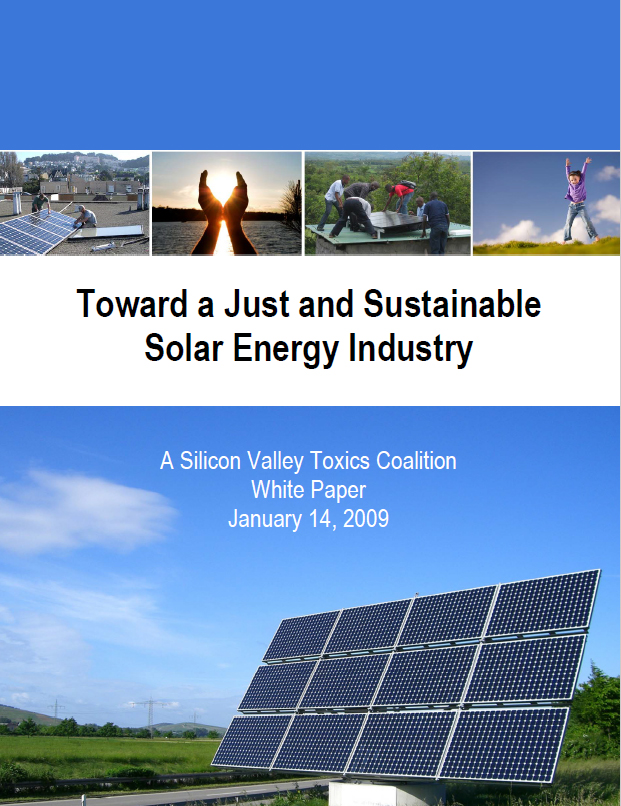 Every hour, enough solar energy reaches the Earth to meet human energy needs for an entire year. Solar photovoltaic (PV) technology is widely seen as a “win-win” solution that can harness this “free energy” to address global warming, reduce U.S. dependence on energy imports, create “green jobs,” and help revitalize the U.S. economy.
The Fine Print I:
Disclaimer: The views expressed on this site are not the official position of the IWW (or even the IWW’s EUC) unless otherwise indicated and do not necessarily represent the views of anyone but the author’s, nor should it be assumed that any of these authors automatically support the IWW or endorse any of its positions.
Further: the inclusion of a link on our site (other than the link to the main IWW site) does not imply endorsement by or an alliance with the IWW. These sites have been chosen by our members due to their perceived relevance to the IWW EUC and are included here for informational purposes only. If you have any suggestions or comments on any of the links included (or not included) above, please contact us.
The Fine Print II:
Fair Use Notice: The material on this site is provided for educational and informational purposes. It may contain copyrighted material the use of which has not always been specifically authorized by the copyright owner. It is being made available in an effort to advance the understanding of scientific, environmental, economic, social justice and human rights issues etc.
It is believed that this constitutes a 'fair use' of any such copyrighted material as provided for in section 107 of the US Copyright Law. In accordance with Title 17 U.S.C. Section 107, the material on this site is distributed without profit to those who have an interest in using the included information for research and educational purposes. If you wish to use copyrighted material from this site for purposes of your own that go beyond 'fair use', you must obtain permission from the copyright owner. The information on this site does not constitute legal or technical advice.
 This site is not the official webpage of the Industrial Workers of the World.