

You are here

agroecology

Resisting RCEP from the ground up: Indian movements show the way

By staff - GRAIN & ICCFM, January 2020

In the history of people’s resistance against free trade agreements, 4 November 2019 is a day to remember. On this day, bowing to immense pressure from peasants, trade unions and rural communities, India’s central government decided to pull the plug on its participation in the Regional Comprehensive Economic Partnership (RCEP), intended to become the largest free trade area in the world. The announcement, made at the ASEAN summit in Bangkok, has implications for free trade negotiations in the entire region and puts a fork in the wheels of unifying the Asian market – a project clearly favouring the interests of agribusiness and transnational corporations.

While countries such as Japan, New Zealand and Australia are making every effort to convince India to come back to the negotiating table, whether they will succeed is not clear. For now, Delhi’s decision has provided immense relief to millions of small-scale food producers and rural workers in India.

So how did a government that is overtly neoliberal, capitalist and with visible authoritarian traits end up bowing to the pressure of farmers and workers? To understand that, we need to understand the decade that just went past us.

Read the report (PDF).

The Industrial Workers’ Climate Plan: A Great Green Charter

By various - Bristol IWW, 2019

An ecology movement that once seemed jaded is budding and blossoming beautifully. The fantastic efforts of the school strikes’ movement and groups like Extinction Rebellion, Earth Strike and the Green Anti-Capitalist Front have forced green issues back into mainstream public debate. This achievement has been marked by declarations that there is a ‘climate emergency’, first by the Welsh and Scottish governments and then, fittingly on 1st May, by the UK Parliament. A fortnight earlier, the University of Bristol had become the first UK university to declare a climate emergency. So successful have these campaigns been that there is now a broad consensus that something must be done. It is essential to build on this achievement and keep up the momentum. We urgently need to continue the conversation about what do to now.

Alongside the general strikes for climate action in September 2019, Earth Strike is therefore proposing that a Great Green Charter would be a powerful rallying document for the environmental crisis of the Twenty-First Century. The nineteenth-century movement called Chartism inspired the idea of a Great Green Charter. The Chartists drew up clear and agreed points which they pursued with a mix of political, economic and cultural approaches. Chartism became the largest reform movement of its time, taken up by thousands of ordinary people across the United Kingdom. The Chartists were successful, in as much as most of the points listed on ‘The People’s Charter’ were eventually attained, and even exceeded. While this was not within the years of Chartism, and achieved only after great struggle, the Chartists defined the terms of political reform for the decades to come.

Read the report (PDF).

Blueprint for Europe's Just Transition: The Green New Deal for Europe (Edition II)

By various - The Green New Deal for Europe, December 2019

Europe today confronts three overlapping crises.

The first is an economic crisis, with rising levels of poverty, insecurity, and homelessness across the continent. The second is a climate and environmental crisis, with severe consequences for Europe’s front-line communities and even more perilous ones on the horizon. And the third is a crisis of democracy. Across the continent, people are disconnected from the locus of political decision-making not only in Brussels, but also in the communities where they reside.

These crises are products of Europe’s political decisions, and they are closely bound together. The promotion of extractive growth has driven environmental breakdown, and the devotion to budget austerity — over and above the democratic needs expressed in communities across Europe — has constrained our capacity to respond to it.

A radically new approach is necessary to reverse this destructive trend — and to deliver environmental justice in Europe and around the world. We call this approach the Green New Deal for Europe, and the following report is a comprehensive policy pack-age charting a course through Europe’s just transition.

Read the report (PDF).

Tackling the Farm Crisis and the Climate Crisis

By Darrin Qualman - National Farmers Union, November 2019

The farm crisis is real, as is the climate crisis. Left unchecked, the climate crisis will dramatically deepen the income crisis on Canada’s farms as farmers struggle to deal with continued warming, more intense storms, and increasingly unpredictable weather. It is clear that climate change represents a major challenge to agriculture, but it also represents an opportunity.
Farmers and policymakers are encouraged to recognize that we are facing an existential crisis, which means that all of our options must be on the table for consideration, even if they are uncomfortable to consider. If we commit to an open and honest conversation about the causes and effects of climate change and how they are intertwined with our agricultural sector, we also take the first steps towards a transition that will benefit us all.

Tackling the Farm Crisis and the Climate Crisis does not claim to have all the answers. Both the climate crisis and the farm crisis are so complex that no single report can provide all the answers. However, this report does have many answers — some of which could be implemented right away. Others provide a starting point to opening up the climate conversation in the agricultural sector. Options that will work for different geographic locations, soil types, or types of farms will be explored, but there is no one-size-fits-all solution.

Read the text (link).

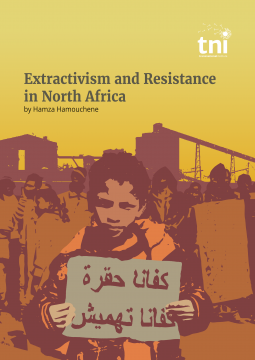
Extractivism and Resistance in North Africa

By Hamza Hamouchene - Transnational Institute, October 2019

Extractivism as a mode of accumulation and appropriation in North Africa was structured through colonialism in the 19th century to respond to the demands of the metropolitan centres. This accumulation and appropriation pattern is based on commodification of nature and privatisation of natural resources, which resulted in serious environmental depredation. Accumulation by dispossession has reaffirmed the role of Northern African countries as exporters of nature and suppliers of natural resources – such as oil and gas- and primary commodities heavily dependent on water and land, such as agricultural commodities. This role entrenches North Africa’s subordinate insertion into the global capitalist economy, maintaining relations of imperialist domination and neo-colonial hierarchies.

The neo-colonial character of North African extractivism reflects the international division of labour and the international division of nature. It is revealed in largescale oil and gas extraction in Algeria and Tunisia; phosphate mining in Tunisia and Morocco; precious ore mining - silver, gold, and manganese - in Morocco; and water-intensive agribusiness farming paired with tourism in Morocco and Tunisia. This plays an important role in the ecological crisis in North Africa, which finds its clear expression in acute environmental degradation, land exhaustion and loss of soil fertility, water poverty, overexploitation of natural resources, pollution and disease, as well as effects of global warming such as desertification, recurrent heat waves, droughts and rising sea levels.

Concurrent with this dynamic of dispossession of land and resources, new forms of dependency and domination are created. The (re)-primarisation of the economy (the deepened reliance on the export of primary commodities) is often accompanied by a loss of food sovereignty as a rentier system reinforces food dependency by relying on food imports, as in the case of Algeria; and/or as land, water and other resources are increasingly mobilised in the service of export-led cash crop agribusiness, as in Tunisia and Morocco. Extractivism finds itself mired in serious tensions, which generates protests and resistance. This paper documents some of these tensions and struggles by analysing activist grassroots work, including the participation in alternative regional conferences and ‘International Solidarity Caravans’ where representative of grassroots organisations, social movements and peasant communities met and travelled together to sites of socio-environmental injustices, providing a space to strategise together and offer effective solidarity to their respective struggles.

The rural working poor and the unemployed in Northern Africa are the most impacted by the multidimensional crisis. Comprising small-scale farmers, near-landless rural workers, fisherfolks and the unemployed, the movements emerging in the five case studies presented here are resisting the looting of their subsoil resources, the despoliation of their lands, pervasive environmental destruction and the loss of livelihoods. The paper asks the following questions: should we see these protests, uprisings and movements as mainly environmental, or are these fundamentally anti-systemic – anti-capitalist, antiimperialist, decolonial and counter-hegemonic protests? Are these circumstantial episodes of resistance, or do they rather represent the latest development in the historical trajectory of class struggle against the latest capitalist offensive in North Africa? The paper presents an assessment of the nature of these movements which grapple with tensions and contradictions that face them.

Read the report (PDF).

Women’s Struggles for a Peasant and People’s Feminism

By Francisca Rodríguez Huerta - La Via Campesina, June 17, 2019

Opinion: The agrarian issue and current challenges

By Fausto Tórrez and Elsa Nury Martínez - La Via Campesina, June 7, 2019

Throughout history, the progressive transformation of agricultural production has at its basis the struggle for land. This struggle aims to introduce a radical change in the productive structure; as a consequence, the agrarian issue is significant for the coexistence of humanity and it was dealt with by the leaders of social struggle.

Internationalising the Green New Deal: Strategies for Pan-European Coordination

By Daniel Aldana Cohen, Kate Aronoff, Alyssa Battistoni, and Thea Riofrancos - Common Wealth, 2019

Climate politics are today bursting to life like never before. For four decades, market fundamentalists in the United States and United Kingdom have blocked ambitious efforts to deal with the climate crisis. But now, the neoliberal hegemony is crumbling, while popular climate mobilisations grow stronger every month. There has never been a better moment to transform politics and attack the climate emergency.

When the climate crisis first emerged into public consciousness in the 1980s, Margaret Thatcher and Ronald Reagan were consolidating a neoliberal doctrine that banished the most powerful tools to confront global heating— public investment and collective action.

Instead, neoliberals sought to free markets from democratically imposed constraints and the power of mass mobilisation. Thatcher insisted that there was no alternative to letting corporations run roughshod over people and planet alike in the name of profit. Soon, New Democrats and New Labour agreed. While the leaders of the third way spoke often of climate change, their actual policies let fossil capital keep drilling and burning. Afraid to intervene aggressively in markets, they did far too little to build a clean energy alternative.

Then the financial crisis of 2008 and the left revival that exploded in its wake laid bare the failures of the neoliberal project. An alternative political economic project is now emerging—and not a moment too soon. As the Intergovernmental Panel on Climate Change put it, keeping global warming below catastrophic levels will require “rapid, far-reaching and unprecedented changes in all aspects of society.” In other words: public investment and collective action.

Fortunately, movements on both sides of the Atlantic have been building strength to mount this kind of alternative to market fundamentalism. On the heels of Occupy Wall Street and Black Lives Matter, Bernie Sanders’s 2016 Democratic primary campaign breathed new life into the American left and its electoral prospects. Jeremy Corbyn’s election as leader of the Labour Party, spurred by a vibrant grassroots mobilisation, gives those of us in the U.S. hope: if New Labour could give way to Corbynism, surely Clintonism can give way to the left wing of the Democratic party. In the U.K., drawing on tactics from the Sanders campaign, Momentum has developed a new model of mass mobilisation to transform a fossilised political party. It’s restoring the dream that formal politics can be a means for genuinely democratic political organising. In turn, U.S. leftists are learning from Momentum’s innovations.

The vision of the Green New Deal that has taken shape in the United States in the past few months is in many ways a culmination of the U.S. left’s revival. The Green New Deal’s modest ambition is to do all that this moment requires: decarbonise the economy as quickly as humanly possible by investing massively to electrify everything, while bringing prodigious amounts of renewable power online; all this would be done in a way that dismantles inequalities of race, class and gender. The Green New Deal would transform the energy and food systems and the broader political economy of which they are a part.

Read the report (PDF).

Pages

The Fine Print I:

Disclaimer: The views expressed on this site are not the official position of the IWW (or even the IWW’s EUC) unless otherwise indicated and do not necessarily represent the views of anyone but the author’s, nor should it be assumed that any of these authors automatically support the IWW or endorse any of its positions.

Further: the inclusion of a link on our site (other than the link to the main IWW site) does not imply endorsement by or an alliance with the IWW. These sites have been chosen by our members due to their perceived relevance to the IWW EUC and are included here for informational purposes only. If you have any suggestions or comments on any of the links included (or not included) above, please contact us.

The Fine Print II:

Fair Use Notice: The material on this site is provided for educational and informational purposes. It may contain copyrighted material the use of which has not always been specifically authorized by the copyright owner. It is being made available in an effort to advance the understanding of scientific, environmental, economic, social justice and human rights issues etc.

It is believed that this constitutes a 'fair use' of any such copyrighted material as provided for in section 107 of the US Copyright Law. In accordance with Title 17 U.S.C. Section 107, the material on this site is distributed without profit to those who have an interest in using the included information for research and educational purposes. If you wish to use copyrighted material from this site for purposes of your own that go beyond 'fair use', you must obtain permission from the copyright owner. The information on this site does not constitute legal or technical advice.
