You are here

agroecology

Food Sovereignty: 25 years in the making

By Jaime Amorim - La Via Campesina, July 28, 2021

Food sovereignty is intrinsically linked to the debate over what we envision for rural areas and what type of development should be applied, as well as what type of food to produce. And why do we want to produce?”

In the same year that La Via Campesina celebrates 25 years of defining, building, and fighting for “food sovereignty,” the United Nations (UN) will convene a summit for heads of state, members of large businesses and private corporations, multinationals and agribusiness representatives to discuss food systems processes.

The UN Food Systems Summit, or FFS, will take place in September of 2021 during the week of the High-Level panel of the United Nations’ General Assembly. Before the Summit, a pre-Summit will take place in Rome at the end of June.

I will take advantage of this space to debate(discuss?) the two subjects which complement each other in two separate articles. In this first one, I will discuss the 25th anniversary of the debate for food sovereignty. In the second will concern the contradictions surrounding the realization of the Summit on food systems, which will be convened by the Secretary General of the United Nations. This is the decade in which the UN and its member states must accomplish the activities and actions to which they committed by 2030, the objectives defined in order to reach their goals for building Sustainable Development.

The Summit on Food Systems will be held just as the world is experiencing a pandemic that has taken the lives of more than four million people worldwide, victims of COVID-19. At the same time, we see, as a consequence of the crises, the rise in the number of people who suffer hunger worldwide, as well as an increase in unemployment, poverty and violence.

Position Document on the Common Agricultural Policy (CAP) Reform

By Pier Francesco Pandolfi de Rinaldis, Berthe Darras, Jean-Matthieu Thévenot - European Coordination Via Campesina, July 13, 2021

Today the Youth Articulation of ECVC has released a Position Document on the reform of the Common Agricultural Policy (CAP). Following the latest agreement between the EU Commission, EU Parliament and European Council, the young members of ECVC want to express their opinions, concerns and proposals for the reformed CAP and its application at the national level.

“We fear that the reformed CAP will continue to neglect the real needs of young farmers, and in particular small, agroecological farmers. Moreover, we expect that the CAP will continue to miss one of its main objectives: facilitating the entrance of new farmers (…). The CAP policies significantly affect us, yet we have no say in its reform process. It is not sufficient that the role of young farmers is acknowledged on paper, we want effective policies to support us and the right to participate in decision-making. As there can be no future for EU agriculture without young farmers.”

Read the text (PDF).

What Might an Ecosocialist Society Look Like?

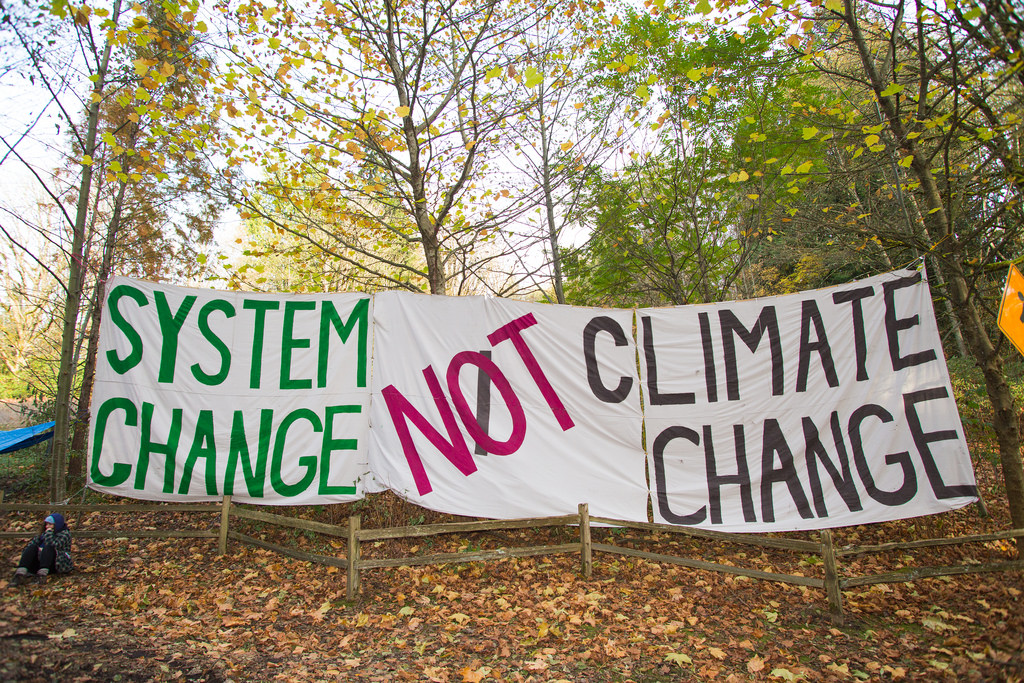
By David Klein - System Change not Climate Change, June 27, 2021

Why can’t the problems that ecosocialism would solve also be remedied within the current global capitalist system?

Before describing possible features of a future ecosocialism, it is worthwhile to consider why such a system is even needed. Why can’t the problems that ecosocialism would solve also be remedied within the current global capitalist system? Part I of this essay addresses that question by summarizing recent scientific reports on the state of the climate and extent of the ecological crisis; reviewing available methods and technologies that could be used to address the climate and ecological crises; and briefly describing capitalism’s structural inability to provide solutions at the scale of the crises. Part II then takes up the subject of the title, ecosocialism, along with strategies to move in that direction. 

Part I: Context and Background

The threat to life on Earth posed by the climate and ecological crises can hardly be overstated. A 2019 Nature article warned that up to a million species of plants and animals are on the verge of extinction, and a United Nations study the same year identified global warming as a major driver of wildlife decline. Much of the devastation to date was catalogued in the 2020 WWF Living Planet report, which recorded a 68 percent decline in the population of vertebrates around the world, in just the past five decades. More succinctly, scientists report that Earth is experiencing a sixth mass extinction. (The previous mass extinction, 66 million years ago, ended the dinosaurs).

The scale of the environmental crisis is unprecedented in human history. At stake are human civilization and billions of lives. An article last year in Proceedings of the National Academy of Sciences predicted that for every additional 1̊C rise beyond the 2019 global average, a billion people will be forced to abandon their locations or endure insufferable heat. The paper warns that under a scenario of increasing emissions, areas now home to a third of the world’s population could experience the same temperatures as the hottest parts of the Sahara within 50 years. 

Summing up the findings of some 150 scientific studies, a 2021 paper authored by 17 scientists warned that the “scale of the threats to the biosphere and all its life forms –- including humanity –- is in fact so great that it is difficult to grasp even for well-informed experts.” Adding further urgency, 101 Nobel laureates released an open letter in April 2021 in which they wrote, “We are seized by the great moral issue of our time: the climate crisis and commensurate destruction of nature.” The laureates called for a worldwide fossil fuel non-proliferation treaty

Global heating is driven by greenhouse gases in the atmosphere, and yet emissions continue at high levels despite the chorus of promises by “climate leaders” in governments. In 2020 global emissions decreased by a meager 5.8 percent due to Covid-19 lockdowns, but they were already on the rebound by the end of the year. For the current year, 2021, the International Energy Agency (IEA) forecasts the second largest annual increase in history of greenhouse gas emissions, as global economies recover from the Covid-19 recession. In May 2021 a record-breaking monthly average concentration of 419 parts per million (ppm) of CO2 was measured in Mauna Loa, Hawaii, breaking the previous May 2020 record of 417 ppm. 

The drivers of ecocide, more generally, include not only climate change, but also habitat destruction, toxic dumping, plastic pollution in the oceans, radiation poisoning, and other customary byproducts of the global capitalist economy. All of this destruction continues unabated despite the flood of warnings from scientists, lobbying by environmental activists, and even warnings from institutions deeply rooted in the capitalist economy. 

Consider, for example, that in May 2021 the IEA released an unprecedented call to the world to rapidly reach zero emissions in its report, Net Zero by 2050: A Roadmap for the Global Energy Sector. Widespread news coverage and expressions of optimism followed. Yet from February to the end of April 2021, the Biden administration approved nearly 1200 drilling permits on federal lands, along with more than 200 offshore permits, and defended in court the ConocoPhillips Willow project in Alaska, which is expected to emit 260 million metric tons of CO2 during the next 30 years, the equivalent of 66 coal-fired plants. And Biden is far from alone among world leaders in his support of fossil fuel expansions.

Why we need a UK Food Sovereignty Movement

By Staff - Land Workers Alliance, June 16, 2021

“Food sovereignty” as a term and a movement has become more prominent in the last few decades, but its reception by governments and institutions in wealthier countries, including the UK, has been unenthusiastic, to say the least.

What is food sovereignty?

“Food sovereignty” is a relatively new way of describing and unifying longstanding aims and methods of the work of peasants, indigenous people, and communities as well as that of various food justice campaigns and organisations. Its six unifying principles are providing food for people; valuing food providers; localising food systems; centring local control; building knowledge and skills; and working with nature. By centring these 6 key principles, the food sovereignty movement seeks to guarantee and protect people’s space, ability and right to define their own models of food production, distribution and consumption.

Where has it grown from?

In 2007, more than 500 people gathered at the Nyéléni forum in Mali, so-called after a Malian peasant farmer who developed crops to feed her people. This forum brought together many diverse groups and individuals working on food issues, and united them under the Declaration of Nyeleni. The food sovereignty movement transformed from being disparate and lacking in visibility into being an interconnected movement, with strong underlying principles, coordination and solidarity between countries, communities and activists working together towards a common goal.

The path of Peasant and Popular Feminism in La Via Campesina

By various - La Via Campesina, June 8, 2021

La Via Campesina, presents the publication “The Path of Peasant and Popular Feminism in La Via Campesina” with the aim of strengthening the training processes of the Movement and to build Peasant and Popular Feminism as a political tool against oppression and violence. This document compiles the historical knowledge accumulated by Peasant and Popular Feminism in identifying the political challenges that exist in the historical moment that we live in, and thus contribute to the analysis and collective reflections to build a plural movement that respects diversities.

The publication is split into four parts: the first one looks back at the conquests of women inside LVC, up to Peasant and Popular Feminism as something to be built collectively. The second chapter highlights the role of women in the Peasants’ Rights Declaration adopted at the UN and highlights the rights achieved with this tool. The third chapter focuses on La Via Campesina’s Global Campaign “End Violence against Women”, the way the campaign is organized and its experience in different territories. Finally, in the last chapter in order to further expand reflections and discussions, we provide a virtual toolbox that will facilitate training and communication processes.

Since its very beginning La Via Campesina has sought to encourage the participation of rural women at all levels of action, power and representation in the building of an international movement that is broad, democratic, politically and socially committed to the defense of peasant agriculture, Food Sovereignty, the struggle for land, justice, equality and to eradicate all forms of gender discrimination and violence.

Recognizing the contribution and participation of women in member organizations has not been an easy task, notably because of patriarchy and the sexism rooted in societies. These have a negative impact even on the practices of comrades and of the organizations that belong to the movement. LVC’s women speak of two revolutions: one that burdens problems with gender relations within the movement, and a broader one aimed at making a revolution inside societies for justice, equity and the emancipation of human beings.

Read the text (PDF).

Anti-imperialist Manifesto in Defense of the Environment

Black Climate Wednesdays: Land and Labor

Colombia: Is Access to Land Democratized?

By various - La Via Campesina, May 9, 2021

Sub-point 1.1 of the Peace Agreement establishes mechanisms for access to land for the benefit of peasants without land or with insufficient land, mainly through land allocation processes and formalization of rights. Thus, it has been planned on the one hand, the formalization of 7 million hectares in 10 years, prioritizing areas such as those related to Development Programs with a territorial approach – PDET, in Spanish, and on the other, the allocation of 3 million hectares in the first 12 years of management of the Fondo de Tierras.

However, the implementation is moving slowly. After the first 4 years of the implementation, the National Land Agency – ANT, the entity responsible for carrying out formalization and allocation processes, reports the formalization of 1,966,691 hectares, however, it should be remembered that 1,055,000 of these lands were handed over and registered before the signing of the Peace Accord. Land formalized before the implementation of the Accord should be excluded, which reduces the deal for formalization to 913,548 hectares; the claim to inflate the figures on the achievement of compromises is obvious. Likewise, it is pointed out that this figure is very low in comparison with the pace of implementation needed to achieve the goal set out in the Accord: nearly 700,000 hectares are expected to be formalized annually.

65.2% of the beneficiaries of formalization processes are men and 31.6% are women. It is also interesting to note that the 93.3% of formalized land corresponds to collective titles of black communities and constitution / expansion of indigenous reserves, similarly, only 14% of formalized hectares are in municipalities focused on the implementation of the Agreement.

Regarding the allocation process, the National Land Agency (ANT) presents the entry of about a million hectares to the Fondo de Tierras, however, if the hectares available to be distributed were strictly counted, in which the allocation condition has no restrictions or they are determined, this figure would be reduced to 90%, given that only 2,253 available plots corresponding to 96,471.1 hectares fulfill this condition1. This accentuates, again, the government’s pretention to inflate the figures for the fulfillment with the Agreement, given that only the entry [in the database] of the available land to be handed over to the peasants without land, in other words, the Fondo de Tierras actually has 96,471.1 hectares.

Likewise, the government is accounting for sources of vacant land and the Fondo Nacional Agrario, the land that is available for distribution, however, these are vacant lands with a previous occupation, which cannot be allocated and on which processes formalization of rights must be executed. In other words, these are cases where the formalization of the property is a must and that can feed the results of the formalization of seven million hectares goal, but this does not represent an accomplishment of the compromise to hand over land.

The Office of the Inspector General reports that 8,143.7 hectares have been allocated. It is important to stress that this figure corresponds to direct purchases and full allocations, that is, there were no allocations without previous occupation. Likewise, the regulatory body indicates that only 6.6% of hectares allocated by direct purchase correspond to municipalities prioritized in the implementation of the Agreement.

However, if we consider the figures presented by the ANT in relation to the Fondo de Tierras – in which the condition of land allocation is not considered – there is a 52.2% of the hectares put into the Fondo where the municipalities prioritized by the Territorially Focused Development Plans – PDET, and the 47.8% in non-priority areas. Likewise, 8 out of 16 PDET sub-regions2 each register less than 1% of the hectares included in the Fondo de Tierras.

As it is seen, the government is inflating the figures of the fulfillment of point 1 of the Agreement and there is no progress in democratizing access to land in the country. Additionally, the actions carried out by the government are not focused on the areas prioritized for its implementation, such as the PDET municipalities, which disregards the principle of prioritization established in the Agreement.

Paraguay: The struggle for Food Sovereignty is the struggle for life.

By Perla Alvarez - La Via Campesina, May 4, 2021

Whether in the movement or outside of it, the word “agribusiness” brings to mind instant associations like “soybeans,” “Brazil,” or “the Mennonites.” Why? When did this word first enter common parlance? What are we actually saying when we use this word?

The word “business” is not an accidental component of this portmanteau word; on the contrary, it is central to the whole concept. Agribusiness embodies a different conception of the earth than the one upheld by peasants and Indigenous peoples. For agribusiness, the earth is a commodity, a product to be bought and sold and made profitable, to be commercially exploited. It is no longer seen as tekoha, the place where we are, where we live, produce, and reproduce, where we come into our own, in which our culture is rooted. No: for agribusiness, the earth and its capacity to support life are negotiable. They are measured in terms of uniformity, not diversity; in tonnes of grain, not seeds; in productivity, not safety; in dollars, not life; in contour lines, not disappearing species of trees and birds.

That is agribusiness: the capitalist exploitation of the earth, extracting from it anything that can generate a profit in record time. Agribusiness subjects the earth to “inhuman” treatment because for agribusiness, agriculture has nothing to do with humanity. What’s human about chemical fertilization, constant tillage with heavy machinery, backbreaking labour, the spraying of toxic compounds, an unswerving routine? That’s not how we provide food our bodies or care for our health, is it? But when agribusiness hears the word food, it thinks in terms of commodities. For agribusiness, the earth is not a living thing but a machine, and to be treated as such. It has been that way ever since capitalism set foot in the countryside. True, these tendencies were there earlier, but timidly, at various stages of production, when merchants refused to pay fair prices, or when they started selling seeds, or when they presented themselves as the peasants’ allies and starting hawking poisons. With the rise of agribusiness, this mentality invaded the countryside and stealthily changed everything, even the way we think.

What do I mean by “changed the way we think”? In general, when we talk of agribusiness, we refer to large commercial plantations. But we also see its effects in the luxury vans cruising through villages, in fantastical-looking, robot-like tractors roaming the streets and kicking up so much dust we have to stay indoors. We see the elements of “success” and we think to ourselves: “So much money made in so little time… Why work so hard, if poisons and machines will make you rich?” We think that maybe, if we emulate this model, we’ll get rich too. Or we take a stab at it and become divorced from our communities; we stop being communitarians and start being landowners. We start using “weedkillers” so we can stop hoeing; we buy genetically modified seeds; we go into debt to buy biotoxins; we get someone to harrow so we don’t have to plough. We lease tractors because we can’t afford to buy them, and can’t get a bank loan without giving our land as collateral (but we don’t have the deed). We secretly take after agribusiness, whom we personify as a successful businessman, a role model. So when agribusiness colonized the countryside, it also colonized minds. It planted genetically modified seeds in the countryside and planted new ideas in our heads. As a complex process of rural capitalist accumulation, agribusiness applies costly, high-tech recipes (machinery, hybrid or GM seeds, biotoxins, trucks, etc). It looks easy and attractive on the surface, and that’s how it took hold of our minds. It occupied the countryside, displacing communities, and it occupied our thoughts, displacing knowledge. What we knew became old hat, a thing of the past, for Luddites only. The result, for rural peoples, for peasant and Indigenous communities, has been depopulation of the countryside, disappearance of wild land, lost seed varieties, and changes in food customs. And we didn’t turn into the nouveau riche, not by a long shot. Instead we were impoverished, lost our land, had our knowledge taken from us. Only the old rich kept getting richer, while a few others managed to sweep up some of the crumbs. And all this is by design: The purpose of agribusiness isn’t to enrich us but to fill the coffers of investment banks and multinationals.

Strengthening the Canada Grain Act and the CGC is critical to farmers’ future

By National Farmers Union - La Via Campesina, April 29, 2021

Today, the National Farmers Union (NFU) provided detailed input to the federal government’s review of the Canada Grain Act (CGA) and the Canadian Grain Commission (CGC). The NFU submission considers the future of grain production in Canada and makes fifteen major recommendations to strengthen and equip the Act and the Commission for expected challenges and opportunities.

“The climate crisis and international measures to deal with it, increasing digitization and data-driven technology, ongoing mergers and acquisitions in the grain trade, and international trade agreements will have big impacts on farmers,” said NFU President, Katie Ward. “We will need a strong and effective CGC to regulate the grain handling system in the interest of farmers, and ensure that Canada will continue to be recognized for the quality of our grain.”

The CGC’s mandate is to “in the interests of the grain producers, establish and maintain standards of quality for Canadian grain and regulate grain handling in Canada, to ensure a dependable commodity for domestic and export markets.” The NFU’s first and foremost point is that this mandate must not be changed.

“The CGC has proved its worth as Canada’s grain system regulator for over a century. The global corporations that dominate the grain trade constantly seek to cut costs and unfairly lower prices paid to farmers in ways that not only remove wealth from our economy, but also compromise the quality of Canadian grain,” said Stewart Wells, NFU 2nd Vice President. “Changes in the grain handling system since the last major review of the Act have resulted in gaps where CGC lacks the authority to fully safeguard farmers’ interests. The need for a strong regulator has not gone away.”

The Act is the solid foundation of our grain economy, our farmers’ livelihoods and our domestic and international customers’ confidence. The NFU is pleased to offer recommendations for making the CGA and the CGC even stronger.

Pages

The Fine Print I:

Disclaimer: The views expressed on this site are not the official position of the IWW (or even the IWW’s EUC) unless otherwise indicated and do not necessarily represent the views of anyone but the author’s, nor should it be assumed that any of these authors automatically support the IWW or endorse any of its positions.

Further: the inclusion of a link on our site (other than the link to the main IWW site) does not imply endorsement by or an alliance with the IWW. These sites have been chosen by our members due to their perceived relevance to the IWW EUC and are included here for informational purposes only. If you have any suggestions or comments on any of the links included (or not included) above, please contact us.

The Fine Print II:

Fair Use Notice: The material on this site is provided for educational and informational purposes. It may contain copyrighted material the use of which has not always been specifically authorized by the copyright owner. It is being made available in an effort to advance the understanding of scientific, environmental, economic, social justice and human rights issues etc.

It is believed that this constitutes a 'fair use' of any such copyrighted material as provided for in section 107 of the US Copyright Law. In accordance with Title 17 U.S.C. Section 107, the material on this site is distributed without profit to those who have an interest in using the included information for research and educational purposes. If you wish to use copyrighted material from this site for purposes of your own that go beyond 'fair use', you must obtain permission from the copyright owner. The information on this site does not constitute legal or technical advice.