You are here

decarbonization

Labor Unions Rally Behind California’s Zero-Emissions Climate Plan

Robert Pollin interviewed by C.J. Polychroniou - Truthout, June 10, 2021

Robert Pollin, distinguished professor of economics and co-director of the Political Economy Research Institute (PERI) at the University of Massachusetts at Amherst, has been spearheading national and international efforts to tackle the climate crisis for more than a decade. Over the past few years, he and a group of his colleagues at PERI have produced green economy transition programs for numerous states. The latest such program is for California, and it is being released today.

The massive study — nearly 200 pages long — shows how California can become a zero emissions economy by 2045 while expanding good job opportunities throughout the state. Nineteen unions have already endorsed the green transition plan, making clear that they reject frameworks that falsely pit labor priorities and the environment against each other, and more are expected to do so in the days and weeks ahead.

In this interview for Truthout, Pollin, co-author with Noam Chomsky of Climate Crisis and the Global Green New Deal: The Political Economy of Saving the Planet (Verso 2020), talks about the climate stabilization project for California and the national implications of union support for a green economy transition.

C.J. Polychroniou: California has been at the forefront of the climate fight for years now, but the truth of the matter is that its efforts have fallen short. Now, you and some colleagues of yours at PERI have just completed a commissioned climate stabilization project for California. How does the project envision the clean energy transition to take place in a manner consistent with the emission targets set out by the UN Intergovernmental Panel on Climate Change (IPCC) in 2018, and how will it be financed?

Robert Pollin: This study presents a recovery program for California that will also build a durable foundation for an economically robust and ecologically sustainable longer-term growth trajectory. California has long been a national and global leader in implementing robust climate stabilization policies. This includes the 2018 Executive Order B-55-18 by then Gov. Jerry Brown. This measure committed the state to cut CO2 emissions by 50 percent as of 2030, to become carbon neutral no later than 2045, and to produce net negative emissions thereafter. These goals are somewhat more ambitious than those set out by the IPCC in 2018. Our study outlines a program through which the state can achieve its own established goals.

Our study shows how these 2030 and 2045 emissions reduction targets can be accomplished in California through phasing out the consumption of oil, coal and natural gas to generate energy in the state, since burning fossil fuels to produce energy is, by far, the primary source of CO2 emissions, and thereby, the single greatest factor causing climate change. The project we propose is to build a clean energy infrastructure to replace the existing fossil fuel-dominant infrastructure. The clean energy infrastructure will require large-scale investments to, first, dramatically raise energy efficiency standards in the state and, second, to equally dramatically expand the supply of clean renewable energy supplies, including solar and wind primarily, with supplemental supplies from low-emissions bioenergy, geothermal and small-scale hydro power. We show how this climate stabilization program for California can also serve as a major new engine of job creation and economic well-being throughout the state, both in the short- and longer run.

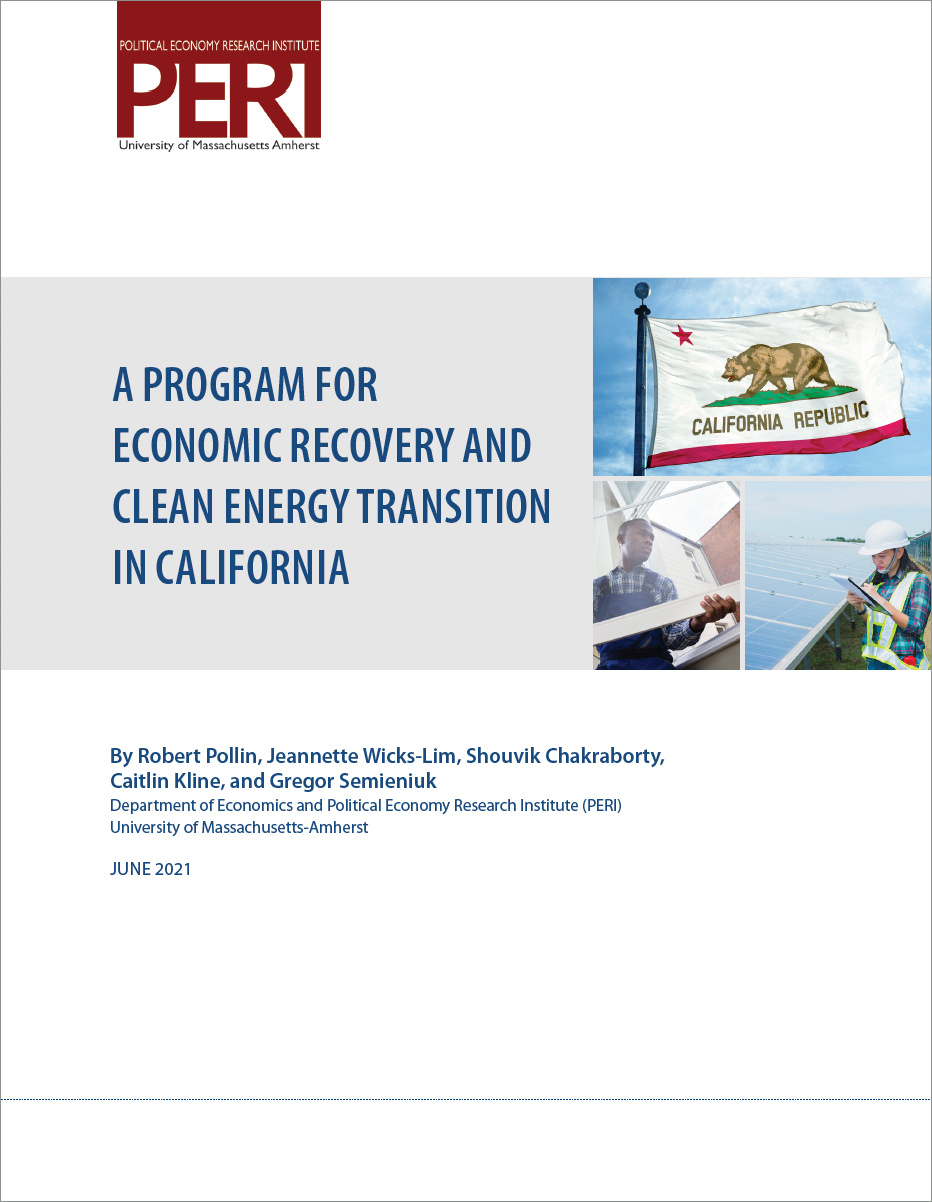
A Program for Economic Recovery and Clean Energy Transition in California

By Robert Pollin, Jeannette Wicks-Lim, Shouvik Chakraborty,Caitlin Kline, and Gregor Semieniuk - Department of Economics and Political Economy Research Institute (PERI); University of Massachusetts-Amherst, June 10, 2021

This study presents a robust climate stabilization project for California. It demonstrates that achieving the state’s official CO2 emissions reduction targets—a 50 percent emissions cut by 2030 and reaching zero emissions by 2045—is a realistic prospect. This climate stabilization project can also serve as a major engine of economic recovery and expanding economic opportunities throughout the state. This includes an increase of over 1 million jobs in the state through investment programs in energy efficiency, clean renewable energy, public infrastructure, land restoration and agriculture. The study also develops a detailed just transition program for workers and communities in California that are currently dependent on the state’s fossil fuel industries for their livelihoods. In particular, we focus here on condi­tions in Kern, Contra Costa, and Los Angeles counties.

The study is divided into nine sections:

  1. Pandemic, Economic Collapse, and Conditions for Recovery
  2. California’s Clean Energy Transition Project
  3. Clean Energy Investments and Job Creation
  4. Investment Programs for Manufacturing, Infrastructure, Land Restoration and Agri­culture
  5. Total Job Creation in California through Combined Investment Programs
  6. Contraction of California’s Fossil Fuel Industries and Just Transition for Fossil Fuel Workers
  7. County-level Job Creation, Job Displacement, and Just Transition
  8. Achieving a Zero Emissions California Economy by 2045
  9. Financing California’s Recovery and Sustainable Transition Programs

Nineteen labor unions throughout California have endorsed this study and its findings.

Read the text (PDF).

It’s time to nationalize Shell. Private oil companies are no longer fit for purpose

By Johanna Bozuwa and Olúfẹ́mi O. Táíwò - The Guardian, June 7, 2021

It has been a bad month for big oil. A Dutch court just ruled that Shell must cut its carbon pollution by 45% by 2030. The court’s decision has rightly been celebrated: it is a much more stringent requirement than the ineffective regulations imposed to date. Meanwhile, shareholders are waging rebellions at various oil giants – ExxonMobil shareholders won two seats on the board to pressure the oil company towards a greener strategy, and shareholders at Chevron and ConocoPhillips passed nonbinding resolutions pressuring the companies to disclose their lobbying efforts and emissions amounts.

Private oil and gas companies are finally up against the wall. Shell has promised to appeal the Dutch court decision, but oil prices went negative last year and put companies on bankruptcy notice, and last week the International Energy Agency said to stop digging. Politicians have floated the idea of oil and gas magnates becoming “carbon management companies” as a way for those companies to have a “future in a low-carbon world” while retaining control over oil, gas, and profit in a planet increasingly aware of and hostile to their emissions-generating activity.

But as far as the Dutch court’s ruling or the new bout of shareholder activism goes, neither go far enough. Nor should Shell be turned into a “carbon management company”. Like all private oil companies, Shell should not exist.

Oil and gas companies are a political structure: they possess private, authoritarian dominion over the pace and volume of oil and gas production, and thus of important determinants of global emissions. These emissions and their consequences do not respect any sort of public/private distinction, nor borders, nor the rights to clean air or clean water. For decades, private oil companies have intentionally and recklessly obscured their role in the destruction of countless local environments as well as their role in the global climate crisis.

Private oil companies have propped up an ever-failing business on a complex system of national and international government subsidies, all of which function to privatize the benefits of oil and gas production while socializing its financial, environmental, and social costs – making the public pay in tax dollars, human rights abuses, and an unlivable climate. Now that these companies fear being left behind by a changing political context, their public relations strategy is to insist to a public increasingly aware of the dire need to stop carbon emissions that there is still a place for private oil companies in a “green” world.

There is a role for the workers, their skills and knowledge, and the equipment and infrastructure of oil and gas companies. But there is no longer a role for companies or profit-seeking as an organizing principle of this aspect of human society – not if we want to continue to have human society...

Read the rest here.

Offshore Oil and Gas Goal for Inclusion in the Regulations of The Sustainable Development Goals Act

By Noreen Mabiza - Ecology Action Center, June 2021

RECOMMENDED GOAL:

Offshore oil and gas development is phased out by 2030 in away that ensures a just transition for workers. Drilling in allprotected areas is banned.

RATIONALE:

There is currently no oil and gas production in NovaScotia’s offshore however actions by the provincialgovernment indicate a desire to keep growing theindustry. In March 2021 the provincial budget indicated anincreased investment in Nova Scotia’s offshore ($10 millioncompared to $1.8 million for renewables). In May 2021, theC-NSOPB announced a call for bids on parcels of landoffshore and if successful would grant a license to explore.

If the province expands offshore oil and gas, allassociated emissions with extraction and production willbe counted towards our emissions inventory while use ofthe fossil fuels will be attributed to the end user. In otherwords, Nova Scotia will not only continue to add to itsemissions through production but is also contributing tocontinued fossil fuel use elsewhere. What the provinceneeds to focus on as we work towards achieving net-zeroby 2050 is a shift away from fossil fuels and the justtransition of fossil fuel workers to green jobs.

Just transition is a social justice framework for facilitatingthe shift to a zero-carbon economy. A just transition of theoil and gas sector would mean that the costs of phasingout the fossil fuels are not unfairly borne by the workersand that the benefits of a clean economy are fairlydistributed. Key components of this transition includecentering the voices of workers, reskilling and upskillingthe workforce and shifting investments from fossil fuelstoward green jobs.

Read the text (PDF).

Fighting for Coal Country

By Staff - United Mine Workers of America, June 1, 2021

Clearly, the UMWA's positions on carbon capture and storage (CCS) and so-called "clean coal" stand in contrast (and, for the most part, opposition) with the entirety of the climate justice movement, ecosocialists, green syndicalists, and a good deal of rank-and-file union members not involved in resource extraction (including the more than 60-70% who support something like the Green New Deal). That said, at least the UMWA finally accepts that coal is a dying industry and a just transition is needed. Therefore, this is presented to show where the UMWA stands, not as an endorsement of their positions.

At the end of 2011, there were nearly 92,000 people working in the American coal industry, the most since 1997. Coal production in the United State topped a billion tons for the 21st consecutive year. Both thermal and metallurgical coal were selling at premium prices and companies were making large profits.

Then the bottom fell out. Over the next 4 years, coal prices cratered, especially in metallurgical coal but also in thermal coal. The global economy slowed, putting pressure on steelmaking and metallurgical coal production. Foreign competition from China, Australia, India and elsewhere cut into met coal production.

Domestically, hydraulic fracturing (fracking) of shale formations opened up previously untapped natural gas fields, caused the price of gas to drop below that of coal for the first time in years. Utilities began switching the fuel they used to generate electricity from coal to gas. Environmental regulations coming from the Obama administration also impacted coal employment. By 2016, just 51,800 people were working in the coal industry. 41,000 jobs had been lost.

Companies went bankrupt. Retirees’ hard-won retiree health care and pensions were threatened. Active miners saw their contracts, including provisions that had been negotiated over decades, thrown out by federal bankruptcy courts. From 2012 to today, more than 60 coal companies have filed for either Chapter 11 reorganization bankruptcy or Chapter 7 liquidation. Almost no company has been immune.

“Just since 2015 we have had companies like Peabody, Arch, Alpha Natural Resources, Walter Energy, Westmoreland and Murray Energy all go bankrupt,” President Roberts said. “Patriot Coal went bankrupt twice. Retirees’ health care was on the brink, but we were successful in preserving that in 2017. The 1974 Pension Fund was on the path to insolvency, but we were able to save that in 2019.

“Even though our contracts were thrown out by bankruptcy judges at company after company, we were successful in preserving union recognition, our members’ jobs and reasonable levels of pay and benefits at every company as they emerged from bankruptcy,” Roberts said. “But in no case has the contract that came out of bankruptcy been the same as the one our members enjoyed when a company went into bankruptcy. This has been extremely painful all the way around.”

Can Carbon Capture Save Our Climate— and Our Jobs?

By Jeremy Brecher - Labor Network for Sustainability, June 2021

As storms, heat waves, fires, floods, and other devastating effects of global warming have grown, more and more people have become convinced of the need to reduce greenhouse gases (GHG) emitted into the atmosphere. The Paris Agreement defined the goal of limiting global average temperature increase to 1.5 degrees Celsius above pre-industrial levels. At the April Climate Summit President Joe Biden announced the U.S. will target reducing emissions by 50-52 percent by 2030 compared to 2005 levels and reaffirmed the U.S. commitment to reach net zero emissions by 2050. These goals indicate what the consensus of climate scientists says is necessary to ward off the most destructive possible effects of climate change. The question remains how to realize them.

There are two well established and proven means to reduce GHG emissions. The first is to replace the burning of fossil fuels with renewable energy from solar, wind, hydropower, and geothermal sources. The other is to reduce the amount of energy we need through a myriad proven means ranging from switching from gasoline to electric vehicles to insulating houses. Numerous studies and thousands of implementations lay out the scientific and economic effectiveness of protecting the climate by reducing fossil fuel emissions.

There is a third means that is being promoted: continue burning fossil fuels but capture carbon–the principal greenhouse gas–either in the smokestack or by sucking it out of the air after it has been released. Various techniques for doing this have been developed with various names–carbon capture and storage (CCS), carbon capture and utilization (CCU), bioenergy with CCS (BECCS), and direct air capture with CCS (DACCS). We will refer to them together as “carbon capture.”

There is a debate in the climate and labor movements about the use of carbon capture as a climate solution. Some maintain that carbon capture is necessary to reduce greenhouse gas emissions. They argue as well that it can be a way to save the jobs of coal miners and fossil-fuel power plant workers and provide power needed for industry while still protecting the climate and that it will create large numbers of jobs. Others say that carbon capture is unproven, costly, problematic for health and the environment, more productive of jobs, and ineffective for climate protection. They argue that renewable energy and energy efficiency are superior both for climate and for workers and communities. They maintain that a transition to fossil-free energy is already underway and that organized labor and the climate movement should take the lead in ensuring that transition benefits rather than harms workers.

Read the text (PDF).

Just Transition/Transition to Justice: Power, Policy and Possibilities

By J. Mijin Cha, Manuel Pastor, Cynthia Moreno, and Matt Phillips - Equity Research Institute, June 2021

This report looks at this process of power building for just transition in four states: California, Kentucky, Louisiana, and New York. We combine an analysis of the pillars of just transition – strong governmental support, dedicated funding streams, diverse coalitions, and economic diversification – with an analysis of how to change power at a state level that focuses on the conditions that impact possibilities, the community-level capabilities that facilitate effective voice, and the arenas in which power is contested. Ultimately, the fight for a just transition is a fight for justice. And, while we know it will be hard and long, the stories we heard showed how advocates and organizers, often in the face of great odds, come together and force the change that makes people’s lives better. Building upon these efforts through supporting organizing, coalition building, and empowering communities is the blueprint for advancing a just transition. Through these channels, we can transition from a dirty polluting past to a just and healthy future.

Read the text (PDF).

Growth of ZEV’s impacts trucks, buses – and their drivers too

By Elizbeth Perry - Work and Climate Change Report, May 17, 2021

The International Energy Agency released its annual Global Electric Vehicle Outlook report for 2021 in April, providing data, historical trends and future projections. Despite the pandemic, there was a 41% increase in electric vehicle registrations in 2020 – compared to a 16% contraction of the overall global automobile market. There are now more than 10 million electric cars on the world’s roads, and for the first time, Europe overtook China as the centre of the global electric car market. In addition, there are roughly 1 million electric vans, heavy trucks and buses globally. A separate forecast by Bloomberg New Energy Finance, as summarized by The Guardian, projects that electric vehicles will reach price parity with internal combustion engine (ICE) vehicles by 2027. Another April report from Boston Consulting Group forecasts that zero-emission vehicles will replace ICE vehicles as the dominant powertrain for new light-vehicle sales globally just after 2035.

Most policy discussions of the electrification of transportation focus on the potential for GHG emissions reductions, consumer preferences, and the economic impacts for the automotive industry. There has been a lack of attention on operational workers – with a few exceptions. A 2020 report from the International Labour Organization and the United Nations Economic Commission for Europe, Jobs in green and healthy transport: Making the green shift , offers modelling of employment impacts in a broad definition of transportation, including personal vehicles, trucks and public transport. It focuses on Europe, and discusses the employment impacts in both manufacturing and operation.

“What’s the alternative?”: Answering the hardest question asked by workers and communities that feel threatened by energy transition

By Sean O'Leary - Ohio River Valley Institute, May 18, 2021

At ORVI, we’ve documented the inability of the fossil fuel and petrochemical industries to serve as engines for job growth and prosperity in Appalachia. Although these findings may be greeted with doubt, disbelief, and sometimes anger, we find that, once the numbers sink in and people in the mining and fracking regions of Pennsylvania and the Ohio Valley look around at their communities — the struggling downtowns, declining populations, and the departures of their sons and daughters to places far away in search of opportunity — reality usually takes hold.

It can be a profoundly sad moment. But, for local leaders who may have invested years promoting these industries as economic saviors, the realization can be bitter and give rise to a question that is equal parts a challenge and a plea — What’s the alternative?

When you’re on the receiving end of that question, you feel its weight. And, if you don’t have an answer, you can feel that you’re stealing someone’s — maybe an entire community’s — hope and you’re leaving them with nothing.

IEA calls for a future without fossil fuel investment

By Elizbeth Perry - Work and Climate Change Report, May 18, 2021

Net Zero in 2050: A roadmap for the global energy system was released by the International Energy Agency on May 18, and has been described as a “bombshell”, and a “landmark”. Why? The normally conservative IEA describes the global energy future bluntly and urgently, calling for “…. from today, no investment in new fossil fuel supply projects, and no further final investment decisions for new unabated coal plants. By 2035, there are no sales of new internal combustion engine passenger cars, and by 2040, the global electricity sector has already reached net-zero emissions.”

This special report claims to be “ the world’s first comprehensive study of how to transition to a net zero energy system by 2050 while ensuring stable and affordable energy supplies, providing universal energy access, and enabling robust economic growth.” It sets out 400 indicators for “an economically productive pathway to 2050”, where energy production will be dominated by renewables instead of fossil fuels. The report also flags and discusses bioenergy, carbon capture, and behavioural changes as “key uncertainties” for the future.

Highlights from the discussion of employment in Chapter 4:

  • In 2021, approx. roughly 40 million people work directly in the oil, gas, coal, renewables, bioenergy and energy network industries . 
  • By 2030 in the Net Zero scenario, 30 million more people will be working in clean energy, efficiency and low‐emissions technologies. 
  • By 2030, employment in oil, gas and coal fuel supply and power plants will decline by around 5 million jobs.
  • Nearly two‐thirds of workers in the emerging clean energy sectors will be highly skilled by 2030, and the majority will require substantial training. 
  • The new jobs created in the net zero economy will have more geographic flexibility. Around 40% are jobs located close to where the work is being done, e.g. building efficiency improvements or wind turbine installation, and the remaining are jobs tied to manufacturing sites. 

Pages

The Fine Print I:

Disclaimer: The views expressed on this site are not the official position of the IWW (or even the IWW’s EUC) unless otherwise indicated and do not necessarily represent the views of anyone but the author’s, nor should it be assumed that any of these authors automatically support the IWW or endorse any of its positions.

Further: the inclusion of a link on our site (other than the link to the main IWW site) does not imply endorsement by or an alliance with the IWW. These sites have been chosen by our members due to their perceived relevance to the IWW EUC and are included here for informational purposes only. If you have any suggestions or comments on any of the links included (or not included) above, please contact us.

The Fine Print II:

Fair Use Notice: The material on this site is provided for educational and informational purposes. It may contain copyrighted material the use of which has not always been specifically authorized by the copyright owner. It is being made available in an effort to advance the understanding of scientific, environmental, economic, social justice and human rights issues etc.

It is believed that this constitutes a 'fair use' of any such copyrighted material as provided for in section 107 of the US Copyright Law. In accordance with Title 17 U.S.C. Section 107, the material on this site is distributed without profit to those who have an interest in using the included information for research and educational purposes. If you wish to use copyrighted material from this site for purposes of your own that go beyond 'fair use', you must obtain permission from the copyright owner. The information on this site does not constitute legal or technical advice.