You are here

decarbonization

As the US Pursues Clean Energy and the Climate Goals of the Paris Agreement, Communities Dependent on the Fossil Fuel Economy Look for a Just Transition

By Judy Fahys - Inside Climate News, June 28, 2021

Perhaps the proudest achievement of Michael Kourianos’ first term as mayor of Price, Utah was helping to make the local university hub the state’s first to run entirely on clean energy. It’s a curious position for the son, brother and grandchild of coal miners who’s worked in local coal-fired power plants for 42 years.

Kourianos sees big changes on the horizon brought by shifts in world energy markets and customer demands, as well as in politics. The mines and plants that powered a bustling economy here in Carbon County and neighboring Emery County for generations are gone or winding down, and Kourianos is hoping to win reelection so he can keep stoking the entrepreneurial energy and partnerships that are moving his community forward.

“That freight train is coming at us,” he said. “You look at all the other communities that were around during the early times of coal, they’re not around.

“That’s my fear,” he said. “That’s my driving force.”

New research from Resources for the Future points out that hundreds of areas like central Utah are facing painful hardships because of the clean-energy transformation that will be necessary if the United States hopes to reach the Paris agreement’s goals to slow climate change. Lost jobs and wages, a shrinking population and an erosion of the tax base that supports roads, schools and community services—they’re all costs of the economic shift that will be paid by those whose hard work fueled American prosperity for so long. 

“If we can address those challenges by helping communities diversify, helping people find new economic growth drivers and new economic opportunities, that might lessen some of the opposition to moving forward with the ambitious climate policy that we need,” said the report’s author, Daniel Raimi, who is also a lecturer at the Gerald R. Ford School of Public Policy at the University of Michigan.

Meeting the Paris agreement’s target of keeping global temperature rise “well below 2 degrees C” by the end of the century means Americans must burn 90 percent less coal over the next two decades and half as much oil and natural gas, Raimi said.

And less fossil fuel use will also affect employment, public finances and economic development region-by-region, according to Raimi. In 50 of the nation’s 3,006 counties, 25 percent or more of all wages are tied to fossil fuel energy, he notes. In 16 counties, 25 percent or more of their total jobs are related to fossil energy.

What Might an Ecosocialist Society Look Like?

By David Klein - System Change not Climate Change, June 27, 2021
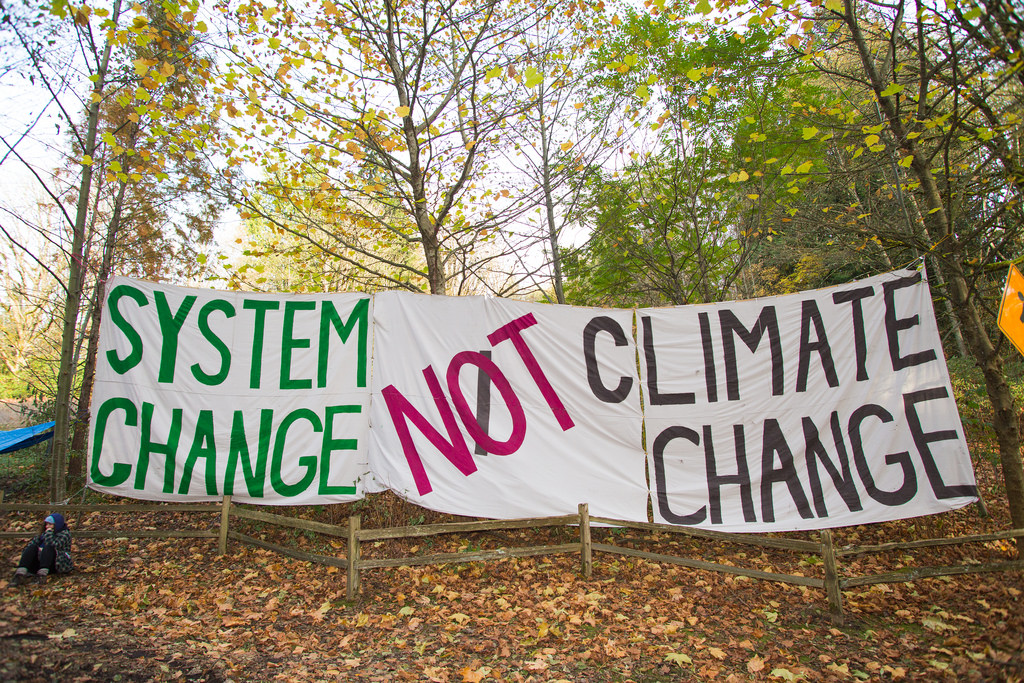
Why can’t the problems that ecosocialism would solve also be remedied within the current global capitalist system?

Before describing possible features of a future ecosocialism, it is worthwhile to consider why such a system is even needed. Why can’t the problems that ecosocialism would solve also be remedied within the current global capitalist system? Part I of this essay addresses that question by summarizing recent scientific reports on the state of the climate and extent of the ecological crisis; reviewing available methods and technologies that could be used to address the climate and ecological crises; and briefly describing capitalism’s structural inability to provide solutions at the scale of the crises. Part II then takes up the subject of the title, ecosocialism, along with strategies to move in that direction. 

Part I: Context and Background

The threat to life on Earth posed by the climate and ecological crises can hardly be overstated. A 2019 Nature article warned that up to a million species of plants and animals are on the verge of extinction, and a United Nations study the same year identified global warming as a major driver of wildlife decline. Much of the devastation to date was catalogued in the 2020 WWF Living Planet report, which recorded a 68 percent decline in the population of vertebrates around the world, in just the past five decades. More succinctly, scientists report that Earth is experiencing a sixth mass extinction. (The previous mass extinction, 66 million years ago, ended the dinosaurs).

The scale of the environmental crisis is unprecedented in human history. At stake are human civilization and billions of lives. An article last year in Proceedings of the National Academy of Sciences predicted that for every additional 1̊C rise beyond the 2019 global average, a billion people will be forced to abandon their locations or endure insufferable heat. The paper warns that under a scenario of increasing emissions, areas now home to a third of the world’s population could experience the same temperatures as the hottest parts of the Sahara within 50 years. 

Summing up the findings of some 150 scientific studies, a 2021 paper authored by 17 scientists warned that the “scale of the threats to the biosphere and all its life forms –- including humanity –- is in fact so great that it is difficult to grasp even for well-informed experts.” Adding further urgency, 101 Nobel laureates released an open letter in April 2021 in which they wrote, “We are seized by the great moral issue of our time: the climate crisis and commensurate destruction of nature.” The laureates called for a worldwide fossil fuel non-proliferation treaty

Global heating is driven by greenhouse gases in the atmosphere, and yet emissions continue at high levels despite the chorus of promises by “climate leaders” in governments. In 2020 global emissions decreased by a meager 5.8 percent due to Covid-19 lockdowns, but they were already on the rebound by the end of the year. For the current year, 2021, the International Energy Agency (IEA) forecasts the second largest annual increase in history of greenhouse gas emissions, as global economies recover from the Covid-19 recession. In May 2021 a record-breaking monthly average concentration of 419 parts per million (ppm) of CO2 was measured in Mauna Loa, Hawaii, breaking the previous May 2020 record of 417 ppm. 

The drivers of ecocide, more generally, include not only climate change, but also habitat destruction, toxic dumping, plastic pollution in the oceans, radiation poisoning, and other customary byproducts of the global capitalist economy. All of this destruction continues unabated despite the flood of warnings from scientists, lobbying by environmental activists, and even warnings from institutions deeply rooted in the capitalist economy. 

Consider, for example, that in May 2021 the IEA released an unprecedented call to the world to rapidly reach zero emissions in its report, Net Zero by 2050: A Roadmap for the Global Energy Sector. Widespread news coverage and expressions of optimism followed. Yet from February to the end of April 2021, the Biden administration approved nearly 1200 drilling permits on federal lands, along with more than 200 offshore permits, and defended in court the ConocoPhillips Willow project in Alaska, which is expected to emit 260 million metric tons of CO2 during the next 30 years, the equivalent of 66 coal-fired plants. And Biden is far from alone among world leaders in his support of fossil fuel expansions.

Telecommuting holds promise for decarbonizing Canada’s economy

By Elizabeth Perry - Work and Climate Change Report, June 24, 2021

Connecting Canada on the Road to 2030 is a report released by the Pembina Institute on June 16, with the subtitle: Exploring the climate benefits and impacts of teleworking. The report states that in 2020, the pandemic resulted in a global GHG emissions drop of 3.9% – and in Canada, GHG emissions dropped by 7% compared to 2019. By August 31, 2020, 27% of Canadians were teleworking full-time (up from 18% in March 2020). The report attributes the greatest proportion of emissions reduction to reduced transportation, but given that the research was commissioned by TELUS Canada, the main focus of the report is to examine the GHG impacts of greater use of the internet.

Using U.S. data when Canadian data is not available, the report states that the increase in residential emissions by employees was outweighed by the decrease in emissions from transportation and commercial buildings, indicating that there is the potential for decarbonization through telework. Residential emissions from internet use are primarily attributed to the energy demand of access devices, such as phones, laptops, and TVs, and the emissions intensity of the electricity grid that powers them – and the report discusses the differences and complexities of renewable energy by Canada’s ICT sector. The attention to the differences in rural and urban Canada is key aspect of this report – both in terms of commuting distances and installed broadband internet capacity. The report concludes that: “governments must recognize the environmental value of connecting homes in rural and underserved areas to broadband, coupled with investments from government and industry in clean energy to ensure all possible emissions reductions are achieved.” It makes clear that Canada requires further research into the GHG emissions of internet use.

10 reasons why climate activists should not support nuclear

By Simon Butler - Climate and Capitalism, June 23, 2021

In a recent Guardian article, Jacobin magazine’s founding editor Bhaskar Sunkara declared that “If we want to fight the climate crisis, we must embrace nuclear power.” He praised nuclear as a clean and reliable and suggested that opponents of nuclear power are either gripped by “paranoia … rooted in cold war associations” or are relying on “outdated information.”

I disagree entirely. Here are 10 reasons why nuclear power is still no solution for climate change.

1. Nuclear is dangerous. Building many new nuclear power plants around the globe means a higher risk of unpredictable Fukushima-type accidents. We know more extreme weather events are locked in due to climate change, adding to the danger as time passes.

What if a nuclear power plant had been in the path of Australia’s huge bushfires in 2020? What nuclear power plant could withstand super typhoons like the one that flattened Tacloban City in the Philippines in 2013? What if a nuclear plant was submerged by unexpectedly massive floods, like those in Mozambique for the past three years in a row?

Planning for a hotter future means switching to safer, resilient technologies. Building more nuclear power plants in this context is reckless.

2. Nuclear wastes water. Nuclear power is an incredibly water-guzzling energy source compared with renewables like solar and wind. We know climate change-induced droughts and floods will make existing freshwater shortages a lot worse. So it’s a bad idea to waste so much water on more nuclear.

Uranium mining can also make nearby groundwater unusable forever. Half of the world’s uranium mines use a process called in-situ leaching. This involves fracking ore deposits then pumping down a cocktail of acids mixed with groundwater to dissolve the uranium for easier extraction. This contaminates aquifers with radioactive elements. There are no examples of successful groundwater restoration.

All Hands on Deck: An assessment of provincial, territorial and federal readiness to deliver a safe climate

By Nichole Dusyk, Isabelle Turcotte, Thomas Gunton, Josha MacNab, Sarah McBain, Noe Penney, Julianne Pickrell-Barr, and Myfannwy Pope - Pembina Institute, July 22, 2021

Unlocking a prosperous future for all will require bold, ambitious action on climate from governments across Canada.
To measure readiness to act on climate, Pembina Institute in collaboration with Simon Fraser University’s School of Resource and Environmental Management assessed the performance of provinces, territories, and the federal government on 24 policy indicators across 11 categories. The indicators represent foundational climate policies and measures to reduce emissions in key sectors of the economy. Governments were invited to review the accuracy and completeness of the data and summary for their region prior to publication.

The assessment shows that there have been important examples of climate leadership and success across the country. Yet, progress made — for example with economy-wide carbon pricing and the phase-out of coal-fired electricity — has been offset by emissions increases elsewhere. In particular, emissions from transportation and oil and gas production have been on a steady upward trajectory since 2005. As a result, Canada’s overall greenhouse gas (GHG) emissions have dropped by only 1% between 2005 and 2019. Modelling that includes the federal climate policy published in December 2020 shows a national emissions reduction of 36% below 2005 levels by 2030 — still short of the federal government’s commitment to reduce emissions by 40-45% by 2030.

Read the Report (PDF).

‘It’s virtually impossible’: Transition to renewables at risk as oil and gas workers struggle to access green jobs

By Daisy Dunne - The Independent., June 22, 2021

The UK’s transition away from fossil fuels to renewable power could be put at risk by barriers facing oil and gas workers looking to move into green jobs, campaigners say.

A survey of 600 offshore workers found that those looking to move from the fossil fuel industry into green jobs in renewable power currently face costly training fees, discouraging them from making the transition.

Workers responding to the poll said they are routinely forced to pay out thousands of pounds of their own cash for training courses when moving between one employer and another in the offshore sector, some of which they have already paid to take part in for their current positions.

One 42-year-old who has worked in the oil and gas sector for 20 years said the cost of training could be putting workers off trying to move into green jobs.

“People really need help to make the transition because it’s just virtually impossible to do it yourself with the way things are at the moment,” he told The Independent. None of the oil and gas workers interviewed wanted to provide their names, for fear of losing work.

He added he was hoping to see more opportunities in renewable power as the country transitions away from using fossil fuels.

“For me, it’s about moving forward in my career and about moving forward for the environment at the same time. I’ve got two young children and I can see the changes that are happening to the climate, it’s obvious to me.”

One 43-year-old who has worked in the sector for 24 years said that he would “love” to see more opportunities in renewable energy.

“I was one of the people living in a bubble thinking ‘that might not be quite right’ when it came to climate change. But it’s really my kids that brought it home to me,” he told The Independent.

Just Transition Strategies: Workers and the Green Revolution

Labor-Backed Report on Path to Equitable Green California

By Staff - Sunflower Alliance, June 10, 2021

Nineteen labor organizations—including unions representing refinery workers in Northern and Southern California and the Alameda Labor Council— have endorsed a detailed plan for an equitable transition to a clean-energy economy in California.

This major new report, A Program for Economic Recovery and Clean Energy Transition in California, details programs for meeting California’s 2030 climate goal (40 percent economy-wide reduction in greenhouse gas emissions from the state’s 1990 level) by creating roughly 418,000 jobs. It argues that state policy should ensure that the jobs created are good-paying jobs with full labor rights and access by historically excluded people.

The same strategies, the report says, could be continued to meet California’s longer-term goal of being carbon-neutral by 2045.

The report was commissioned by the American Federation of State, County and Municipal Employees Local 3299, the California Federation of Teachers, and the United Steelworkers Local 675. Its authors are faculty members of the University of Massachusetts at Amherst, including Robert Pollin, a leading expert on just transition.

The report provides detailed calculations for strategies outlined in an earlier report, Putting California on the High Road, from the UC Labor Center. Both reports emphasize the need for measures to protect fossil fuel industry workers including:

  • Pension guarantee for all workers.
  • Re-employment and income-level guarantees for all displaced workers.
  • Retraining and relocation support as needed.
  • “Glide-path income support” for workers 60 – 64.

The report comes as the Newsom administration is developing a report on Just Transition in California.

'Fossil Fuel Exit Strategy' Shows Transition to Renewable Future Totally Doable

By Andrea Germanos - Common Dreams, June 10, 2021

Ditching fossil fuels in favor of renewable energy in order to keep warming below the 1.5ºC threshold is both "necessary and technically feasible."

That's the conclusion of an analysis released Thursday entitled Fossil Fuel Exit Strategy. Produced by the University of Technology Sydney's Institute for Sustainable Futures in cooperation with the Fossil Fuel Non-Proliferation Treaty Initiative, the report states clearly that "there is no need for more fossil fuels" because the world is overflowing with renewable energy capacity.

Such a pathway, said Sanjay Vashist, director of Climate Action Network South Asia, would avert a "criminal waste of money" that would "have devastating climate and humanitarian consequences."

A key point in the analysis is that simply stopping the industry's planned expansion of fossil fuel projects is insufficient to meet the Paris climate agreement's temperature goal and would actually "push warming well above 1.5ºC."

With this angle, the new analysis goes beyond the International Energy Agency's report last month calling for no oil and gas expansion in order to meet a goal of net zero carbon emissions by 2050. That's because even if there were no expansion, the report's projections show, the world would produce 35% more oil and 69% more coal than is consistent with meeting the 1.5°C target.

As such, Fossil Fuel Exit Strategy lays out a dirty energy phaseout with an annual decline of 9.5% for coal, 8.5% for oil, 3.5% for gas from 2021-2030.

Just Transition in California: Robert Pollin in Conversation with Robert Kuttner

Pages

The Fine Print I:

Disclaimer: The views expressed on this site are not the official position of the IWW (or even the IWW’s EUC) unless otherwise indicated and do not necessarily represent the views of anyone but the author’s, nor should it be assumed that any of these authors automatically support the IWW or endorse any of its positions.

Further: the inclusion of a link on our site (other than the link to the main IWW site) does not imply endorsement by or an alliance with the IWW. These sites have been chosen by our members due to their perceived relevance to the IWW EUC and are included here for informational purposes only. If you have any suggestions or comments on any of the links included (or not included) above, please contact us.

The Fine Print II:

Fair Use Notice: The material on this site is provided for educational and informational purposes. It may contain copyrighted material the use of which has not always been specifically authorized by the copyright owner. It is being made available in an effort to advance the understanding of scientific, environmental, economic, social justice and human rights issues etc.

It is believed that this constitutes a 'fair use' of any such copyrighted material as provided for in section 107 of the US Copyright Law. In accordance with Title 17 U.S.C. Section 107, the material on this site is distributed without profit to those who have an interest in using the included information for research and educational purposes. If you wish to use copyrighted material from this site for purposes of your own that go beyond 'fair use', you must obtain permission from the copyright owner. The information on this site does not constitute legal or technical advice.

