You are here

fossil fuel capitalism

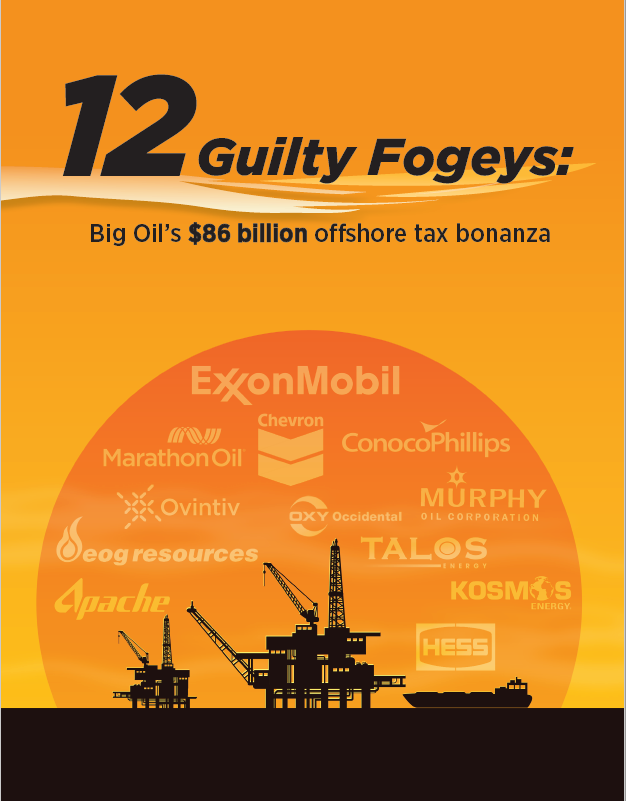
12 Guilty Fogeys: Big Oil’s $86 billion offshore tax bonanza

By staff - Friends of the Earth, Bailout Watch, and Oxfam, September 2021

Few letter-soup acronyms in Washington bureaucratese are so aptly pronounced as GILTI and FOGEI, two esoteric provisions in the tax code worth tens of billions of dollars to Big Oil’s multinational majors.

Under the Trump Administration’s radical 2017 tax law, companies that extract oil and gas overseas enjoy special exemptions within the Global Intangible Low-Tax (GILTI) regime covering Foreign Oil and Gas Extraction Income (FOGEI).

It is a fitting accident of nomenclature: FOGEI’s GILTI carveout helps prop up the fossil firms most culpable for the climate crisis — to the tune of $84 billion. An additional international tax loophole enjoyed by Big Oil is worth at least another $1.4 billion, for a grand total of over $86 billion in offshore tax giveaways.

Read the text (PDF).

Shareholder Engagement With Fossil Fuel Companies Is a Failure for Climate Change

By Carlos Davidson - Common Dreams, November 22, 2021

Shareholder engagement promotes the image of fossil fuel companies as good corporate citizens, and strengthens their political power to fight climate legislation.

What should pension funds, university endowments and other institutional investors do to help address climate change? The fossil fuel divestment movement calls on funds to divest from fossil fuel companies. Fund owners and managers often oppose divestment, preferring "shareholder engagement"--that is, owning fossil fuel company stocks and voting at shareholder meeting and urging companies to change. While shareholder engagement with fossil fuel corporations on climate change is well intentioned, I will argue that it harms rather than helps efforts to address climate change.

Shareholder engagement is detrimental to winning needed government climate action

The pace and magnitude of emissions reductions needed to respond to the climate crisis will not come from voluntary actions by companies, but only from strong government regulations, programs and public investments. Shareholder engagement is aimed solely at getting companies to change and does nothing to get needed government climate action. Tariq Fancy is BlackRock's former chief investment officer for sustainable investing. He writes in BlackRock hired me to make sustainable investing mainstream. Now I realize it's a deadly distraction from the climate-change threat that "Only governments have the wide-ranging powers, resources and responsibilities that need to be brought to bear on the problem." The perception that shareholder engagement is moving companies to address climate change weakens public support for the need for government action. Fancy calls sustainable investing a "deadly distraction" and argues that it is "harming the world by creating a societal placebo that delayed overdue government reforms."

More importantly, shareholder engagement promotes the image of fossil fuel companies as good corporate citizens, and strengthens their political power to fight climate legislation. This is exactly opposite the strategy of divestment, which aims to weaken the political power of fossil fuel companies by calling them out as bad actors, and thereby win climate legislation. Former SEC commissioner Bevis Longstreth in Climate Change and Investment in Fossil Fuel Companies: The Strategy of Engagement Won't Work explains it this way:

"Indeed, engagement is likely to assist Big Oil and Big Coal in postponing the day when governments limit the burning of fossil fuels. The International Energy Agency reckons that, if governments act to compel adherence to the carbon budget, necessary to have a chance of holding the planet to only a 3.6 F rise in temperature from pre-industrial levels, it will cause Big Oil and Big Coal to lose about $1 trillion a year. Engagement with institutional investors like Harvard gives the fossil fuel giants the protective cover they need to stretch out the transition process to renewables for as long as they can. It legitimizes talk over action."

Chomsky and Pollin: Protests Outside of COP26 Offered More Hope Than the Summit

By C.J. Polychroniou, Noam Chomsky, and Robert Pollin - Truthout, November 22, 2021

The legacy of the 2021 United Nations Climate Change Conference (COP26) this fall was perhaps best encapsulated by its president, who bowed his head and — close to tears — actually apologized for the process, which ended with a last-minute watering-down of participants’ pledges on coal.

“May I just say to all delegates I apologize for the way this process has unfolded and I am deeply sorry,” said Alok Sharma, the British politician who served as president for COP26. The conference ended on November 13 with a disheartening “compromise” deal on the climate after two weeks of negotiations with diplomats from more than 190 nations.

In the interview that follows, leading public intellectuals Noam Chomsky and Robert Pollin offer their assessments of what transpired at COP26 and share their views about ways to go forward with the fight against the climate crisis. Chomsky — one of the most cited scholars in history and long considered one of the U.S.’s voices of conscience — is Institute Professor Emeritus at the Massachusetts Institute of Technology and currently Laureate Professor of Linguistics and Agnese Nelms Haury Chair in the Agnese Nelms Haury Program in Environment and Social Justice at the University of Arizona. He is joined by one of the world’s leading economists of the left, Robert Pollin, who is Distinguished Professor and co-director of the Political Economy Research Institute at the University of Massachusetts at Amherst. Chomsky and Pollin are co-authors of the recently published book, Climate Crisis and the Global Green New Deal: The Political Economy to Save the Planet.

C.J. Polychroniou: COP26, touted as our “last best hope” to avert a climatic catastrophe, has produced an outcome that was a “compromise,” according to United Nations Secretary General António Guterres, while activists conducted a funeral ceremony at the Glasgow Necropolis to symbolize the failure of the summit. Noam, can you give us your analysis of the COP26 climate agreement?

Noam Chomsky: There were two events at Glasgow: within the stately halls, and in the streets. They may have not been quite at war, but the conflict was sharp. Within, the dominant voice mostly echoed the concerns of the largest contingent, corporate lobbyists; rather like the U.S. Congress, where the impact of lobbyists, always significant, has exploded since the 1970s as the corporate-run neoliberal assault against the general population gained force. The voice within had some nice words but little substance. In the streets, tens of thousands of protesters, mostly young, were desperately calling for real steps to save the world from looming catastrophe.

COP26 Report Back: Climate Justice Activists Speak Out

Noam Chomsky: Ending Climate Change “Has to Come From Mass Popular Action,” Not Politicians

By Poyâ Pâkzâd, Benjamin Magnussen, and Noam Chomsky - Jacobin, November 19, 2021

Benjamin Magnussen: To change subjects: What do you see as the greatest obstacle in solving the climate crisis?

Noam Chomsky: There are two major obstacles. One is, of course, the fossil fuel companies. Second is the governments of the world, including Europe and the United States. We have just seen that very dramatically over the summer. On August 9, 2021, the IPCC [Intergovernmental Panel on Climate Change] issued its last analysis of the climate situation. It was a very dire warning — much more than before.

The message basically was, “We have two choices.” We can either start right now cutting back on fossil fuel use, [and] do it systematically every year, until we phase them out by mid-century. That’s one choice. The other choice is cataclysm. The end of organized human life on earth. Not immediately — we’ll just reach irreversible tipping points, and it goes on to disaster. Those are the options.

How did the great powers react? The day after the IPCC report, Joe Biden issued an appeal to the OPEC cartel [Organization of the Petroleum Exporting Countries] to increase production. Europe chimed in by calling on all producers, including Russia, to increase production. Increase production. This is a response to the IPPC warning that we have to start reducing right now.

That’s for political reasons, for profit for the oil companies. [The] political reason is that they want the price reduced. It’s better for them. [For] Joe Biden, if the gas prices are high, it harms his electoral prospects. [If] you read the major business press right now, [there’s] a big discussion going on: What’s the best way to increase production? Is it through the American shale oil — the fracking industry — or is it through OPEC? But how do we increase production best? That’s the business press. Turn to the petroleum journals. [They are] euphoric: “We just found new fields to exploit. Demand is going up. It’s great.”

Let’s go to the US Congress. The Biden program — under pressure from young activists, the Bernie Sanders movements, and so on — is actually a big improvement on any previous ones, on paper. It’s not wonderful, but it’s much better than anything else. Well, the [previous] negotiations in Congress over the “reconciliation bill,” initiated by Bernie Sanders, cut back very sharply from Sanders’s proposals. It’s a very valuable bill. It somewhat reverses the huge assault on the population during the neoliberal era.

The Republicans are 100 percent opposed. Nothing. [They] won’t accept anything. The Democrats do have a swing vote. The so-called moderate Democrats, who should be called “ultra-reactionaries,” are the swing vote. One of them is the chair of the Senate Energy Committee, [who] also happens to be the champion in Congress of receiving funding from the fossil fuel industry — which is quite an achievement, because they pay off everyone — but he’s the champion. His name is Joe Manchin. He has a policy — he’s made it explicit — that’s taken from the playbook of the oil companies. He made it very clear; he said: “No elimination, only innovation.” So, no cutbacks on the use of fossil fuel. If you can make up something new, it’s okay. So, he’s blocking it. There are climate change provisions in it. They’re already out. Blocked.

In Europe, it varies. There are some countries, like Denmark, for example, that are moving toward renewable energy pretty significantly. Others vary. But when it comes to the crunch, telling the oil companies and the producers right now what to do, Europe is, as far as I know, unified in saying, “Increase production” — right after the warning that we have to decrease production. That’s the world we live in.

Unions Are Inadvertently Propping Up Fossil Fuels

By Julia Rock - Jacobin, November 15, 2021

In early October, an oil pipeline owned by Amplify Energy spilled into the ocean in Southern California. Roughly 25,000 gallons of crude oil leaked into the ocean off the coast of Orange County, according to the US Coast Guard, prompting local, state, and federal criminal investigations. The pipeline may have been damaged by a ship dragging its anchor in January.

Complicating matters is that Amplify, the product of a merger and vulture capital restructuring of another bankrupt oil company, may not have enough cash to pay for cleanup or decommission the pipeline. That means taxpayers could end up bearing the costs.

This ecological and financial nightmare was in part funded by the retirement savings of schoolteachers in Pennsylvania.

That’s because the largest shareholder in Amplify is a hedge fund called Avenue Capital Group. The hedge fund is led by Milwaukee Bucks owner Marc Lasry, the short-lived chair of the scandal-plagued media company Ozy and the father of Wisconsin Democratic Senate candidate Alex Lasry.

According to an Avenue spokesperson, one of the firm’s funds invested in the debt of an oil company in 2015 that would later merge with Amplify. Avenue currently holds a 6.7 percent ownership stake in Amplify, making it the company’s largest shareholder and giving the firm a seat on Amplify’s board.

That fund is financed with money from public employees’ retirement funds — spotlighting how millions of workers’ savings are now being used to prop up the fossil fuel industry amid the climate crisis.

A Farewell to Copitalism

By Brendan Montague - The Ecologist, November 12, 2021

The future was supposed to be copitalism: a new global economic paradigm where national governments work together through the United Nations (UN) Conference of the Parties (COP) process to limit emissions and prevent runaway climate breakdown - while leaving capitalism otherwise intact.

The climate conferences have taken place annually for a quarter of a century. The aim is to negotiate global emissions targets that will be translated into national policies. The high-water mark was the Paris Agreement of COP21 when the worlds’ leaders agreed to limit global heating to 1.5C. 

The mechanism agreed was "nationally determined contributions" (NDCs). This means national governments are responsible for submitting commitments to cut emissions to the UN. The COP process is also supposed to include a “ratchet mechanism” where those government commitments are made increasingly ambitious. 

Some oil and gas workers worry about a 'just transition.' Others think it won't come in their working lives

By Padraig Moran - CBC Radio, November 9, 2021

Kirk Olsen says transitioning away from fossil fuels "is probably a good thing," but as an oil and gas worker, the uncertainty around how that will happen makes him nervous.

"If there was a sure thing around the corner and you knew, I'm just going to slide into this other job, everything's going to be great ... it would make a guy feel a lot better," said Olsen, a heavy equipment mechanic working on the Coastal GasLink pipeline project in Kitimat, B.C.

Olsen has worked on and off in the sector for 12 years. Four years ago, he started his own company supplying and maintaining machinery. He works 20 days on-site, then has 10 days off to travel home to Campbell River, B.C., almost 1,000 kilometres away — a sacrifice he says he's willing to make to provide for his young family.

For him, a "just transition" means the federal government provides training in a new field and makes a commitment that wages won't drop.

Until he has that clarity, Olsen feels "like you worked so hard for something and then it kind of gets taken away," as he told CBC Radio's What on Earth. "I guess that's life, but it's no less frustrating."

Some oil and gas workers worry about a 'just transition.' Others think it won't come in their working lives

By staff - CBC Radio, November 9, 2021

Kirk Olsen says transitioning away from fossil fuels "is probably a good thing," but as an oil and gas worker, the uncertainty around how that will happen makes him nervous.

"If there was a sure thing around the corner and you knew, I'm just going to slide into this other job, everything's going to be great ... it would make a guy feel a lot better," said Olsen, a heavy equipment mechanic working on the Coastal GasLink pipeline project in Kitimat, B.C.

Olsen has worked on and off in the sector for 12 years. Four years ago, he started his own company supplying and maintaining machinery. He works 20 days on-site, then has 10 days off to travel home to Campbell River, B.C., almost 1,000 kilometres away — a sacrifice he says he's willing to make to provide for his young family.

For him, a "just transition" means the federal government provides training in a new field and makes a commitment that wages won't drop.

Until he has that clarity, Olsen feels "like you worked so hard for something and then it kind of gets taken away," as he told CBC Radio's What on Earth. "I guess that's life, but it's no less frustrating."

Transforming Eskom: Working Class Climate Justice

Pages

The Fine Print I:

Disclaimer: The views expressed on this site are not the official position of the IWW (or even the IWW’s EUC) unless otherwise indicated and do not necessarily represent the views of anyone but the author’s, nor should it be assumed that any of these authors automatically support the IWW or endorse any of its positions.

Further: the inclusion of a link on our site (other than the link to the main IWW site) does not imply endorsement by or an alliance with the IWW. These sites have been chosen by our members due to their perceived relevance to the IWW EUC and are included here for informational purposes only. If you have any suggestions or comments on any of the links included (or not included) above, please contact us.

The Fine Print II:

Fair Use Notice: The material on this site is provided for educational and informational purposes. It may contain copyrighted material the use of which has not always been specifically authorized by the copyright owner. It is being made available in an effort to advance the understanding of scientific, environmental, economic, social justice and human rights issues etc.

It is believed that this constitutes a 'fair use' of any such copyrighted material as provided for in section 107 of the US Copyright Law. In accordance with Title 17 U.S.C. Section 107, the material on this site is distributed without profit to those who have an interest in using the included information for research and educational purposes. If you wish to use copyrighted material from this site for purposes of your own that go beyond 'fair use', you must obtain permission from the copyright owner. The information on this site does not constitute legal or technical advice.