You are here

fossil fuel capitalism

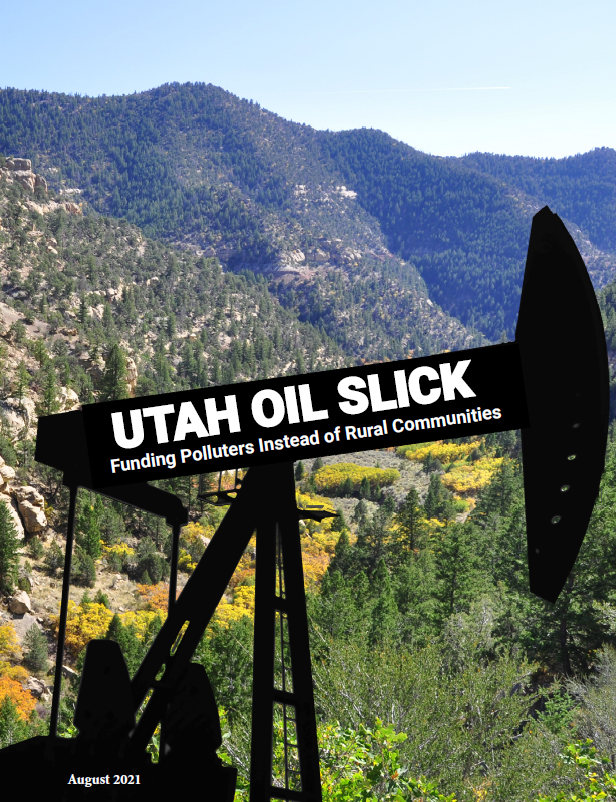
Utah Oil Slick: funding polluters instead of Rural Communities

By Deeda Seed and Adair Kovac - Center for Biological Diversity, et. al., August 2021

Every year Utah receives tens of millions of dollars in federal lease revenues and royalties from oil, gas and mineral extraction as a way to help mitigate the impacts of drilling and mining. Even before scientists linked fossil fuels to the climate crisis, Congress intended this money to be used to help rural communities experiencing rapid growth and infrastructure challenges. The influx of new workers and increased drilling and mining take a toll on communities.

This report from the Utah Clean Infrastructure Coalition shows that, since 2009, the little-known board charged with distributing this public money has funneled more than $109 million to projects that promote or expand fossil fuel extraction in violation of the federal Mineral Leasing Act. That includes more than $2.2 million approved after a state audit found the board was using the public funds improperly.

We examined dozens of public records — including the 2020 audit of the Permanent Community Impact Fund Board by the Utah Legislative Auditor General, meeting minutes, audio tapes and project documents — and found that:

  • Since 2009 the Permanent Community Impact Fund Board, or CIB, has issued $109 million in grants and low- or no-interest loans — all of it public money — to finance road construction, engineering studies, attorney fees and other costs to enable fossil fuel development on public and private land. Beneficiaries include well-connected private firms trying to get approval for the proposed $1.5 billion Uinta Basin Railway.
  • Over the past two years small towns, cities and special improvement districts in two counties have identified more than $60 million for community improvement projects that have not yet been funded. Unfunded projects include water and sewer services, recreation centers, road improvements and public safety equipment. Over this same period, the CIB gave more than $48 million in grants to fossil-fuel related projects.
  • The Utah Legislature failed to oversee the board’s activities. Even worse, in 2021 it changed state law to allow mineral lease revenues and royalties to finance fossil-fuel infrastructure projects, which is illegal under federal law. The new law followed the 2020 state audit criticizing the board’s spending and haphazard decision-making.
  • County governments and local agencies continue to seek public funding for projects that facilitate fossil fuel extraction and enrich private corporations over community needs. Since the audit, Uintah County commissioners approved seeking $39 million in public funds to help a private, Ogden-based oil company build a 640-acre oil refinery in eastern Utah.3 The proposed $1.4 billion Uintah Advantage refinery would have the capacity to refine 40,000 barrels of oil a day, and it may also include a rail yard for the proposed Uinta Basin Railway.

The CIB must stop funding fossil fuel development projects. The Utah Legislature should oversee the board’s grant and loan-making process to ensure it complies with the Mineral Leasing Act, which requires these public funds be used to mitigate harm inflicted on communities by oil, gas and mineral extraction and forbids using the money for economic development. Rural communities should call on legislators to ensure that infrastructure needs are met and public money is spent properly.

As Utah and the western United States experience the devastating consequences of climate change in the form of intense heat, drought and wildfires, it is even more critical that the CIB stop siphoning public funds away from much-needed community projects to finance dangerous fossil fuel extraction that worsens the climate crisis.

Read the text (PDF).

Reclaiming Hydrogen for a Renewable Future: Distinguishing Fossil Fuel Industry Spin from Zero-Emission Solutions

By Sasan Saadat and Sara Gersen - Earth Justice, August 2021

To chart a course toward a safer climate and more habitable planet, we must rapidly reduce emissions of greenhouse gases across our society. The biggest contributor to greenhouse gas emissions is the burning of fossil fuels. Consequently, the clearest path to reducing emissions is to switch from fossil fuels to renewable, zero-emission energy in our transportation, buildings, and power generation (sectors that are collectively responsible for about 75% of United States’ greenhouse gas emissions). This transition would make significant strides in eliminating the devastating public health impacts of pollution throughout the life cycle of fossil fuels—pollution that is most severely concentrated in Black, Brown, Indigenous, and poor communities. A just transition will also require careful policy design and meaningful engagement from frontline communities. Renewable energy, energy efficiency, and electrification are zero-emission solutions that eliminate both greenhouse gases and health-harming air pollution. To meet the scale and urgency of the climate crisis will require deployment of renewable resources on an unprecedented scale— ultimately achieving 100% clean power generation—and a complete transition to efficient, electric models for things like household appliances and cars.

As we electrify everything that can feasibly plug into a clean power grid, “green hydrogen” is a promising tool for transitioning to renewable energy in sectors that lack a viable route to direct electrification. Green hydrogen is hydrogen produced by using 100% renewable electricity to split water molecules.

To understand the potential role of green hydrogen, consider the challenges of cutting climate pollution from one hard-to-electrify sector: maritime shipping. Maritime travel is difficult to decarbonize because battery-powered ocean-going vessels will not be able to handle long-haul voyages across the ocean, at least for the foreseeable future. The hope for green hydrogen is that it may store energy from clean electric resources like wind and solar in a fuel that could be used to propel large, long-haul ships. This vision is at least a decade away from reality, if it overcomes the challenges to cost-effective production and efficient on-vessel storage. Still, it offers a path to displacing the highly polluting bunker fuel currently relied on to move much of the world’s goods across oceans.

Read the text (Link).

Striking Alabama coal miners protest corporate greed at NYC BlackRock headquarters

By Jaisal Noor - The Real News Network, July 28, 2021

Striking Alabama coal miner Mike Wright says workers at Warrior Met Coal are taking their calls for fair pay and benefits to the NYC headquarters of their company's biggest investor: BlackRock.

US Energy Transition Presents Organized Labor With New Opportunities, But Also Some Old Challenges

By Delger Erdenesanaa - Inside Climate News, July 27, 2021

President Biden’s push for “good, union jobs” in clean energy has increased hope that organizing solar and wind workers can close the pay gap between them and fossil fuel workers.

President Biden’s push for “good, union jobs” in clean energy has increased hope that organizing solar and wind workers can close the pay gap between them and fossil fuel workers.

Two years ago, Skip Bailey noticed a lot of trucks from a company called Solar Holler driving around Huntington, West Virginia. A union organizer with the International Brotherhood of Electrical Workers, Bailey saw an opportunity.

“We want to get in on the solar business,” he said, predicting the industry will grow in his home region, which includes historic coal communities in West Virginia, Kentucky and Ohio.

Bailey talked to Solar Holler about unionizing its employees who install photovoltaic panels on homes. IBEW showed the company its local training facility for electricians, and explained the health insurance and pension plans it offers. 

“It wasn’t a hard sell in either direction,” said the company’s founder and CEO, Dan Conant. He was already interested in securing union protections for his employees when Bailey contacted him, he said. The move fit with Solar Holler’s dedication to West Virginia’s legacy of energy production and strong union membership.

“It was not just good business, but it just really spoke to our history as a state,” he said.

Conant and Bailey’s efforts paid off in March 2020, when IBEW Local 317 and Solar Holler signed a contract. It’s just a start—Solar Holler only has about 20 unionized employees—but the agreement is an early example of the future Joe Biden is promising. The president frequently pledges to create millions of jobs while transitioning the U.S. to clean energy. Every time he does, he’s quick to add that these will be “good, union jobs that expand the middle class.”

“It’s a great talking point,” said Joe Uehlein, president of the Maryland-based Labor Network for Sustainability, an advocacy group pushing to unionize green jobs. But he added that Biden faces a difficult balancing act to achieve his pledge. 

Combatting Climate Change, Reversing Inequality: A Climate Jobs Program for Texas

By Lara R. Skinner, J. Mijin Cha, Hunter Moskowitz, and Matt Phillips - ILR Worker Institute, Cornell, July 26, 2021

Texas is currently confronted by three major, intersecting crises: the COVID-19 public health pandemic and ensuing economic crisis; a growing crisis of inequality of income, wealth, race and power; and the worsening climate crisis, which continues to take its toll on Texans through hurricanes, major flood events, wildfires, debilitating heat waves and the significant economic cost of these extreme weather events. These crises both expose and deepen existing inequalities, disproportionately impacting working families, women, Black, Indigenous and people of color (BIPOC) communities, immigrants, and the most vulnerable in our society.

A well-designed recovery from the COVID-19 global health pandemic, however, can simultaneously tackle these intersecting crises. We can put people to work in high-quality, family- and community-sustaining careers, and we can build the 21st century infrastructure we need to tackle the climate crisis and drastically reduce greenhouse gas emissions and pollution. Indeed, in order to avoid the worst impacts of the climate crisis, it is essential that our economic recovery focus on developing a climate-friendly economy. Moreover, there are significant jobs and economic development opportunities related to building a clean energy economy. One study shows that 25 million jobs will be created in the U.S. over the next three decades by electrifying our building and transportation sectors, manufacturing electric vehicles and other low-carbon products, installing solar, wind and other renewables, making our homes and buildings highly-efficient, massively expanding and improving public transit, and much more.

Conversely, a clean, low-carbon economy built with low-wage, low-quality jobs will only exacerbate our current crisis of inequality. The new clean energy economy can support good jobs with good benefits and a pipeline for historically disadvantaged communities to high-quality, paid on-the-job training programs that lead to career advancement. Currently, the vast majority of energy efficiency, solar and wind work is non-union, and the work can be low-wage and low-quality, even as the safety requirements of solar electrical systems, for example, necesitate well-trained, highly-skilled workers.

Read the text (PDF).

California unions endorse a plan for Green Recovery and fossil fuel phase-out

By Elizabeth Perry - Work and Climate Change Report, July 21, 2021

A Program for Economic Recovery and Clean Energy Transition in California, released in June, is the ninth in a series of reports titled Green Economy Transition Programs for U.S. States, published by the Political Economy Research Institute (PERI), and written by researchers led by Robert Pollin. In this latest report, the authors address the challenge of economic recovery from the Covid-19 pandemic, and contend that it is possible to achieve California’s official CO2 emissions reduction targets—a 50 percent emissions cut by 2030 and zero emissions by 2045— and at the same time create over 1 million jobs. The investment programs they propose are based on the proposed national THRIVE Agenda, (introduced into the U.S. Congress in February 2021), and rely on private and public investment to energy efficiency, clean renewable energy, public infrastructure, land restoration and agriculture. The report discusses these sectors, as well as the manufacturing sector, and also includes a detailed just transition program for workers and communities in the fossil fuel industry.

In Chapter 6, “Contraction of California’s Fossil Fuel Industries and Just Transition for Fossil Fuel Workers”, the authors note that only 0.6% of California’s workforce was employed in fossil fuel-based industries in 2019 – approx.112,000 workers. They model two patterns for the industry contraction between 2021-2030: steady contraction, in which employment losses proceed evenly, by about 5,800 jobs per year; and episodic contraction, in which 12,500 job losses occur in just three separate years, 2021, 2026, and 2030. After developing transition programs for both scenarios, they estimate that the average annual costs of episodic contraction would be 80% higher ($830 million per year) than the costs of steady contraction ($470 million per year). As with previous PERI reports, the authors emphasize the importance of the quality of jobs to which workers relocate: “It is critical that all of these workers receive pension guarantees, health care coverage, re-employment guarantees along with wage subsidies to insure they will not experience income losses, along with retraining and relocation support, as needed. Enacting a generous just transition program for the displaced fossil fuel-based industry workers is especially important. At present, average compensation for these workers is around $130,000. This pay level is well above the roughly $85,000 received by workers in California’s current clean energy sectors.” Relief Programs for Displaced Oil & Gas Workers Elements of an Equitable Transition for California’s Fossil Fuel Workers is a 2-page Fact Sheet summarizing the chapter.

DOE Quietly Backs Plan for Carbon Capture Network Larger Than Entire Oil Pipeline System

By Sharon Kelly - DeSmog, July 18, 2021

Obama Energy Secretary Ernest Moniz and major labor group AFL-CIO are behind the “blueprint” for a multi-billion dollar system to transport captured CO2 — and offer a lifeline to fossil fuel plants.

An organization run by former Obama-era Energy Secretary Ernest Moniz, with the backing of the AFL-CIO, a federation of 56 labor unions, has created a policy “blueprint” to build a nationwide pipeline network capable of carrying a gigaton of captured carbon dioxide (CO2).

The “Building to Net-Zero” blueprint appears to be quietly gaining momentum within the Energy Department, where a top official has discussed ways to put elements into action using the agency’s existing powers.

The pipeline network would be twice the size of the current U.S. oil pipeline network by volume, according to the blueprint, released by a recently formed group calling itself the Labor Energy Partnership. Backers say the proposed pipeline network — including CO2 “hubs” in the Gulf Coast, the Ohio River Valley, and Wyoming — would help reduce climate-changing pollution by transporting captured carbon dioxide to either the oil industry, which would undo some of the climate benefits by using the CO2 to revive aging oilfields, or to as-yet unbuilt facilities for underground storage.

The blueprint, however, leaves open many questions about how the carbon would be captured at the source — a process that so far has proved difficult and expensive — and where it would be sent, focusing instead on suggesting policies the federal government can adopt to boost CO2 pipeline construction. 

Climate advocates fear that building such a large CO2 pipeline network could backfire, causing more greenhouse gas pollution by enabling aging coal-fired power plants to remain in service longer, produce pipes that could wind up carrying fossil fuels if carbon capture efforts fall through, and represent an expensive waste of federal funds intended to encourage a meaningful energy transition.

In March, over 300 climate and environmental justice advocacy groups sent a letter to Congress, arguing that subsidizing carbon capture “could entrench the fossil economy for decades to come.”

The AFL-CIO and the Energy Futures Initiative, which jointly produced the blueprint, did not respond to questions about concerns over their proposals.

Proponents of carbon capture, usage, and sequestration (CCUS) often highlight ways that it could be used for sectors like steel and cement whose carbon pollution is generally considered “hard to abate.” Yet, the pipeline network envisioned by Moniz would be capable of carrying over 10 times as much carbon dioxide as the steel and cement industries emit in total nationwide, according to U.S. Environmental Protection Agency (EPA) data from 2019. In fact, it could transport more CO2 than the entire industrial sector emits in the U.S., leaving the rest of the pipeline network’s capacity available for carbon from fossil fuel-fired power plants or from “direct air capture” technologies that would remove ambient CO2 but don’t currently exist at a commercial level

“Even the advocates of direct air capture technology acknowledge that they don’t anticipate that it would be at a scale to make any meaningful reduction in atmospheric CO2 levels until 2060, 2070 and beyond,” said Carroll Muffett, president of the environmental law nonprofit Center for International Environmental Law. “When we’re dealing with a world where we need to cut emissions in the next decade, direct air capture just has no meaningful place in that conversation.”

Instead, the proposed CO2 pipeline network would be used to offer a lifeline to existing fossil fuel power plants. In Appalachia, for example, 90 percent of the carbon emissions the plan seeks to capture would come from existing coal-fired power plants in the Ohio River Valley. Those plants, none of which are currently outfitted with the costly upgrades needed for capture carbon, are already facing difficult questions about their ability to compete economically with wind and solar energy.

Nonetheless, momentum behind the project appears to have been gathering behind the scenes in Washington, D.C., particularly inside the Department of Energy (DOE).

“It’s a great pleasure to have our first kind of public interaction with our good friend, Dave Turk,” Moniz said of Biden’s Deputy Secretary of Energy at the blueprint’s online launch on July 1.

“It’s incredible the volume and quality of the thought-leadership that you all are behind,” Turk, who is second in command to Energy Secretary Jennifer Granholm, told Moniz. “And I think the report that you all have put together is incredibly helpful to show that we need to do more from the DOE side, other agencies, and Congress,” he added, describing the blueprint as “actionable.”

Iran oil workers’ strike: a spectre haunting neoliberalism

By Simon Pirani - People and Nature, July 16, 2021

More than 60,000 Iranian oil workers have joined a strike for better pay and contracts – the biggest such action since the general strike of 1978-79 that helped toppled the Shah’s regime.

The stoppage is supported by teachers, pensioners, and families seeking justice for their relatives killed during the big wave of protests in November 2019.

The protest began on 19 June, the day after the elections won by the conservative cleric Ebrahim Raisi, who takes over as president next month.

The Iranian oil industry is dominated by the state-owned National Iranian Oil Company. But in recent years it has employed a host of contractors – many owned and controlled by state officials and their relatives – who have slashed pay levels and undermined working conditions.

The Strike Organisation Council for Oil Contract Workers, that has been set up during the action, is reported to have said that the workers’ main demand is higher wages, and added:

We will no longer tolerate poverty, insecurity, discrimination, inequality and deprivation of our basic human rights. Given the skyrocketing cost of expenses, the [monthly] wages of workers should not be less than 12 million tomans ($491).

The strikers are demanding the elimination of temporary contracts, an end to the use of contract companies and the recognition of the right to form independent unions, according to other reports.

The strike is supported both by contract employees and by skilled workers in less precarious jobs, according to interviews published by the Kayhan Life media outlet.

Fighting fossil fascism for an eco-communist future

By The Zetkin Collective and Kai Heron - ROAR Mag, July 15, 2021

The West Coast of North America is, once again, on fire. Last month, Phoenix, Arizona, recorded temperatures of 46 degrees Celcius five days in a row. A new record. Every afternoon, the surface temperature of concrete and tarmac climbed to 82 degrees Celsius — hot enough to cause third-degree burns. In California and Texas, where temperatures were marginally lower, energy grid operators feared a prolonged heat wave would wreak havoc on energy infrastructure, forcing a repeat of last years’ rolling blackouts. For many dependent on air conditioning to stay cool in the sweltering heat, this would cause health complications or even death.

North America’s ongoing heatwave follows months of dry weather across the West Coast that have established the conditions for a summer of unprecedented water shortages, crop failures and wildfires. California and Arizona’s wildfire season started unusually early. One of Arizona’s first fires roared for four days, incinerating 27 square miles of countryside and forcing the evacuation of two townships. As this interview is prepared for publication, more than 60 wildfires are raging across the West Coast, some two times the size of Portland. As has become commonplace in the US, state officials are sending prisoners in to tackle the flames, paying them as little as $1.50 an hour.

Already this year Pakistan and Northern India have been wracked by temperatures reaching 52 degrees Celsius. While the small town of Lytton, 124 miles outside Vancouver, hit 49.6 degrees Celsius, the highest temperature ever recorded in Canada. Meanwhile, Brazil has suffered under its worst drought in 100 years, sending food prices spiraling upwards. At these extremes, life as normal is suspended. People die. Ecosystems collapse. And out of the disarray, reactionary social forces make their move.

Through a toxic combination of long-established anti-immigrant and racializing tropes and a regressive denialist climate agenda, far-right parties and social movements are exercising increased influence across Europe and the Americas. The Zetkin Collective’s White Skin, Black Fuel: The Danger of Fossil Fascism charts the rise of these movements and ideas and, with an eye to the horizon, forecasts the emergence of “fossil fascism.”

Zetkin Collective member Andreas Malm’s most recent individually authored works How to Blow up a Pipeline and Corona, Climate, Chronic Emergency, were rapidly-written conjunctural analyses of our intersecting ecological, epidemiological and political predicaments. Both books sought to drive a red-and-green wedge into conversations about capitalism’s breathless trajectory towards ecological collapse and the limits of prevailing strategies among elements of the capitalist core’s climate movements.

While none of the urgency of these works is lost in White Skin, Black Fuel, it drops into the background as a richly detailed analysis of the interrelations of racial capitalism, fossil fuel extraction, nationalism and climate breakdown takes precedence. The book is an example of engaged scholarly research at its best. A clarion call to movements and a forceful reminder of the reactionary forces that are stacked against us as we fight to realize an eco-communist future.

In this interview Kai Heron speaks to Zetkin Collective members Andreas Malm, Laudy van den Heuvel and Ståle Holgersen about the Collective’s writing process, climate denial and resistance to fossil fascism.

How to Protect Workers While Protecting the Climate

Pages

The Fine Print I:

Disclaimer: The views expressed on this site are not the official position of the IWW (or even the IWW’s EUC) unless otherwise indicated and do not necessarily represent the views of anyone but the author’s, nor should it be assumed that any of these authors automatically support the IWW or endorse any of its positions.

Further: the inclusion of a link on our site (other than the link to the main IWW site) does not imply endorsement by or an alliance with the IWW. These sites have been chosen by our members due to their perceived relevance to the IWW EUC and are included here for informational purposes only. If you have any suggestions or comments on any of the links included (or not included) above, please contact us.

The Fine Print II:

Fair Use Notice: The material on this site is provided for educational and informational purposes. It may contain copyrighted material the use of which has not always been specifically authorized by the copyright owner. It is being made available in an effort to advance the understanding of scientific, environmental, economic, social justice and human rights issues etc.

It is believed that this constitutes a 'fair use' of any such copyrighted material as provided for in section 107 of the US Copyright Law. In accordance with Title 17 U.S.C. Section 107, the material on this site is distributed without profit to those who have an interest in using the included information for research and educational purposes. If you wish to use copyrighted material from this site for purposes of your own that go beyond 'fair use', you must obtain permission from the copyright owner. The information on this site does not constitute legal or technical advice.