You are here

green unionism

A Real Green New Deal Means Class Struggle

By Keith Brower Brown, Jeremy Gong, Matt Huber, and Jamie Munro - Jacobin, March 21, 2019

On the morning of November 13, 2018, the Twitter account of the Sunrise Movement, a youth-based organization demanding a Green New Deal (GND), posted the following message:

BREAKING: we’ve begun a sit in inside @NancyPelosi’s office because @HouseDemocrats have failed our generation time and time again. They offer us a death sentence. We demand a #GreenNewDeal.

Joined by the Congresswoman-elect from New York’s 14th District, Alexandria Ocasio-Cortez, the crowd of young activists occupying Pelosi’s office catapulted the idea of a Green New Deal into mainstream discussion. Unfortunately, just before Christmas, Majority Leader Nancy Pelosi brushed aside the proposal for a GND select committee and replaced it with a hollowed-out and toothless substitute.

Not to be deterred Ocasio-Cortez and Massachusetts Senator Edward Markey introduced in February a new resolution outlining more specific principles and goals for a GND. It has already gained seventy-six co-signers in Congress and has spurred another round of international media attention. Once again, the resolution was brushed off by Pelosi as a “green dream or whatever they call it.”

As four climate writers in Jacobin argued on the day it was unveiled, the resolution is quite good. While a few business-friendly elements of the plan don’t square with a socialist climate politics, it does commit to confronting the overwhelming challenge of climate change with massive federal programs that tackle head-on the country’s horrific economic and racial injustices in access to clean air, water, housing, transit, and many other basic needs.

The confrontational strategy used by both Sunrise and Ocasio-Cortez to promote the GND is a major step forward for climate politics. During the Obama administration, most environmental groups focused on cozying up to the Democratic political establishment, only to watch an ill-conceived “cap and trade” bill go down in flames amidst a lack of popular mobilization. In contrast, the recent GND campaign began in earnest with corporate-free electoral campaigns that challenged neoliberal politicians, and won startling victories. After the election, these forces chose a public showdown with Democratic elites and their fossil fuel industry donors. As the campaign sharply targeted these establishment obstacles to climate action, it popularized the vital demand for a GND across a mass audience.

This wave of confrontational activism has now catapulted the GND into mainstream attention. Unfortunately, a policy’s popular support is anything but a guarantee of its passage. Medicare for All, for example, enjoys 70 percent popular approval but elite opposition to it remains formidable. And while confrontations with elected elites are certainly a step in the right direction, they won’t be sufficient to win a GND on the scale — and at the pace — we so desperately need.

In the likely case we don’t completely end capitalism in the next decade, we need a plan for effectively dealing with climate change anyway. Winning a transformative GND will require massive leverage over the political and economic system. We need the ability to force these changes over the objection of broad sections of the capitalist class, who are fiercely unwilling to lose their profits. The confrontational tactics and electoral challenges of the growing GND movement are essential parts of the leverage we need, but we think history shows they won’t be enough. We will also need direct leverage against the capitalist class, right in the places where they make their money.

Ecological Politics for the Working Class

By Matt T Huber - Catalyst, Spring 2019

The climate and ecological crisis is dire and there’s little time to address it. In just over a generation (since 1988), we have emitted half of all historic emissions.1 In this same period the carbon load in the atmosphere has risen from around 350 parts per million to over 410 — the highest level in 800,000 years (the historic preindustrial average was around 278).2 Human civilization only emerged in a rare 12,000 year period of climate stability — this period of stability is ending fast. The recent Intergovernmental Panel on Climate Change (IPCC) report suggests we have a mere twelve years to drastically lower emissions to avoid 1.5 C warming — a level that will only dramatically increase the spikes in extreme superstorms, droughts, wildfires, and deadly heat waves (to say nothing of sea-level rise).3 New studies show changing rainfall patterns will threaten grain production like wheat, corn, and rice within twenty years.4 A series of three studies suggest as early as 2070, half a billion people will, “experience humid heat waves that will kill even healthy people in the shade within 6 hours.”5

You don’t have to be a socialist to believe the time frame of the required changes will necessitate a revolution of sorts. The IPCC flatly said we must immediately institute “rapid, far-reaching and unprecedented changes in all aspects of society.”6 The noted climate scientist Kevin Anderson said, “… when you really look at the numbers behind the report, look at the numbers the science comes out with, then we’re talking about a complete revolution in our energy system. And that is going to beg very fundamental questions about how we run our economies.”7

The radical climate movement has long coalesced around the slogan “system change, not climate change.” The movement has a good understanding that capitalism is the main barrier to solving the climate crisis. Yet sometimes the notion of “system change” is vague on how systems change. The dilemma of the climate crisis is not as simple as just replacing one system with another — it requires a confrontation with some of the wealthiest and most powerful sectors of capital in world history. This includes a mere 100 companies responsible for 71 percent of the emissions since 1988.8 The fossil fuel industry and other carbon-intensive sectors of capital (steel, chemicals, cement, etc.) will not sit by and allow the revolutionary changes that make their business models obsolete.

Like all other such battles, this confrontation will take a highly organized social movement with a mass base behind it to force capital and the state to bend to the changes needed. Yet, as Naomi Klein argues, this is really “bad timing” because over the last several decades it is capital who has built formidable power to neutralize their main challenges like a regulatory state, progressive tax structures, and viable trade unions.9 The history of the nineteenth and twentieth century shows that the largest challenge to the rule of capital has come from organized working-class movements grounded in what Adaner Usmani calls “disruptive capacity” — particularly strikes and union organizing. 10 It is the working class that not only constitutes the vast majority of society, but also has the strategic leverage to shut down capital’s profits from the inside.11

AFL-CIO Energy Committee releases letter opposing the Green New Deal

By Elizabeth Perry - Work and Climate Change Report, March 12, 2019

A letter, dated March 8, was addressed to Senator Ed Markey and Representative Alexandra Ocasio Cortez, and signed by  Cecil Roberts, president of the United Mine Workers of America , and Lonnie Stephenson, president of the International Brotherhood of Electrical Workers, on behalf of the  AFL-CIO’s Energy Committee.  The letter  states :   “..the Green New Deal resolution is far too short on specific solutions that speak to the jobs of our members and the critical sectors of our economy. It is not rooted in an engineering-based approach and makes promises that are not achievable or realistic.”  “…We want to engage on climate issues in a manner that does not impinge on enacting other labor priorities, especially much-needed infrastructure legislation…”

How they would engage and what they would propose is contained in a position paper posted on the IBEW website, and drafted by the IBEW, UMWA, and five other unions in the electric utility, construction, and rail transport sectors.  The position paper,  Preliminary  Labor Positions on Climate Legislation , states their opposition to carbon tax legislation and grave concerns about the Green New Deal . It calls for comprehensive, economy wide climate legislation which would include an national emissions trading scheme, to be introduced no earlier than 10 years after enacting legislation, to allow for development of Carbon Capture Utilization and Storage (CCUS)  technologies.  It also calls for worker transition protections, including compensation and retraining.  The policy document was submitted to the House of Representatives Energy and Commerce Committee for the record of their  February 6th meeting:  “Time for Action: Addressing the Economic and Environmental Effects of Climate Change“.

Reaction:  The Washington Post reported:  “AFL-CIO criticizes Green New Deal, calling it ‘not achievable or realistic’” (March 12)  and  in a follow-up piece , “Labor opposition to Green New Deal could be a big obstacle” ( March 14).  The United Mine Workers re-posted the Washington Post article .  Friends of the Earth, in its reaction to the March 8 letter, states “one-fifth of the unions that make up the AFL-CIO energy committee commented on the Green New Deal”,  and,  “With the energy committee’s position, the AFL joins climate deniers like the Koch brothers, the Republican Party and Big Oil. We encourage the AFL and other unions within it to rethink this position.”

Why Unions Must Bargain Over Climate Change

By Nato Green - In These Times, March 12, 2019

Union contract negotiations include mandatory and permissive subjects of bargaining. Employers are required by law to negotiate over mandatory subjects—wages, benefits and working conditions. Permissive subjects, such as decisions about which public services will be provided and how, have historically been the purview of management. We only negotiate over how managerial decisions affect members’ jobs. Employers may voluntarily agree to negotiate permissive subjects, but unions can’t legally strike over them.

In recent years, some unions have embraced “bargaining for the common good,” which use the union campaign to win broad, righteous public benefits. The best current example of this is the Los Angeles teachers’ strike, which opposed the underfunding, privatization and overcrowding of schools—all of which hurt students. Common good goals often bump against the constraints of what is legally bargainable. For instance, does a demand from teachers' unions that school districts use district-owned property to fund and build affordable housing for teachers affect working conditions? While shortages of affordable housing affect teachers very directly, how school districts use their land and invest their money is normally considered a managerial prerogative.

But last fall’s report from the Intergovernmental Panel on Climate Change is a game-changer. It concludes that humanity has 12 years to cut greenhouse gas emissions enough to hold global warming to 1.5 degrees Celsius—and avoid civilization-threatening consequences of climate change. There is a lot of space between projected best- and worst-case future scenarios. It’s the difference between bad and apocalyptic. That space represents hundreds of millions of people dying. Avoiding worst-case scenarios, in strictly scientific terms, requires everyone to do everything, immediately.

The looming timeline of the IPCC report means unions must have a right to bargain over climate change, especially in the public sector. What good is it to negotiate the assignment of overtime when the sky is on fire? Does a public employer really want to claim that its direct complicity in the potential collapse of civilization has no bearing on working conditions? Can government claim that abandoning its workforce to die or flee their homes doesn’t affect working conditions? If employers don’t accept that every choice made today affects the near future, they’re denying science. Local and state governments in Democratic strongholds may find it politically challenging to posture about resisting Republicanism nationally while denying the local implications of that stance.

Thanks to the Sunrise Movement and Rep. Alexandria Ocasio-Cortez (D-N.Y.), the Green New Deal provides a framework for us to declare our part in everyone doing everything immediately. The Green New Deal calls for a government-funded jobs program to carry out a just transition to a carbon-free economy at the rates called for by the IPCC report. This is a perfect common good framework for unions to respond to the most urgent challenge of our time, while simultaneously promoting a high-functioning public sector as antidote to neoliberalism’s degradation of public services.

LNS Videoconference: The Green New Deal – What Does It Mean for Labor?

By staff - Labor Network for Sustainability, March 2019

Sunrise Movement founders Varshini Prakash and William Lawrence speak and answer questions at a special LNS videoconference on labor and the Green New Deal. View it here »

A glimpse of what could be: The NSW BLF, the most radical and innovative union the world has ever seen

By John Tully - Links, March 2019

Fifty years ago, a group of dedicated left-wing activists wrested control of the NSW Builders Labourers’ Federation (BLF) from the corrupt gangster types who had used it to feather their own nests. The militants, who included Jack Mundey, Joe Owens and Bob Pringle, rebuilt the union into a radically democratic, socially progressive and environmentally-aware organisation the likes of which Australia—and the world—had never seen. Today, we live in dark times for trade unionism. Only around 7% of workers in private industry are organised and unionists face ruthless attacks by the bosses and the state. The achievements of the NSW BLF, however, give us a glimpse of the liberating potential of the working class and are a beacon for the future.
It is to the great credit of militant building workers in Australia that almost 50 years ago they nailed their green colours to the mast and insisted that ecology was as much the concern of workers as wages and conditions. Jack Mundey asked “What is the use of higher wages alone, if we have to live in cities devoid of parks, denuded of trees, in an atmosphere poisoned by pollution and vibrating with the noise of hundreds of thousands of units of private transport?”

The union did not claim to be perfect—it was a work-in-progress, inventing itself as it went—but it showed that an alternative kind of unionism was possible. Its innovative radicalism shocked the bosses and conservative politicians, and confounded right-wing union bureaucrats by its daring larrikinism. It shook up Sydney in a way that had only been the stuff of dreams for socialists and surprised many who had written off the working class as a force for progressive change. Sadly, as the years go by, its achievements risk being forgotten under the crushing weight of neoliberal ideology.

As elsewhere in Australia, the BLF covered the unskilled and semi-skilled workers in the building and construction industry: labourers of various types; concrete finishers; jackhammer-men; excavation workers; hoist drivers; steel fixers who placed the steel rods and bars for reinforced concrete; scaffolders; powder monkeys or explosives experts; riggers, who erected cranes, gantries, hoists and other structures, along with structural steelwork and bridges; and dogmen, who slung loads from cranes and “rode the hook” hundreds of metres above the city streets in a spectacular, but hazardous aerial performance. Due to technological change in the industry, much of their work became at least as skilled as that of the traditional craftsmen, who had served traditional apprenticeships, and who were organised in separate unions at that time.

An Ecosocialist Green New Deal: Guiding Principles

By the DSA Ecosocialist Working Group - Democratic Socialists of America - February 28, 2019

The IWW has not endorsed this document; however, individual members of the IWW EUC have helped shape it.

Humankind has reached a moment of existential crisis. Human activity is causing disastrous climate disruption and Earth’s sixth mass extinction event, triggering critical losses of biodiversity. We are already locked in for global warming that will have catastrophic effects, and we are on a slippery path to our own extinction. The 2018 Special Report from the Intergovernmental Panel on Climate Change (IPCC) warns unequivocally that “without societal transformation and rapid implementation of ambitious greenhouse gas reduction measures, pathways to limiting warming to 1.5°C and achieving sustainable development will be exceedingly difficult, if not impossible, to achieve.”

Yet, the crisis we face exceeds ecological breakdown. Deepening inequality, suppressed democracy, precarious jobs, racial and gendered violence, border hostility, and endless wars make up the terrain on which climate destabilization will be unleashed. The most vulnerable members of society will be hit hardest, first, and suffer most.

We must solve the climate crisis and the inequality crisis together. Climate remedies in the context of austerity will produce a popular backlash, as we see in the yellow vest protests against a fuel tax. Corporations profiting from fossil extraction have long worked to turn workers against environmentalists, claiming that clean energy would be a job killer. But working class and poor people’s quality of life, gravely threatened by climate disruption, would greatly improve in a just transition. Because corporate capitalism rewards extraction to concentrate wealth, it must be replaced by a sustainable economy. A Green New Deal can begin the transition from exploitative capitalism to democratic ecological socialism.

The urgency and scale of the crisis we face demand solutions that meet the magnitude of this moment. The ineffectual gradualism and corporate obedience demonstrated by the U.S. government’s climate response has proven to be a dead-end for humanity. We need rapid, systemic transformation that heals the stratification of wealth and power while putting decarbonization and justice at the forefront.

We need a Green New Deal. We demand a Green New Deal, and we demand that it serve people and planet—not profit.

Read the report (PDF).

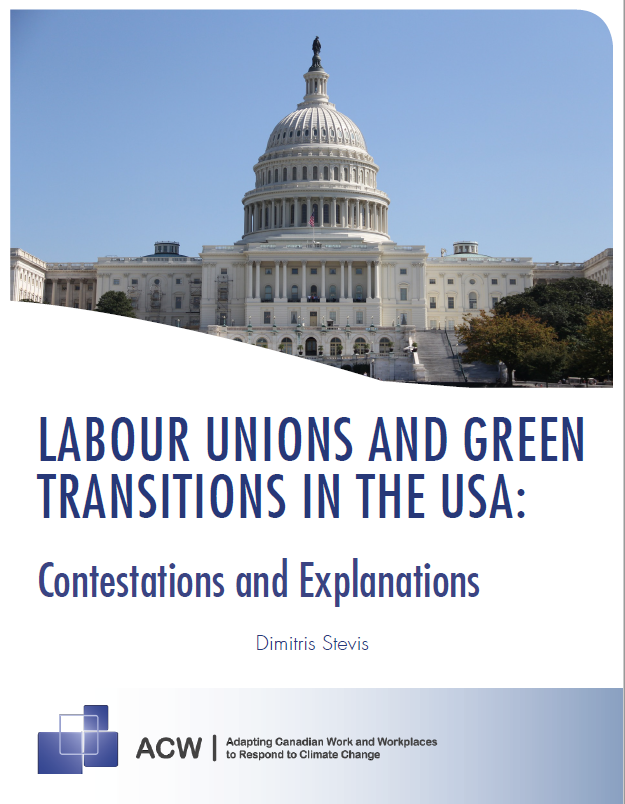
Labor Unions and Green Transitions in the USA

By Dimitris Stevis - Adapting Canadian Work and Workplaces to Respond to Climate Change, February 27, 2019

“In broad terms there are now two camps amongst US labour unions with respect to climate change and renewables (the two not always related). On one side, are those unions that believe that something needs to be done about climate change and that renewables are a good strategy. On the other side are those that are opposed to meaningful climate policy –even as they claim that climate change is a problem.”

This report outlines the deep cleavages with respect to climate policy but also argues that the views of unions are more complex and contradictory than the opposition-support dichotomy. Additionally, it seeks to understand what explains the variability in union responses to climate change and policy. What can account for the contradictions evident amongst and within unions?

Read the report (PDF).

The Green New Deal and Labour

By Elizabeth Perry - Work and Climate Change Report, February 27, 2019

The Labor Network for Sustainability in the U.S.  published a new Discussion Paper written by Jeremy Brecher in late February.   18  Strategies for a Green New Deal: How to Make the Climate Mobilization Work  states that initial discussion of the Green New Deal resolution was rightly focussed on values and goals, but this Discussion paper moves on to the “how”- in 18 specific proposals which are itemized individually, but are intended to work together. The paper explains and consolidates many of the goals and strategies which have been proposed before by  LNS, including: protect low-income energy consumers and empower communities; mobilize labour and leave no worker behind; ensure worker rights and good union jobs, and yes, provide a “job guarantee.”  The 18 Strategies Discussion paper is summarized as “The Green New Deal can work: Here’s How”, which appeared in Commons Dreams on February 25  and was re-posted in  Resilience on Feb. 26.  In the article, Jermey Brecher states: “A GND will not pit workers against workers and discourage the growth of climate-protecting industries and jobs abroad. It will oppose both escalating trade wars and the free trade utopia of neoliberalism.”

The Labor Network for Sustainability has worked to build solidarity behind the Green New Deal, and on February 26,  published a Special  Issue of their newsletter, which profiles the GND endorsements and initiatives of the San Diego and Imperial Counties Labor Council in California, SEIU Locals 32BJ in New York, SIEU Local  1021 in San Francisco, and the Business Manager of IBEW Local 103 in Dorchester, Massachusetts, along with other examples and resources.  The LNS  website also hosts a new blog by Todd Vachon,  Green New Deal is a Good Deal for New Jersey workers , in which he argues for the GND and cites some of his research  which shows that union members are more likely than the general population to support environmental action.

The Green New Deal Isn’t Just Affordable, It’s Necessary Now

By Ryan Smith - Broke Ass Stuart, February 27, 2019

Editor's Note: the IWW has not taken a position on the Green New Deal; the author is a cofounder of the IWW EUC; the image is from the Intercept.

The Green New Deal resolution Rep. Alexandra Ocasio-Cortez (D-NY) and Senator Ed Markey (D-MA) have proposed has captured the attention of the American public like nothing else. The deal presents a sweeping vision for meeting the challenge of climate change by creating a more just, equitable and equal society — in the weeks since its introduction, the Green New Deal has stirred up enormous controversy. It’s been co-sponsored by five Democratic presidential candidates and panned by others like Senator Diane Feinstein (D-CA) and former Rep. John Delaney (D-MD) as unrealistic with Delaney going so far as to say:

The Green New Deal as it has been proposed is about as realistic as Trump saying that Mexico is going to pay for the wall. Let’s focus on what’s possible, not what’s impossible.

Donald Trump easily takes the cake when he said, “I really don’t like their policy of taking away your car, of taking away your airplane rights, of ‘let’s hop a train to California,’ of you’re not allowed to own cows anymore!”  In fairness, you have to be impressed by Trump topping former President George HW Bush’s ranting that environmental regulations would leave everyone jobless, “and up to our necks in owls!”

Regardless of the criticism, some of which is couched in more reasonable language than others, there’s strong evidence that the Green New Deal is not only desirable but actually very feasible.

Pages

The Fine Print I:

Disclaimer: The views expressed on this site are not the official position of the IWW (or even the IWW’s EUC) unless otherwise indicated and do not necessarily represent the views of anyone but the author’s, nor should it be assumed that any of these authors automatically support the IWW or endorse any of its positions.

Further: the inclusion of a link on our site (other than the link to the main IWW site) does not imply endorsement by or an alliance with the IWW. These sites have been chosen by our members due to their perceived relevance to the IWW EUC and are included here for informational purposes only. If you have any suggestions or comments on any of the links included (or not included) above, please contact us.

The Fine Print II:

Fair Use Notice: The material on this site is provided for educational and informational purposes. It may contain copyrighted material the use of which has not always been specifically authorized by the copyright owner. It is being made available in an effort to advance the understanding of scientific, environmental, economic, social justice and human rights issues etc.

It is believed that this constitutes a 'fair use' of any such copyrighted material as provided for in section 107 of the US Copyright Law. In accordance with Title 17 U.S.C. Section 107, the material on this site is distributed without profit to those who have an interest in using the included information for research and educational purposes. If you wish to use copyrighted material from this site for purposes of your own that go beyond 'fair use', you must obtain permission from the copyright owner. The information on this site does not constitute legal or technical advice.

